Cycling Apparel

Best Reflective Cycling Vests of 2026

A reflective vest doesn't glow. The tape and panels on it — glass beads or microprisms bonded to fabric — sit there looking flat gray until a light source finds them, and then they throw that light straight back at whoever's driving. So the real question isn't which vest looks brightest in the package; it's which one puts enough of that material where a headlight will actually hit it when you're moving at speed.

I ride before work most mornings, and the vests I ended up trusting were the ones I forgot I had on: no flapping, no clammy back, no strap sawing at my shoulder. My team and I rode in 14 of them over six months, in the dark and in the rain, and the pattern held. One thing first-time buyers get wrong is assuming more tape is automatically safer — a single wide stripe across the back can leave your sides dark to a car pulling out of a side street. The ones that survived the six months are below, sorted by the riding they suit best.

1

noxgear Tracer2

Top Pick
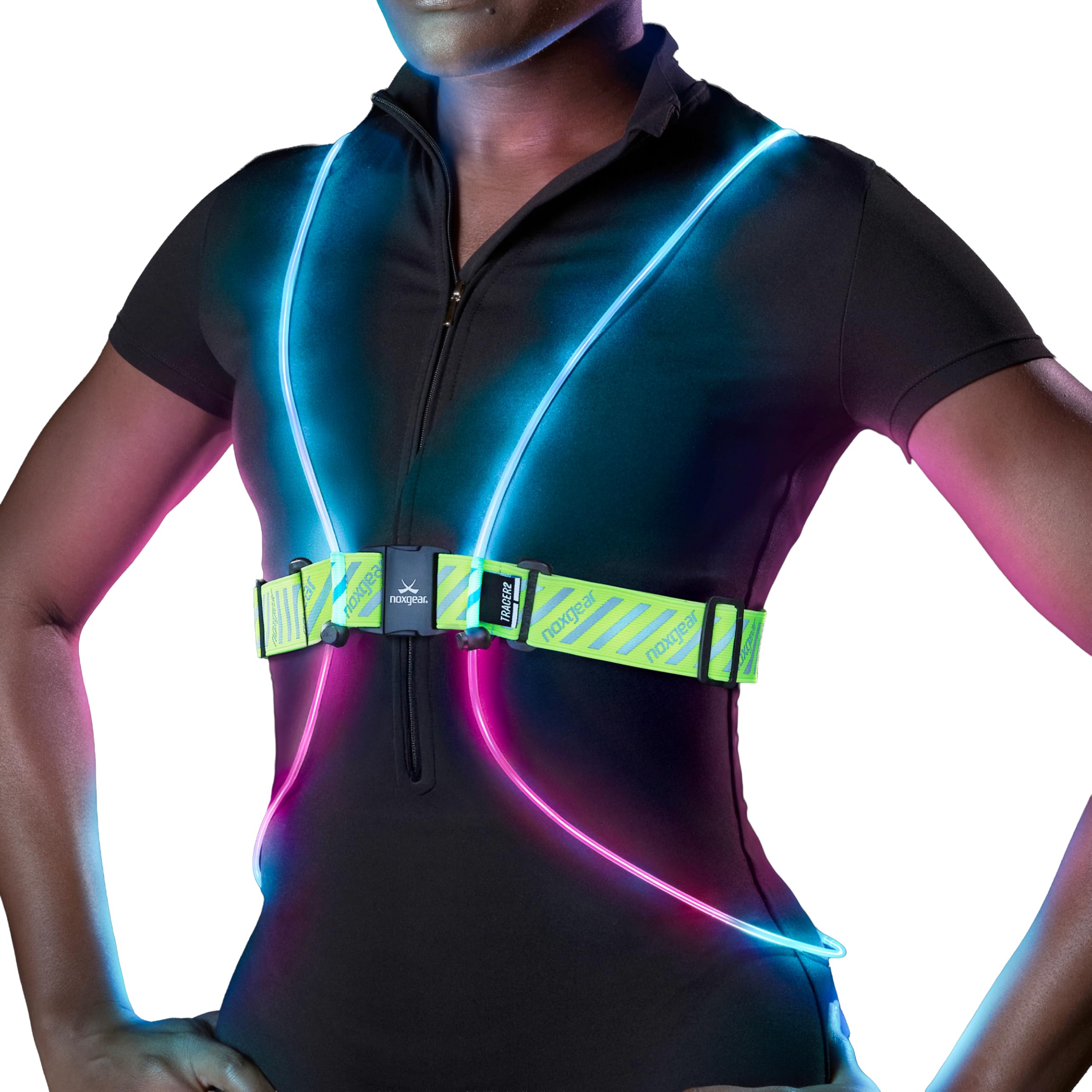
noxgear Tracer2

Unlit night rides

Our Score 9.6/10
Check Price

Worth Noting

  • Slim cut leaves little room across the shoulders
Weight
6.5 oz
Closure
Front quick-clip buckle
Lighting
Fiber-optic cables, 360 degrees
Reflective
3M chest reflectors
Read the full review

A reflector does nothing until someone points a light at it, and on an unlit road that someone is a driver who is already close. The Tracer2 puts light out front, back and sides through fiber-optic cables running the straps, with 3M reflectors across the chest for the moment a headlight does find you. Of the light-up vests in this group it is the most complete: eight solid colors, eight two-tone mixes, and a fit that spans a summer jersey to a winter shell.

At 6.5 ounces it's barely there — mesh and elastic, a quick-clip buckle at the front, and a utility pocket that takes a phone. We wore it over a jersey in warm weather and over a shell in the cold, and the adjustment has enough travel for both, which is more range than most riders need and exactly what a four-season commuter does.

The colors sound like a gimmick until you use them. A steady color reads as a person at a distance; a flash reads as a hazard. We keep ours on a slow pulse on shared paths and steady on the road, and the waist belt is reflective too, which matters because that's roughly where a driver's eye lands.

The trade is money and coverage: this is the premium pick here, and the reflective tape is a chest band rather than a full wrap of silver. You're buying the light. For a route with no streetlights on it, that's the right thing to buy.

Bottom line: Our pick for unlit roads: the most complete light-up vest here, with reflectors as backup and enough adjustment to cover every layer you own.

2

JKSafety JK150

JKSafety JK150

Carrying gear

Our Score 9.2/10
Check Price

Worth Noting

  • Pocket seams and stitching give out with hard use
Weight
4.8 oz
Pockets
9
Standard
ANSI Class 2
Strip Width
2 in
Read the full review

Two-inch reflective strips wrap the waist, chest, shoulders and back, the whole vest weighs 4.8 ounces, it carries a Class 2 rating, and it costs less than nearly every other vest on this list. That combination is why it's our budget pick, and the nine front pockets are why it's the one we'd hand a commuter who currently rides with a backpack.

The cut is worth knowing about. Thirteen inches from shoulder to hem means it stops around the top of your jersey pockets rather than covering them, and we like that on a bike — nothing bunches at the hips when you're down in the drops. The polyester mesh moves air, and the whole thing goes in the machine.

Sizing is the thing to get right. The vest is cut small, and the brand's own advice is to go up a size or two if you want it loose over a jacket; do that and it sits where it should rather than riding up over your ears. At this money, owning two and keeping one in the pannier is a reasonable way to live.

Bottom line: Class 2 reflectivity and nine pockets for less than nearly everything else here, as long as you order a size or two up.

3

FREEMOVE Ultralight Vest

FREEMOVE Ultralight Vest

Warm-weather rides

Our Score 9.0/10
Check Price

Worth Noting

  • Runs large, and the small is short in the body
Weight
3.53 oz
Included
Vest, 2 bands, bag
Adjustment
Hook-and-loop side tabs
Reflectivity
Silver panels on fluorescent fabric
Read the full review

If your bike already runs a bright front and rear light, you don't need a vest that emits anything. You need one that's loud when it's lit and quiet when it isn't, and that's this one: silver reflective panels on fluorescent fabric, hook-and-loop tabs at the hips, and 3.53 ounces on the scale.

We put it over a thin jacket on a warm evening and barely noticed it, which is the point — no harness to loosen, no battery to charge, no bulk across the back. The side tabs take up the slack when you're in a t-shirt and let out again over a shell. The arm bands went on our wrists and then, honestly, into the bag it comes with.

A front zip pocket holds a phone and keys, which is more than most passive vests here offer. In daylight it's the fluorescent fabric doing the work rather than the silver, and that's worth remembering on grey mornings when the sun is behind you and nobody's headlights are pointed your way yet.

Bottom line: The vest to buy if your bike lights already do the work: 3.53 ounces, adjustable at the hips, with a pocket and two arm bands in the box.

4

SAWNZC 2-Pack

SAWNZC 2-Pack

Two riders

Our Score 9.0/10
Check Price

Worth Noting

  • No back panel, so coverage is narrower than a vest
  • Straps ride up and run tight over a winter coat
Power
None required
Material
Nylon
Pack Count
2
Shoulder Fit
14–24 in
Read the full review

Two harnesses in one pack is the entire pitch, and it's a good one if you ride with someone else: a partner, a teenager, a kid on a tagalong. Four buckles, elastic straps, silver reflective stripes and no batteries to remember before you leave the house.

It's a harness rather than a vest, so coverage comes from the straps themselves. Shoulders adjust from 14 to 24 inches, a wider range than most of the full vests here, and the four buckles let you set it once and leave it. The nylon is thin enough to fold into a seat bag and forget about until dusk.

For evening rides on lit streets it's an easy buy: reflective area for two riders for less than most vests here cost for one, and nothing to charge. It's the pack we hand to guests who join a loop after work, and nobody has yet complained about the look of it.

Bottom line: Two adjustable reflective harnesses for the price of one vest — the sensible buy for couples, families and anyone kitting out a second rider.

5

GoxRunx Reflective Vest

GoxRunx Reflective Vest

Everyday commuting

Our Score 9.0/10
Check Price

Worth Noting

  • Arm bands slip on the smallest setting
Pocket
Zippered front pocket
Weight
3.53 oz
Included
Vest and arm bands
Dimensions
9.84 x 7.87 x 0.3 in
Read the full review

A zippered front pocket is the detail that separates this from the other passive vests here. Phone, keys, a gel — it takes what you'd otherwise push into a jersey pocket, and it closes.

At 3.53 ounces it's the same weight as our favorite reflective-only vest, and it comes with two reflective arm bands. Silver material over a fluorescent background is the whole technology; there's no battery, no harness to tension, and nothing to charge on a Sunday night.

Fit is where it gives ground. The medium is roomy, the hook-and-loop waist tabs have limited travel, and a smaller rider ends up with a vest that shifts when they're out of the saddle. Ordering to the larger side of the chart and setting the tabs with the jacket you ride in keeps it settled.

For a taller or broader rider who wants a pocket without spending much, it's the straightforward choice, and the silver is as bright as anything here that runs on batteries.

Bottom line: A light, cheap reflective vest with a zippered pocket for your phone; it suits taller riders best, since the waist tabs take up little slack.

6

Zacro Rechargeable Vest

Zacro Rechargeable Vest

Budget light-up

Our Score 8.8/10
Check Price

Worth Noting

  • Battery can stop accepting a charge
Waist Fit
26–49 in
Charge Time
About 50 minutes
Light Colors
5
Shoulder Fit
16–24 in
Read the full review

The lights are the easy part: five colors, three modes, LEDs front and back, and a USB-C port on each side that fills the battery in about 50 minutes. The harness is where we spent our time. Shoulders adjust from 16 to 24 inches and the waist from 26 to 49, which covers most riders, but the straps work loose and slide off a narrow shoulder unless you set them with the jacket you actually ride in.

At 5.6 ounces it's light enough to forget, and the reflective strips run beside the LEDs rather than instead of them, so a flat battery leaves you a reflective vest rather than a dark one. A one-year warranty covers it, which is more than most budget picks here offer.

A driver sees a moving light long before they resolve a silver stripe, and that's the argument for a powered vest over tape alone. Three modes cover steady road riding and flashing for dull afternoons; the colors are mostly for you, though white and green read furthest at distance.

Bottom line: A light-up vest without premium money: bright front and back, USB-C on both sides, and a waist range that fits most riders.

7

Simket LED Vest

Simket LED Vest

Rainy commutes

Our Score 8.8/10
Check Price

Worth Noting

  • LED strips light only the middle of each strap
Weight
3.88 oz
Runtime
10–12 hours
Weather
Water-resistant
Charging
Dual USB
Read the full review

Water resistance is the one claim no other powered vest here makes, and it's the difference between a vest you wear in a drizzle and one you leave on the hook when the forecast is uncertain. The Simket is a polyester strap harness with LED strips front and back, a listed 110 grams, and a claimed 10 to 12 hours of runtime from a dual USB charge.

For a wet commute this is the one we take. Three modes — steady, slow flash and fast flash — adjust at the shoulder and waist, and there's enough strap length to sit over a rain shell without fighting it. The lighting is the compromise: the LEDs sit in the middle of each strap, so you get a bright core rather than a wash of light, and the ends stay dark.

Charging is the habit worth building — a top-up after every ride rather than a scramble when the light fades. The one-year warranty covers the electrics, and for something you'll wear in the rain, that's the reassurance that actually matters.

Bottom line: The wet-weather pick: water-resistant, 110 grams, rechargeable from either side, and bright front and back with three modes.

How We Tested Reflective Cycling Vests After Dark

We started by pulling every vest we could find that published real reflectivity specs, then cut anything that came in a single unisex size or that reviewers described as shedding tape after a few washes. That left 14 vests, from budget to serious, which we rode in for six months.

Most of that riding happened where it actually matters: a 5:40 a.m. commute, an unlit path at dusk, a soaking wet evening toward the end of fall. I wore each vest over a thin jersey and again over a puffy jacket, checked my chest measurement against every size chart, and noted whether the front rode up or the shoulders bunched. We weighed each one, then tried folding it into a jersey pocket.

For visibility, we parked a car 100 feet out with low beams on and walked toward it, ranking how soon each vest lit up, then photographed them at 50 and 150 feet in failing light. We also looked at placement: whether the reflective trim wrapped the sides and arms, or sat only across the back.

Functionality came down to small things — could I unzip with winter gloves on, did a pocket hold a phone without bouncing, did the vest fit over a backpack. Then we ran each through 10 wash cycles and checked tape edges and seams for curling. For the rechargeable ones, we drained the battery, timed a full charge, and rode a week of commutes on a single charge to see how quickly it faded.

How to Choose Reflective Cycling Vests

Light-Up or Reflect-Only

Reflective tape does nothing until light hits it. On a lit street that's fine, because headlights find the silver long before the car reaches you. On an unlit lane it isn't, because the only light coming your way belongs to the vehicle that's already close. A powered vest — the noxgear, Zacro or Simket here — puts light out in front of that moment, and drivers pick you up sooner.

If any part of your ride is unlit after dark, pay for LEDs. If your commute is lit and your bike already runs a bright front and rear, a passive vest like the FREEMOVE does the job for a fraction of the money.

Where the Reflectors Actually Sit

Drivers see your back, not your chest, so check that the reflective material wraps the sides and rear. The JKSafety runs two-inch strips across the waist, chest, shoulders and back; even the noxgear's waist belt is reflective. A vest with a bright front panel and a token strip over the shoulders is the wrong way round for cycling.

Test it at home: hold the vest in front of a phone torch and look at how much of it lights up from behind. If the answer is a narrow band across the shoulders, keep looking.

Fit, Layers and Staying Put

A cycling vest has to sit still over a jersey in July and stretch over a shell in January, so look for independent shoulder and waist adjustment. Zacro quotes 16 to 24 inches at the shoulder and 26 to 49 at the waist; the SAWNZC harness runs 14 to 24 at the shoulder.

Sizing is where these go wrong most often — the JKSafety runs small enough to need a size or two up, while the GoxRunx and the FREEMOVE run large. A vest that flaps or rides up is worse than useless, because the panels end up aimed at the ground.

Power, Charging and Rain

A powered vest is only as good as its last charge. Zacro fills in about 50 minutes over USB-C, and Simket claims 10 to 12 hours of runtime along with the only water-resistant shell in this group. Charge after every ride rather than when it dies mid-commute, and keep the cable with your bike lights so it travels with you.

If you ride through winter, water resistance is worth more than an extra color or a fourth flash pattern.

Pockets and What You Carry

Pockets are the quiet reason people end up in a work vest. The JKSafety's nine will swallow a lock, gloves and a phone, which can be the difference between carrying a backpack and not. The GoxRunx takes the opposite approach with a single zippered front pocket.

If you already ride with a frame bag or jersey pockets, skip them. Extra compartments add bulk, and the seams that hold them are the parts most likely to give out.

Frequently Asked Questions

Final Verdict

The noxgear Tracer2 is the vest we recommend for any ride that includes an unlit stretch. It puts light out front, back and sides, it weighs almost nothing, and the adjustment range covers a summer jersey and a winter shell without a second purchase.

If your route is lit and your bike lights are already good, the FREEMOVE gives you reflective panels, a pocket and arm bands for a fraction of the money. And if the priority is spending as little as possible while carrying as much as possible, the JKSafety is still the value play — order it a size or two up.