Components

Best Dropper Posts of 2026

The moment you realize a dropper post is worth it usually happens mid-trail: you're pointed down something steep, your saddle is still sky-high, and you're doing the awkward quick-release shuffle instead of riding. A dropper fixes that by letting you drop your saddle with a thumb and pop it back up for the climb, but the difference between a good one and a fussy one comes down to reliability, installation, and how cleanly it adjusts to your bike and body.

I've lived with a handful of droppers over the years, and my team has now spent eight months riding 12 different posts across trail, gravel, and bike-park laps. We paid attention to the stuff that actually matters once the new-parts shine wears off: consistent actuation, clean cable routing and sensible cable length, saddle-angle adjustability, and whether the price felt fair for the hardware. The best ones made us forget about the post entirely, which is exactly the point—and the picks below are the ones that earned a permanent spot on our bikes.

1

TranzX Kitsuma Dropper Post

Top Pick
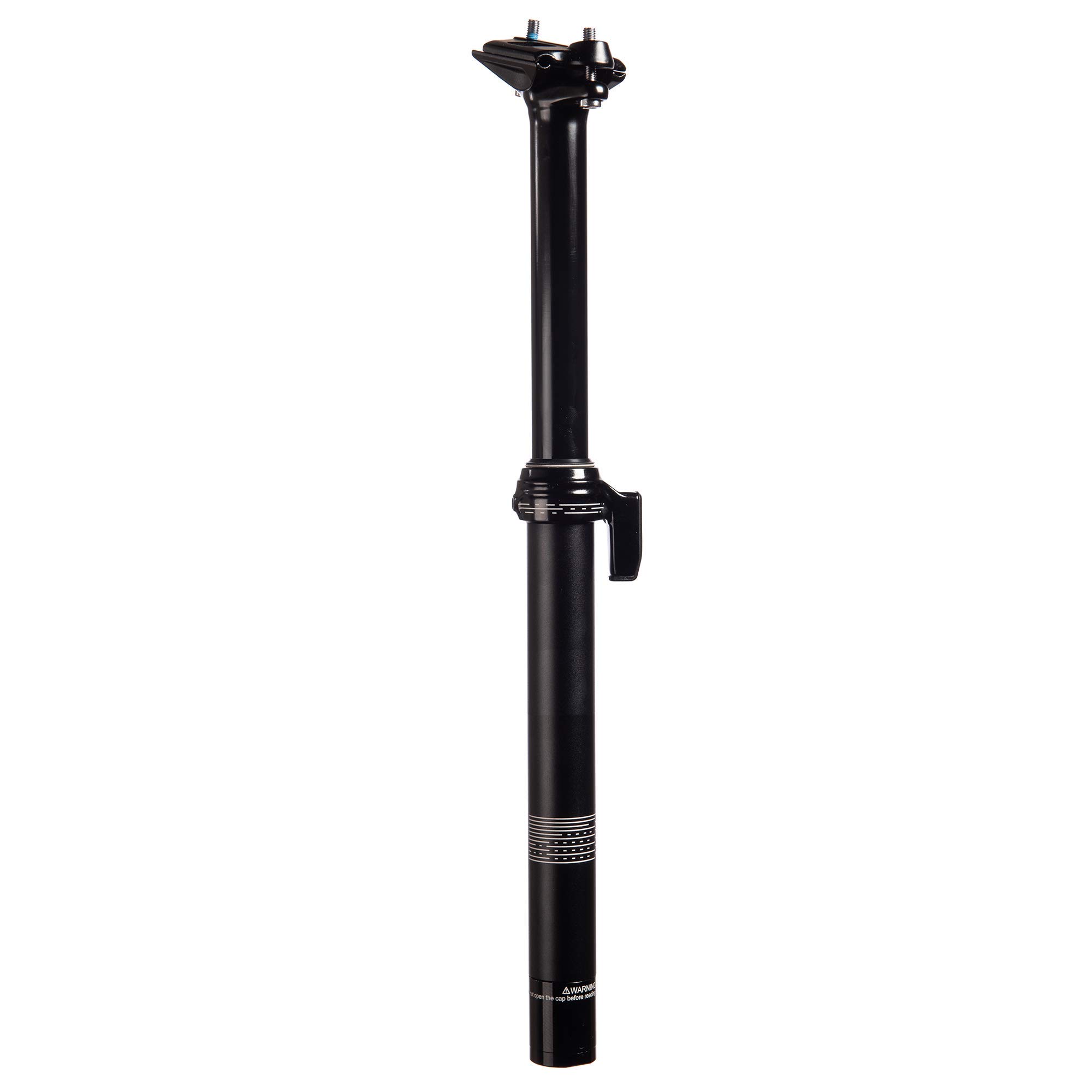
TranzX Kitsuma Dropper Post

Budget trail builds

Our Score 9.2/10
Check Price

Worth Noting

  • No remote lever in the box
Routing
External
Diameter
31.6 mm
Body Material
Aluminum
Read the full review

The Kitsuma is the budget pick of this group, and it's the one we point to when someone wants the drop without much outlay. The cable runs outside the frame, which looks busier than internal routing but bolts onto an older bike without drilling, threading or a bleed kit.

What impresses us is how little drama it brings at that position. Actuation is crisp, the return finishes with a positive thunk rather than a mushy slide, and it keeps working when the temperature drops — the kind of reliability you stop noticing, which is the point. It's listed here in 31.6 mm, a size that covers a lot of trail bikes and eMTBs.

One thing to know before you ride it hard: there's a little rotational play at the saddle once it's clamped in. You feel it if you twist the seat by hand, it doesn't show up while pedaling, and for the savings it's a trade worth making. The post arrives without a lever, so plan for that before the first ride.

Bottom line: We rate it the value pick: crisp actuation, external routing that suits older frames, and a price that leaves room for a remote.

2

Bibike Dropper Post

Bibike Dropper Post

Unusual seat tubes

Our Score 9.0/10
Check Price

Worth Noting

  • Cable can fall short on long routing
  • Keyway has broken on some posts
Length
440 mm
Travel
125 mm
Routing
External
Diameters
27.2, 30.4, 30.9, 31.6 mm
Read the full review

30.4 mm is a size most dropper makers skip, and that alone puts the Bibike on this list. It covers 27.2, 30.4, 30.9 and 31.6 mm, so the oddball seat tube on an older frame or a hybrid finally gets a drop, and the 440 mm body carries 125 mm of travel with the cable running outside the frame.

What we appreciate is how much adjustment is built in. A hex nut near the lever sets how fast the post returns, so you can tame one that wants to fire the saddle at you, and the post stops anywhere in its travel rather than only at the ends — which matters more than the headline number when you're chasing a height that feels right.

It's the heaviest post here at a listed 828 g, and you notice that carrying the bike up stairs more than riding it. Bibike also rates it to 200 kg, well past most riders and a hint that it's built for eBike and cargo duty as much as trail use. Installation is the easy part: clamp it in, run the housing, set the height, then trim the cable once the adjustment is finished.

Bottom line: We keep it on the list for the diameter you can't find elsewhere; the adjustable return makes it a proper post rather than a compromise.

3

OneUp Components Dropper Post V2

OneUp Components Dropper Post V2

All-round trail use

Our Score 0.0/10
Check Price

Worth Noting

  • No remote lever in the box
Travel
120, 150, 180, 210 mm
Lengths
360, 420, 480, 540 mm
Warranty
2 years
Diameters
30.9, 31.6 mm
Read the full review

The measurement that decides a dropper purchase isn't travel, it's how much room your frame gives you. OneUp builds the V2 around a short lower body, and that's why it's our default recommendation: on frames where a long-bodied post bottoms out against a bottle boss or a bend in the seat tube, this one goes in and gives you more drop. If your seat tube is short, that difference is the whole purchase rather than a detail.

The range helps. Four lengths run from 360 to 540 mm, travel comes in 120, 150, 180 and 210 mm steps, and each post ships with a shim so you can take 10 or 20 mm off the drop later instead of buying again. Return speed is set by air pressure rather than a sealed factory tune, so a shock pump turns a lazy post quick or calms one that fires the saddle up too hard.

Set up properly, it's the most settled post in this group. The saddle holds its height under weight, side-to-side play at the head stays minimal, and the return is fast without being violent. Getting the cable barrel seated in the mechanism before you tension anything is the one install step that catches people out; do that and the rest is a ten-minute job.

It's sold in 30.9 and 31.6 mm, which leaves out 27.2 mm gravel frames and the 30.4 mm seat tubes on some older bikes — both have better answers further down this list. And if you don't want to own a shock pump just to set up a seatpost, the Crankbrothers below is the fit-and-forget alternative.

Bottom line: Our default recommendation: a short body that fits more drop into a tight frame, a saddle that stays put, and a return you can tune to taste.

4

Crankbrothers Highline 3

Crankbrothers Highline 3

Easy installation

Our Score 0.0/10
Check Price

Worth Noting

  • Listed only in 30.9 mm
Weight
1.42 lb
Diameter
30.9 mm
Warranty
5 years
Cable And Housing
Jagwire
Read the full review

The lever is where the Highline earns its keep. It mounts left or right, above or below the bar, on a separate clamp that slips in beside your brake and shifter instead of fighting them. If you've ever bolted on a dropper lever that fouled something, that flexibility is worth more than it sounds.

The cable side is just as friendly. A quick-connect fitting lets you set the post in the frame first and click the cable in afterward, and Jagwire housing comes in the box. Inside, a self-contained hydraulic cartridge and IGUS glide keys handle the movement, with infinite stops anywhere in the travel and a return that's quick without slamming the saddle into you.

Our verdict: this is the dropper we suggest when installation is the part you're dreading, and the five-year warranty backs the confidence. It takes real body weight to push down, so lighter riders may find the drop slow to start — worth knowing before you blame the post. And if the saddle starts sinking, check cable tension first; a cable set too tight holds the valve open.

Bottom line: We suggest it when installation is the worry — the lever goes where you need it and the cable clicks in last, backed by a five-year warranty.

5

PNW Components Coast

PNW Components Coast

Gravel and hardtails

Our Score 0.0/10
Check Price

Worth Noting

  • Only 100 mm of drop on the 27.2 mm version
Routing
Internal or external
Warranty
Lifetime
Dropper Travel
100 mm at 27.2 mm; 120 mm at 30.9 and 31.6 mm
Suspension Travel
40 mm air
Read the full review

Two jobs in one tube: the Coast is a dropper with 40 mm of tunable air suspension stacked above it, and on a gravel bike, a hardtail or a rigid commuter that's a better use of the seat tube than either part on its own. The suspension takes the sting out of washboard and root chatter that the frame passes straight through, and the drop gets the saddle out from under you when the surface turns.

The suspension is subtle by design, and we think that's the honest way to sell it: forty millimeters softens chatter without turning the bike into a couch, but it won't rescue a rigid bike in a rock garden. It also wants a shock pump and a few rides of fiddling before it feels right, which is the price of having something to tune at all.

It comes set up for internal or external routing, so it covers most frames with a round seat tube, and the lifetime warranty is the longest in this group. Watch the hold: the saddle can creep down over a ride if the air pressure and cable tension aren't right, so set both before your first proper ride rather than discovering it on a descent.

Bottom line: We recommend it to gravel and hardtail riders who want comfort and a drop from one post, as long as they'll spend time on setup.

6

EXA Form 900i

EXA Form 900i

Internal routing kits

Our Score 0.0/10
Check Price

Worth Noting

  • One-year limited warranty
Travel
100, 120, 150 mm
Lengths
345, 395, 445 mm
Routing
Internal only
Diameters
30.9, 31.6 mm
Read the full review

Internal routing is what scares people off a first dropper build, and the 900i arrives as a kit: post, lever, cable and housing in the box. That's the reason it's here. If your frame has ports and you don't want to source a remote separately, this shows up ready to fit, and the 7075 alloy body keeps weight between roughly 480 and 670 g depending on length.

Three lengths — 345, 395 and 445 mm — go with 100, 120 or 150 mm of travel, so there's a short version for small frames and a 150 mm option for taller riders. The 30.9 and 31.6 mm diameters cover the common trail sizes.

The kit is the payoff, but setup is where it tests your patience: the printed instructions are thin enough that a video is worth more than the leaflet, the housing can come up short on a long internal run, and the release feels sticky if the actuator clamp isn't holding the cable firmly. There's also some side-to-side movement at the saddle head over time. None of it is fatal — a longer housing, a careful clamp and an evening solve it.

Our take: it's a lot of post and hardware for the money, and the right call for a first internal-routing build where the budget is tight. If you want the saddle to feel locked in and the return to feel factory-set, the OneUp above is the one that does it — the 900i asks you to be the mechanic.

Bottom line: We rate it the best-value way into internal routing, provided a little movement at the saddle won't bother you.

7

DJC Bike Dropper Seatpost

DJC Bike Dropper Seatpost

Small frames

Our Score 0.0/10
Check Price

Worth Noting

  • Lever sits under the saddle, not on the bar
Length
375 mm
Travel
100 mm
Weight
1.39 lb
Diameters
30.9, 31.6 mm
Read the full review

At 375 mm overall with 100 mm of travel, the DJC is the shortest post here — short enough for a small frame, a kids' build or a bike with very little standover. That's the whole reason to look at it, because plenty of droppers won't physically fit those bikes no matter how the rest of the spec reads.

The hydraulic cartridge stops anywhere in its 100 mm, which is more useful than it sounds when you're setting a height for a rider who's still growing, and it's built to ISO 4210 rather than to a marketing slogan. The rest is basic but sound: 6061 aluminum, 630 g, and a lever that tucks up between the saddle rails out of the way.

Where we land: it does a narrow job well. You set your height before the trail turns rather than halfway down it — awkward with gloves on, and no use at all if you want the saddle out of the way mid-corner. On a kid's bike, a town bike or a commuter where you stop often, none of that matters, and you get a dropper without a cable to route or a remote to buy.

Bottom line: We recommend it for small frames and kids' bikes, where a 375 mm post is the difference between having a dropper and having none.

How We Tested the Best Dropper Posts

We started by pulling together dropper posts across the common travel ranges and seatpost diameters, then filtering out anything with vague sizing, a lever sold separately without saying so, or no clear service path. That left us with 12 posts, which we installed on our own trail, gravel, and park bikes and rode for eight months.

Installation was its own test: we timed solo installs, routed each cable through the frame, and measured housing length at full saddle height and full drop. A good post left enough cable to turn the bars without tugging and no tight kink behind the head tube; a bad one either came up short or had us re-routing to lose a loop. We also noted lever feel and how easy it was to set saddle angle and fore-aft position with the hardware in the box.

On the trail, we dropped and raised the post dozens of times per ride—on punchy climbs, steep chutes, gravel washboards, and lift-served laps—and noted whether it returned at the same speed every time, whether it stuck down in the cold, and whether the saddle had any side-to-side play. After rides, we cleaned and checked seals and stanchions for grit, then kept riding through mud, dust, and creek crossings to see what loosened up or started to squeak.

At the end, we compared what each post cost against what came in the box—lever, cable, travel adjustability, service kits—and whether it still felt tight after eight months. A cheaper post that needed a new cable or a rebuild halfway through did not count as good value; one that stayed consistent and easy to live with did.

How to Choose Dropper Posts

Start With Diameter and Insertion Depth

The diameter is stamped on the lower part of the post you already have, and it's the one number you can't work around: 27.2, 30.9 and 31.6 mm cover most bikes, with 30.4 mm turning up on some older and budget frames. Then measure how far a post can slide in before it meets a bottle boss, a weld or a bend in the seat tube.

That depth, minus the post's minimum insertion line, is the drop you can actually run. It's why a short-bodied design such as the OneUp V2 can give more travel than a longer post on the same frame, and why the travel figure on the box means nothing until you've measured. Take the longest post your frame will swallow, not the longest one in the catalog.

Handlebar Remote or Lever Under the Saddle

A bar-mounted remote is what makes a dropper useful on technical ground: you drop the saddle without taking a hand off the grip. Posts with the lever tucked under the saddle are a different tool — you reach down at a stop, set your height and ride on. That's fine for a commuter, a kids' bike or a town bike, and it saves a cable and a remote.

It is not fine for anything where you want the saddle out of the way halfway down a descent, and the lever position isn't always obvious from product photos. Look at the included-parts list, not the headline.

Match the Routing and Check the Box

Internal routing hides the cable inside the frame and suits modern frames with ports; external routing runs the housing along the seat tube and fits older bikes without drilling. Either way, measure the full run before you cut anything, including the loop at the post, because housing that comes up short is the most common reason a build stalls.

Then read what ships. Some posts arrive with a lever, cable and housing; the OneUp V2 doesn't include a lever, while the EXA Form 900i and the Crankbrothers Highline 3 come as kits. An air-sprung post also wants a shock pump, which is rarely in the box.

The Details That Show Up After a Month

Travel gets the attention, but the saddle interface decides whether you like a post. A good one holds height under your weight, stops anywhere in the stroke and has minimal side-to-side play at the head; a loose head feels like a worn bottom bracket with every pedal stroke. Return speed matters too — a post that fires up too fast is as irritating as one that dawdles.

Finally, check the warranty and whether the mechanism can be serviced. A dropper is a wear item rather than a forever part, and the difference between a five-year warranty and a twelve-month one is the difference between a rebuild and a replacement.

Frequently Asked Questions

Final Verdict

Most riders should buy the OneUp V2. Its short lower body lets you run the longest drop your frame will take, the return is tunable rather than fixed, and the saddle stays where you put it — which is the entire job. Add a remote, since one isn't included, and you have a post that will outlast the bike it's fitted to.

If the budget is tight, the TranzX Kitsuma does the same work with an external cable and a simpler install. And if you ride gravel or a hardtail and want the post to soak up chatter as well as drop, the PNW Coast is the one to buy — provided you'll spend an evening with a shock pump getting the air pressure right.