Lights & Electronics

Best E-Bike Battery Chargers of 2026

A charger is the cheapest part of an e-bike and the easiest one to get wrong. The brick that came in the box usually works — right up until it needs six hours to top off a big battery, gets hot enough that you clear space around it, or sparks at the plug because the connector sits a hair too loose. A better one fixes all three: it moves power faster without cooking the cells, seats into your battery's port the way it should, and doesn't leave you wondering whether it'll still be alive next season.

I've been charging bikes in my garage for years, and the spec sheet lies by omission. Voltage has to match, amperage can go lower but never higher, and a 5-amp charger isn't automatically better than a 2-amp one if your battery's management system can't take it. Over the past eight months, my team and I ran 12 chargers across three e-bikes, from a daily commuter to a long-tail cargo rig, and the ones worth your money are below — sorted by how you actually ride.

1

HEXWATT 54.6V 2A Charger

Top Pick
HEXWATT 54.6V 2A Charger

Most 48V e-bikes

Our Score 9.2/10
Check Price

Worth Noting

  • CE listing only
Output
54.6V 2A
Housing
Aluminum with cooling fan
Warranty
2 years
Connectors
Seven interchangeable
Read the full review

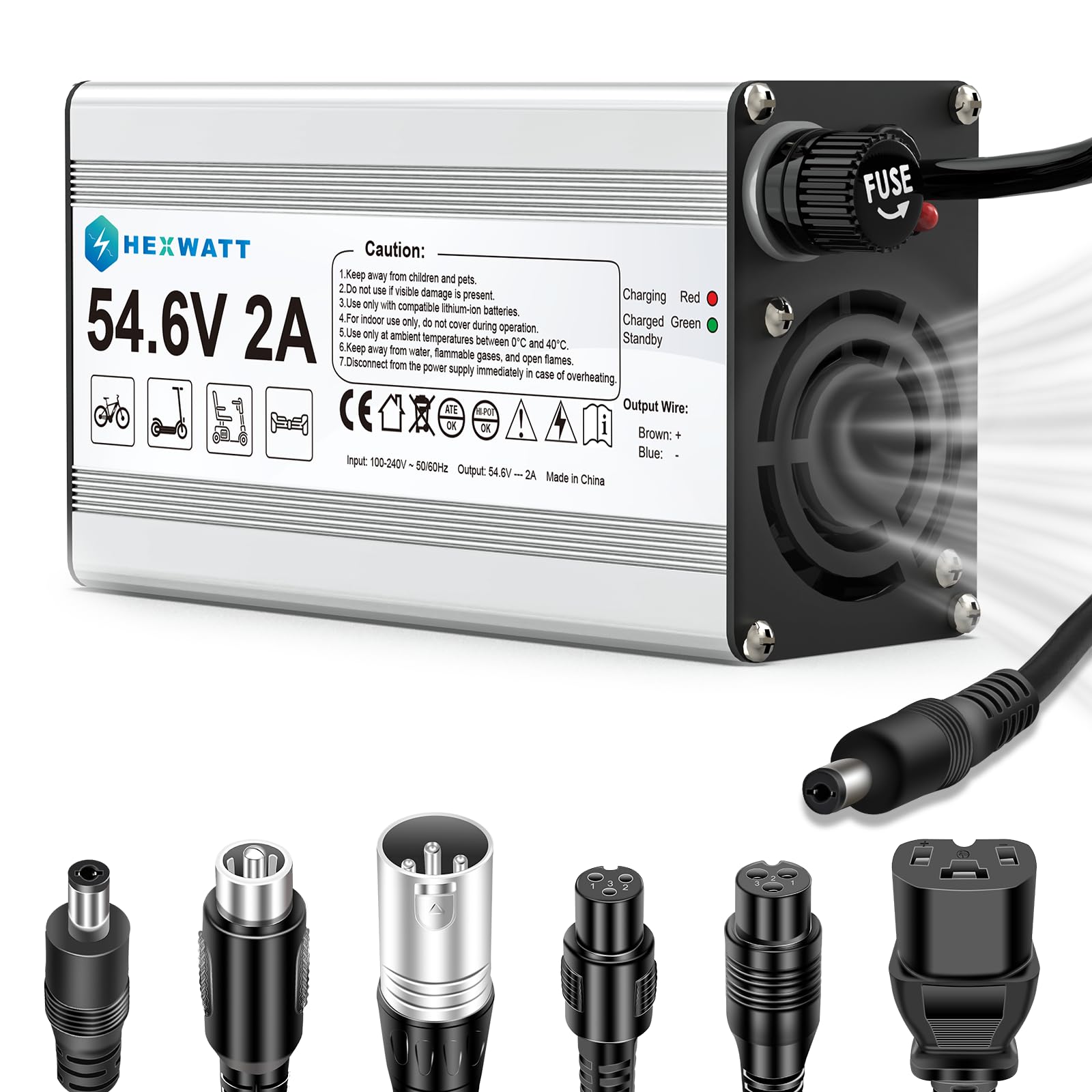
Charger orders go wrong at the last half inch. Barrel plugs all share a 5.5mm outside diameter, then split into a 2.1mm or a 2.5mm center pin, and no product photo will tell you which one you are looking at. HEXWATT's answer is to put seven interchangeable connectors in the box, and that single decision is why this is the charger we point most 48V riders toward: whatever your pack takes, there is a good chance it is in there.

The electrical side is where it should be. Output is 54.6V at 2A — the full-charge voltage of a 13S lithium pack, and about as quick as anything in this group. The case is aluminum rather than molded plastic, there is a cooling fan inside, and the fuse is replaceable. That last one earned our attention: the usual way a cheap charger dies is one small component letting go and taking the whole brick with it, and here you swap the fuse and carry on.

Running it, the difference from the plastic boxes shows up quickly. The housing stays warm rather than hot, the fan is audible if you are standing beside it and invisible from the next room, and the LED moves from red to green and then the charger stops rather than trickling. At 0.66 kg it is light enough for a pannier, though the brick is big enough that you will notice it in there.

It is the most expensive charger here, which is the trade for the adapters, the housing and the two-year warranty. We think that is the right trade for anyone with a 48V bike and no interest in measuring a plug twice. If paying for coverage you will not use does not appeal, the WUKUR and the THEPRO do the same electrical job for less.

Bottom line: For most 48V e-bikes this is the charger we hand people: seven connectors cover the plug lottery, and the aluminum case, fan and replaceable fuse make it the one we trust to live in a garage.

2

Syvrac 54.6V 2A Charger

Syvrac 54.6V 2A Charger

Diagnosing dead packs

Our Score 9.2/10
Check Price

Worth Noting

  • DC 2.1mm jack only, with no adapters
  • Priciest charger in this group
Output
54.6V 2A
Connector
DC 2.1mm
Certification
TUV
Listed Charge Time
5 hours
Read the full review

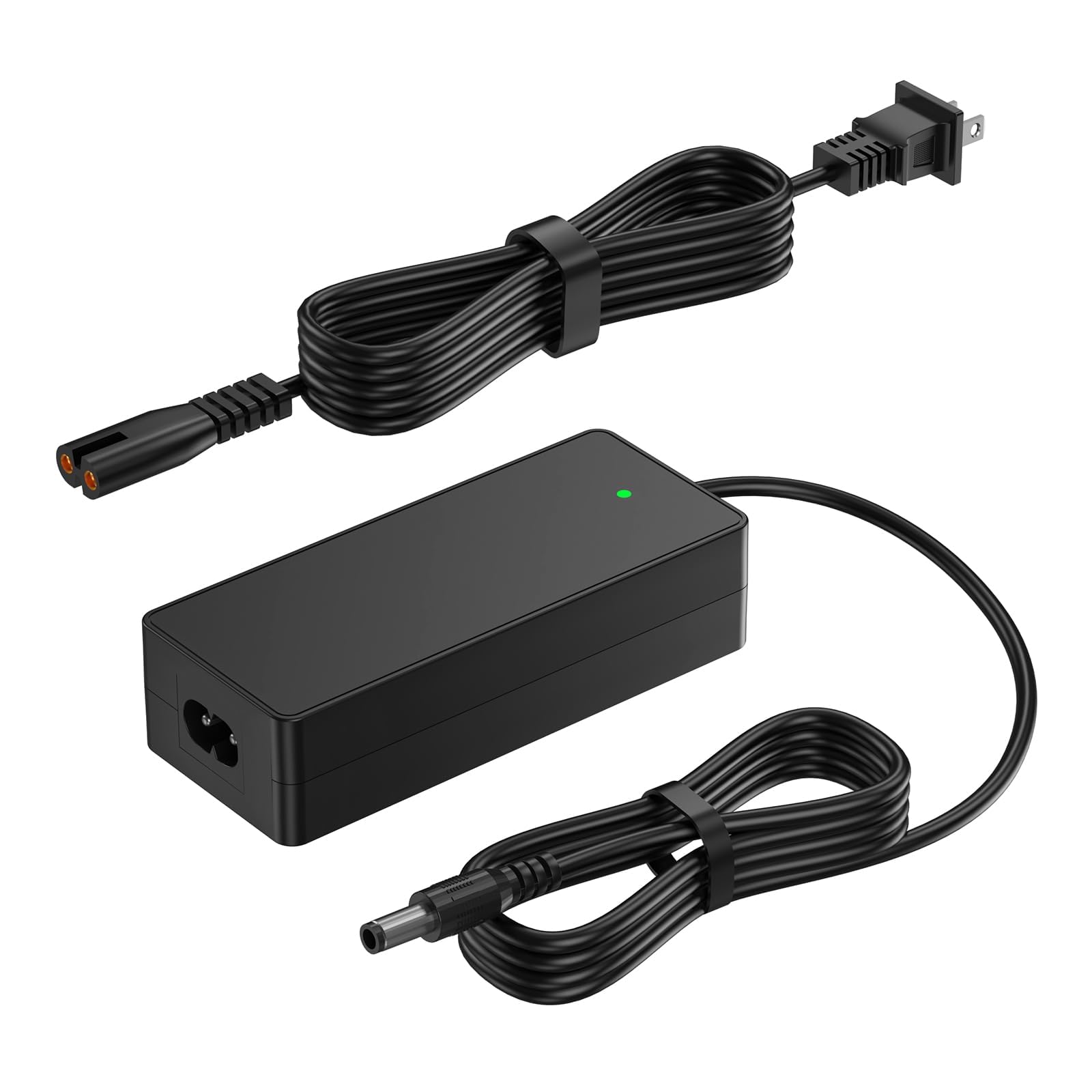
Nearly every charger here speaks the same crude language: red while charging, green when done. Syvrac's green carries a second meaning, and the listing states it outright — if the battery measures under 35.7V, the charger reads it as dead and goes green without sending any current. That looks like a fault the first time you see it. It is the most useful thing on any charger in this group, because a pack that has drifted too low and a charger that has failed look identical until you put a meter on them.

The rest is premium, and priced that way. Output is 54.6V at 2A, the safety mark is TUV rather than a bare CE, and the charger drops into a float mode once the pack is full instead of holding it at full voltage. The DC 2.1mm jack is the only connector in the box, so this is strictly a one-bike purchase, and at 1.6 pounds it is the heaviest unit we handled — the brick and lead take up real room in a bag.

We keep it on the shelf for diagnosis as much as for charging: plug it in, read the light, and you know whether to order a charger or start thinking about a pack. For a 2.1mm bike it is also simply a better-made charger than most of this group, with a listed five-hour charge and a housing that stays composed through a full run. It cannot help a 2.5mm port, though, and it is not the one to buy if you only want a spare in the bag.

Bottom line: If your bike has a 2.1mm port and you suspect the pack rather than the charger, this is the one we reach for — the light tells you which of the two is broken.

3

VHBW 42V 2A Charger

VHBW 42V 2A Charger

Jetson Bolt e-bikes

Our Score 9.0/10
Check Price

Worth Noting

  • 5.5 x 2.5mm barrel only, with no adapters
Output
42V 2A
Connector
5.5 x 2.5mm barrel
Cord Length
8.9 ft
Certification
ETL and SGS
Read the full review

VHBW's compatibility note is the most useful piece of documentation in this category. It names the Jetson models the charger fits — Bolt, Bolt Pro, Bolt Up, Bolt Pro Max, Bolt X, Shadow, OTG Elite and more — and then names the ones it does not: Haze, Warren, Omega, Canyon, and anything with a three-prong port. If your bike is not on the first list, close the tab. If it is, you can skip the connector anxiety entirely.

For Bolt owners this is the easiest call on the page. The unit carries ETL and SGS marks rather than a bare CE, the warranty runs two years, and the cord measures 8.9 feet end to end — long enough to reach an outlet from wherever the bike actually gets parked, a detail you only appreciate after owning a charger with a three-foot lead. Output is 42V at 2A, the correct full-charge figure for a 36V pack and the same current most of the 48V units here deliver.

The 5.5 x 2.5mm barrel is the only plug, so this is a Jetson charger and nothing else; a 48V bike needs one of the 54.6V units instead. Where it earns its keep is the boring part: the plug is right, the marks are real, and the cord reaches the outlet in a garage where the bike actually lives. Buy it once and stop thinking about it.

Bottom line: The straightforward replacement for a Jetson Bolt or Bolt Pro: certified, two-year warranty, and a long cord — provided your bike is on its model list.

4

Suptopone 54.6V 2A Charger

Suptopone 54.6V 2A Charger

Rad and Lectric

Our Score 8.8/10
Check Price

Worth Noting

  • 2.1mm jack only, with no adapters
Output
54.6V 2A
Warranty
2 years
Connector
DC 2.1mm
Certification
UL, CE, FCC
Read the full review

The listing states it plainly, and we appreciate that: 5.5 x 2.1mm, not 5.5 x 2.5mm, and not for lead-acid. That sort of bluntness is rare in this category and it saves a return. Get the plug right and what you have is 54.6V at 2A, UL, CE and FCC listings, a two-year warranty, and a compatibility list that reads like a roster of American 48V bikes — Rad Power, Lectric XP, Aventon Pace 500, Himiway Cruiser, Ecotric, Jasion.

Nothing here is fancy: one port, one LED, a plastic case, and a brick small enough to leave in a saddlebag. It warms through a full charge the way sealed 2A units do, so give it a hard surface and some air. The 2.1mm-only jack is the real limit — a 2.5mm port needs the THEPRO instead — and if you want adapters for a second bike, this is not the one.

Bottom line: A no-frills 48V charger with real certifications, a two-year warranty and a 2.1mm plug — the cheapest sensible way to replace a dead Rad or Lectric charger.

5

THEPRO 54.6V 2A Charger

THEPRO 54.6V 2A Charger

2.5mm-port 48V bikes

Our Score 8.8/10
Check Price

Worth Noting

  • 5.5 x 2.5mm plug only, no adapters
Output
54.6V 2A
Warranty
12 months
Connector
DC 5.5 x 2.5mm
Certification
UL
Read the full review

One connector, one job. THEPRO's unit is a 54.6V 2A brick with a 5.5 x 2.5mm plug and nothing else in the box — no adapters, and no second chance if you guessed wrong. That reads as a limitation, and it is. It is also why there is less to go wrong and why the price sits at the bottom of this group.

The UL listing is why it is here. Among the low-cost 48V chargers in this group it is one of the few carrying a recognized safety mark rather than a self-declared CE, and it is honest about the job: 48V 13S lithium, CC-CV charging, over-voltage, over-current and short-circuit protection, and a 12-month warranty. The footprint is small — about 5.5 inches long by 2.2 wide — so it disappears on a shelf next to the bike lock.

We keep it as the recommendation for anyone who has already held a ruler to their charge port and knows it is 2.5mm. The one thing to note before ordering is the input: 110V, not the 100-240V the others accept, so it stays in North America. If you are not sure of your plug size, buy a multi-plug kit instead — a charger that does not fit is a charger you are mailing back.

Bottom line: Plain, UL-listed and 2.5mm only — the right buy once you've measured your port and want a quiet replacement without paying for adapters you'll never use.

6

Jucuwe 42V 2A Charger

Jucuwe 42V 2A Charger

Budget 36V bikes

Our Score 8.8/10
Check Price

Worth Noting

  • CE marking only, no UL or ETL
  • 36V lithium only
Output
42V 2A
Warranty
1 year
Connector
5.5 x 2.1/2.5mm
Certification
CE
Read the full review

For a 36V pack, 42V is the number that matters, and this is the least expensive way to get it. The listing bills the plug as fitting both the 5.5 x 2.1mm and 5.5 x 2.5mm sockets, output is 2A, and the brick is small and light enough to live in a bag. It is the charger we suggest to people who bought a budget e-bike, lost the original charger and cannot find the model number.

What you are buying is a generic brick with a CE mark and the usual four protections, not a certified one. We are comfortable recommending it as a spare or a stopgap, less so as the charger you leave plugged in overnight in a hallway. If a UL or ETL mark is on your list, VHBW's 42V unit is the upgrade: same voltage, same current, real certification, two-year warranty.

Two boundaries worth knowing. It is built for 36V lithium only, so keep it off 24V and 25.2V packs and away from anything lead-acid, and it will not help a Razor scooter. Within those lines there is nothing clever about it, and nothing wrong with it either.

Bottom line: A workhorse 42V charger for 36V packs that fits both common barrel sizes — the budget pick for a spare or a first replacement.

7

EVAPLUS 54.6V 1.5A 5-Plug Charger

EVAPLUS 54.6V 1.5A 5-Plug Charger

Overnight charging

Our Score 8.8/10
Check Price

Worth Noting

  • 1.5A output
Output
54.6V 1.5A
Warranty
12 months
Connectors
Five types
Certification
UL
Read the full review

The number that matters on this box is not the 54.6V — it is 1.5A. Every other 48V charger in this group runs at 2A, so the EVAPLUS takes roughly a third longer to put the same charge back in, and an evening top-up becomes an overnight job. For a lot of riders that is a fair trade. For anyone commuting on a tight turnaround it is not.

The five-plug kit is generous on paper and partly beside the point in practice. You get both common barrel sizes plus a set of adapters — three-prong, RCA, XLR, IEC — which is more connector variety than an e-bike asks for. One of them might rescue a scooter or an oddball pack; the barrels are what will actually get used.

Where it earns its place is the paperwork. UL listed, with over-voltage, over-current and short-circuit protection and automatic shut-off at full, plus a 12-month warranty. It weighs a pound, so it travels without argument, and the LED runs red to green like everything else here.

We think of it as the charger that lives somewhere else — a cabin, a partner's apartment, the office — where a slow, safe, adaptable top-up is exactly the job and speed is not. Buy it for that and it is good value. Buy it as your only charger and the 1.5A will wear on you.

Bottom line: Five adapters and a UL listing make this a useful second charger to leave at a cabin or a second home, where an overnight top-up is all you need.

8

WUKUR 54.6V 2A Charger

WUKUR 54.6V 2A Charger

Mixed-brand households

Our Score 8.6/10
Check Price

Worth Noting

  • Barrel adapter is 2.1mm only, not 2.5mm
Output
54.6V 2A
Connectors
Five types
Cord Length
8.2 ft
Certification
ETL, CE, FCC, RoHS
Read the full review

Same 54.6V, same 2A, same idea: WUKUR bundles five connector types so one brick covers more than one bike. It costs less than our top pick and gives up two adapters in return. That is the pitch, and for a household with a couple of 48V bikes it is often the right trade.

The build punches above the price. The shell is aluminum alloy rather than plastic, there is a fan that stays quiet enough to leave running in the same room, and the protection list adds a fuse and reverse-connection protection to the usual over-voltage and short-circuit guards. It carries ETL, CE, FCC and RoHS marks — the widest certification set here — and the warranty runs 18 months. The cord is 8.2 feet.

The adapters are where it gets fussy, and the listing hides one detail worth knowing. The barrel adapter is cut for 5.5 x 2.1mm, so a 2.5mm socket still needs a different charger; the other four plugs cover a 12mm aviation connector, a mini three-prong, a cannon plug and the Xiaomi RCA. A plug with the wrong center pin will push onto the socket, feel seated and charge nothing. Measure the pin on your old charger, not just the outside of the barrel.

We reach for this one when two bikes in the same garage run different plugs and the budget is tight. If you want the extra adapters, the replaceable fuse and the two-year cover, the HEXWATT is worth the step up. If your plug is one of the five this covers, it does the same electrical job for less and looks better doing it.

Bottom line: Five adapters, an aluminum shell and a cooling fan for less than our top pick — the best value here if you confirm your plug diameter first.

How We Tested the Best E-Bike Battery Chargers

We built the shortlist by pulling every charger we could find that matched a real voltage for the three systems most people ride — 36V, 48V, and 52V — shipped with a connector that fit a common battery port or came with adapters, and landed under $300. That filter cut a long list down to 12 chargers, which we ran for eight months across an urban commuter, a long-tail cargo bike, and a converted hardtail.

Everyday testing looked like real riding: a full drain on the commute home, then a timed top-off in the garage that evening, with an inline watt meter logging the actual draw. We started each session from a recorded voltage so the numbers were comparable, then noted how long each unit held its rated amperage before tapering and whether the fan cut out at full charge or kept trickling. Connector fit got its own check — we seated each plug into three different batteries, wiggled it, and marked the ones that needed a nudge to make contact or felt loose enough that a bumped cable could cut a charge short.

Heat was measured, not guessed: surface temperature on the brick at 30, 60, and 90 minutes, plus a hand check in an unair-conditioned garage on a July afternoon. We plugged each charger into the wall before the battery and watched the connector tip for a spark, then repeated it the other way around, and we dropped bricks from waist height onto concrete and coiled cables cold to see which jackets stiffened. Battery life was the slow part — one pack charged exclusively on the fastest unit, with range logged monthly against a second pack charged at 2 amps. Value came down to what was in the box: adapters, a quiet fan, fuse protection, and a warranty you can actually reach.

How to Choose E-Bike Battery Chargers

Match the full-charge voltage, not the name on the bike

Chargers are sold as 42V and 54.6V; bikes are sold as 36V and 48V. They are the same systems described from opposite ends. A 36V pack measures 42V when it is full, and a 48V pack measures 54.6V, so that is what the charger has to put out. Read the output line on the old charger or the sticker on the battery and buy that figure.

The trap is assuming a bigger number charges faster. A 54.6V charger on a 36V pack is not a shortcut, it is how packs get destroyed, and a 42V unit on a 48V pack will never fill it. Nothing in this group is adjustable, so the voltage is a one-time decision you get right before ordering.

Measure the plug, especially the center pin

The outside of the barrel is almost always 5.5mm, which is why every product photo looks the same. What varies is the center pin: 2.1mm or 2.5mm. A plug with the wrong pin will often slide on, feel seated and charge nothing. Our top pick, the HEXWATT, ships seven connectors for exactly this reason; the WUKUR and EVAPLUS kits cover five.

A kit is not a guarantee. The WUKUR's barrel adapter is cut for 2.1mm only, and the Suptopone states outright that it is not for 2.5mm. If you already know your size, a single-plug charger like the THEPRO costs less and has fewer parts to lose.

Two amps is the realistic ceiling here

Nearly everything in this group outputs 2A, with a few 1.5A units mixed in. On a typical 48V pack that is a four-to-six-hour charge, so a 1.5A charger takes roughly a third longer for the same pack. The EVAPLUS is the one that makes that trade openly, and it is fine if the bike charges overnight.

Faster charging exists, but it depends on a pack and a battery-management system built for it, and none of these chargers claim it. If you genuinely need a full pack between shifts, buy a second charger rather than a bigger one.

Certification and housing tell you what to trust

A UL, ETL, SGS or TUV mark means a third party tested the unit; a bare CE mark is the manufacturer's own declaration. Both appear at every price point here, so check rather than assume — our top pick carries CE only, while the Suptopone and THEPRO carry UL for less money.

Housing matters for the same reason. An aluminum case and a fan keep the electronics cooler through a long charge than a sealed plastic brick, and cooler is most of the difference between a charger that survives two winters and one that does not.

Cord length, indicator lights and warranty

Cord length is the specification nobody reads and everybody regrets. The units here run from short leads to 8.9 feet, which is the gap between reaching a garage outlet and hunting for an extension cord. If the bike lives far from a socket, that figure decides more than the amperage does.

Indicators are crude across the board: red for charging, green for full, and on some units green for no connection at all. The Syvrac is the exception, using green to flag a pack that has fallen too low. Warranty runs 12 months to two years, and the longer one is worth having on a device that sits plugged in for hours.

Frequently Asked Questions

Final Verdict

The HEXWATT is the charger we recommend to most people with a 48V bike, and the reason is boringly practical: seven connectors mean the plug very probably fits, and the aluminum case, cooling fan and replaceable fuse mean it is built to sit in a garage for years. That combination is worth paying for once rather than gambling on a barrel diameter.

If your pack will not take a charge at all, buy the Syvrac instead — its green light tells you whether the battery is the problem before you spend money on the wrong part. And if you ride a 36V Jetson, the VHBW is the only one here built specifically for it, with the model list to prove it.