Indoor Training

Best Exercise Bikes of 2026

An exercise bike looks like an easy purchase until you're twenty minutes into a ride and the frame starts rocking, or the flywheel wakes up whoever's asleep downstairs. What a good one actually fixes is everything around the pedaling: it stays planted when you stand to climb, it fades into the background instead of clanking, and it doesn't saddle you with a seat you'll feel for two days. Assembly matters too — a bike that arrives with vague instructions and a missing bolt never quite feels solid again.

Here's what surprised me most after nine months with eight bikes in my garage and my team's living rooms: seat size and padding vary far more than the spec sheets admit, and the saddle that's perfect for one rider is punishing for another. We rode them the way people actually ride — early mornings before work, long weekend sessions, standing climbs, sweaty intervals — and tracked how they felt on day one versus week six. The ones below stayed quiet, stayed steady, and were still worth the money months later.

1

MERACH S19 Recumbent Bike

Top Pick
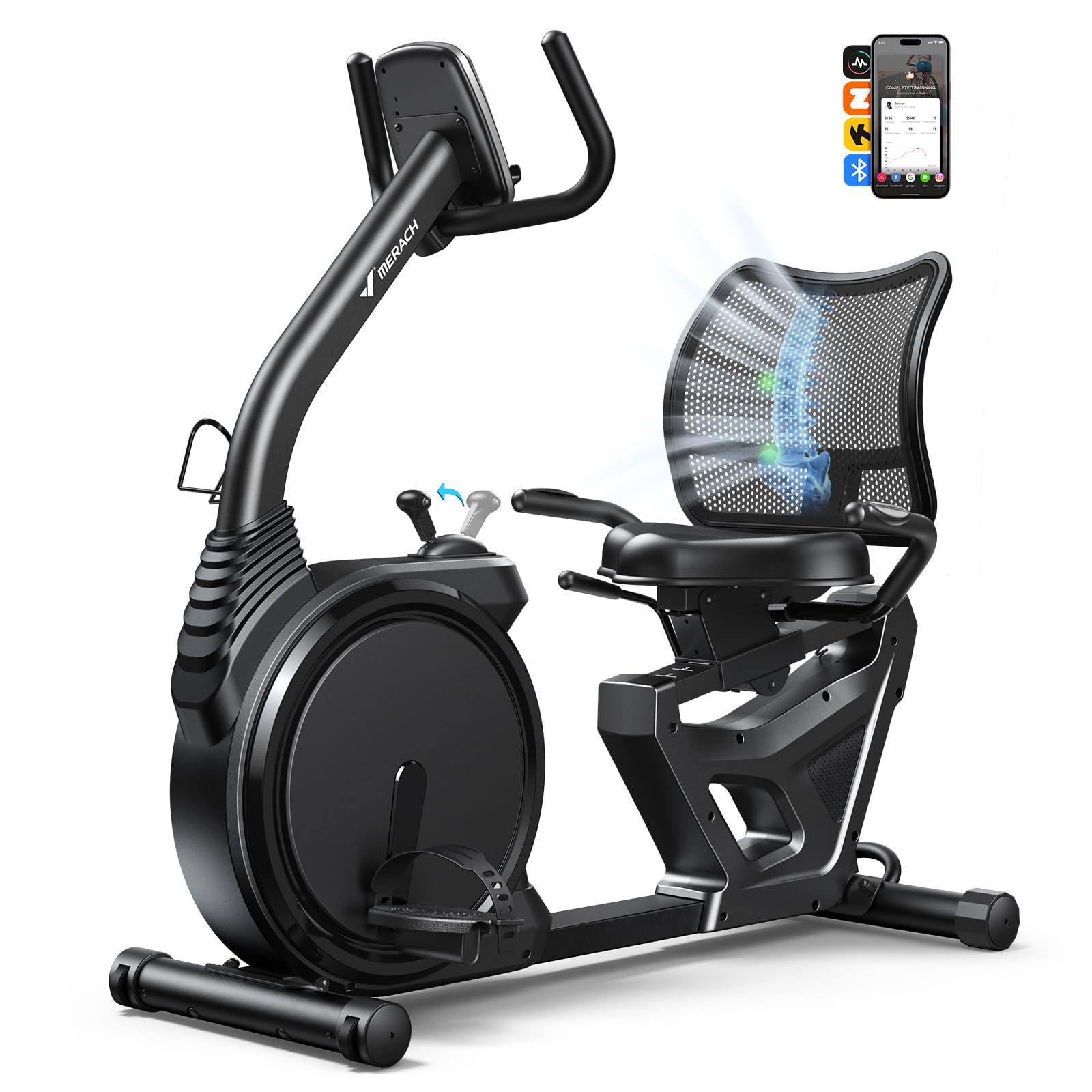
MERACH S19 Recumbent Bike

Back-supported recumbent rides

Our Score 9.2/10
Check Price

Worth Noting

  • Only eight resistance levels
Resistance
Magnetic, 8 levels
Connectivity
Bluetooth app
Seat Positions
8
Weight Capacity
330.7 lb
Read the full review

A recumbent bike is the right answer for a rider who wants cardio without folding forward over the handlebars, and the S19 is the one we recommend first. The seat has eight positions, the backrest is breathable mesh, and the side handles give you something to hold when you mount or when you want a more supported ride. We found the seated position easy to settle into, which is the point of this bike.

What we like best is how little the S19 asks of you mid-ride. The car-style resistance lever moves through its range with one hand, and the dual-belt drive is quiet enough that you can ride while someone else watches television. The 150-kg weight limit and eight seat positions cover a wide range of riders, though the bike is long: its footprint is 48 inches deep, so measure the room before you commit.

This is not the bike for someone chasing a hard spin-class feel. The finer jumps of the IC4 or the S26 suit interval work better. For a rider who wants to keep moving with back support, though, the S19 is the pick we trust for a long, quiet session.

Bottom line: For riders who want back support and an easy step-through mount, the S19 is our recumbent pick, with a quiet drive and a wide adjustment range.
2

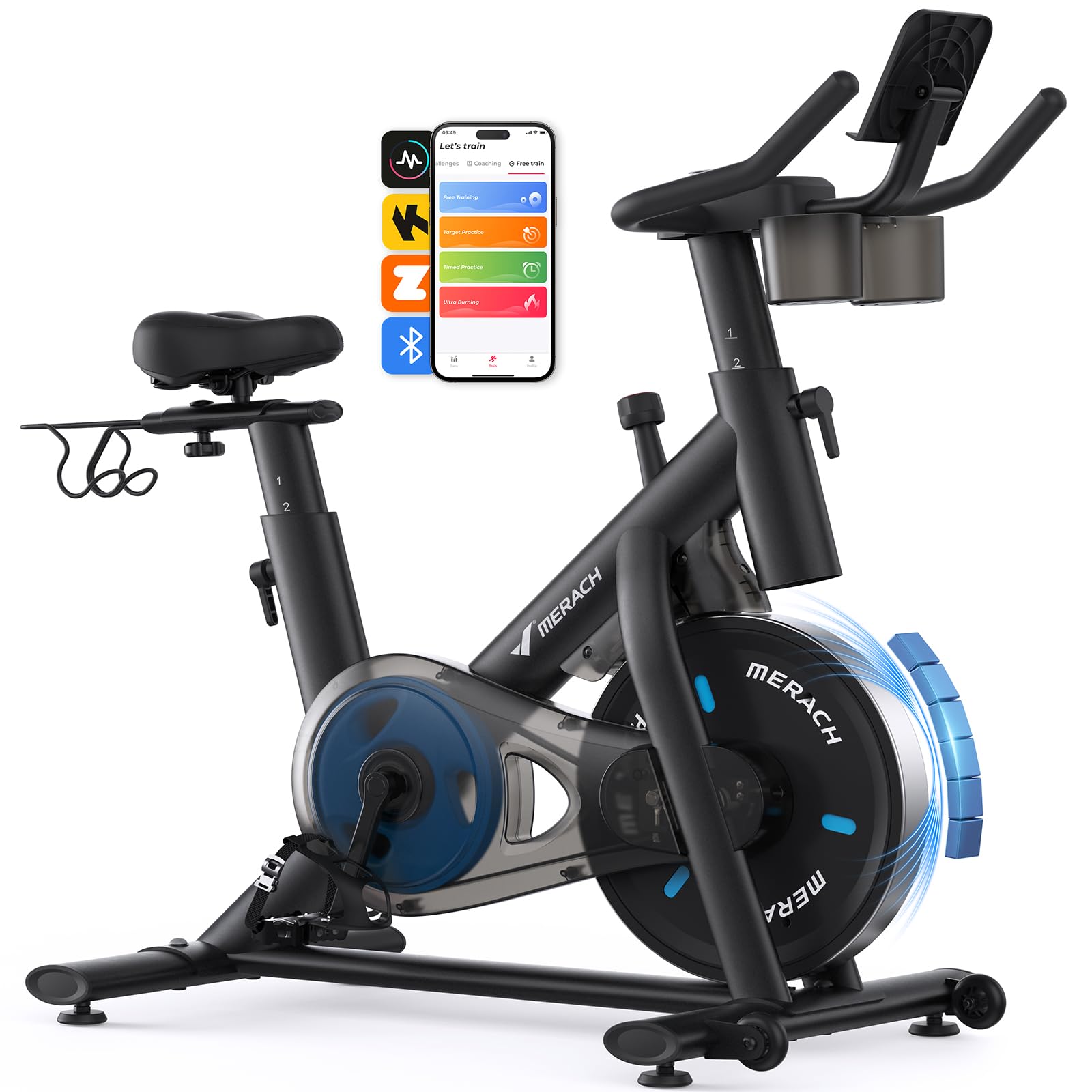
MERACH S26 Exercise Bike

MERACH S26 Exercise Bike

All-around home cardio

Our Score 9.0/10
Check Price

Worth Noting

  • 62-pound frame is hard to move often
Resistance
Magnetic, 8 levels
Connectivity
Bluetooth app
Height Range
4'8" to 6'2"
Weight Capacity
300 lb
Read the full review

The S26 is the bike we point most people to, and the reason is the resistance: it builds progressively instead of jumping from easy to heavy. We noticed that most at the start of a ride, when a warm-up should feel like a warm-up, not like a fight with a tension knob. The magnetic unit and belt drive keep the pedaling quiet, which matters if the bike lives near a bedroom or a shared wall.

A reinforced steel frame gives it a planted feel that lighter budget bikes miss, and the 300-pound weight limit covers a wide range of riders. The seat and handlebars adjust for riders from 4'8" to 6'2", so a household can share it. The Bluetooth app adds real-time metrics, but the bike's own controls are enough for a simple ride.

What keeps it from being a no-compromise pick is the saddle. The shape is firm, and long sessions are where you feel it; if you already know you like a softer seat, price a replacement into the purchase rather than hoping it breaks in. The resistance dial falls easily to hand when you change pace, and the pedals have adjustable straps that keep your feet from sliding.

If you want one bike for steady weekday rides, a weekend interval session, and a household with riders of different heights, the S26 is the easiest recommendation in this group. It does not have the studio-bike heft of the Schwinn IC4 or the backrest of a recumbent, but it covers the everyday job with fewer compromises than the budget bikes. We keep coming back to it because it makes the ride feel normal, not like a piece of equipment you have to negotiate with.

Bottom line: We recommend the S26 as the default for most home riders: the magnetic resistance is smooth, the steel frame is stable, and the fit range covers shared households.

3

Schwinn IC4 Indoor Cycling Bike

Schwinn IC4 Indoor Cycling Bike

App-led spin sessions

Our Score 9.0/10
Check Price

Worth Noting

  • 112-pound frame is hard to relocate
Warranty
1 year labor, 10 years frame, 3 years parts
Resistance
Magnetic, 100 levels
Weight Capacity
330 lb
App Compatibility
Peloton and Zwift
Read the full review

The IC4 is the closest thing here to a studio spin bike, and you feel that in the first pedal stroke: the frame stays planted, the belt drive is quiet, and the magnetic resistance moves in fine steps rather than clunky jumps. We like it most for riders who follow Peloton or Zwift classes, because the Bluetooth connection and 100 micro-adjustable levels let you match a callout without guessing. The ride is smooth enough that a short session does not feel like a compromise.

The frame warranty is the quiet argument for the IC4. A 10-year frame, 3-year parts, and 1-year labor coverage is the kind of support we want on a bike that costs premium money; the 330-pound weight limit also gives bigger riders more room than several picks here. Assembly is manageable, but the bike is heavy enough that a second person helps with the unpacking and the final lift.

The saddle is the part we want to change. It is firm and narrow enough that long classes become a countdown, so plan on a replacement or a gel cover if you ride often. Once that is sorted, the IC4 is the rare premium bike that earns its price through the frame and the training connection rather than a flashy console. It is built for a dedicated workout space, not a corner you rearrange every week.

Bottom line: Choose the IC4 if you want a near-studio ride and train with Peloton or Zwift; its magnetic flywheel, stable frame, and long warranty justify the premium.

4

Goimu G0605 Folding Bike

Goimu G0605 Folding Bike

Small-space home gyms

Our Score 8.8/10
Check Price

Worth Noting

  • Wide seat crowds some riders
  • Adjustment knobs take fiddling
Folding
Yes
Resistance
Magnetic, 16 levels
Height Range
4.4 to 7 feet
Weight Capacity
330 lb
Read the full review

The G0605 is built around an X-frame that folds down for storage, which is the whole reason to consider it over a standard upright. The 16-level magnetic resistance, belt drive, and heavy-duty steel frame are there to make the ride feel smoother than the folding mechanism might suggest. It also adds a padded backrest, a detail that makes low-impact sessions easier to settle into.

We think the folding design is the right trade for a small home, as long as you are realistic about the weight. At 50.6 pounds, it is not a one-hand lift, and the fold is a two-step routine rather than a magic trick. What you get back is floor space and a bike that can be rolled aside; what you give up is the planted feel of a heavier studio frame. The 330-pound capacity and 4.4-to-7-foot height range make it versatile for a folding bike.

The backrest is what makes this one worth a look for a senior rider or anyone coming back from an injury; you can sit down, find the pedals, and start without balancing on a standard saddle. We also appreciate that the bike is easy to assemble, so the first session is not an afternoon project. For a solo rider in a small space, it is an easy bike to live with.

Bottom line: Buy the G0605 when your workout space doubles as living space: it folds, adds a backrest, and keeps the ride quiet.

5

SLUNSE 509A Exercise Bike

SLUNSE 509A Exercise Bike

Budget home cardio

Our Score 8.8/10
Check Price

Worth Noting

  • Narrow, firm saddle
  • 59.5 pounds makes daily moving a chore
Resistance
Magnetic, 100 levels
Height Range
4.8 to 6.1 feet
Weight Capacity
350 lb
Included Accessories
Two resistance bands
Read the full review

The 509A is the budget upright in this group, and it spends its money in the right places: a magnetic resistance unit, a belt drive, and a 350-pound frame. You get 100 resistance levels, a tablet mount, and a pair of resistance bands for upper-body work. The bike is compatible with apps such as Zwift and Kinomap, which is unusual at this end of the set.

We found the ride quiet enough for an apartment and smooth enough for longer sessions, and the 350-pound capacity gives it more headroom than several budget bikes. The seat height and handlebar adjustments cover a wide range, and the console keeps time, speed, distance, and calories in view. The package feels more complete than the price tier suggests.

What makes the 509A our budget pick is not one headline feature but the balance. It gives you magnetic resistance, app compatibility, and a high weight limit without asking you to accept a flimsy frame. The included bands are a bonus rather than the reason to buy, and the bike feels planted when you push the pace. For everyday cardio in a spare room, it is the value choice we keep coming back to.

Bottom line: The 509A is our budget pick for riders who want magnetic resistance, a 350-pound capacity, and app compatibility without a premium frame.

6

CURSOR CBE10 Exercise Bike

CURSOR CBE10 Exercise Bike

Lightweight budget rides

Our Score 8.6/10
Check Price

Worth Noting

  • Friction resistance needs pad upkeep
Assembly
Tool-free, about 30 minutes
Resistance
Friction, 100 levels
Height Range
4'8" to 6'2"
Weight Capacity
300 lb
Read the full review

The CBE10 is the lightest full-size upright here at 39.7 pounds. That makes it easier to roll aside after a workout and less intimidating to set up alone than the heavier bikes in this group.

The spec sheet is aimed at budget riders who still want range: 100 friction resistance levels, a 300-pound capacity, and a fit range from 4'8" to 6'2". The bike is designed for tool-free assembly in about 30 minutes, and the tablet mount is there for entertainment or a training app. The direct feel of friction resistance is different from the magnetic bikes here, and the 100-step dial gives you plenty of room to settle into a pace.

We like the CBE10 for a rider who wants a simple upright bike that is easy to move and does not need a dedicated room. It is not the bike we choose for a studio-style session; the 100-step dial and lighter build make more sense for steady, seated cardio. If that is your workout, the lower weight is a feature, not a compromise.

Bottom line: Consider the CBE10 if you need a lighter upright bike for steady cardio and can accept friction resistance in exchange for easy moving.

How We Tested the Best Exercise Bikes

We built the shortlist from scratch, starting with roughly 40 bikes sold by brands with long review histories, then narrowing by price band, footprint, resistance type, weight limits, and whether the seat and handlebars adjusted far enough for riders under 5-foot-4 and over 6-foot-2. Eight made the cut, and each one lived in a real home for nine months — a carpeted spare room, a garage, a second-floor apartment — rather than on a showroom floor.

Assembly came first. I built each bike alone with a stopwatch running and only the tools the box provided, noting where the instructions went vague, whether the bolts lined up without persuasion, and how much of the job really needed a second pair of hands. A week later I re-checked every bolt to see what had shaken loose. Sturdiness got tested the honest way: standing climbs at the heaviest resistance, watching for side-to-side sway at the front stabilizer, and noting whether the whole bike crept across the floor during a sprint.

Noise was judged from the next room with a rider mid-interval, and again at 6 a.m. with someone asleep on the other side of a wall, listening for flywheel whine, pedal clicking, and fan drone. Functionality meant changing resistance mid-climb, moving the seat one-handed, and living with the console for nine months. For comfort, I rode 45 minutes in street shorts on every saddle and measured each one — width, padding density, nose length — because a seat that's generous for one rider is a bruise for another. Finally, we weighed value: what actually came in the box, and what still felt tight and quiet after nine months of three rides a week.

How to Choose Exercise Bikes

Start With Riding Position

An upright bike puts you over the pedals for spin-style intervals and takes less floor depth than a recumbent. A recumbent spreads your weight across a backrest and makes mounting easier, which suits steady cardio or a rider who has trouble swinging a leg over. A folding bike is the compromise for a room that has to do two jobs: it stores smaller, but you still have to fold and move it. Decide where the bike will live before you compare features; a great frame in the wrong room becomes a clothes rack. The MERACH S19 is our recumbent example, while the Goimu G0605 earns its place on storage.

Resistance, Noise, and Maintenance

Most home riders are best served by magnetic resistance. A magnet moves toward or away from the flywheel, so the change is smooth, the drive stays quiet, and there is no friction pad to replace. Friction bikes can cost less and feel direct, but the pad wears, tension can change with heat, and the ride is often louder. More resistance steps are not automatically better: the MERACH S19's eight levels suit steady recumbent work, while the Schwinn IC4's 100 micro-adjustments give app-led riders finer control. Pick the feel you will use, not the biggest number.

Fit Comes Before Features

Fit is the part shoppers skip and the part that decides whether the bike becomes furniture. You want the seat high enough for a slight knee bend at the bottom of the stroke, and fore-aft adjustment so you are not reaching for the handlebars. Check the maker's height range and weight limit, but also check the saddle: a firm, narrow seat is a common complaint because it suits one rider and punishes another. The MERACH S26 covers 4'8" to 6'2"; the Goimu G0605 adds a backrest, but its wide seat crowds some riders.

Space, Assembly, and Connectivity

Measure the floor footprint, not just the folded size, and leave room to mount from the side. A 112-pound Schwinn IC4 stays planted but is a pain to move; a 39.7-pound CURSOR is easier to roll aside but feels lighter under hard efforts. Assembly is usually a one-person job, though heavy flywheels reward a second pair of hands. Bluetooth is worth paying for only if you will use Peloton, Zwift, or the maker's app; otherwise a basic console is enough. Check the warranty before you buy, especially on the frame.

Frequently Asked Questions

Final Verdict

For most people, the MERACH S26 is the exercise bike to buy: its magnetic resistance is smooth enough for daily cardio, the steel frame feels planted, and the app adds structure without making the console the whole point. If you want a premium spin feel for Peloton or Zwift, choose the Schwinn IC4; if back support matters more than a compact footprint, the MERACH S19 is the better fit.