Security & Locks

Best Ground Anchors for Bikes of 2026

A bike lock is only as good as what you loop it through, and plenty of us park where there's nothing to lock to — a garage slab, a back patio, the dead end of a driveway. A ground anchor fixes that: a hardened loop bolted into concrete or driven into soil so your lock finally has something solid to hold. What separates a good one from a bad one rarely shows on the box, though — it's whether the steel survives a winter, whether usable hardware comes with it, and whether the install takes twenty minutes or an afternoon.

I've bolted a few of these into my own garage slab, and the lesson that stuck is that the bolts in the box matter nearly as much as the anchor itself. We installed 14 anchors over four months — into concrete, packed dirt, and one stubborn paver corner — and the ones that held best all went in cleanly with a socket wrench and a masonry bit that actually matched the shield. The picks below are the ones I'd trust with a bike overnight; I'll note where each one fits best.

1

Urban UR55 Ground Anchor

Top Pick
Urban UR55 Ground Anchor

Everyday bike locking

Our Score 9.4/10
Check Price

Worth Noting

  • Shackle is thinner than the two 16mm anchors here
Profile
Folding swing shackle
Shackle
14 mm case-hardened CrMo
Mounting
Floor or wall
Anchor Points
4 expansion bolts
Read the full review

The shackle on the UR55 stands up on its own. Lift it, thread a chain through with one hand while the other keeps the bike upright, and it drops back into its cover when you're done. We noticed that on the first lock-up and it's the reason this one sits at the top: an anchor you use without thinking about it is worth more than one with a thicker ring and a fiddlier routine.

Under the polypropylene cover is a 14mm shackle of case-hardened chrome-molybdenum steel, level with both Kryptonite anchors here. It's held by four expansion bolts, each sitting behind an anti-drill ball bearing, so the fixings can't simply be spun back out. Urban's own figure for the shackle is more than eight metric tons of pull; we can't recreate that in a driveway, but four bolts and a hardened ring is the right architecture.

Fitting it is a drilling job: four holes, a hammer drill and a masonry bit of the right size, none of which come in the box. The bolts and inserts do, and at just under three pounds the unit is light enough to hold in place and mark through the base on your own. It mounts to a floor or a wall, indoors or out.

Against the rest of the group, this is the one that gets the everyday details right — a cover that never has to be removed, a shackle that stays where you put it, a base low enough to roll a wheel over. The ABUS buys you a thicker shackle for an outdoor wall; the EYPINS buys you a wider loop for less. Neither makes locking up as quick.

Bottom line: We recommend it to most riders: a hardened 14mm shackle on four anti-drill bolts, with a folding arm that makes daily locking quick.
2

ABUS WBA100 Ground Anchor

ABUS WBA100 Ground Anchor

Outdoor wall mounting

Our Score 9.4/10
Check Price

Worth Noting

Fixings
Mounting accessories included
Shackle
16 mm hardened steel
Mounting
Floor or wall, indoor or out
Base Size
6.3 x 6.5 x 2.56 inches
Read the full review

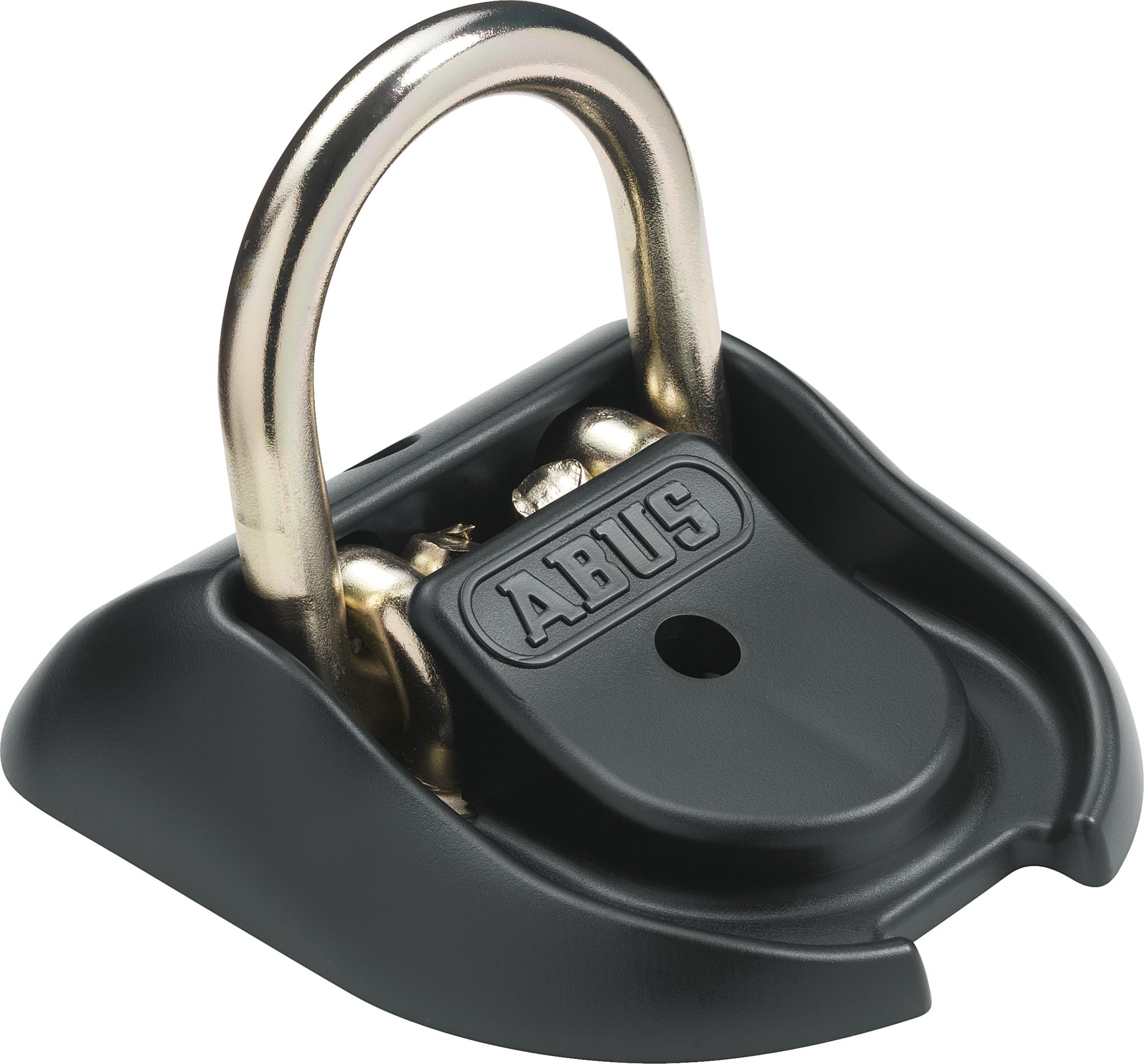
Sixteen millimeters of hardened steel is the entire argument for the WBA100. That's the thickest shackle in this group, level with the Kryptonite Stronghold, and it matters at the only moment that counts: a disc cutter has to get through more material, in less space, and every extra millimeter costs time and a fresh disc.

We were struck by how small the base is for that shackle — about six and a half inches square, compact enough to fit between a door frame and a downpipe. ABUS rates the unit as weatherproof, which is the detail that separates it from most of the anchors here. Bolted to an outside wall by the front steps or to a pad in an open carport, it doesn't need a roof over it.

It mounts to ground or wall, and the mounting accessories come in the box, so there's no second trip for anchors. A round shackle is also easier to live with than a square one: a chain slides around the ring instead of hanging off a corner.

The price is the trade-off. This is the most expensive anchor on the page, and unlike the Kryptonite plates it doesn't bring masonry bits or a folding cover. What the extra buys is a thicker shackle and an outdoor rating, and nothing else here offers both.

So if the anchor goes on a wall the street can see, or on a slab where the bike sleeps outside, the premium is buying real resistance. If it goes inside a locked garage, the money is protection you'll never need — the Urban does the same job indoors for a great deal less.

Bottom line: The one for an outdoor wall: a 16mm weatherproof shackle that's the thickest here, and worth the premium where the bike is visible.

3

EYPINS Security Ground Anchor

EYPINS Security Ground Anchor

Budget bike security

Our Score 9.4/10
Check Price

Worth Noting

  • Thinner steel and lighter build than the premium picks
Profile
Folds to 4 cm base
Shackle
14 mm steel
Loop Opening
5.5 x 6.5 cm inside
Anchor Points
4 x 16 mm
Read the full review

The opening inside the EYPINS ring is 5.5 by 6.5 cm, which is wide enough for two 10mm chains, four 7mm ones, or a chunky U-lock. That measurement matters more than most of the spec sheet: a ring that won't take your chain makes the anchor useless however thick the steel is.

At the bottom of the price range we expected to make excuses for it and mostly haven't. The shackle is 14mm steel, the base has four 16mm anchor points with anti-pullout balls, and the arm folds into a 4cm base you can drive over. For a bike in a carport or on a garage floor, that's the job done for the least money here.

Slow down on the fixings. Check all four expansion bolts before you drill, because one that won't bite turns a four-point anchor into a three-point one, and the bolts are where a budget anchor saves money. Covers, cover screws and an Allen key are all in the box.

Bottom line: The budget pick we're comfortable recommending: a wide 5.5 x 6.5 cm loop that swallows a fat chain, on four bolts.

4

KRASER KR52B Anchor

KRASER KR52B Anchor

Exposed high-risk bays

Our Score 9.4/10
Check Price

Worth Noting

  • Bulkiest base of the four-bolt anchors here
Weight
5.05 lb
Shackle
Closed double arch
Baseplate
5 mm steel
Anchor Points
4 stainless steel
Read the full review

Two and a quarter kilos arrive in a small box, and the weight is the first thing you notice about the KR52B. The baseplate is 5mm of high-strength steel, a heavier gauge than anything else here, and the shackle is a closed double arch rather than an open hook — a slack chain has nothing to slip off.

KRASER lists resistance to shears, saws, hammers and drills, and the construction matches the claim: four anchor points, stainless steel screws and plugs in the box, and a double paint layer over steel that's meant to be hit. We can't shear an anchor in a driveway, but nothing in the assembly looks like a shortcut.

It takes any chain, U-lock or padlock you already own; KRASER pairs it with their own KR50 chain and mini U-lock, which is one way to be sure the shackle and the chain are in the same league. It mounts to a floor or a wall.

Where it earns its place is a bay, an alley or a shared garage that a thief can see and take their time over. For a bike that lives in a private garage behind a locked door, the extra steel is weight you'll never use.

Bottom line: For an exposed bay or alley: a 5mm plate, a closed double arch and four stainless fixings that make a thief work in the open.

5

RADIKAL RK54 Anchor

RADIKAL RK54 Anchor

Sheds and garages

Our Score 9.4/10
Check Price

Worth Noting

  • 14mm arch, thinner than the 16mm anchors here
Finish
Zinc coated
Profile
Folds flat, drive-over
Shackle
ø14 mm welded arch
Anchor Points
4 expansion bolts
Read the full review

Four expansion bolts, a folding 14mm hardened arch and an anti-drill metal ball behind each fixing: the RK54 is the least expensive way here to get the full four-bolt layout. It comes from the same maker as the KRASER anchors, which is why the shape looks familiar.

The finish is where it differs. RADIKAL zinc-coats the arch instead of chroming it and says so plainly — less shiny, more resistant to knocks. We appreciate the honesty of that, because an anchor like this takes hits from pedals, boots and car doors, and a coating that shrugs them off is worth more than one that photographs well.

For a shed floor, a second bike or a spot where the anchor is a deterrent rather than a fortress, the RK54 does the work for the least money in this group. It's a 14mm arch rather than the 16mm of the two big anchors, and the folding arm is the part that will wear first — at this price, both are fair trades.

Bottom line: The value four-bolt anchor: a folding 14mm hardened arch, anti-drill balls and a sensible zinc finish for a shed or second bike.

6

KRASER KR802 Anchor

KRASER KR802 Anchor

Narrow wall strips

Our Score 9.4/10
Check Price

Worth Noting

  • Only two anchor points instead of four
Ring
ø14 mm pivoting
Fixings
2 x 16 mm plugs
Profile
0.91 inches tall
Drill Bit
16 mm, not included
Read the full review

The KR802 needs a 16mm masonry bit and doesn't include one. That's worth knowing before the box arrives, because 16mm isn't a size most households keep in the drawer, and a hole drilled a size small is a hole you drill twice.

Fitted, it's the most discreet anchor here: 0.91 inches tall, just over five inches long, with a pivoting 14mm ring on a baseplate a fifth of an inch thick. Two 16mm expanding plugs hold it, which makes it the pick for a concrete wall where there's only a narrow strip of clear surface — beside a door, under a stair, between a downpipe and a corner.

Two fixings is the trade-off. Four bolts spread the load across more concrete, and on a garage slab four is what we want to see. As a wall anchor in a tight spot it makes sense, and the pivoting ring means the chain hangs where you point it rather than where the wall decides.

Bottom line: Choose it for a narrow wall strip rather than a floor slab: a low-profile pivoting ring on two 16mm plugs.

7

Oxford Anchor 10

Oxford Anchor 10

Tight wall spots

Our Score 9.2/10
Check Price

Worth Noting

  • Lightest and smallest anchor here at 500 g
Size
5.12 x 4.09 x 2.28 inches
Fixings
All fixings plus Allen key
Attack Rating
5-minute attack tested
Bolt Protection
Ball bearings and covers
Read the full review

Five inches across and half a kilo: the Anchor 10 is the one we reach for when the only free surface is a strip of wall by a door, or the edge of a pad that's already crowded with bins. It bolts to floors and walls, and the small footprint means it fits where the wide plates in this group simply won't.

Oxford supplies every fixing plus an Allen key, and the bolts sit behind ball bearings before being covered once a lock is through the shackle, so a passer-by has nothing to put a spanner on. The rating is a five-minute attack — a modest claim, and an honest one.

The anchor is only as good as where you put it: low down, on solid masonry, away from a gate or a downpipe that a locked bike could be used to lever against. Get that right and the Anchor 10 does everything the bigger plates do, with far less to trip over in the dark.

Bottom line: Our pick for a wall or a tight corner: hardened steel, shielded fixings and a five-minute attack rating in half a kilo.

8

Kryptonite Stronghold Anchor

Kryptonite Stronghold Anchor

Garage floor fixing

Our Score 9.0/10
Check Price

Worth Noting

  • Needs a clear 16 x 11-inch patch of floor
Fixings
5/8 inch cement anchor bolts
Shackle
16 mm carbon alloy steel
Included
Two masonry bits
Footprint
16 x 10.8 x 3.5 inches
Read the full review

Two masonry bits come in the box with the Stronghold, a pilot bit and one cut for the 5/8-inch cement anchors. That's a nicer gesture than most anchors here make, and the bits are still the first thing to replace — a fresh carbide bit of exactly the right diameter is what decides whether the install takes an hour or eats a weekend.

The anchor itself is a serious piece of steel. A 16mm carbon alloy shackle sits on a hardened baseplate roughly 16 by 11 inches across, and that width is the point: it spreads the pull over more concrete than the compact anchors here can, and the 5/8-inch bolts bite deep. Kryptonite also lists mounting to a truck or trailer bed, which tells you what it is built to take.

If the bike lives on a concrete garage or workshop floor, this is the anchor we point to first — the fixing is stronger than the shackle needs to be, and that's the right way round. It is not discreet: 16 by 11 inches wants a clear patch of floor, not the corner where the mower and the paint tins live.

Bottom line: Buy it for a garage slab: a 16mm shackle on a wide, deeply bolted baseplate that spreads the load better than anything else here.

9

Kryptonite Evolution Anchor

Kryptonite Evolution Anchor

Compact indoor spots

Our Score 9.0/10
Check Price

Worth Noting

  • 14mm shackle, thinner than the 16mm anchors here
Cover
Lays shackle flat
Shackle
14 mm carbon alloy
Baseplate
Hardened steel
Anti-drill
Ball bearing inserts
Read the full review

Kryptonite's Stronghold gets the attention, but the Evolution is the neater of the two: a 14mm carbon alloy shackle on a hardened baseplate, in a package that costs less and takes up far less floor.

The polypropylene cover lets the shackle lie flat when there's nothing locked to it, which matters if the anchor sits where a car, a wheelbarrow or a foot passes. Under the cover the baseplate is hardened, and each fixing sits behind an anti-drill ball bearing insert, so the bolts aren't the way in.

Installation is the part to plan. The included bit and bolts are where this kit is weakest, so a sharp carbide masonry bit of exactly the right diameter and a hammer drill are what make the difference between a straightforward job and a frustrating one. If you don't already own a rotary hammer, that is part of the real cost of any of these anchors, this one included.

For a covered patio, a tight garage bay or the strip of concrete behind a flat, this is the Kryptonite we point to: the same hardened baseplate and shielded fixings as the Stronghold, in a footprint that doesn't take over the floor.

Bottom line: The tidier Kryptonite: hardened baseplate, shielded fixings and a cover that lies flat, in a footprint that fits a tight bay.

How We Tested Bike Ground Anchors

We started by rounding up every ground anchor we could find that was rated for outdoor use and sold with its own mounting hardware, then narrowed the field by anchor style — folding arm, fixed plate, ring, and screw-in — and by whether the specs for concrete and bolt size were listed up front rather than buried in a question-and-answer section. That left 14 anchors, which we installed across four real spots over four months: a garage slab, a concrete patio, a packed-dirt side yard, and a short run of brick pavers.

Each install was done solo with hand tools and timed. I noted whether the box included a masonry bit and whether it matched the shield diameter, whether the hole had to go deeper than the instructions claimed, and how much play was left once the bolt was torqued down. Any anchor that spun in its hole or sat proud enough to rattle a lock got flagged right there.

Then we lived with them. Everything stayed outside through rain, heat, and two freezes, and I checked welds, bolts, and washers for rust every few weeks. I hooked a U-lock and a chain through each loop and pulled hard, rocked the anchor side to side, and tried to work the lock off the arm at odd angles. We also counted what came in the box — stainless versus zinc-plated bolts, spare washers, whether the head took a standard socket — because an anchor with soft hardware is one you reinstall a year later.

How to Choose Ground Anchors for Bikes

Start With What You're Drilling Into

Every anchor on this page holds the same way: expansion bolts squeezed into holes drilled in concrete or masonry. That makes the surface more decisive than the product. A poured slab or a concrete pad is ideal; engineering brick will hold but can spall; drywall, timber decking and paving slabs bedded on sand are not options at all.

Then decide floor or wall. A floor plate lets you get the frame and both wheels down at ground level, which is what you want for an e-bike or anything heavy. A wall anchor takes less floor and suits a narrow garage or a covered passage, but it needs solid masonry behind it — a low fixing in soft brick will pull out long before the steel gives.

Shackle Thickness, Hardening and Shape

A 14mm hardened shackle is the sensible baseline, and it is what most of this group uses. The two 16mm anchors, the ABUS WBA100 and the Kryptonite Stronghold, buy extra cutting time and are worth it where the bike is visible from the street. Hardening matters as much as diameter: unhardened steel of the same thickness cuts far faster.

Shape matters too. A closed arch or a folding swing shackle gives a chain nothing to slip off, while an open hook can be beaten by a slack chain. And if the anchor sits where you park or walk, check that the ring folds or lies flat — a shackle left standing is something you meet with your shin at night.

Four Bolts or Two

Four anchor points spread the pull across more concrete than two, which is why the compact KRASER KR802 reads as a wall anchor first and a floor anchor second. On a slab, take the four-bolt layout every time.

Height when nothing is locked to it is the other half of this. The EYPINS folds into a 4cm base and the RADIKAL's swing arm lies flat, so a car or a trolley can pass over them; a fixed plate wants a bay you never park in.

Match the Ring to the Lock You Own

Anchor and lock are one system, and the weaker half sets the standard — a 14mm shackle paired with a thin cable is really a cable problem. Measure the chain or U-lock you already have before you order anything.

The EYPINS opening is 5.5 by 6.5cm and takes two 10mm chains or four 7mm ones. A fat 12mm chain with a big padlock needs more room than some compact anchors give, and a U-lock needs a ring it can pass around rather than a slot it has to thread.

The Bit Decides How the Install Goes

The steel comes with the anchor; the hole doesn't. A rotary hammer and a sharp carbide bit of exactly the diameter the fixing specifies are what turn installation into a job rather than an ordeal.

Bits bundled with a kit are the part to replace first, and a battery hand drill with a masonry bit will not get through an old slab. If you don't own a hammer drill, borrow or buy one before the anchor arrives — it is part of the real cost of any of these.

Frequently Asked Questions

Final Verdict

For most riders the Urban UR55 is the one to buy. A 14mm hardened shackle on four anti-drill bolts is plenty for a bike that sleeps indoors, and the folding arm makes the lock-up quicker than any fixed plate here — which is the part you notice every single day.

Two alternatives change the answer. If the anchor goes on an outside wall the street can see, the ABUS WBA100's 16mm weatherproof shackle earns its premium. If it goes on a garage slab, the Kryptonite Stronghold fixes into the concrete harder than anything else here.