E-Bikes

Best Hardtail Electric Mountain Bikes of 2026

A hardtail e-mountain bike is a simple idea: a trail frame with a motor at the cranks and no rear shock. That simplicity is the point. You get help on the climb without the pivots, bearings, and servicing that come with rear suspension, and the bike still handles like a bike instead of a scooter. What it actually fixes is the thing that quietly ends most rides early — the grind back up, and the gap between you and the friend who talked you into this in the first place.

The first time I pointed one up a fire road I'd been walking for years, I understood immediately. Ten months and six hardtails later, the spread still surprises me: two felt planted and quick, one rattled over roots, and assembly ranged from fifteen minutes with the boxed tools to a trip to a shop. What first-timers don't expect is that a motor flatters a cheap frame — stability and ride quality matter more here, not less. The picks below are the ones that earned their place.

1

Qlife Racer

Top Pick
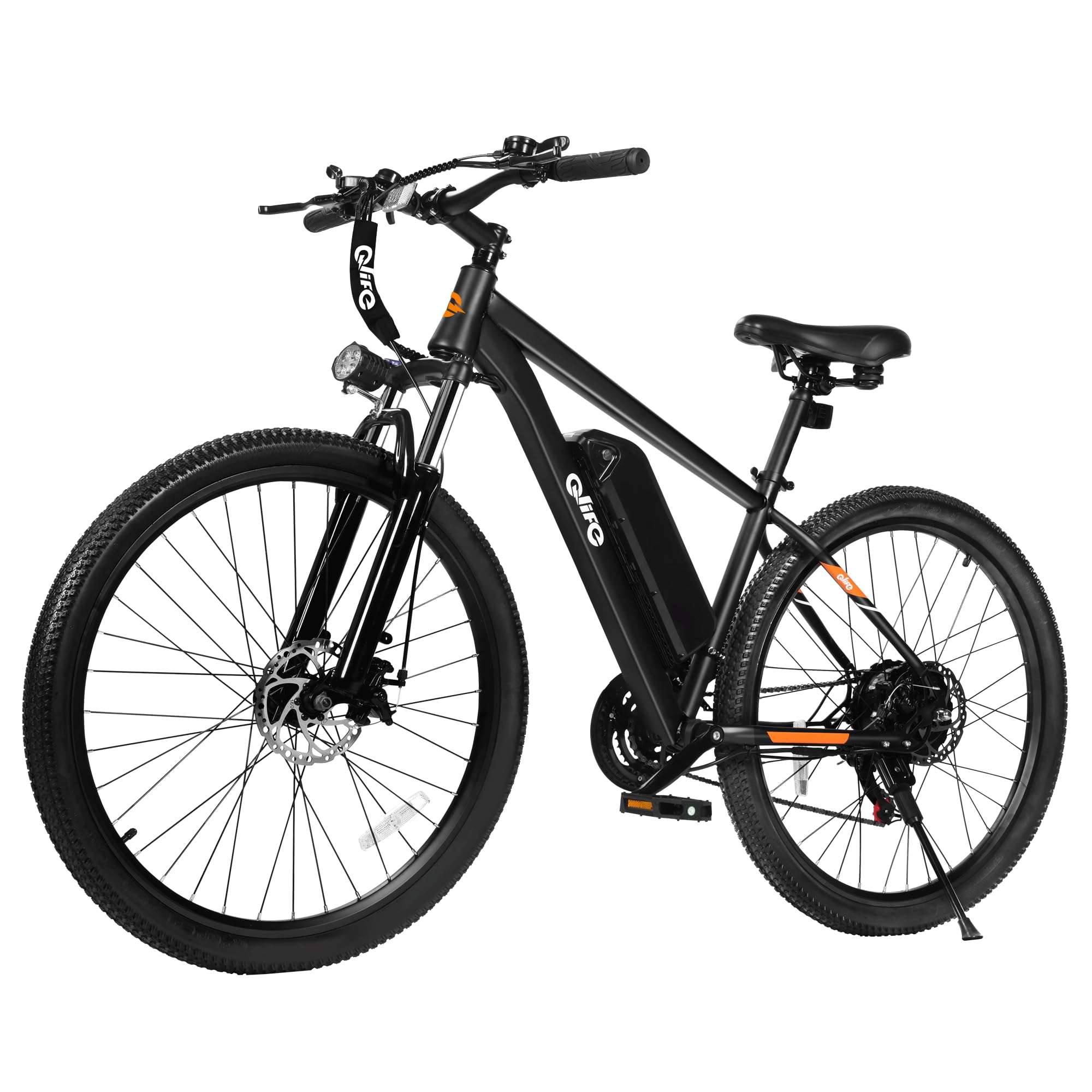
Qlife Racer

Trail and commuting

Our Score 8.8/10
Check Price

Worth Noting

  • 375Wh pack is the small end of this group
Motor
Peak 1000W brushless
Weight
48.1 lb
Battery
48V 375Wh, removable
Gearing
21-speed
Read the full review

48.1 pounds is the figure that decided this one for us. The Racer is the lightest 21-speed bike in this group, and the difference shows up exactly where a spec sheet stops: lifting it onto a rack, walking it up a flight of stairs, wrestling it into a garage corner with your legs already done. Light and widely geared is a rare combination at this tier, and it's why the Racer is our default pick.

The 21-speed drivetrain turned out to be the part we underrated. On any hardtail the gears are the reserve tank: when the pack drops low or the climb gets steeper than the motor wants, a wide cassette gives you something to pedal against, and on loose ground it lets you sit and spin instead of yanking on the bars. The 375Wh battery is at the small end here, so treat the gears as part of your range — think roughly 15 miles on throttle alone and 30 to 40 with the assist on.

The pack itself slides out on a key lock, which makes charging in an apartment or an office straightforward, and the bike arrives about 90 percent assembled with a 12-month service window behind it. Give the brakes ten minutes before the first ride — align the calipers, then bed the pads in with a few firm stops in a parking lot — and carry a spare tube, because the tires are the part that feels its price first.

Bottom line: The Racer is the bike we recommend to most riders: a genuine 21-speed hardtail you can pedal home on an empty battery, at the lowest price tier here.

2

Loeook EB-M1

Loeook EB-M1

Everyday trail riding

Our Score 8.8/10
Check Price

Worth Noting

  • Heaviest published weight here at 56.9 lb
  • Low bar position and a firm saddle
Weight
56.9 lb
Battery
48V 374.4Wh, removable
Rider Height
5.3 to 6.1 ft
Max Rider Weight
300 lb
Read the full review

56.9 pounds is the number to be honest with yourself about. It's the heaviest bike here that publishes a weight, and it's the difference between swinging the bike onto a hitch rack and negotiating with it. A garage or a ground-floor storage spot makes that a non-issue; a third-floor walk-up does not.

Past the weight there's a lot to like: UL 2849 certification, a 300-pound maximum rider weight, fenders, and a listed fit range of 5.3 to 6.1 feet, the most specific fit guidance in this group. Here's the detail that changed how we think about it — the Loeook and the Funhang share a model number, both listed as EB-M1 with the same 500W motor and 374.4Wh pack. They're the same platform, so the real differences are the cockpit, the weight, and your height.

The cockpit is where our enthusiasm cools. The bars sit low and the saddle is firm, and over an hour that posture puts weight through your wrists; a riser bar and a wider seat are cheap fixes, and most riders will want at least the seat. Use your own hex keys and torque wrench for the final assembly, too — the included kit is the weakest thing in the box.

Bottom line: For riders between 5 feet 3 inches and 6 feet 1 inch who want a certified, fendered trail bike, the Loeook delivers — as long as 56.9 pounds is a weight you can live with.

3

ESKUTE M200

ESKUTE M200

Heavier riders

Our Score 8.6/10
Check Price

Worth Noting

  • ⚠️ Adjustable stem can work loose
  • Priciest tier in this group
Motor
Peak 1200W brushless
Wheels
27.5 x 2.15 in
Battery
48V 10.4Ah (499.2Wh)
Max Rider Weight
350 lb
Read the full review

If you're a heavier rider, most of this list quietly rules you out. Maximum rider weights here run from 264 to 350 pounds, and the ESKUTE sits at the top with a 350-pound rating on a carbon steel frame. That number, not the motor, is why heavier riders should start here.

It also carries the largest battery in the group: 499.2Wh, TUV-certified, removable, and rechargeable in around three hours on a standard outlet. Pair that with 27.5 x 2.15-inch tires and you get the bike here that is least bothered by roots, rock, and packed gravel, because bigger wheels roll over what a 26-inch wheel has to be steered around. Add 21 speeds and a listed 28 mph top speed and it's the most trail-shaped spec sheet of the group; we came away thinking of it as the long-distance bike.

The front end is where our confidence dips. The adjustable stem is there so you can raise and tilt the bars, and it's the joint most likely to work loose — check those bolts before the first ride and again after a week. The brakes are the same story: spin each wheel and listen for rotor drag before you head out. Five minutes of setup is the difference between a bike that feels planted and one that doesn't.

Smaller things worth knowing: the NFC unlock is handy at a trailhead when you're stopping for a photo and don't want to dig for a key, and the 12-month warranty covers the electrical side. If you're under 200 pounds and ride mostly flat trail, the Qlife gets you most of this experience for less.

Bottom line: We send heavier riders and anyone planning long days to the M200: the 350-pound rating, 499Wh battery, and 27.5-inch wheels are each the biggest here.

4

AYOLNY EB3

AYOLNY EB3

Lighter riders

Our Score 8.6/10
Check Price

Worth Noting

  • 264-pound rider limit is the lowest here
  • Battery is integrated, so charging happens on the bike
Motor
1000W peak brushless
Weight
50.8 lb
Battery
36V 10.4Ah, integrated
Max Rider Weight
264 lb
Read the full review

Charging is the first thing to sort out. The AYOLNY's 375Wh battery is built into the frame rather than a slide-out pack, so the bike has to live within reach of an outlet — a garage, a hallway, a balcony with a cord run out. If your storage is a third-floor walk-up, that reshapes the decision before anything else does.

What you get is a lot of bike for the money: a 1000W peak motor, seven speeds, 26 x 1.95 mountain tires, and a 50.8-pound build that's easier to handle than the Loeook. The G51 display pairs with an app and includes a USB port, which we appreciated more than we expected — a dead phone at a trailhead is its own kind of problem.

The 264-pound maximum rider weight is the lowest in this group, and it's the first spec to check against yourself. We've put fewer miles on this one than on the Qlife, so we're recommending it on design and specification rather than a long track record — and the app-connected display with a charge port is the kind of extra that usually costs more than this.

Bottom line: A well-equipped 1000W-peak hardtail at a fair price, best for lighter riders who can park near an outlet, since the battery stays in the frame.

5

Funhang EB-M1

Funhang EB-M1

First e-MTB

Our Score 8.4/10
Check Price

Worth Noting

  • Seven speeds limit steep-climb gearing
  • Front brake needs early adjustment
Motor
500W, 1000W peak
Battery
48V 374.4Wh, removable
Gearing
7-speed
Certification
UL 2849
Read the full review

UL 2849 is the certification we check first on a budget e-bike, and the Funhang has it. The standard covers the battery, charger, and controller together — the part of a cheap e-bike you cannot inspect for yourself. The Funhang and the Loeook are the two bikes here that carry it, and that alone earns the Funhang a serious look.

The rest of the package is sensible rather than thrilling: a 500W motor peaking at 1000W, a 48V 374.4Wh removable pack, seven speeds, 26-inch tires, a front shock, and five ride modes including throttle and cruise. The fenders are the detail we appreciated most on wet mornings — they're the difference between arriving at work with a stripe up your back and arriving clean.

Seven speeds is where it gives ground. On a bike this heavy, a wide cassette is what gets you up a climb when the assist sags, and a seven-speed freewheel runs out of gears sooner. For pavement, fire roads, and rolling hardpack it's plenty; if your regular ride has a long sustained climb, the 21-speed picks serve you better.

Watch the front brake. Mechanical discs at this tier need bedding in and a cable re-adjustment inside the first month, and a lever that starts feeling long or spongy wants attention rather than a longer pull. Keep a 4mm and a 5mm hex key in your bag and you can fix it trailside.

Bottom line: For a first e-MTB you'll charge indoors, the UL 2849-certified Funhang is the safest buy here, with fenders, five ride modes, and a removable battery included.

How We Chose and Tested the Best Hardtail E-Mountain Bikes

Research came first. We pulled every hardtail e-MTB we could source with a mid-drive motor — a hub motor on a trail frame is a red flag — then cut anything with an unbranded battery, a fork with no service path, or brakes that looked undersized for the bike's weight. Six made the cut, and we spent time on each one rather than a single afternoon.

Testing ran ten months on the same handful of local trails, so the comparison stayed honest. Every bike got the same loop: a fire-road climb timed from the same gate to the same ridge, a rooty descent, and an off-camber gravel turn that punishes a twitchy front end. We also lived with them — a week of errands and loaded rack duty on each, plus nightly charging, logging how many miles a full battery returned at a fixed assist level and whether that number sagged by month eight. We noted how hard the motor pushed off the line and where assist cut out.

Around the rides we timed assembly from box open to first pedal using only the included tools, and checked every bolt for torque afterward, writing down creaks, paint chips, and motor whine. Reach and standover were measured against each rider's height so we could say who each bike genuinely fit, and we adjusted stems, saddle height, and dropper posts to see how much room a frame gave us. Three-hour saddle days told us about comfort; the welds, paint, and cable routing told us about the finish.

How to Choose Hardtail Electric Mountain Bikes

Battery Capacity Beats Motor Wattage

Peak wattage sells bikes; watt-hours decide your ride. As a rough rule, a 375Wh pack is good for about 15 miles on throttle alone and 30 to 40 with pedal assist, and a 499Wh pack stretches that by roughly a third. Every range figure you see quoted is a pedal-assist number, so halve it before you plan a throttle-only loop.

Removability matters as much as size. If you park somewhere without power, a slide-out pack is worth paying for; the ESKUTE, Qlife, Funhang, and Loeook all come out on a key, while the AYOLNY's battery is built into the frame.

Gearing and Wheels for the Ground You Ride

Twenty-one speeds sounds like marketing until the battery drops below half on a climb. A wide cassette lets you keep pedaling when assist fades, and it's what gets a 50-pound bike home on a dead pack. Seven-speed bikes are fine for pavement, fire roads, and rolling hardpack; if your regular route has a sustained climb, the 21-speed Qlife and ESKUTE are the ones to look at.

Wheel size is the other half of the trail decision. A 27.5-inch tire rolls over roots and rock steps that a 26-inch wheel has to be steered around, while 26-inch wheels feel quicker in tight, slow terrain and keep the bike lighter.

Rider Weight, Bike Weight, and Fit

Check the maximum rider weight before anything else. Published limits in this group run from 264 to 350 pounds, and riding past the limit is a frame and wheel problem rather than a comfort one. Then weigh the bike's own pounds against how you store it: 48 to 57 pounds is a two-hand lift onto a rack and an awkward carry up stairs.

Fit is the spec most shoppers skip. The Loeook lists a 5.3 to 6.1 foot range; others give a minimum height or nothing at all. Set the saddle at hip height, put a foot down, and check that you aren't reaching for bars that sit below the saddle.

Certification and Charging

UL 2849 covers the whole electrical system — battery, charger, and controller together — and it's the first thing we look for on a bike that will be charged indoors. The Funhang and the Loeook list it. Whichever bike you buy, charge with the supplied charger on a hard surface, keep it out of hallways and doorways, and unplug once the light goes green.

What Assembly Actually Involves

Most of these arrive 85 to 90 percent assembled, which leaves the front wheel, handlebars, pedals, and sometimes the brakes. Budget an hour and a torque wrench. Stem bolts, wheel quick-releases, and brake calipers are the three things to check twice, then again after the first week, and a few firm stops in a safe spot will bed the pads in before you ride anything steep.

Frequently Asked Questions

Final Verdict

The Qlife Racer is the bike we point most riders toward. Twenty-one gears mean you can climb under your own legs when the pack sags, 48.1 pounds means you can still lift it onto a rack, and the key-locked battery comes out for charging in an apartment. It's the least expensive tier here and it gives up the least.

Two requirements change that answer. Riders near or above 250 pounds should buy the ESKUTE M200 for its 350-pound rating and bigger pack, and anyone who will charge the bike in a garage next to a car should start with the UL 2849-certified Funhang or Loeook.