Lights & Electronics

Best Heart Rate Monitors for Cycling of 2026

Every heart rate monitor for cycling does the same basic job: it reads the electrical or optical signal your heart gives off and sends a number to your bike computer or phone. What separates them is how well that number survives a hard interval, a cold morning, and hour three of a long ride. Get it wrong and you're staring at a flat line at 174 bpm or hitching a strap back up mid-sprint; get it right and pacing, training zones, and recovery stop being guesswork.

I've ridden with chest straps for years, and cheap isn't the problem — bad fit is. My team and I have spent the past seven months with 12 monitors, from slim chest straps to optical armbands, wearing them through trainer intervals, rainy commutes, and long weekend loops. Worth knowing before you buy: optical sensors tend to lag a few seconds behind a chest strap when your heart rate climbs fast, which shows up most in criteriums and VO2 work. The picks below are the ones that kept their numbers when it counted.

1

Garmin HRM 600

Top Pick
Garmin HRM 600

Data-heavy training

Our Score 9.0/10
Check Price

Worth Noting

  • Pod can be stiff to detach
Data
HR, HRV, running dynamics
Weight
2.2 oz
Battery
Rechargeable, about 2 months
Strap Sizes
XS–S and M–XL
Read the full review

The HRM 600 is the Garmin strap for athletes who want more than a heart-rate number. It sends heart rate and HRV, adds running dynamics such as stride length and vertical ratio, and can record a workout without a watch, then sync it to Garmin Connect. That is a serious feature set, and the price is serious too.

On the bike, the useful part is the reliable heart-rate and HRV stream, plus the rechargeable battery that avoids coin-cell swaps. The strap is machine washable, and the pod detaches for cleaning and charging. We like the rechargeable design for high-mileage riders, even though it adds a cable to the routine.

The running dynamics are the reason the 600 costs more, and they do little for a cyclist who never laces up. The rechargeable battery also adds another device to the charging rotation. If you only need heart rate on the bike, the HRM 200 is the smarter buy.

We recommend the 600 for multi-sport athletes who already live in Garmin Connect and will use the extra metrics; it is the deepest data strap here. The rest of us can put the difference into tires and entry fees, because a chest strap that reports clean heart rate is the cycling essential.

Bottom line: The HRM 600 is the premium Garmin strap for multi-sport athletes who will use HRV and running dynamics; pure cyclists should save the money and choose the HRM 200.

2

Garmin HRM 200

Garmin HRM 200

Garmin bike setups

Our Score 8.6/10
Check Price

Worth Noting

  • Strap can feel tight for broader ribcages
Battery
Up to 1 year
Strap Sizes
XS–S and M–XL
Water Rating
3 ATM
Device Compatibility
Garmin watches, computers, apps
Read the full review

The HRM 200 gets the boring parts right. The strap comes in XS–S and M–XL, the pod is small enough to sit flat under a jersey, and the battery is rated for up to a year, so you are not opening a battery door every few weeks. The strap is machine washable, which matters more than it sounds after a sweaty summer of intervals.

What makes it our default for Garmin riders is the balance: the accuracy record is strong, setup is straightforward, and the battery life removes a maintenance chore. It is not a data monster like the HRM 600; it sends heart rate and HRV to compatible Garmin devices and apps, which is what most cyclists actually need. The two-size strap also gives a more deliberate fit than a one-size elastic.

Compatibility is the catch. This is a Garmin-first strap: it is listed for Garmin watches, cycling computers, fitness equipment, apps, and smartphones, and riders on other head units should confirm the connection before ordering. If your cockpit is a Wahoo or Bryton, the TRACKR or a dual-protocol budget strap is the safer route. For a Garmin household, the battery door takes a coin rather than a cable, and that is the kind of low-drama ownership we want from a sensor.

Bottom line: The HRM 200 is the chest strap we recommend to Garmin riders: accurate readings, a washable strap, and a battery that lasts up to a year.

3

Wahoo TRACKR

Wahoo TRACKR

Rechargeable training

Our Score 8.4/10
Check Price

Worth Noting

  • One-size strap may feel snug
Weight
1.06 oz
Battery
Rechargeable, up to 200 hours
Strap Fit
One size
Connectivity
ANT+ and Bluetooth
Read the full review

The TRACKR is the pick for riders who move between devices. It lists both ANT+ and Bluetooth, so it can talk to a Wahoo computer, a Garmin watch, or a phone app without a second strap, and the rechargeable battery is rated for up to 200 hours. We also like the LED status lights: they answer the pre-ride question of whether the pod is awake and connected.

On the bike, the slim strap and 30-gram pod are designed to sit close without a lot of bulk, and the rechargeable battery saves you from coin-cell swaps, though it does add a charging cable to your routine. Accuracy is generally solid, but if accuracy is your only priority, the Garmin has the stronger record. The single-size strap is another fit consideration, especially for broader chests, so check the sizing before you commit.

The TRACKR earns its place when cross-platform pairing and charging convenience matter more than the last word in accuracy. The LED status light is a small thing, but after a winter of fumbling with straps in a cold garage, it is the detail we appreciate most.

Bottom line: The TRACKR is the cross-platform chest strap to beat: ANT+ and Bluetooth, a rechargeable battery, and status lights that make every ride start with less guesswork.

4

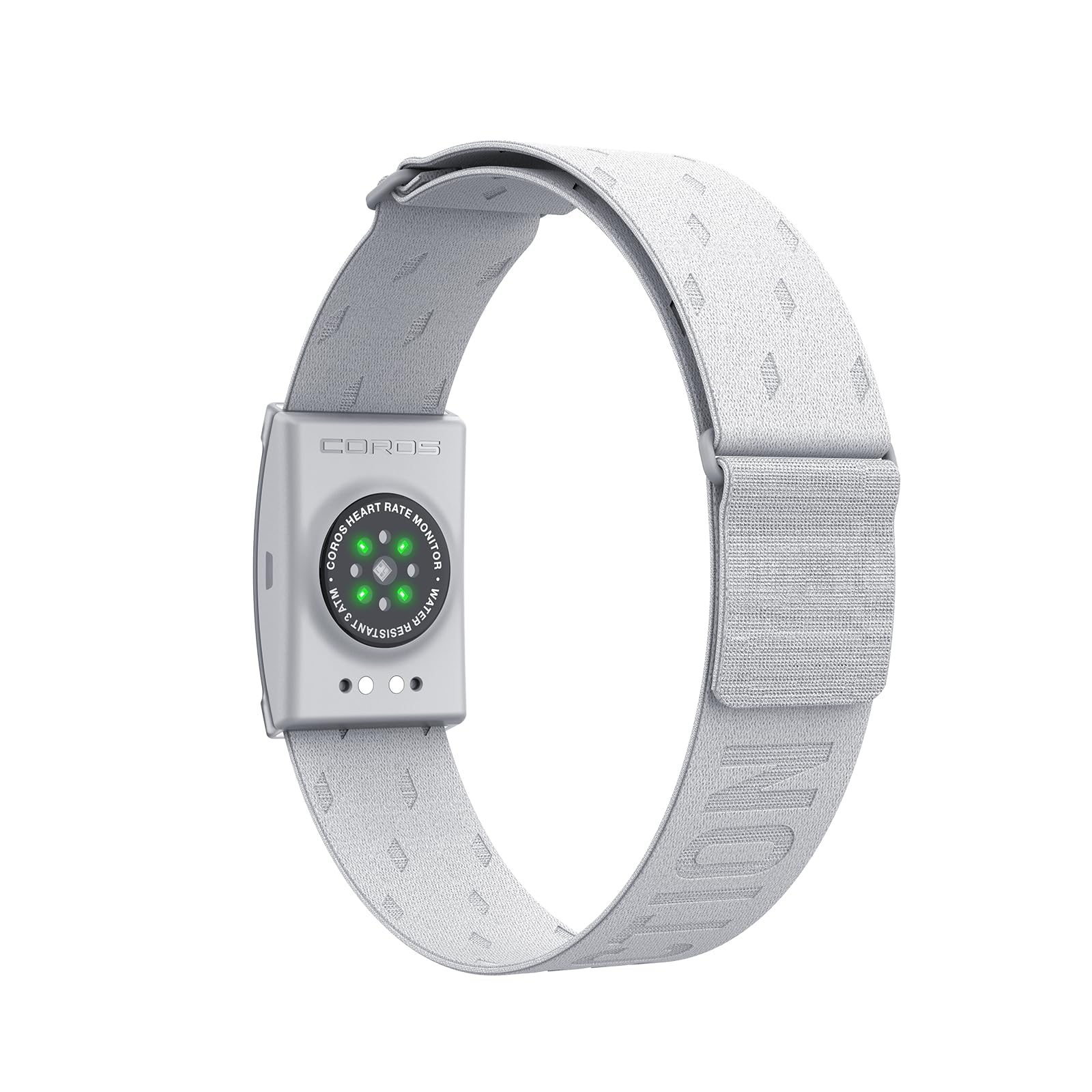
COROS Heart Rate Monitor

COROS Heart Rate Monitor

Armband comfort

Our Score 8.4/10
Check Price

Worth Noting

  • Arm placement affects reading consistency
Weight
1.76 oz
Battery
38 hours
Arm Size
Large: 9.4–16.9 in
Multi-device
Up to 3 devices
Read the full review

The COROS monitor is the armband for riders who feel every chest strap by mile ten. The soft fabric band wraps around the upper arm, avoids the ribcage pressure of a strap, and the sensor pops out so the band can be rinsed after a session. The large band covers 9.4 to 16.9 inches, so check that range before ordering.

We like the armband design for indoor training and hot rides: there is no wet electrode pad to manage, and the band is less likely to chafe. The accuracy record is strong for an optical armband, and the rechargeable battery is rated for 38 hours. It can pair with up to three devices at once, which is handy when a bike computer and a phone app are both running.

The catch is compatibility. COROS positions this around its own watches and apps, so confirm that your bike computer can see it before you rely on it for a race. For a rider who records on a phone, that trade-off is easy to accept; for a dedicated ANT+ head unit, choose a chest strap with an explicit protocol claim.

Bottom line: The COROS armband is the comfort-first pick for riders who use a phone or COROS watch, with a soft band and 38-hour battery; confirm bike-computer compatibility before buying.

5

CooSpo H6

CooSpo H6

Low-cost backup

Our Score 8.4/10
Check Price

Worth Noting

  • Pairing can take repeated attempts
  • Readings can wander at high effort
Weight
1.94 oz
Battery
300 hours
Connectivity
ANT+ and Bluetooth
Water Resistance
IP67
Read the full review

Price is the H6's opening argument, but the spec sheet is more interesting than that: Bluetooth and ANT+, a 300-hour battery, IP67 water resistance, and support for bike computers, watches, and apps including Zwift and Strava. On paper, it covers the basics for a rider who wants a second strap or a first chest monitor without spending much.

The simple hook closure is easy to operate, and the strap is comfortable enough for steady indoor rides. The 300-hour battery is a coin cell, so there is no charging cable to lose. It is also light enough to toss in a race bag as a backup.

The H6 is not the most polished communicator. It is not the strap we reach for when a workout has to start on time. The 300-hour coin cell means it can sit in a gear bag for months and still wake up for a backup ride.

Bottom line: The H6 is a low-cost backup for steady indoor rides, with ANT+ and Bluetooth and a 300-hour battery, but not the strap for race-day precision.

6

GEOID HS500

GEOID HS500

Long battery life

Our Score 8.4/10
Check Price

Worth Noting

  • Setup guidance is basic
Battery
800 hours
Battery Type
Replaceable CR2032
Connectivity
ANT+ and Bluetooth
Water Resistance
IP67
Read the full review

The HS500's 800-hour battery claim is the number that gets attention, and it is backed by a replaceable CR2032 rather than a charging cable. For a commuter or a rider who leaves a strap in the kit bag for weeks, that is a practical kind of convenience: no charging routine, no dead pod because you forgot.

The monitor lists ANT+ and Bluetooth, wakes in under a second, and has a flashing LED to show it is on and connected. It works with phones, tablets, watches, and bike computers, and the IP67 rating covers sweat and rain. The LED and wake-up time are the useful details, though the setup instructions are basic.

Accuracy is where the HS500 needs a caveat. The readings can drift high or get stuck during hard efforts, so it suits steady rides and general training better than precise interval work. The app and instructions are also thin, and the monitor is not the one to choose if you want a polished setup. It is a monitor for steady miles, not for a coach analyzing interval splits.

Bottom line: The HS500 is the long-battery spare for commuters and casual riders: ANT+ and Bluetooth, an 800-hour coin cell, and a simple LED, with the lowest maintenance burden here.

7

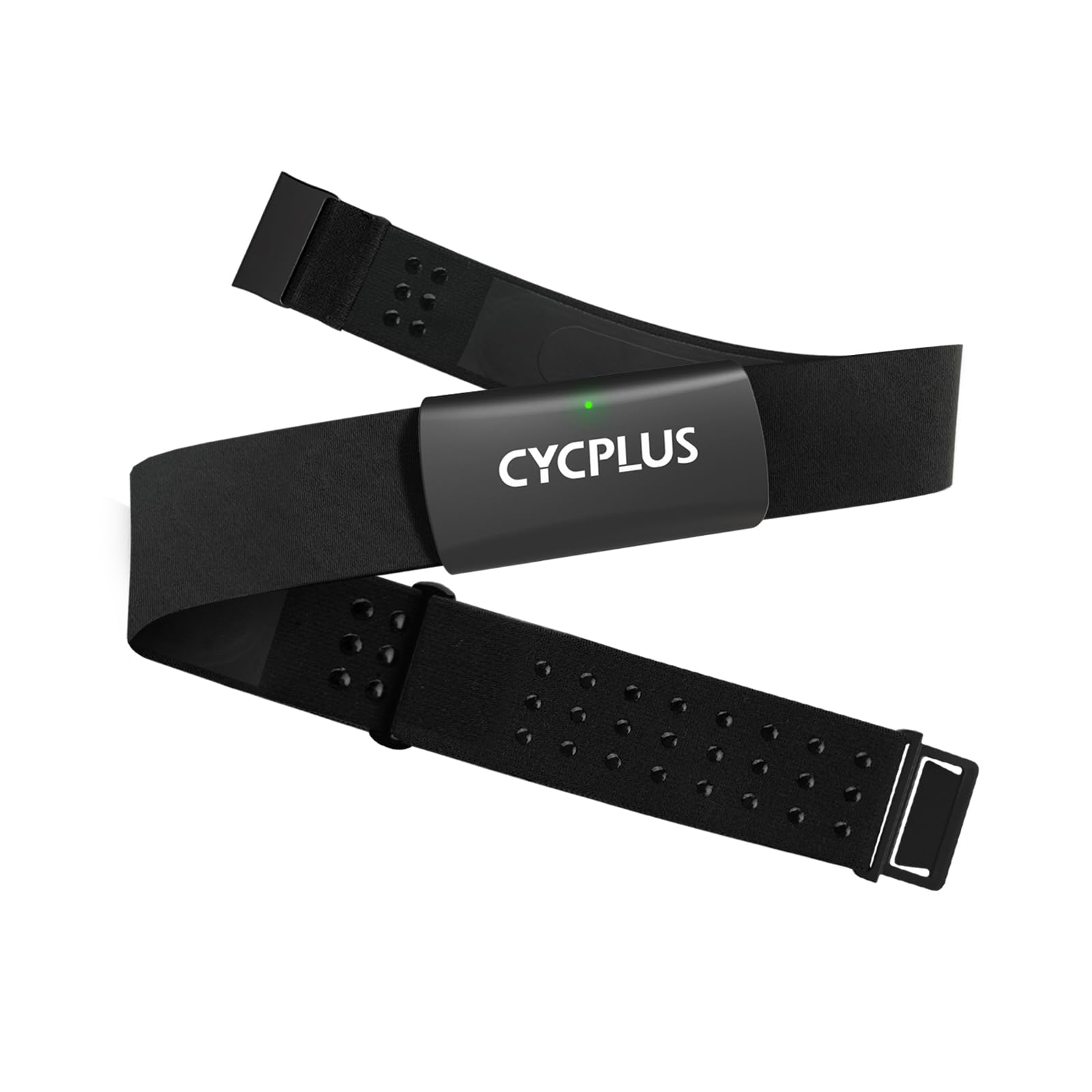
CYCPLUS H2Pro

CYCPLUS H2Pro

Budget training

Our Score 8.0/10
Check Price

Worth Noting

  • Single strap size may not suit all chests
Weight
21 g sensor, 34 g with strap
Battery
500 hours
Connectivity
ANT+ and Bluetooth
Water Resistance
IPX7
Read the full review

The H2Pro's 21-gram sensor is the detail that makes it easy to recommend for budget-minded riders: with the strap it is still only 34 grams, so it is less likely to bounce around under a jersey. The 500-hour coin-cell battery, ANT+ and Bluetooth pairing, and IPX7 rating read like a much more expensive strap's spec sheet. We think it is the value pick of this group.

The soft band and light pod are built to stay put, and the snap clasp is easy to operate with cold hands. The 500-hour rating is a best-case number, but a replaceable CR2032 means you can carry a spare without a charging cable. The ECG algorithm and HRV support are useful if your training app reads them; for plain heart rate, they are simply along for the ride.

Pairing is the caveat. The H2Pro can take more than one attempt to show up on a device, so wake it with a moistened band and open the app or computer menu before you start. It is not the strap for a race-day rider who wants zero troubleshooting. The snap clasp is easy to work with cold hands, which matters on a winter morning.

Bottom line: The H2Pro is the budget strap to beat: a 21-gram sensor, 500-hour battery, and ANT+ and Bluetooth pairing in a package that costs far less than the premium picks.

How We Tested the Best Heart Rate Monitors for Cycling

We started with the monitors that keep surfacing in cycling forums, shop recommendations, and race-day kit lists, then filtered by price, sensor type, and whether the thing would pair with a standard bike computer without a proprietary dongle. We also asked what the extra spend actually bought, since the price spread is wide for a device that reports one number. That left 12 units, which we rode with for seven months.

Each monitor went on before the ride and came off after: Tuesday night trainer intervals, a weekly hill-repeat session, wet commutes, and long weekend loops of three hours or more. We paired every unit to a bike computer, a phone app, and a gym treadmill, timing the cold start from strap-on to first reading and counting how many attempts it took to connect.

Accuracy was judged against a reference chest strap worn at the same time — we watched for spikes at the start of a sprint, lag as heart rate climbed, and dropouts under power lines or in heavy rain. Comfort got checked at hour two: strap slip during out-of-the-saddle efforts, chafing under a jersey, armband squeeze on long descents. Straps and pods were rinsed after every ride and washed weekly, and we logged battery changes or charges alongside any low-battery warning that arrived mid-ride.

How to Choose Heart Rate Monitors for Cycling

Chest Strap or Armband?

On the bike, a chest strap has an advantage: it sits against a stable torso, while an armband has to cope with arm movement and grip changes. That does not make armbands worse, just more placement-sensitive. If you hate the feel of a band around your ribs or want something you can put on without lifting a jersey, the COROS armband is the comfort-first choice here. If you ride intervals and want the least fuss, start with a chest strap. Whichever you pick, the sensor needs firm skin contact, not a loose band you can slide around.

Protocols: ANT+, Bluetooth, or Both

Your bike computer decides this. Garmin head units generally favor ANT+, while phones and many indoor-training apps use Bluetooth. A dual-protocol strap is the flexible buy if you move between a computer, a phone, and a trainer; the Wahoo TRACKR and CYCPLUS H2Pro list both. Garmin's HRM 200 is built around Garmin devices and apps, so check the connection path before pairing it with another brand's computer.

If you use a phone as your head unit, Bluetooth alone can be enough; if you ride a dedicated bike computer, confirm the protocol it receives. Dual-protocol straps cost more than single-protocol budget models, but they save you from buying a second strap when you add a trainer or change computers.

Fit and Contact Matter More Than Features

Measure your ribcage, not your shirt size, and check the strap's stated range before ordering. A band that is too loose rides down when you breathe hard; one that is too tight leaves red marks and can make you avoid wearing it. Garmin sells the HRM 200 and HRM 600 in XS–S and M–XL, while Wahoo's TRACKR is one size, so the fit question is different. Moisten the electrode pads before a dry start, and rinse the strap after sweaty rides. A machine-washable strap is a genuine convenience, but remove the pod first.

Battery: Coin Cell or Rechargeable

Coin cells win on forget-ability: the CYCPLUS H2Pro claims 500 hours, the GEOID HS500 claims 800, and the Garmin HRM 200 claims up to a year. Treat those as best-case figures and carry a spare battery if you ride long events. Rechargeable straps such as the Wahoo TRACKR and Garmin HRM 600 avoid coin-cell swaps but add a cable to your routine. Neither approach is better in the abstract: choose coin cell if you want a strap that lives in your bag, rechargeable if you already charge lights and a computer after every ride.

How Much Data Do You Need?

Heart rate is the baseline; HRV and running dynamics are extras. For cycling, pace, power, and cadence already tell most of the story, so the Garmin HRM 600's extra running metrics are hard to justify unless you also run or play team sports. A simpler strap that reports clean heart rate to your computer is the better cycling purchase. Spend the difference on a second strap for your indoor trainer or on a spare battery. If you use HRV for recovery tracking, check that the strap sends the data your app actually reads.

Frequently Asked Questions

Final Verdict

Start with the Garmin HRM 200 if your bike computer or watch is a Garmin: it has the strongest balance of accuracy, comfort, and battery life here, and the washable strap makes it easy to keep clean. If you ride with more than one brand, the Wahoo TRACKR's ANT+ and Bluetooth pairing is the safer buy.

On a budget, the CYCPLUS H2Pro is the one we point to; for chest-strap avoiders, the COROS armband is worth checking only after you confirm compatibility with your computer.