Bikes

Best Hybrid Bikes of 2026

A hybrid bike is a compromise on paper: not as fast as a road bike, not as sure-footed as a mountain bike. In practice, that middle ground is exactly what most riders need for commuting, errands, and weekend path rides — provided the frame fits and the build holds up. I learned that with a borrowed bike a size too small; my knees ached for a week, and no amount of tuning fixed it. The right hybrid makes a normal trip feel easier and more reliable.

Over six months, we rode ten hybrid bikes through morning commutes, grocery runs, and longer weekend loops. We paid attention to ride quality and performance, but also to the less glamorous stuff: how each bike assembled, whether the fit could be adjusted for different riders, and how it held up after repeated lock-ups and curb hops. Appearance matters too — you are more likely to ride a bike you like looking at. The picks below are the ones that felt solid, shifted cleanly, and made me want to keep riding.

1

Schwinn Discover

Top Pick
Schwinn Discover

Commuting and fitness

Our Score 8.6/10
Check Price

Worth Noting

  • Brake and derailleur setup can need a shop
  • 250-pound maximum rider weight
Frame
Aluminum, 17-inch step-through
Brakes
Alloy linear pull
Gearing
21-speed twist shift
Fits Riders
5'5" to 5'9"
Read the full review

Plenty of hybrids get bought for a commute that quietly turns into a weekend path ride. The Discover is the bike we hand to that rider: 21 speeds, a front suspension fork, and a step-through frame you can swing a leg over with a bag on your shoulder. The riding position is upright enough to keep your neck happy in traffic, and the adjustable-rise stem lets you tilt the bars toward wherever your hands want them.

This is the pick we keep coming back to for a first hybrid, because nothing on it is a gimmick. Twenty-one gears is the real separator from the seven-speed bikes in this group: on a bridge, into a headwind, or with a rack loaded, the smaller steps between gears are what keep you pedaling instead of walking. It rolls smoothly on paved paths, and the white step-through frame is the one of the three that people notice.

At 35.5 pounds it's a bike that prefers a hallway to a third-floor walk-up, and the listed fit range of 5'5" to 5'9" is worth taking literally — at the bottom of it the seat post sits near its limit.

Comfort is where this bike is most likely to disappoint: the saddle suits short rides better than long ones, and a wider replacement turns it into an all-day rider for about the price of a tune-up.

Bottom line: Our pick for most riders: 21 gears and a suspension fork cover hills and rough pavement, and the step-through frame makes a loaded commute easy. Budget for a shop check in week one.

2

Viribus Hybrid Bike

Viribus Hybrid Bike

Budget commutes

Our Score 8.2/10
Check Price

Worth Noting

  • One size, listed for 5'3" to 5'9"
Frame
Aluminum, size M
Brakes
Dual disc
Gearing
7-speed thumb shift
Rider Weight Limit
330 lb
Read the full review

The Viribus is the least expensive bike here by a clear margin, and it's the one we point at when the budget is fixed and the alternative is a used bike of unknown history. Aluminum frame, dual disc brakes, 700c wheels, and an IPX4 front light — that's not the combination we expected to find at the bottom of the price range.

Assembly is where it earns goodwill. Eighty-five percent arrives done, and the box includes the hex keys, a pedal wrench, and a screwdriver, so the last stretch doesn't stall because you're missing a 5mm Allen key. The frame is corrosion-resistant aluminum rather than steel, which matters if the bike lives outside or gets ridden through a wet winter.

The front disc brake is the one place to slow down and get it right. A rotor that isn't sitting square in the caliper rubs, drags, and makes the whole bike feel slower than it is, and that alignment can be a fight on a bike that ships in a box. If you're not confident setting pad clearance, hand that job to a shop before the first real ride — it's a quick job for anyone who does it every week.

The light is a small thing that saves an errand, and IPX4 means it shrugs off splashes rather than a downpour, which covers most commutes.

Bottom line: Buy this one if the budget is fixed and you're between 5'3" and 5'9": aluminum, disc brakes, and a 330-pound rider limit for the least money here.

3

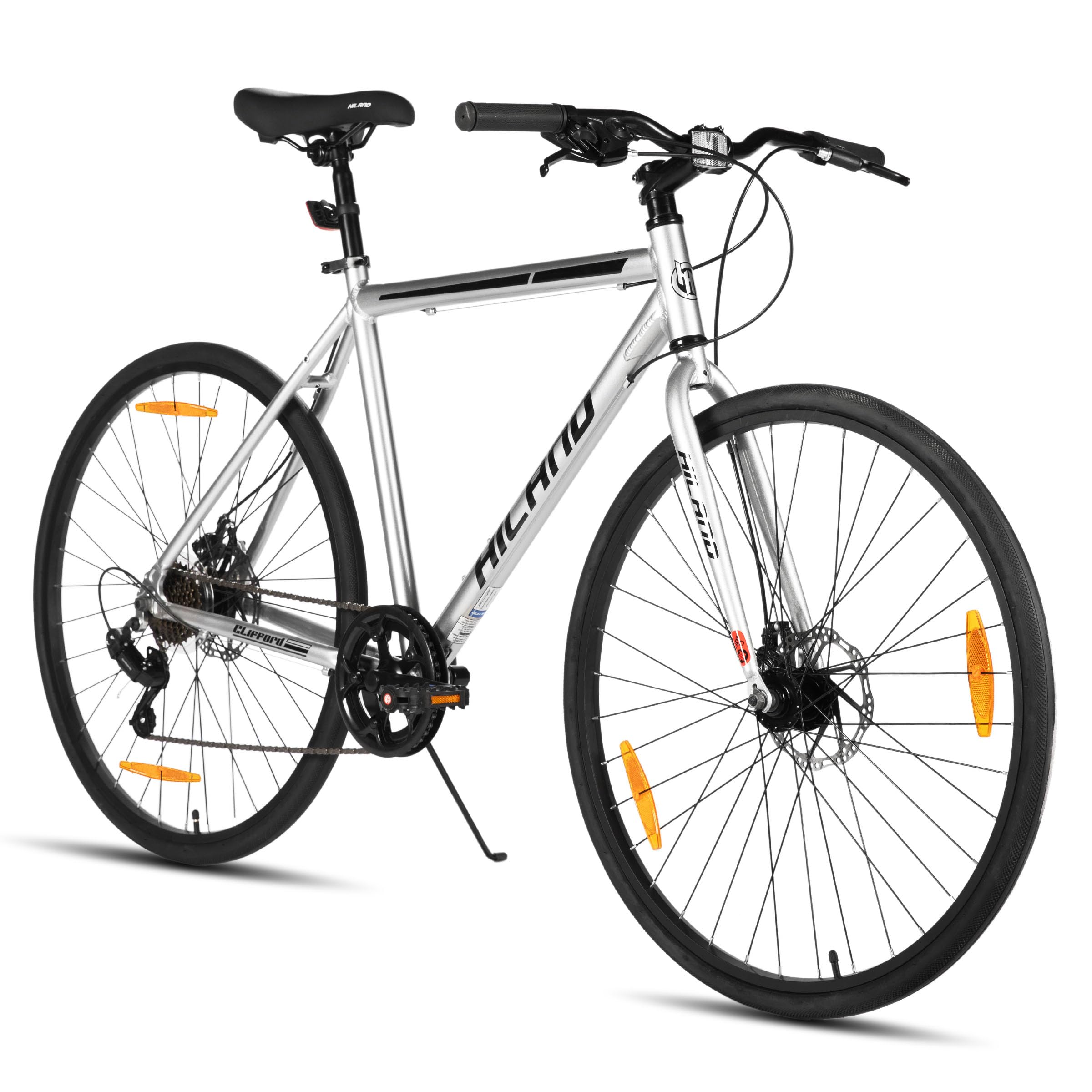
Hiland 700C Hybrid

Hiland 700C Hybrid

Taller riders

Our Score 8.0/10
Check Price

Worth Noting

  • Seven speeds run short on steep, loaded climbs
Brakes
Dual disc
Gearing
7-speed thumb shift
Assembly
90% pre-assembled
Frame Sizes
53cm M and 57cm L
Read the full review

If you're six foot one or taller, most of this group runs out of frame before you run out of leg. The Hiland doesn't: it comes as a 53cm M published for 5'9" to 6'1" and a 57cm L that picks up from there, which makes it the only bike here that a genuinely tall rider can set up properly.

Ninety percent assembled is the other number that matters, and it goes together without drama — pedals and tools are in the box, and the last few bolts are the whole job. What we appreciate most is that the money went into the frame and the brakes rather than the badge: aluminum, dual disc brakes, and a one-year manufacturer warranty.

The fork is rigid, so coarse chip-seal pavement comes up through the bars in a way the suspended Discover absorbs. On smooth city asphalt you won't notice, and you get a lighter, simpler bike for it. One build detail to check before the first ride: the seat-post clamp can need a proper tool rather than fingers before it holds.

The warranty is the other thing to weigh — a year from Hiland against Schwinn's limited lifetime coverage on the Discover — which tells you something about how each brand expects the bike to be used.

Bottom line: Taller riders should start here: the L frame reaches past 6'1", the build is nearly done in the box, and dual disc brakes come standard.

How We Tested the Best Hybrid Bikes

We built the shortlist by comparing frame sizes and standover heights, gearing ranges, tire clearance, brake types, and how easy each bike would be to service. From that pool we narrowed to ten hybrid bikes that covered different fits, riding styles, and price bands, then rode them for six months. Assembly was timed and checked at the start: how long it took, whether the brakes and derailleurs needed adjustment out of the box, and how clear the instructions were.

For fit and adjustability, I had riders of different heights set the saddle and handlebars, then noted whether the reach felt cramped or stretched and whether the seatpost and stem offered enough range. On the road, we rode the same commute loop and a weekend path with pavement cracks, gravel patches, and a few curb transitions, paying attention to how the tires absorbed vibration, how stable the bike felt at low speed, and whether the gearing made short climbs manageable. We also loaded each bike with a commuter bag or grocery run to see how it handled weight and whether racks and fenders could be added without fuss.

Throughout, we checked build quality and durability: welds and joints, brake rub, cable stretch, and whether bolts stayed tight after repeated rides. We cleaned each bike and looked for paint chips or scuffs, because appearance is part of liking a bike enough to ride it daily. Reliability showed up in the small stuff — clean shifts under load, consistent braking in wet weather, and no mystery creaks after a few weeks. The bikes that rose to the top were the ones that needed the least fiddling and felt the same on month six as they did on the first ride.

How to Choose Hybrid Bikes

Size and standover come first

Every maker here publishes a rider-height range, and every one of those ranges is a starting point rather than an answer. The Schwinn Discover's 17-inch step-through is listed for 5'5" to 5'9", the Viribus for 5'3" to 5'9", and the Hiland splits its two frames at 6'1". What no chart tells you is whether you can stand flat-footed over the top tube with both feet down.

On a step-through that's easy. On a diamond frame, take the smaller size if you're between two, then raise the seat post rather than the handlebar. A bike you can hold at a red light without wobbling is a bike you'll actually ride.

Seven speeds or twenty-one

Seven gears cover a flat commute, particularly if you ride unloaded and don't cross a bridge twice a day. Twenty-one gives you a low gear for climbs and a taller one for descents and tailwinds, which is why the 21-speed Discover is our default for mixed terrain.

The trade-off is upkeep: a triple chainring adds a front derailleur and another cable to keep adjusted. If your route is genuinely flat, the seven-speed Viribus and Hiland are simpler things to own.

Disc brakes or linear pull

Disc brakes hold their stopping power more consistently in the wet and don't wear the rim, which is why both of our value picks use them. Linear-pull brakes are lighter, cheaper to service, and easy to adjust at home with a hex key.

Either is fine on a commuter; what matters is that the brake is right on day one. A rotor that isn't square in the caliper rubs and drags, and it's the first-week frustration on a boxed bike worth heading off before you ride in traffic.

Frame material, weight, and rider limits

Aluminum dominates at this price because it doesn't rust and it's light enough to carry upstairs. Weight still matters more than the number suggests: the Discover is 35.5 pounds, fine on the road and less fun on a third-floor walk-up. Check the maximum rider weight as carefully as the frame size — the Discover is rated to 250 pounds, the Viribus to 330. If you're anywhere near a limit, that decides the bike for you.

Assembly and the shop visit

Boxed hybrids arrive anywhere from 85% to 90% assembled, which sounds like a lot until you're setting brake pad clearance and indexing a derailleur. Bars, front wheel, pedals, and seat post are the usual remainder. Budget for a shop check in the first few weeks, once the cables have stretched; it costs far less than a bent derailleur hanger. If the bike will commute, confirm rack and fender mounts before you order rather than after.

Frequently Asked Questions

Final Verdict

The Schwinn Discover is the hybrid we recommend to most people. Twenty-one gears handle the hills, the suspension fork takes the edge off chipped pavement, and the step-through frame makes a loaded commute easier to manage. Nothing else here covers that much ground for a rider between 5'5" and 5'9".

Two riders should choose differently. If you're under 5'9" with a fixed budget, the Viribus gives you aluminum and disc brakes for the least money here. If you're over six feet, order the Hiland's large frame — it's the only one in this group that will set up properly.