Cycling Shoes

Best Indoor Cycling Shoes of 2026

The first time I traded sneakers for a real indoor cycling shoe, my foot stopped sliding before the warm-up ended and the pedal stroke felt rounder. That's what a stiff sole and a secure hold fix: they turn a wobbly spin session into actual training. But the wrong pair can pinch your toes, numb your feet, or fight you every time you clip in. Over eight months, I rode 12 pairs through studio classes and my living room bike, and the differences came down to fit, straps, and pedal connection.

Comfort is the first thing you'll notice or curse, so I paid attention to toe box room, heel lift, and whether the sole flexed under hard efforts. Ease of use matters too: a strap you can tighten mid-climb without looking down beats a fancy dial that jams. I also weighed appearance and value, because a scuffed shoe that feels good after months is a better buy than a pretty one that falls apart. The picks below are sorted by what each pair does best, whether you're clipping in for the first time or upgrading a worn-out pair.

1

TIEM Slipstream

Top Pick
TIEM Slipstream

Spin studio classes

Our Score 9.2/10
Check Price

Worth Noting

  • SPD cleats only, no Look Delta option
Style
Sneaker-like low top
Sizing
Women's
Cleat Type
SPD (2-bolt)
Read the full review

The walk from the locker room to the bike is where most cycling shoes embarrass themselves, and it's the first thing the Slipstream fixes. The sole is walkable enough to cross a gym floor without the heel-down waddle, and the upper looks like a low-top sneaker rather than a race shoe — a detail that matters if you're changing at the studio and heading straight out afterward.

We like it for class regulars more than for anyone chasing watts. Support is better than the sneaker look suggests: a strap across the forefoot pins the foot down, the shoe stays steady under effort, and the whole thing is still comfortable at the end of a full 45 minutes. Sizing is snug and the opening is tight, so order a half size up, and expect to work the shoe on if you have a high instep.

SPD two-bolt cleats are what it takes, and that's the format most studio bikes run, so the Slipstream slots into a class schedule without adapting. It's also the pair we reach for when we don't know what the studio floor will throw at us — polished wood, rubber matting, a flight of stairs — because the sole handles all three.

Bottom line: We recommend it to anyone whose riding happens in a studio: SPD cleats, a walkable sole, and sneaker-level comfort that survives the trip from locker room to bike.

2

Giro Cadet

Giro Cadet

Hard indoor efforts

Our Score 9.0/10
Check Price

Worth Noting

  • Runs small with a narrow last
Upper
Vented Synchwire
Closure
BOA L6 dial
Outsole
Carbon composite plate
Cleat Mount
2-bolt and 3-bolt
Read the full review

A carbon composite plate underfoot and a BOA dial on top is the pairing that made the Cadet our top pick. The sole is stiff enough that a hard standing effort goes into the pedals rather than into flexing the shoe, and the L6 dial takes up tension a click at a time as your feet warm and swell over a class. The difference shows late in a ride, when a softer shoe starts letting your arch roll.

The mount is the practical half of the story. Two-bolt SPD and three-bolt Look Delta or SPD-SL cleats both fit the same sole, with 5mm of fore-aft adjustment to dial in cleat position, so one pair covers a Peloton, a studio bike and the road bike in the garage. The vented Synchwire upper moves air well for an indoor shoe and needs essentially no break-in — we were comfortable on the first ride, not the fifth.

The part to look after is the cleat mounting plate. Repeated cleat swaps are where these shoes wear first, and the screw holes can strip, so fit your cleats once, snug the bolts, and leave them alone after that. Do that and there's very little else to think about, which is roughly what we want from a shoe that has to disappear under a hard interval session.

Bottom line: Our pick for most indoor riders: a stiff carbon-composite sole, a precise BOA dial, and a mount that fits both Delta and SPD pedals, so it works on whatever bike you clip into.

3

KESCOO KSC-X68

KESCOO KSC-X68

Budget Peloton setups

Our Score 9.0/10
Check Price

Worth Noting

  • Sizing runs large
  • Ratchet can top out on narrow feet
Cleats
Pre-fastened at delivery
Closure
Ratchet strap with hook-and-loop
Cleat Compatibility
Look Delta and SPD
Read the full review

The cleats are already bolted on when the box opens, which saves an evening of templates and missing bolts, and that's the pitch: a shoe that's ready to clip into a Peloton or an SPD studio bike the day it arrives. We think it's the easiest entry into clipless riding in this group. Comfort is genuinely good out of the box, the upper feels sturdier than the price suggests, and it clicks into both pedal formats without drama.

What it skips is hardware: a ratchet strap and a hook-and-loop strap instead of a dial, and an upper with a little give rather than a rigid plate. Wide feet do well here, and the shoe is roomy enough for thicker socks in a cold studio. It's the pair we hand someone who isn't sure yet whether clipless is for them, because nothing about it is precious — no dial to baby, no fragile-looking trim, no reason to save it for race day.

Bottom line: Our budget pick: cleats arrive pre-fastened, comfort is there from the first ride, and it clicks into Peloton or SPD pedals without fuss.

4

Peloton Cycling Shoes

Peloton Cycling Shoes

Peloton brand match

Our Score 9.0/10
Check Price

Worth Noting

  • Runs small with a narrow toe box
Sizing
Unisex
Closure
Straps with ratchet buckle
Cleat Type
Look Delta (3-bolt)
Read the full review

If your bike says Peloton on the frame, these are the shoes it was designed around: a three-bolt Look Delta sole, a supportive platform, and no compatibility question to answer. That certainty is worth something, and it's why they stay in the conversation despite stiffer competition here.

The buckle is the part to check before your first ride. It needs to release cleanly with your foot in the shoe, so test it a few times before you commit to a class rather than discovering a jam while you're clipped in. Past that, the build feels solid, the straps hold the foot evenly, and the shoe clips in and out cleanly once you've done it twice.

Where it makes sense is the household that already owns a Peloton and wants the shortest path onto it: cleats, pedals and shoe all agree, with no adapter and no second standard to learn. We still think most riders get more comfort for less money elsewhere in this group, but if 'it just works with the bike' is the priority, this is the pair.

Bottom line: If the bike is a Peloton and you want the simplest possible match, these are it; everyone else gets better comfort and fit elsewhere in this group.

5

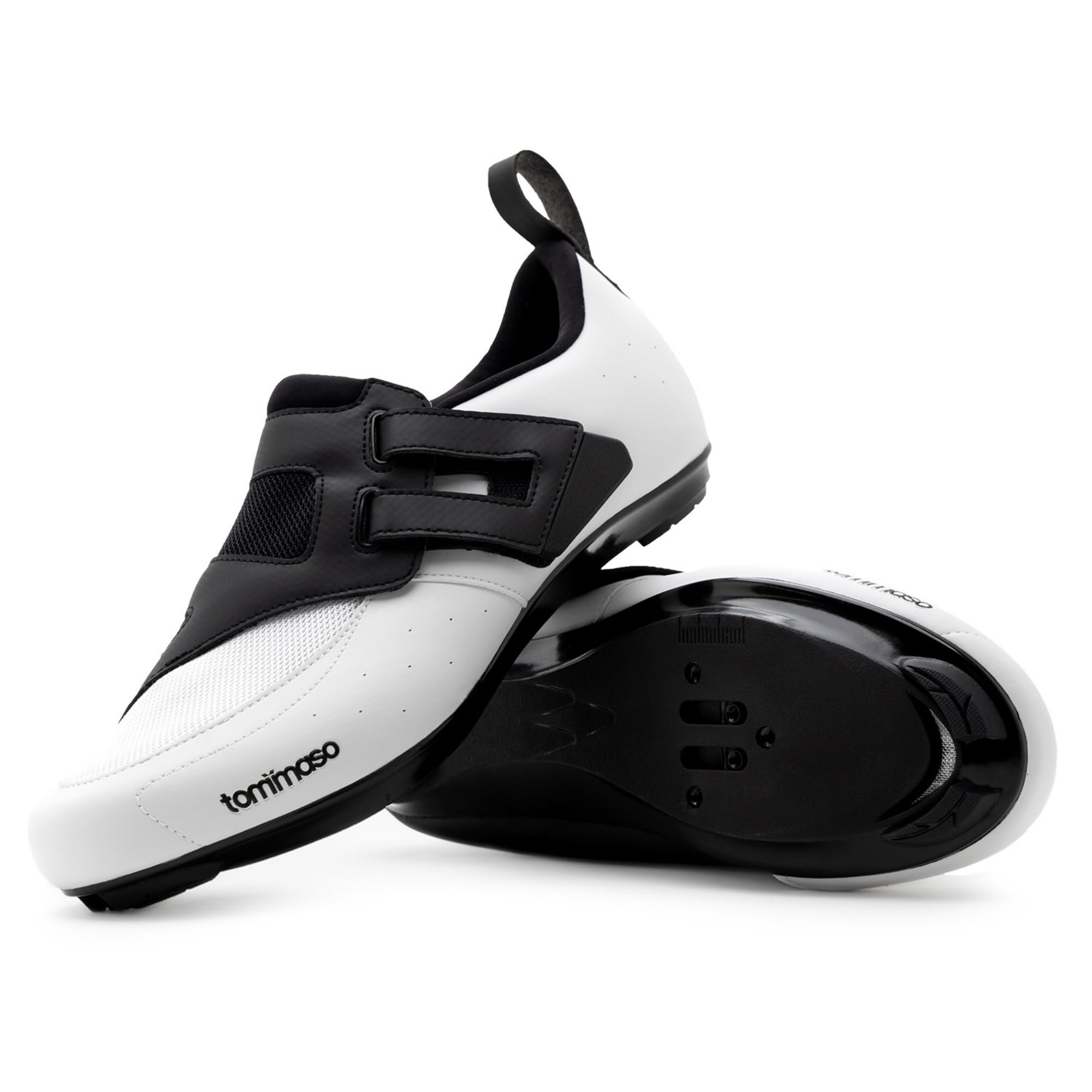
Tommaso Veloce II

Tommaso Veloce II

Hot, sweaty rides

Our Score 8.8/10
Check Price

Worth Noting

  • Sizing runs large
  • Narrow toe box and widely spaced straps
Closure
Hook-and-loop straps
Ventilation
Airy mesh upper
Cleat Compatibility
Look Delta, SPD and SPD-SL
Read the full review

Indoor riding is sweatier than road riding — no breeze, no coasting, and a warm room full of people — so ventilation earns more weight here than it does outside. The Veloce II has the airiest upper of the shoes in this group: mesh across the top, a light lining, and enough airflow that heat moves out during a class instead of pooling around your toes.

Cleats are the other reason to look at it. Look Delta, SPD and SPD-SL all mount to the sole, so the shoe moves between a Peloton, a studio bike and a road bike without a second purchase. The hook-and-loop straps are quick to set and quick to release, and the shoe pulls on and off in a way that suits back-to-back classes.

What we appreciate most is how little it asks: no dial to fiddle with, no break-in to endure, and it dries between sessions instead of sitting damp in a bag. For anyone who overheats indoors, or who wants one pair covering the Peloton and the Saturday road ride, this is the one we point to.

Bottom line: The airiest shoe here, and the one we choose when the room is hot — Delta, SPD and SPD-SL mounts make it a single pair for the studio and the road bike.

6

VikoViren Cycling Shoe

VikoViren Cycling Shoe

Clean everyday look

Our Score 8.8/10
Check Price

Worth Noting

  • Tight across the front of the foot
Sizing
Unisex
Closure
Ratchet buckle
Cleat Compatibility
Look Delta and SPD
Read the full review

The white upper with almost no branding is the first thing anyone notices, and it's a real advantage if you don't want to look like a billboard on the way to class. Clean lines, a low profile, and a ratchet buckle instead of a dial — it reads like a plain gym shoe that happens to take cleats.

Underfoot it's more competent than the plain look suggests. The foot sits low and stable, the padded tongue keeps the buckle from digging in when you crank it down, and there's no rubbing around the ankle, which is the usual complaint with a stiff collar. Quality reads higher than the price does.

Clipping in takes a few attempts at first. The fix is almost always at the cleat rather than the shoe — a quarter turn on the mounting bolts changes how much force the pedal needs — and once you've found the setting, the connection is solid. The buckle also lets you make small adjustments mid-ride without stopping, which the hook-and-loop-only shoes here can't do.

What settles it is value: the price sits at the low end of this group, and the shoe doesn't ask you to baby it — comfortable, tidy, and easy to live with. It's the pair we recommend to someone who wants a clean-looking shoe for class and doesn't need the stiffest plate in the drawer.

Bottom line: A clean, understated shoe we like for class regulars who don't want to look like a billboard, with comfort and hardware that outclass the price.

7

Vicogn Cycling Shoe

Vicogn Cycling Shoe

First clipless pair

Our Score 8.6/10
Check Price

Worth Noting

  • Pre-installed cleats are Look Delta only
Cleats
Look Delta, pre-installed
Closure
Hook-and-loop straps
Padding
Cushioned tongue and heel
Read the full review

For a first clipless pair, what stops most people isn't the pedaling, it's the shopping: cleat type, bolt pattern, position. The Vicogn removes most of it by arriving with Look Delta cleats already installed, so a Peloton owner can pull the shoe on and clip in the same afternoon.

We like the detailing for the money: a cushioned tongue and heel collar, straps that adjust easily, and a fit that runs true through a full class. Performance is unremarkable in the way you want from a first pair — it holds your foot, it doesn't rub, and it lets you concentrate on the ride rather than on your feet. Comfort held up at high cadence with low resistance, which is where cheaper uppers usually start pinching.

The learning curve is the honest part. Clipping in can take a few tries, and the fix is usually at the cleat rather than the shoe — a small turn on the mounting bolts changes how much force the pedal needs. Once that's set, it does what a budget pair should: gets you riding clipless and leaves room in the budget for the classes.

Bottom line: A sensible first clipless pair — Delta cleats already installed, a cushioned fit, and enough comfort to get you through a full class without thinking about your feet.

How We Built and Tested Our Indoor Cycling Shoe Shortlist

We started by pulling together more than 40 pairs from brands we've ridden before and newer names that kept showing up in class reviews. We filtered by cleat compatibility, price, available sizes, and whether the shoe was designed for indoor riding rather than road racing. That left 12 pairs, which my team and I rode for eight months.

Each pair went through at least three 45-minute rides a week: a Saturday morning studio class with long climbs, a weekday interval session on a home bike, and a recovery spin where I stayed seated and noticed pressure points. We measured every footbed against the maker's size chart, tried them with thin and thick socks, and checked for toe box room, heel lift, and numbness after 30 minutes.

To test the clip and strap systems, we clipped in and out 20 times per shoe, adjusted every ratchet, dial, and Velcro strap mid-ride, and noted whether we could do it by feel alone. We also checked two- and three-bolt cleat compatibility and looked for play between the cleat and sole. After eight months, we inspected scuffs, strap wear, and sole separation, then compared what each pair cost against how it still felt. We ruled out shoes that only looked good on the shelf — the winners stayed comfortable, secure, and easy to get into after months of sweat.

How to Choose Indoor Cycling Shoes

Match the cleat to the pedal first

Three systems cover almost every indoor bike. Look Delta is the wide three-bolt triangle Peloton ships with, SPD is the small two-bolt metal cleat most studio bikes use, and SPD-SL is the road version of the three-bolt shape. A shoe takes one, the other, or both: the Giro Cadet and the Tommaso Veloce II take both, which is why they travel between bikes so easily.

The trap is assuming a listing that says Peloton-compatible tells you everything. It describes a bolt pattern; the cleat that actually engages your pedal still has to be the right one. Look at the pedal on the bike, or ask the studio, before you order anything.

How stiff a sole you actually need

Indoor bikes reward stiffness. There's no coasting and no rough road to absorb, so every watt goes through the pedal, and a rigid plate stops a hard effort from bending the shoe instead of turning the flywheel. The Giro Cadet's carbon composite outsole is the stiffest here, and it's the difference you feel in a standing climb.

The counterweight is off-bike comfort. A stiff plate is awkward on tile, stairs and locker-room floors, while the walkable sole on the TIEM Slipstream trades some rigidity for a shoe you can wear across a gym. Ride hard four times a week and stiffness wins; change at a studio and walk a lot, and it doesn't.

Fit, width and closure

Sizing across these brands is all over the place — several run small, at least one runs large — so treat your running shoe size as a starting point and check the specific model. Width matters just as much: a few of these are cut narrow through the toe box, and no amount of strap tension rescues a box that's too tight.

On closure, a BOA dial gives the most even, micro-adjustable tension, a ratchet is quicker to set, and hook-and-loop is cheapest and least precise. Whichever you pick, the test is the same: your heel should stay locked with no lift when you push down.

What wears out, and what it costs after purchase

The parts that fail first are the ones you touch: straps, ratchets, buckles and the cleat mounting threads. Indoor sweat is hard on all of them, so wipe shoes down after a class and let them dry instead of sealing them in a gym bag.

Cleats are consumable too. Walking across a parking lot wears the tabs that hold you in the pedal, and replacements are a recurring cost that isn't in the shoe price. Inspect the tabs and bolts a few times a season and swap cleats once engagement starts to feel vague.

Frequently Asked Questions

Final Verdict

Across the whole group, the Giro Cadet is the pair we hand most riders. The carbon-composite plate and the BOA dial make hard efforts feel direct, and the two-bolt/three-bolt mount keeps it working if you change bikes or studios.

If your riding happens in a class and you want to walk in and out without changing shoes, the TIEM Slipstream is the better fit. And when the budget is the deciding factor, the KESCOO KSC-X68 arrives with cleats already on.