Components

Best Suspension Seatposts of 2026

Every pothole and expansion joint reaches your saddle before it reaches your hands, which is why a sore lower back is often the first thing riders upgrade away from. A suspension seatpost puts a spring, an elastomer stack, or a short parallelogram linkage between saddle and frame, so the jolt is absorbed a couple of inches below you instead of traveling up your spine. The catch is that those three designs feel remarkably different, and the post has to match your seat tube diameter exactly — there's no adapter for a wrong guess. Get both right and rough pavement stops being something you brace for.

Over the past eight months, my team and I have ridden a dozen of these on commutes, rail trails, and one memorably bad gravel loop, and the gap between a great post and a mediocre one shows up within a mile. The good ones disappear under you; the bad ones creak, twist a degree or two under hard pedaling, or thunk to the bottom of their travel on the first curb. Below, the picks are sorted by how much travel and adjustability you actually need.

1

Aventon Advanced Suspension Seatpost

Top Pick
Aventon Advanced Suspension Seatpost

Zero-setback builds

Our Score 9.0/10
Check Price

Worth Noting

  • Heaviest post here at 1.04 kg
Length
365 mm
Travel
50 mm
Weight
2.29 lb
Fits Diameters
27.2 / 30.4 / 30.9 mm
Read the full review

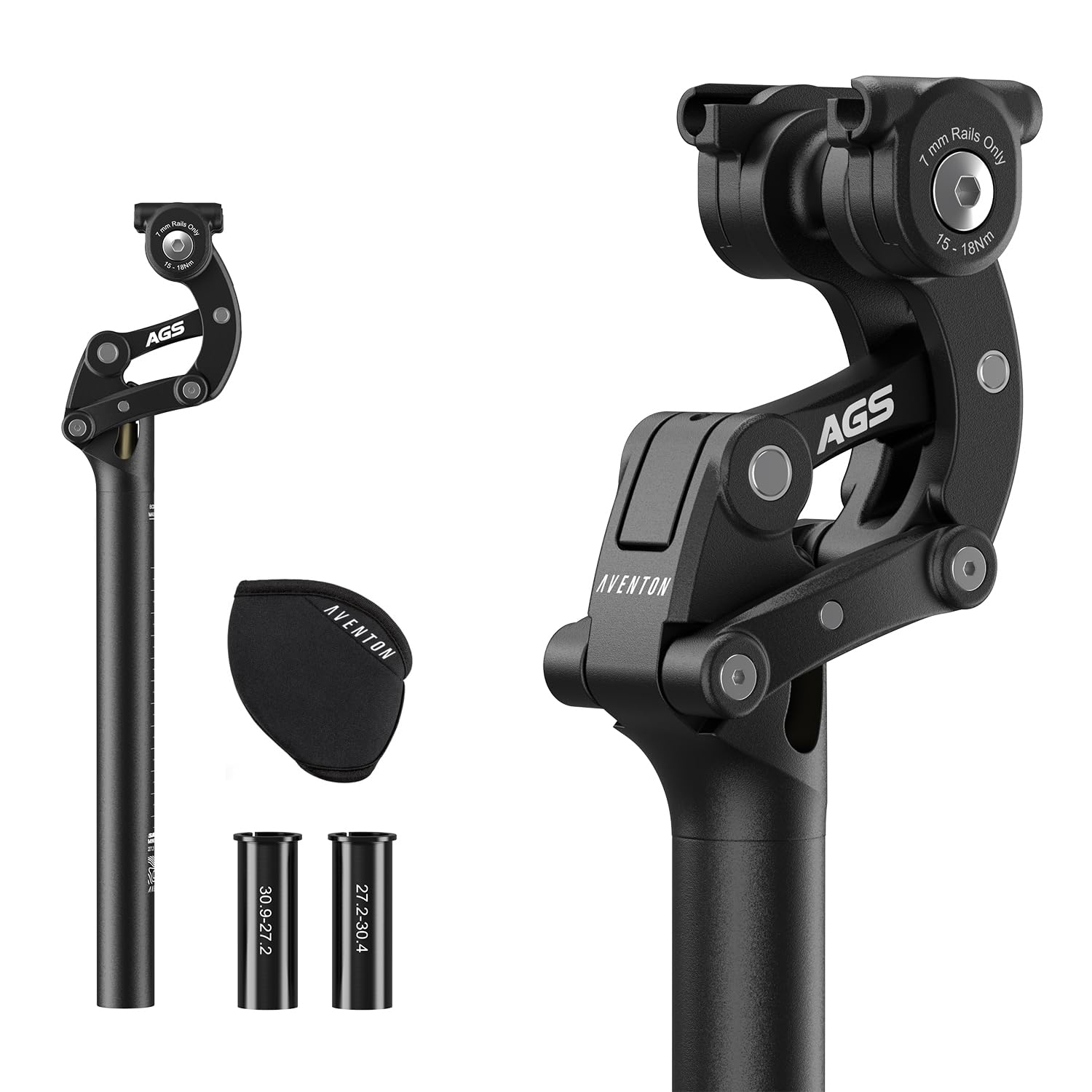
The clamp on the Glide rotates, so the saddle can sit directly over the post at zero setback instead of trailing behind it. Add a dust sleeve over the parallelogram and you have the tidiest post of the group, the one that looks like it came with the bike rather than being bolted onto it.

We noticed that tidiness first and the ride second, but the ride holds up: 50 mm of parallelogram travel with a firm initial stroke, and a full 250 mm of usable extension from a 365 mm body. It's the post we reach for when the bike is a commuter that has to look deliberate.

The saddle clamp is wide, and a narrow or deeply contoured stock saddle can foul it, so check the rails of the saddle you plan to run before you order. Expect to spend a few minutes getting the tilt right as well; the instruction sheet is thin enough that it's worth working out in a stand. Once it's set and torqued, the clamp holds.

Bottom line: A clean, well-finished parallelogram post for riders who want zero setback and a dust sleeve, as long as the wide clamp suits the saddle you own.

2

Cane Creek Thudbuster LT

Cane Creek Thudbuster LT

Rough surfaces

Our Score 8.6/10
Check Price

Worth Noting

  • 2.1 lb is a lot of post for a road bike
  • Retuning means swapping elastomer blocks
Length
390 mm
Travel
90 mm
Weight
2.1 lb
Diameter
27.2 mm
Read the full review

Ninety millimetres is roughly double the travel of most posts in this guide, and the Thudbuster LT spends all of it. Washboard gravel, cobbled streets, and broken asphalt disappear under the parallel linkage in a way that 35 or 50 mm simply cannot match.

We keep handing it to anyone whose ride includes a mile of bad pavement, and that's the honest summary: on rough ground it's the plushest post here, and the difference shows immediately rather than after twenty miles. The long-travel linkage is also the most forgiving of a heavy rider who hasn't got the spring rate exactly right.

What it asks in return is space. A 390 mm body with 90 mm of travel above it sits tall, so it suits a frame with plenty of exposed seatpost and a rider who isn't already at the top of their saddle height. The pivots are serviceable, which matters on a post with this much linkage to wear.

Bottom line: Ninety millimetres of travel for washboard, cobbles, and long dirt days — the plushest post here, provided your frame has the exposed post to carry it.

3

SR Suntour SP12 Suspension Seatpost

SR Suntour SP12 Suspension Seatpost

Everyday comfort

Our Score 0.0/10
Check Price

Worth Noting

  • Rider weight capped at 100 kg / 220 lb
Length
350 mm
Travel
50 mm
Diameter
27.2 mm
Rider Weight
60–100 kg
Read the full review

This is the suspension seatpost we recommend to most riders, and the reason sits in the specification: 50 mm of travel from a brass-bushed parallelogram, a 350 mm body, a 27.2 mm shaft, and nothing exotic to maintain. Alloy arms, a coil spring tucked inside the linkage, and a design that has been quietly doing this job on hybrids and hardtails for years.

What the linkage buys you is the shape of the movement. The saddle travels down and slightly rearward rather than straight down, so the post absorbs a hit instead of pogoing you back up out of it. We also appreciate that the spring is rated from 60 kg upward: a lighter rider gets real movement out of the post rather than a linkage that never quite opens.

Two habits make it work better. Set your fore-aft saddle position knowing the saddle drifts back slightly as the post compresses, and skip the sprung saddle — a sprung saddle on top of a sprung post doubles the bounce and leaves the whole bike feeling vague.

The one limit worth checking first is diameter. This version is 27.2 mm, which covers most road, gravel, and hybrid frames, but if yours takes a 30.9 or 31.6 you need one of the multi-diameter posts below. That's a measuring job, not a research job.

Bottom line: For most riders this is the suspension seatpost to buy: 50 mm of parallelogram travel that works on pavement and gravel, with a spring rated for riders from 60 kg.

4

Redshift ShockStop Endurance

Redshift ShockStop Endurance

Road and gravel

Our Score 0.0/10
Check Price

Worth Noting

  • Premium price for the travel on offer
Length
350 mm
Travel
35 mm, tunable
Weight
1.54 lb
Diameter
27.2 mm
Read the full review

The step up from our top pick buys damping rather than distance. The ShockStop Endurance uses a four-bar linkage with dual springs and 35 mm of tunable travel, and at about 700 g it disappears from the bike in a way the coil posts don't.

The detail we keep coming back to is what the linkage doesn't do. As it compresses, the distance between the saddle and the bottom bracket barely changes, so you keep the leg extension you set up. On a simple coil post you can feel the saddle sink away from you over a long ride, and that slow loss of position is exactly the fatigue this post is built to remove.

For gravel, all-road, and long commutes that steadiness is worth more than extra travel, which is why this is our pick for those bikes: constant small chatter rather than the occasional big hit. Installation is quick and there is nothing to service beyond wiping the linkage down. If all you want is the jar gone from a rail trail, the Suntour does that with more travel; the Redshift is for riders who plan to be in the saddle for hours.

Bottom line: Worth the step up for gravel and long road days: 35 mm of damped, tunable travel, negligible weight, and a linkage that keeps your saddle height where you set it.

5

Kinekt XR Suspension Seatpost

Kinekt XR Suspension Seatpost

Riders 80–320 lb

Our Score 0.0/10
Check Price

Worth Noting

  • Costlier than the posts it competes with
Length
350 mm
Springs
5 interchangeable
Diameter
27.2 mm
Rider Weight
80–320 lb
Read the full review

Five springs come in the box, two of them already mounted, each colour-coded to a rider weight. The idea is straightforward: rather than one coil tuned for an average rider, you fit the spring that matches the person actually pedalling, anywhere from 80 to 320 lb.

On the bike the feel is livelier than an elastomer post, spring-loaded rather than damped, and the preload dial on the back lets you take up slack as the springs settle or as you load up a rack and panniers.

Getting it set up is the part that takes an evening. Swapping springs is a bench job with the post out of the frame, and the colour coding helps without making it quick. Set the preload first, ride it, and only change the spring if you're still using all the travel.

Where it earns its place is at the ends of the weight range. A rider past the Suntour's 100 kg ceiling, or a lighter rider who wants a livelier post, finally has something tuned to them rather than a compromise. That's the judgement: the money and the fiddling buy you a spring rate that is genuinely yours.

Bottom line: The post for riders the others leave out: five interchangeable springs cover 80 to 320 lb, and the ride stays composed on rough pavement and gravel.

6

Safort SP18 Suspension Seatpost

Safort SP18 Suspension Seatpost

E-bikes, long posts

Our Score 0.0/10
Check Price

Worth Noting

  • Some listed diameters rely on a shim
Length
365 mm or 580 mm
Offset
25 mm
Travel
50 mm
Max Rider Weight
150 kg / 330 lb
Read the full review

Two numbers make the SP18 the e-bike answer: a 580 mm length for frames with long seat tubes and a rider range that runs from 50 kg to a stated 150 kg maximum, with 130 kg as the comfortable ceiling. Nothing else in this guide carries that much capacity.

The four-link parallelogram is the same family of design as the Suntour and Aventon posts, and it keeps the saddle stable under power rather than letting it bob with every stroke. The offset is the detail to look at: 25 mm, where most posts here run 14 mm, so the saddle ends up further back and your reach to the bars gets longer.

We like it as a straight swap onto a heavy e-bike or a cruiser with a slack seat angle, and it's the post that best tolerates a rider at the top of a normal post's range. It ships with a cover for the linkage too, which is the sort of small thing that keeps grit out of the pivots through a winter.

Bottom line: The best choice for e-bikes and long seat tubes: a 580 mm option, a 330 lb ceiling, and a four-link linkage that keeps the saddle stable under power.

7

BICYCGEAR Suspension Seatpost

BICYCGEAR Suspension Seatpost

Budget builds

Our Score 0.0/10
Check Price

Worth Noting

  • Less travel than the 50 mm posts here
Length
350 mm
Offset
14 mm
Travel
40 mm
Weight
1.1 lb
Read the full review

Two bolts hold the saddle on this one instead of the single bolt you get on most budget posts, and that's the detail that earns it a place here. Saddle tilt is where inexpensive posts give trouble first, and a second bolt resists it. It's the cheap post we're comfortable recommending.

The rest of the package is honest: 40 mm of travel from a coil spring and damper rubber, an adjustable rebound screw at the base of the post, a 14 mm offset, and a 350 mm body. It won't flatten a pothole the way the long-travel Cane Creek does, but it takes the edge off broken pavement and hard-packed gravel, which is what most riders actually want.

The spring runs soft, so if you're well over 200 lb, wind in the preload before you pass judgement — and if you're much heavier than that, spend the extra on the Kinekt instead. For everyone else it's a sensible first suspension post, and the one-year warranty covers the parts that move.

Bottom line: The budget pick that gets the basics right: a two-bolt saddle clamp that holds its angle, 40 mm of coil travel, and a 14 mm offset that suits most frames.

8

Cane Creek Thudbuster ST

Cane Creek Thudbuster ST

Light builds

Our Score 0.0/10
Check Price

Worth Noting

  • Saddle tilt can creep at the single-bolt clamp
  • Instructions barely cover the elastomer change
Travel
50 mm
Diameter
27.2 mm
Post Length
354 mm
Rider Weight Limit
115 kg / 250 lb
Read the full review

The ST is the short-body version of the Thudbuster: 50 mm of travel out of a 354 mm post, with elastomer blocks you change without tools. On a frame where the saddle sits close to the top tube, that shorter body is the difference between fitting and not fitting.

The numbers that matter are the extension figures: 100 mm minimum insertion and 274 mm maximum extension. With less than 100 mm of post in the frame you cannot safely run it, and if you need more than 274 mm above the collar you need a longer post altogether. Check both before anything else.

Ride-wise the elastomer gives a firmer, more controlled feel than a coil — less bounce, more squash — and the two-piece block design means you can change the rate without pulling the linkage apart. Elastomer does firm up in the cold, so a block that feels right in July is a little wooden in January.

At 0.58 kg it's the lightest post in this guide, which matters if the bike lives up a flight of stairs, and 50 mm is enough for pavement, gravel, and the potholes that end a ride early. For a rider with limited exposed post on a road or hybrid frame, it's the neatest fit in this set.

Bottom line: For a frame with little exposed seatpost, the ST is the neat, light option: 50 mm of travel from a 354 mm body that retunes without tools.

How We Chose and Tested Suspension Seatposts

We started by gathering every suspension post we could find that was genuinely sold in multiple diameters, then cut anything with no published travel figure or no way to replace worn elastomers and springs. That left 12 posts, spanning simple telescoping springs, elastomer stacks, and parallelogram linkages. Each was ordered in the diameter the manufacturer listed for our 27.2mm test frame and measured with calipers before installation.

Every post went onto the same steel frame and was ridden for eight months on a cracked-asphalt commute, a rail trail with root heaves, and a washboard gravel loop, plus one loaded grocery run a week with roughly 20 pounds on a rear rack. We set saddle height and tilt, marked the post and saddle rails with tape, and torqued the clamp to spec so any creep would show up as a shifted mark. A heavier rider on the team also ran each one for a week to see how the spring rate held up.

What we watched for: whether small chatter reached us at all or only the big hits got muted, and whether a hard curb sent the post to the floor of its travel with a thunk. We checked for side-to-side play at the saddle after every few weeks of riding, then re-read the tape marks for tilt slip. Fit was judged at installation — whether a post dropped in by hand or needed persuasion. We also noted weight added and what replacement parts cost, and asked each rider a month in whether they'd buy the thing again, since a post that saps your climbing feel is a poor trade for comfort.

How to Choose Suspension Seatposts

Measure the Diameter Before You Read a Single Review

The size is usually printed on the lower part of your existing post, just above the minimum-insertion line; if it isn't, a caliper on the shaft settles it. Diameters are not interchangeable. A 27.2 and a 30.9 mm post look close enough side by side and are far enough apart in practice that the wrong one will either refuse to enter the frame or slip once you sit on it.

Read what actually ships, too. Some listings sell a nominal size that arrives as a smaller post plus a shim, which is fine as long as you know before you order.

Match Travel to Your Worst Regular Surface

Thirty-five to 50 mm covers pavement seams, gravel chatter, and rail-trail washboard, and that's what most riders need. Ninety millimetres is for cobbles, graded dirt, and long stretches of broken asphalt, and it arrives with a taller stack and more movement underneath you.

Buy for the road you ride every week rather than the one you rode once on holiday. Extra travel you don't need is just extra height and extra bounce.

Get the Spring Rate Right for Your Weight

Every post here states a rider range, and it's a real limit rather than a suggestion: the SR Suntour SP12 lists 60 to 100 kg, the Thudbuster ST 115 kg, the Safort SP18 a 150 kg maximum. A rider at the very top of a range spends the whole ride on a compressed spring, and a light rider on a heavy spring never gets the post to open at all.

Preload adjusts within a range; interchangeable springs, as on the Kinekt, or elastomer blocks, as on the Cane Creek posts, change the rate outright. If you're near a boundary, spend the tuning effort or move up a post.

Understand What the Linkage Does to Your Position

Parallelogram and four-bar posts move the saddle down and slightly rearward, which stops the movement feeling like a pogo and generally holds your leg extension better than a straight coil. The trade is a small change in saddle position as the post works.

Offset matters as much as travel. Fourteen millimetres is the common figure here, the Safort SP18 runs 25 mm, and the Aventon's rotating clamp can take it to zero. Set saddle height and fore-aft after fitting, not before.

Clamps, Weight, and What Upkeep Looks Like

Two bolts at the saddle hold tilt better than one, and tilt creep is the most persistent complaint about single-bolt clamps. Weight across this set runs from 0.58 kg to just over 1 kg — irrelevant on an e-bike, noticeable on a road bike you carry up stairs.

Upkeep is modest: keep grit out of the pivots (a dust sleeve helps), check the saddle clamp after the first few rides, and on elastomer posts replace the blocks as they age.

Frequently Asked Questions

Final Verdict

If you want one post and no research project, the SR Suntour SP12 is the one: 50 mm of parallelogram travel, a spring that works from 60 kg up, and a design that has been proving itself on hybrids, hardtails, and e-bikes for years. It's the best value in this set, and it will suit most riders who simply want the jar gone.

Two requirements change that answer. A frame that isn't 27.2 mm sends you to the Redshift ShockStop Endurance or the Safort SP18, which cover other diameters and, in the Redshift's case, hold your saddle height as they work. A rider over 100 kg sends you to the Kinekt XR, whose five springs run to 320 lb.