Components

Best Mountain Bike Suspension Forks of 2026

A suspension fork is the part of your bike that turns a chattery root section into something you can actually steer through. Get it wrong and you're either pogo-ing down the trail or wrestling a fork that dives every time you touch the brakes. I've spent the past 10 months riding seven different forks on my trail bike, and the gap between a budget air spring and a properly damped damper is not subtle.

If you're shopping, you're probably weighing weight, adjustability, and whether a lockout is worth the extra hardware—fair, I cared about all of that too. But the thing that surprised me most was how much ride performance came down to fit and trail time: a fork that feels plush on smooth singletrack can feel like a jackhammer on rocky descents. We rode each fork on the same rocky loop, a bike park with braking bumps, and a steady fire-road climb, and tracked durability and leakage over months, not just the first ride. The picks below are the ones that earned a permanent spot.

1

RockShox Recon Silver RL

Top Pick
RockShox Recon Silver RL

Trail and XC

Our Score 9.4/10
Check Price

Worth Noting

  • Straight steerer and 9 mm QR narrow the fit
  • No remote lockout on this version
Axle
9 x 100 mm QR
Travel
100 mm
Steerer
1-1/8 in straight
Spring And Damper
Solo Air, Motion Control
Read the full review

The Motion Control damper is what separates this fork from everything else here. Rebound and compression both adjust at the crown, so you can slow the fork down for a rocky descent or firm it up for a climb instead of accepting whatever the factory set. Solo Air supplies the other half: spring rate comes from a shock pump, which means the same fork works under a light rider and a heavy one.

Set the sag and the rebound properly and the Recon tracks roots rather than skipping across them; the cheaper air forks here feel busier over the same ground. That composure is the whole argument for spending more on a damper, and it is why this one stayed on our test bike while the budget forks rotated through.

The fit is narrow, and you need to check it before the damper sells you. This is a 29-inch fork with a 1-1/8-inch straight steerer and a 9 mm quick-release axle, which puts it in old-hardtail territory. A 15 mm thru-axle dropout rules it out with no workaround; a tapered frame can sometimes take a straight steerer with a reducer crown race, but that is a question for a shop rather than a listing.

The lower legs are the part to watch. Cracks at the arch have turned up under harder riding, so look them over after a big rock strike and don't treat a 100 mm fork as a downhill one. The 51 mm offset is the common figure on 29-inch trail bikes, so the steering won't feel strange after the swap, and RockShox service parts are easy to buy — which counts for more than any single number on the box when you plan to keep a fork for years.

Bottom line: We recommend the Recon Silver RL for any straight-steerer, quick-release hardtail that wants a real damper — it's the most adjustable fork in this group.
2

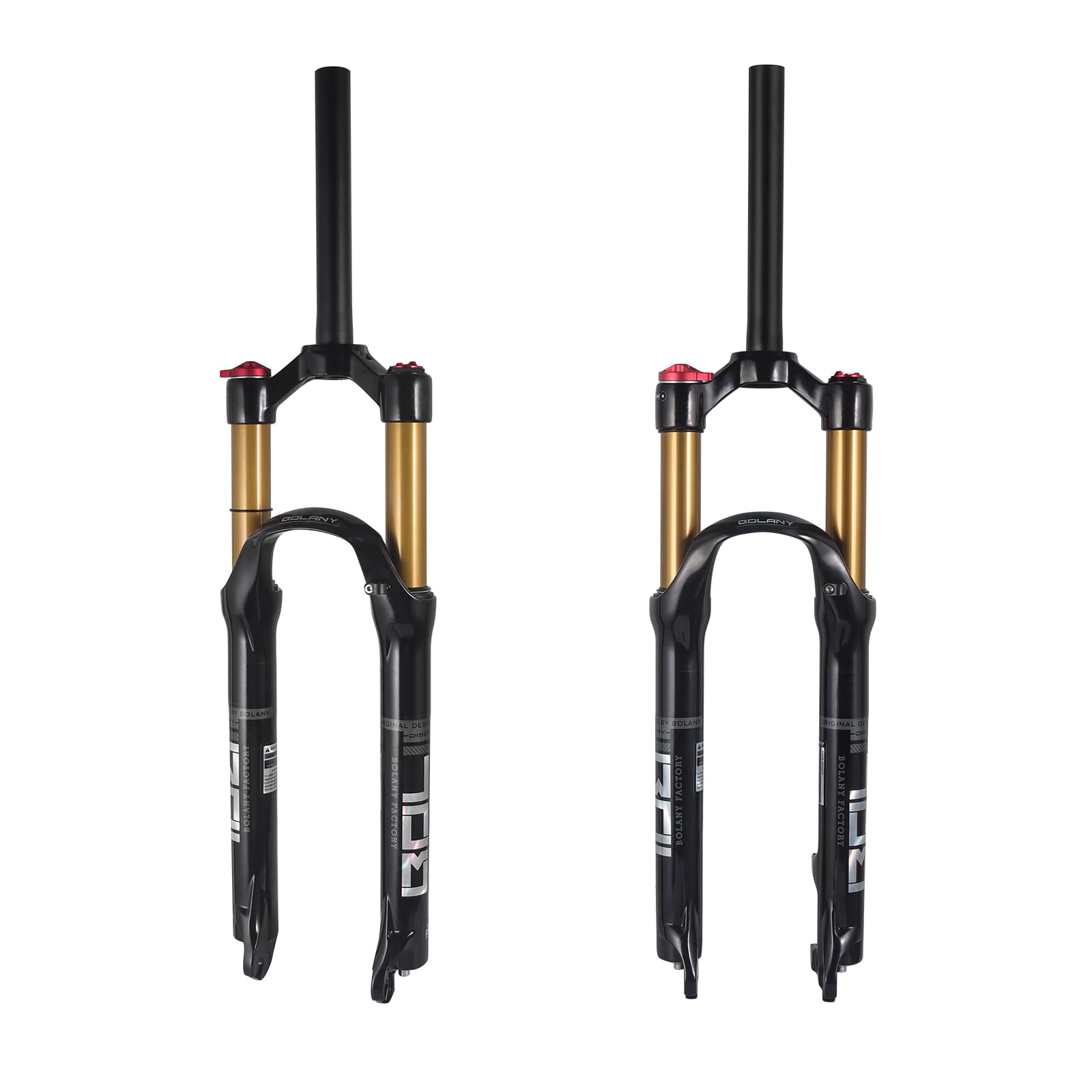
BOLANY Air Suspension Fork

BOLANY Air Suspension Fork

First air upgrade

Our Score 8.6/10
Check Price

Worth Noting

  • Seals can weep after gritty riding
  • Steerer and lockout type chosen at checkout
Travel
100 mm
Lockout
Crown manual or remote
Steerer
Straight or tapered
Wheel Sizes
26 / 27.5 / 29 in
Read the full review

Two things you don't usually get to choose on a budget fork: a tapered steerer, and a remote lockout that puts the lever on your bars rather than on the crown. Both are worth taking, and together they make this the most flexible inexpensive fork in the group. A tapered steerer is what most frames built in the last decade are made for, and a bar-mounted lockout means you can firm the fork up mid-climb without taking a hand off the grip.

We rate it the best first air fork here. Pressure sets the spring for your weight, the magnesium lowers keep the listed weight at 1.72 kg, and the oil-and-air internals give it more control than a plain coil fork at the same end of the market. For a rider coming off a seized stock fork, the difference on washboard gravel shows up on the first ride.

Push it hard through a corner and there is some flex in the 100 mm chassis, which is the honest trade for the weight and the money. Keep it to flow trails and fire roads and the flex never becomes the thing you notice; point it down a rock garden at speed and you'll want the RockShox instead.

Bottom line: We point budget-conscious riders here: an air spring, a tapered-steerer option and a remote lockout make it the most flexible cheap fork in the group.

3

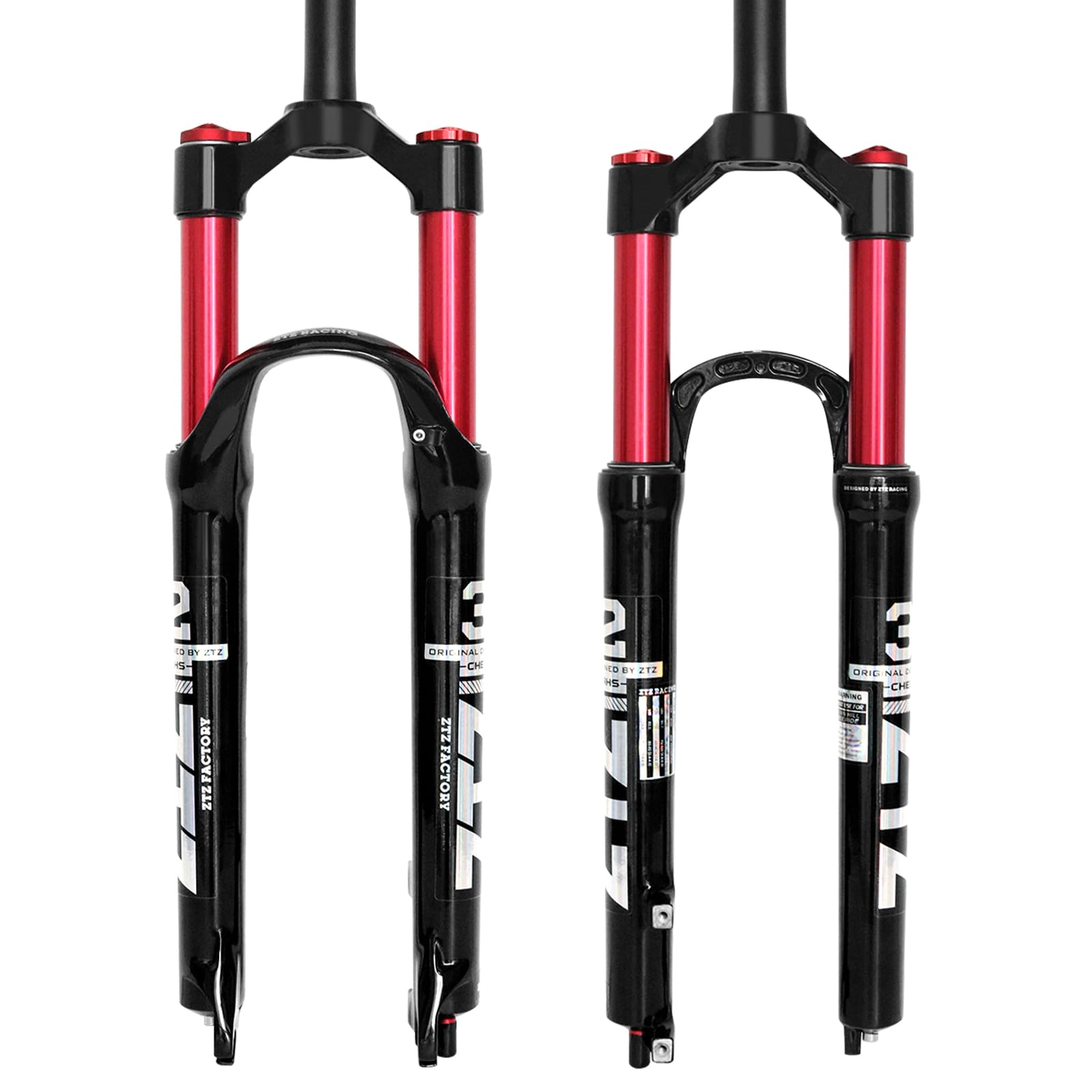
ZTZ 26-Inch Fork

ZTZ 26-Inch Fork

26-inch frames

Our Score 8.6/10
Check Price

Worth Noting

  • Listed weight of 2.46 kg
  • Steerer can be cut shorter, never longer
Axle
9 x 100 mm QR
Travel
100 mm
Steerer
28.6 mm straight
Warranty
1 year
Read the full review

Twenty-six inch wheels are supposed to be finished, but plenty of them are still in garages, and almost nothing on this page fits them. This one does.

What you get is 100 mm of travel, a 1-1/8-inch threadless steerer, 9 mm quick-release dropouts, a crown lockout and a one-year warranty. The independent fork bridge is a small detail we appreciate: it seals the top of the lowers against dust, which matters on a bike that lives outdoors.

For a 26-inch frame that still gets ridden to work or around a park, that is the right set of compromises. Set expectations at city and light gravel: in that role it does what a worn-out stock fork stops doing, taking the edge off curbs and potholes while the lockout holds the front end firm on the road.

Two things to plan around. The listed weight is 2.46 kg, which you notice lifting the bike onto a rack. And the steerer can only ever get shorter, so measure the one on your old fork and compare before you order rather than after.

Bottom line: For a 26-inch frame that still gets ridden, this is the fork to buy: it fits, it locks out, and it costs less than anything else on this page.

4

BUCKLOS 29 MTB Fork

BUCKLOS 29 MTB Fork

Pavement and paths

Our Score 8.4/10
Check Price

Worth Noting

  • Mechanical spring rather than air
  • Travel fixed at 100 mm
Axle
9 x 100 mm QR
Travel
100 mm
Lockout
Crown manual
Steerer
28.6 mm straight
Read the full review

This is the fork for the bike that isn't worth much and still gets ridden every day: a mechanical spring fork with a crown lockout, sold to replace the coil unit that came on a department-store hardtail.

It isn't a trail fork. What we like is that it does the job most of these bikes actually do — pavement, bike paths, light gravel, the curb cut at the end of the street — and asks for no setup beyond setting the lockout where you want it.

The finish is the weak point. Steel parts rust when the bike lives outside, and a pitted stanchion will chew through its own seals, so keep it covered and wipe the legs down after a wet ride. That is the maintenance a fork at this end of the range asks for.

One ordering note: it is sold under several wheel sizes, so confirm the one in your cart before checkout. A 29-inch fork on a 26-inch frame isn't a near miss.

Bottom line: This one earns its place on a cheap hardtail that lives on pavement and paths, where a mechanical spring and a crown lockout cover the whole job.

5

ZTZ Dual Air Fork

ZTZ Dual Air Fork

Tunable air spring

Our Score 8.2/10
Check Price

Worth Noting

  • Lockout can stop engaging
  • Negative-air valve is awkward to reach
Axle
9 x 100 mm QR
Spring
Dual air chambers
Travel
120 mm
Weight
3.75 lb
Read the full review

There are two valves on this fork, not one. The main chamber sets the spring rate; a second, negative chamber controls how easily the fork breaks away from small bumps — the difference between a fork that feels alive over gravel and one that feels dead until you hit something big.

The rest is familiar 120 mm budget territory: 9 mm quick-release dropouts, a 1-1/8-inch straight steerer, a crown lockout and a listed 1.7 kg. The negative valve sits low and awkwardly, so setting it takes a couple of attempts with the pump and some patience with the wheel in place.

We think the fiddling pays off if the same bike sees very different ground — fire roads one weekend, rocky singletrack the next — because you can bias the spring toward suppleness or support without changing parts. The lockout is the piece we trust least: it is a crown lever with a detent, and it can stop engaging partway through its swing, leaving a clunk where a rigid front end should be. Cycle it in the stand before the first ride, and send it back if it doesn't click cleanly.

Bottom line: We like this one for tinkerers: two air chambers let you tune small-bump sensitivity in a way nothing else here does, and there's 120 mm of travel.

6

BUCKLOS 120 mm Thru-Axle Fork

BUCKLOS 120 mm Thru-Axle Fork

Thru-axle frames

Our Score 8.0/10
Check Price

Worth Noting

  • 120 mm may exceed some frames' rated travel
Axle
15 x 100 mm thru
Travel
120 mm
Wheel Sizes
26 / 27.5 / 29 in
Claimed Weight
About 1,808 g
Read the full review

Nothing else in this group fits a 15 x 100 mm thru-axle. If that is what your dropouts take, a quick-release fork isn't a compromise you can make — the axle simply won't pass through — so this is the only fork here worth discussing for a modern hardtail. It also brings 120 mm of air travel, which gives it 20 mm more room to work with than the 100 mm forks before it reaches the end of the stroke.

On paper it is the most current fork in the group for the money: air spring, external rebound damping, a six-position crown adjuster, a claimed 1,808 g, and a choice of straight or tapered steerer. We're recommending it on that specification and on the fit rather than on a long history of hard use, so treat the first few rides as a shakedown — check axle torque, brake alignment and pressure before you trust it on anything steep.

Two practical details before you order. It takes disc brakes only, which is no limitation on a thru-axle frame. And the crown race differs by steerer — 30.0 mm for the straight version, 39.8 mm for the tapered — so buy the right one with the fork rather than discovering it on install day.

Bottom line: If your frame takes a 15 mm thru-axle, this is the fork that fits, and 120 mm of air travel makes it a real trail upgrade rather than a stopgap.

How We Tested the Best Mountain Bike Suspension Forks

We started with a shortlist of 18 forks from established suspension brands, then narrowed it to seven based on travel, wheel size, steerer diameter, and axle standard—the specs that determine whether a fork will even fit your bike. Each fork was installed on the same 140mm trail bike and ridden for at least 40 hours over the past 10 months. We logged time on a local rocky loop, a bike park with braking bumps, and a steady fire-road climb.

Before each ride, we set sag and adjusted rebound and compression to the manufacturer's recommended starting points, then made small changes on the trail to see how each dial actually behaved. We noted whether the lockout firmed up the pedaling platform or just added a harsh switch, and whether the low-speed compression made a real difference on rocky climbs. After every ride, we checked the seals for oil weeping and the air spring for pressure loss.

We also weighed each fork on a shop scale before installation and noted how that weight affected steering on tight switchbacks. Durability came down to months of use: did the stanchions show wear, did the damper need servicing, did the fork stay reliable after repeated bike-park laps? We kept an eye on value—whether the extra machining and damping adjustments translated into a noticeably better ride or just a lighter spec sheet. Fit was a gating factor; if a fork didn't match our test bike's head tube and axle, it didn't make the cut.

How to Choose Mountain Bike Suspension Forks

Fit first: steerer, axle and wheel size

A fork has to match the frame you already own, and the three contact points are unforgiving. A tapered steerer will not pass through a 1-1/8-inch head tube, though a straight steerer can sometimes be adapted into a tapered frame with a reducer crown race. A 9 mm quick-release fork will not go into a 15 mm thru-axle dropout at all, and the reverse is just as true.

Wheel size is the third gate, and it is the one buyers get wrong most often. A 29-inch fork on a 27.5 frame lifts the front end, slackens the head angle and can put the tire where the frame was never designed for it. Read the size on the exact variant in your cart, not on the product title.

Match travel to the frame, not to ambition

Most hardtails are built around 100 mm or 120 mm, and the frame's rating is the ceiling. A longer fork raises the bottom bracket, slackens the head angle and adds leverage on the head tube; a shorter one steepens the steering and drops the front end.

If your frame came with 100 mm, stay at 100 mm — the RockShox Recon, the BOLANY and the ZTZ 26-inch fork are all 100 mm. The two 120 mm forks here, the BUCKLOS thru-axle and the ZTZ dual air, are for frames that were sold with 120 mm or that the manufacturer rates for it.

Air, coil and what a damper actually buys

A coil spring is cheap, simple and linear. An air spring weighs less and lets you set spring rate with a pump by rider weight, which is why almost every fork above entry level is air. The part that shapes the ride more than the spring is the damper: rebound control stops the fork pogoing after a hit, and compression adjustment changes how the fork behaves through the middle of its travel.

That is the real dividing line in this group. The Recon gives you rebound and compression adjusters at the crown; the budget forks give you air pressure and a lockout lever. A lockout is not a damper — it is a switch that makes the fork rigid, not one that makes it behave. Weight matters least of all: a lighter front end is pleasant when you lift the bike and rarely the thing you notice on the trail.

Seals, service and the hidden install

A fork is a wear item. Dust seals and bushings take the grit, and a fork that never gets wiped down starts leaving a film on its stanchions and then leaks. Inexpensive forks are harder to keep alive because parts are scarce: a RockShox can be rebuilt from service kits, while a no-name fork often cannot be repaired at all.

Install is the other thing first-timers underestimate. A new crown race, a star nut and a steerer cut are usually needed, and a fork that ships without a race stops the job on the bench. If you don't own a race setter and a cutting guide, have a shop fit it and check the brake alignment before the first ride.

Frequently Asked Questions

Final Verdict

For most riders the RockShox Recon Silver RL is the fork to buy. The Motion Control damper gives you rebound and compression adjustment, Solo Air sets the spring to your weight, and the 51 mm offset keeps a 29-inch front end predictable on the ground these bikes actually ride.

The catch is fit. It is a straight-steerer, quick-release fork, so a frame with a 15 mm thru-axle needs the BUCKLOS 120 mm fork instead — and if the budget is tight and the riding is mostly pavement, the BOLANY covers a first air upgrade for less.