Components

Best Mountain Bike Derailleurs of 2026

A chain that skips under power can turn a fun descent into a walk of shame. A derailleur is the part that decides whether every shift lands cleanly, and the wrong one will fight you on climbs, rattle on rough ground, and wear out faster than it should. I've spent enough rides fiddling with barrel adjusters trailside to know the difference comes down to mud clearance, cassette tracking, and whether it still shifts after a season of abuse. At its best, the part disappears: you click, the chain moves, and you keep pedaling.

Over eight months, our team tested 12 derailleurs across rocky singletrack, muddy enduro laps, and bike-park days. Fit matters as much as price: a derailleur has to match your drivetrain's pull ratio, cassette range, and cage length, because a bargain that skips shifts through your full gear range is no bargain. The best ones held their alignment after rock strikes and kept shifting crisply under clutch load. Below are the picks that earned a permanent spot on our test bikes.

1

SRAM GX Eagle

Top Pick
SRAM GX Eagle

12-speed SRAM

Our Score 9.6/10
Check Price

Worth Noting

  • Needs the full SRAM Eagle 12-speed ecosystem
Speeds
12-speed
Max Cog
52T
Cassette Fit
10-50T and 10-52T
Pulley Bearings
Sealed cartridge
Read the full review

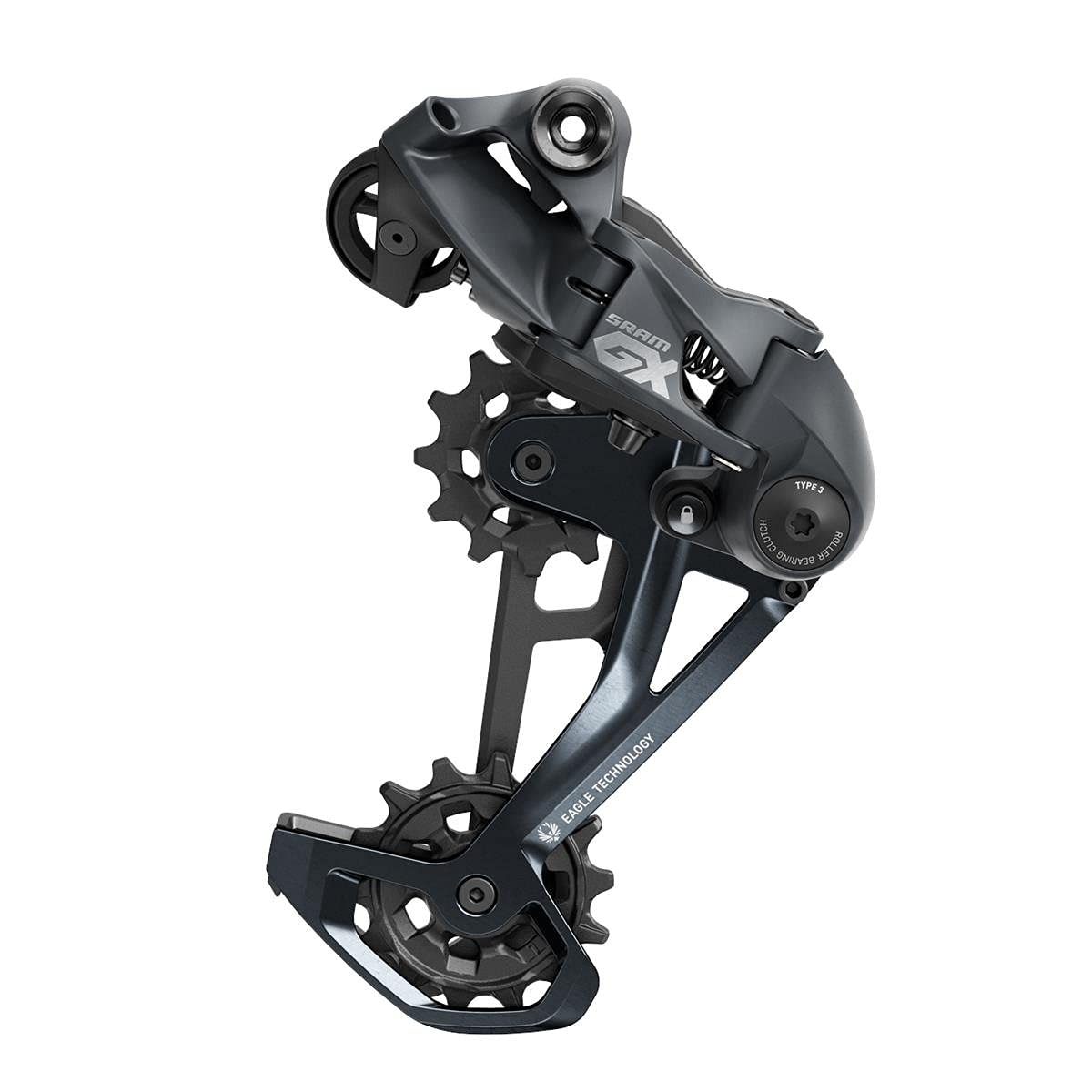
SRAM builds the Eagle line in steps, and the GX is the step where the hardware changes rather than the finish. Sealed cartridge pulley bearings, a revised mounting system and a repositioned Cage Lock separate it from the NX and SX units that come stock on less expensive bikes — and those are the parts that wear first.

That's why we recommend it without much hesitation to anyone already on SRAM 12-speed. It takes both the 10-50 and the 10-52 cassettes, so adding range later doesn't mean buying another derailleur, and the shifts stay crisp when you're pushing hard rather than nursing it along. Chain noise is well controlled too, which on a 1x bike is most of what you notice on a descent.

The limit is the ecosystem: it's an Eagle 12-speed part and needs an Eagle shifter, cassette and chain, so it's no help on a Shimano bike or an older 10-speed. Its cage and pulleys are also the exposed parts on any derailleur, and a drive-side knock is what ends them — worth remembering on a rocky descent where the trail runs close to the crank.

Bottom line: For a bike already built around SRAM Eagle, this is the derailleur we recommend: the smoothest shifting here and room for a 52-tooth cassette.

2

Shimano XT RD-M8100

Shimano XT RD-M8100

12-speed Shimano trail

Our Score 9.4/10
Check Price

Worth Noting

  • 12-speed Shimano only; no 11-speed or SRAM indexing
Speeds
12-speed
Weight
7.05 oz
Max Cog
51T
Pulleys
13T
Read the full review

The silhouette is the argument. The XT's body tucks in under the cassette with a low profile that keeps it clear of roots and rock edges, and 13-tooth pulleys run the chain through a gentler arc than the 11-tooth wheels on cheaper units.

It's a 12-speed Shimano mountain part, which means a 12-speed Shimano mountain shifter: an 11-speed lever won't index it and nothing from SRAM will either. Fitted to the right bike it clears a 51-tooth cassette, and the shifts hold together while you're climbing rather than only on the flat, which is the point of paying up for a trail drivetrain.

At 200 grams on the spec sheet it sits three grams under the Deore, which is the clearest sign that the extra money isn't buying weight. It buys the shape, the bigger pulleys and the way the cage behaves under power. One thing worth knowing before you order: Shimano quotes a 90-day limited warranty on this one, a short window for the priciest Shimano unit in this group.

Bottom line: The 12-speed Shimano pick for a bike that gets ridden hard: quiet, low-profile and worth the premium if your frame and shifter are already 12-speed.

3

Shimano Deore RD-M5120

Shimano Deore RD-M5120

10/11-speed Shimano

Our Score 9.2/10
Check Price

Worth Noting

  • Capped at 10/11-speed Shimano drivetrains
Clutch
Shadow RD+
Speeds
10/11-speed
Max Cog
46T (1x10)
Chain Wrap
41T
Read the full review

The cable clamp is the detail that decides whether this one works. On the Deore M5120 the inner wire loops back around the clamping bolt before it tightens, and a cable run the obvious way will never index cleanly no matter how carefully you adjust it. Route it the way Shimano intends and the rest is straightforward: a 10- or 11-speed Shimano drivetrain, a single or double crank, and the Shadow RD+ clutch that keeps the chain off the stays when the trail turns rough.

The capacity figures decide the fit. Shimano rates it for a 46-tooth largest cog with a 1x10 crank and 42 teeth with a double, on 41 teeth of total chain wrap. That covers the 11-42 and 11-46 cassettes most trail bikes run. If you're on 1x11 with a wide spread, the wrap figure is the one to check rather than the cog figure alone.

The cage is stamped steel rather than forged, and we count that as a trail-bike advantage: a clip with a rock will usually leave it bent rather than cracked, and bent can be straightened at the side of the trail. At 203 grams on the spec sheet it isn't the lightest unit in this group, though the difference is not something you'll feel through the pedals.

What we noticed most is the lack of drama. No chain noise on rough ground, no second adjustment after the first ride, no fuss about the cable once it's routed correctly. For everything from an older hardtail to a current 1x11 trail bike, it's the part we reach for.

Bottom line: For the widest spread of bikes here — 10- or 11-speed Shimano, single or double crank — this is the derailleur we recommend, clutch included.

4

microSHIFT Advent RD+

microSHIFT Advent RD+

Wide-range 1x9

Our Score 9.2/10
Check Price

Worth Noting

  • Requires microSHIFT's own shifter and cable pull
Cage
Medium
Clutch
Yes
Speeds
9-speed
Chain Wrap
41T
Read the full review

A clutch and a wide cassette on an older 9-speed bike used to mean a whole new drivetrain. The Advent RD+ gets you both: a medium-cage aluminium body with an integrated clutch and 41 teeth of total capacity, enough to run a 1x setup with a big rear sprocket on a frame that came with a triple. It's the most useful part in this group for a bike nobody is going to rebuild from scratch.

microSHIFT's own figures are worth reading closely, because they don't quite agree. The specifications list a 42-tooth largest cog while the product description quotes a 40-to-46-tooth range, so measure the biggest sprocket on your cassette and compare it against both before ordering. The cage return spring is strong on its own, which is why the clutch doesn't have to work hard to keep tension.

Where it gives ground is at the top of the cassette. The shift onto a 46-tooth sprocket can balk when the clutch is engaged, and the end of the cage can develop a little side-to-side play. On a ride where the last climb is the steepest one, that's the shift you'll notice most.

Bottom line: We recommend it for one job: turning a 9-speed bike into a clutch-equipped 1x trail bike, with 41 teeth of capacity and a medium cage.

5

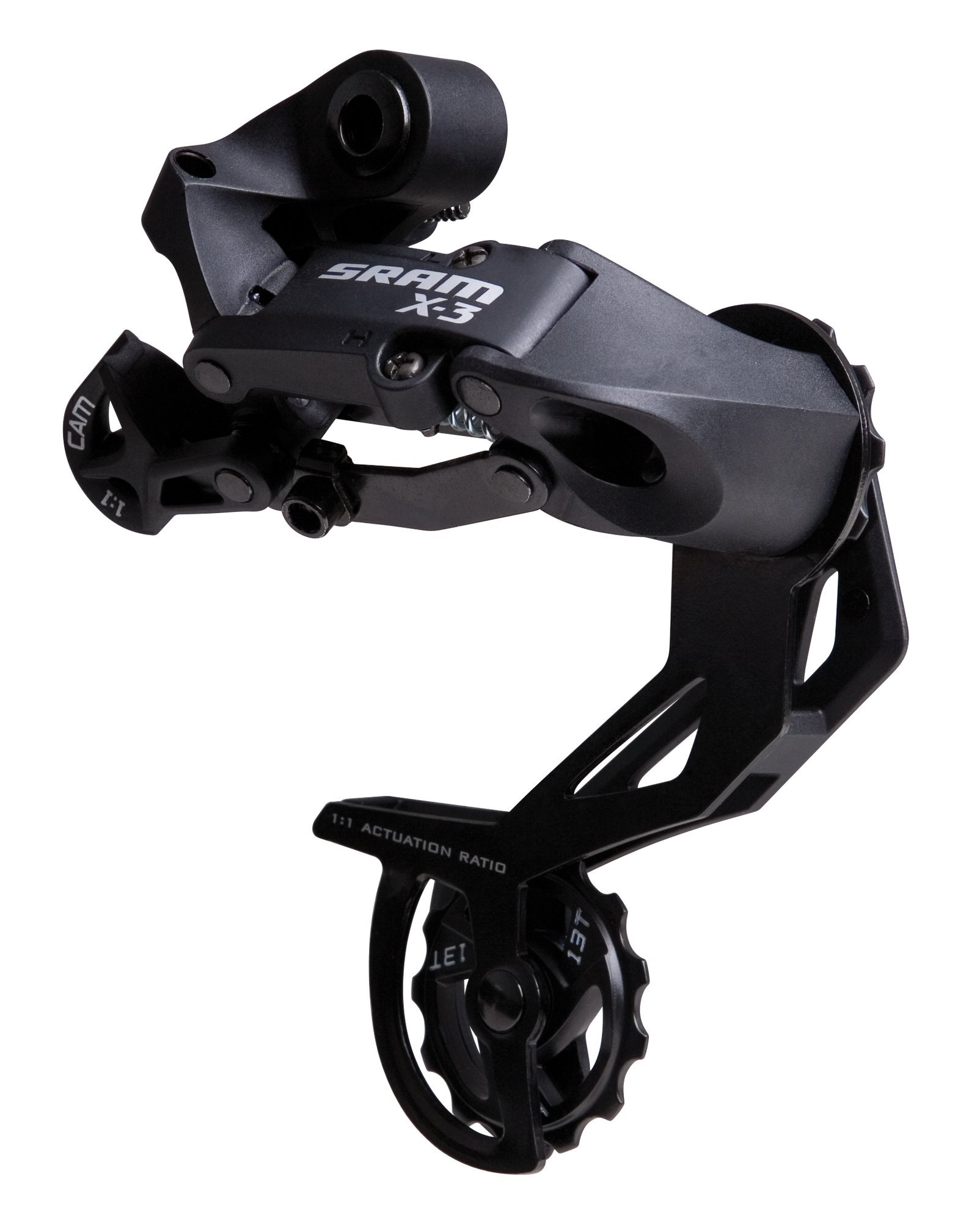
SRAM X3

SRAM X3

Budget 7-9 speed

Our Score 8.8/10
Check Price

Worth Noting

  • No clutch, so the chain slaps on rough ground
  • Needs SRAM 1:1 shifters; no Shimano indexing
Speeds
7, 8 or 9-speed
Weight
9.59 oz
Actuation
1:1 ratio
Chain Wrap
45T
Read the full review

Seven, eight or nine speeds, depending on which shifter you pair it with: the X3 is the long-cage option for bikes that predate the 1x era. Forty-five teeth of chain wrap lets it swallow a wide cassette, and it bolts to a standard 10x1 mount without an adapter.

For a bike that just needs to shift again — a kid's mountain bike, a commuter, an older hardtail — this is the pick we reach for. It indexes cleanly, the long cage takes a wide cassette without complaint, and the 272-gram body is honest rather than delicate. What you give up is the clutch: on a 1x setup over roots and braking bumps, the chain will slap the stays in a way a clutch-equipped unit won't.

Bottom line: Our budget pick for a 7-, 8- or 9-speed bike — as long as it's already running SRAM 1:1 shifters, because nothing else will index it.

6

Relwears RD-TY21B

Relwears RD-TY21B

6/7-speed direct mount

Our Score 0.0/10
Check Price

Worth Noting

  • 34-tooth limit rules out wide cassettes
Mount
Direct mount
Speeds
6/7-speed
Max Cog
34T
Pulleys
11T
Read the full review

Direct mount, not hanger mount: the listing says it twice, and it's the first thing to check. If your old derailleur hangs from a replaceable hanger on a 10mm bolt, this isn't the part for you. If the frame has an integrated tab the derailleur bolts straight to, it drops on without an adapter and the job takes minutes.

What arrives is a 6/7-speed unit with a 34-tooth capacity, 11-tooth guide and tension pulleys, and an aluminium body. It follows the same pattern as the Shimano TY21B it replaces, which makes it a sensible swap for a bent original on a kids' bike, a hybrid or an older hardtail that isn't worth much.

We treat this as a functional replacement rather than an upgrade, and that's the right framing for it. It's for the bike whose derailleur is mangled and whose owner isn't spending much to fix it — get the mount and the cog count right and it will put a second-hand 7-speed back on the road.

Bottom line: A cheap, honest replacement for a 6- or 7-speed bike with a direct-mount frame tab — and the one pick here where confirming the mount is the whole purchase.

How We Tested the Best Mountain Bike Derailleurs

We started by pulling spec sheets for two dozen derailleurs and narrowing to 12 that covered the main drivetrain standards, cage lengths, and price points. That meant checking pull ratios against the shifters we already had, confirming maximum cassette tooth counts, and ruling out anything that couldn't run a clutch or fit our test frames. Each one went onto a trail bike, an enduro bike, or a park bike, depending on its intended use.

Over eight months, we rode those 12 derailleurs on local singletrack, a rocky enduro loop, and lift-served bike-park days. We shifted under load on steep climbs, backpedaled through rock gardens, and sluiced through mud to see what happened. At each step, we logged missed shifts, ghost shifts, chain drops, and how often we reached for the barrel adjuster. We also checked chain alignment with a straightedge after installation and again after a month of riding, because a derailleur that hangs slightly off will never shift its best.

Back in the garage, we inspected the cage, pulleys, and clutch for play, grit, and wear, which told us more about build quality than any spec sheet. Compatibility got equal weight: we tracked install time, cable routing, and whether each derailleur played nicely with the cassette range and shifter we paired it to. To judge value, we compared replacement pulley and cage costs, not just the sticker price. The ones that made the cut shifted cleanly through the full cassette, stayed aligned, and felt solid after months of abuse.

How to Choose Mountain Bike Derailleurs

Match the shifter before anything else

Derailleurs and shifters speak the same language or they don't work at all. Shimano mountain levers, SRAM's 1:1 pull and microSHIFT's Advent line each move the cage a different amount per click, and Shimano's 12-speed mountain family is its own group again. Count your cassette cogs and read the brand on your shifter, then buy inside that family.

A Shimano 10-speed lever will not index the SRAM X3 here, and a 12-speed Eagle derailleur will not index a Shimano 12-speed lever. If you're replacing the shifter at the same time, buy the two as a pair and save yourself a second order.

Biggest cog and chain wrap are different limits

Two numbers decide fit and they're easy to confuse. Largest cog is the biggest sprocket the upper pulley can clear; total capacity, or chain wrap, is how much slack the cage can take up across the whole drivetrain. A derailleur can clear a big sprocket and still run out of wrap.

The Deore M5120 shows how they interact: Shimano rates it for a 46-tooth cog with a 1x10 crank but only 42 teeth with a double, on 41 teeth of wrap. If you keep a double crank, the wrap figure is the one that decides.

Clutch or no clutch

A clutch is a one-way damper in the cage that stops it swinging forward over bumps, and it is the single biggest reason modern 1x bikes run quiet. It also adds drag and one more part to look after, and on some units a firm clutch makes the shift onto the largest sprocket heavier.

For a 1x trail bike, insist on one. For a bike that never leaves pavement, a plain derailleur shifts more lightly and costs less. Every pick here except the SRAM X3 and the Relwears unit has a clutch.

Mount, hanger and cage length

Two mount standards turn up on mountain bikes: a derailleur that bolts to a replaceable hanger, and a frame with an integrated direct-mount tab. Look at the old part before you order, because the Relwears unit here is direct-mount only and says so twice.

Hanger condition matters as much as the part. A hanger bent even slightly will spoil the indexing of the best derailleur on this page, so check it against a straight edge or have a shop align it. Cage length follows capacity: long for wide-range cassettes, medium for tighter 1x blocks.

What the extra money actually buys

Above the entry price you're buying better bearings, bigger pulleys and shifting that holds up under load, not weight. The two Shimano units here are listed three grams apart, so the XT's premium is about its low-profile body and 13-tooth pulleys rather than the scale.

What money doesn't buy is immunity. Any derailleur can be destroyed by a rock strike, and a straight hanger, a correctly sized chain and a spare set of pulleys will do more for longevity than an upgrade will.

Frequently Asked Questions

Final Verdict

If your bike is 10- or 11-speed Shimano, the Deore M5120 is the derailleur we point to: clutch, 41 teeth of wrap, a stamped cage that survives a knock, and mid-tier money. It's the least fussy way to get a quiet, reliable trail drivetrain.

On a 12-speed SRAM bike, take the GX Eagle instead, since it shifts the crispest of anything here and takes both the 10-50 and 10-52 cassettes. Shimano 12-speed riders should go straight to the XT, and anyone keeping a 9-speed bike alive gets the most from microSHIFT's Advent, provided the matching shifter goes in the basket at the same time.