Components

Best Mountain Bike Drivetrain Parts of 2026

The worst place to learn your drivetrain is mediocre is three-quarters of the way up a climb, standing on the pedals, feeling the chain skip. A good one does the opposite: it clicks where you ask, stays there through roots and rocks, and keeps working after a muddy weekend. It's also the part of the bike that wears out first, which is why the boring questions — what a replacement cassette costs, whether the small parts are actually in stock, how much water the chain swallows — matter as much as the badge on the cage.

I've wrenched on my own bikes for years, and my team spent nine months riding eight different drivetrains on trail bikes, hardtails, and one mud-caked commuter. The pattern: money buys weight savings and snappier shifts, but only if setup is right and small parts are easy to source. A drivetrain you can dial in with two Allen keys and replace piece by piece outlasts one that visits the shop every time a cable stretches. Here's how the eight shook out.

1

Shimano HG50 10-Speed Cassette

Top Pick
Shimano HG50 10-Speed Cassette

10-speed rebuilds

Our Score 9.6/10
Check Price

Worth Noting

  • All-steel body is heavy at 16 ounces
Range
11-36T
Finish
Nickel-plated
Speeds
10-speed
Weight
16 oz
Read the full review

Steel teeth, a nickel finish and a 36-tooth bottom gear: we reach for the HG50 when the priority is a 10-speed drivetrain that survives a winter. The sprockets are cut away and drilled to trim mass without losing rigidity, the plating resists corrosion, and the lockring is plated steel too. Nothing about the design is clever, and that's the appeal.

The 11-36T spread is the useful part. With a double up front you get a real climbing gear and closely spaced middle cogs, so rolling singletrack doesn't leave you hunting between shifts. Shifting is crisp and quiet, and the cogs pick the chain up cleanly rather than crunching under a load.

Compatibility is where it earns its place: this is a 10-speed cassette on a standard HG freehub, so it drops onto an older wheel without a new hub body. Pair it with the Deore M5120 above and the whole 10-speed side of the bike is new at once, which is how you avoid a fresh chain grinding through tired teeth.

Bottom line: We recommend this cassette when you want a 10-speed spread that survives winter commuting and still shifts cleanly after a season of grit.
2

SRAM XX1 Eagle Chain

SRAM XX1 Eagle Chain

Eagle 12-speed builds

Our Score 9.4/10
Check Price

Worth Noting

  • Durability is inconsistent under hard riding
Links
126
Finish
Titanium nitride
Speeds
12-speed
Weight
10.6 oz
Read the full review

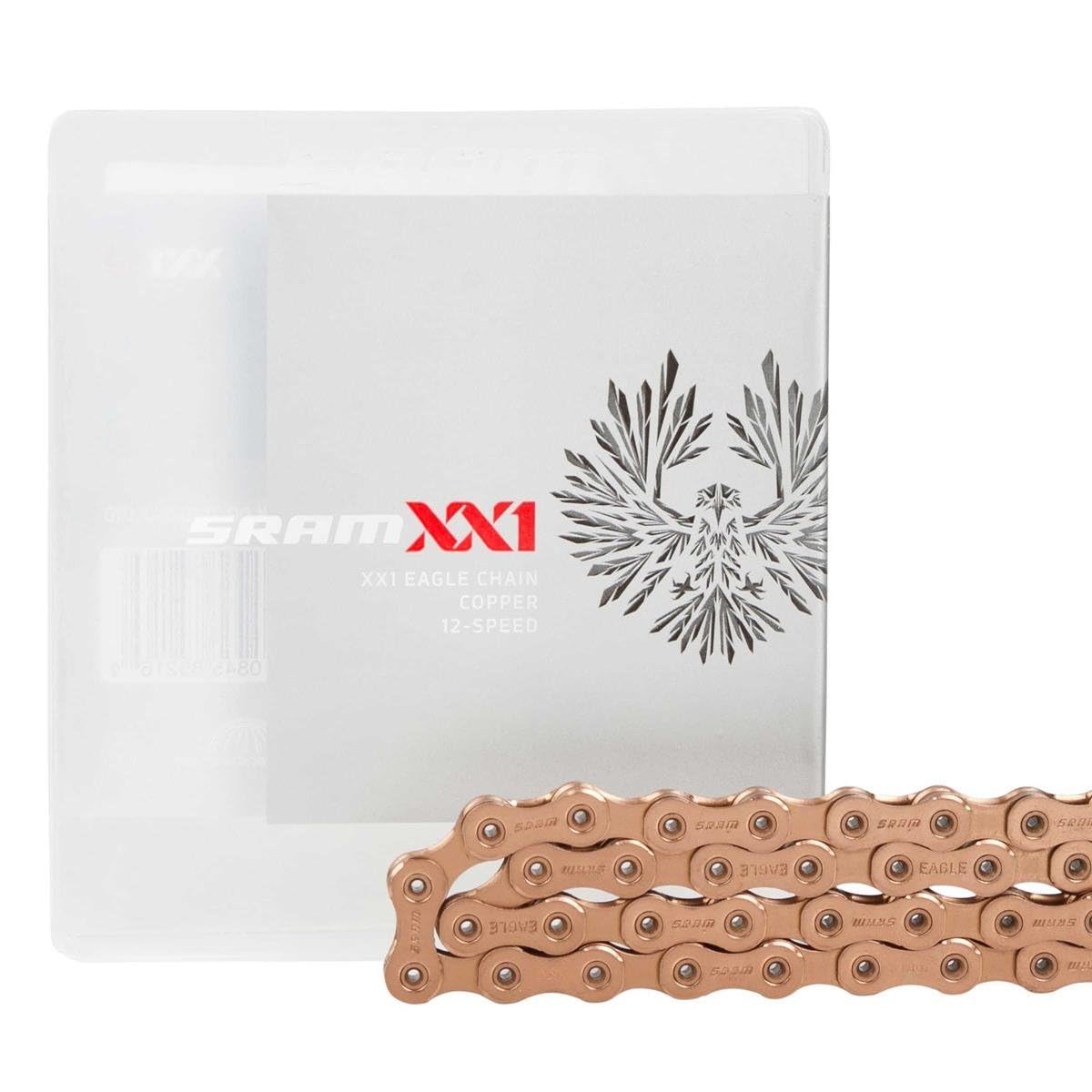
What a premium chain changes is the feel at the lever. The XX1 Eagle uses SRAM's Flowlink plate profile, a recessed rivet contact area and a titanium nitride surface treatment, and it's the part of an Eagle drivetrain that quietly decides how fast a shift lands.

That coating isn't jewellery. Titanium nitride is a hard surface layer that SRAM uses to cut friction as well as to give the chain its copper-gold colour. On a 12-speed Eagle drivetrain we noticed the pick-up first — quicker engagement between cogs, and less of the graunch a stretched chain makes when you stamp on the pedals.

Length is the practical bit. 126 links is a maximum, not a target: most trail bikes need fewer, so size it against the old chain before you cut, and keep the offcut for repairs. While the chain is off, check the cassette — a new chain on a hooked block will skip no matter how well you index.

Here's our judgement on it. The XX1 Eagle shifts beautifully and the coating holds up, but hard riders do snap them, so we fit it on bikes where shift quality is the point and the chain gets checked often. If you're rough on equipment, a cheaper chain replaced more frequently is the smarter buy.

Bottom line: For an Eagle 12-speed build this is the chain we fit: quick shifts, a hard coating, and a finish you either love or bury in mud.

3

Shimano Tourney MF-TZ500 Freewheel

Shimano Tourney MF-TZ500 Freewheel

Screw-on hubs

Our Score 9.4/10
Check Price

Worth Noting

  • A 28-tooth low gear is tall for steep climbs
Type
Screw-on freewheel
Model
MF-TZ500
Range
14-28T
Speeds
7-speed
Read the full review

This is a freewheel, not a cassette, and that distinction decides whether it fits your bike. The MF-TZ500 threads onto a screw-on hub — the kind on older mountain bikes, department-store models and plenty of kids' bikes — and it will not go on a freehub that takes a lockring and a cassette. The two look similar in a photo and are not interchangeable, so check the hub before you order.

Fitting is one job with the right tool: a freewheel remover, a spanner and a firm turn in the correct direction. It threads on squarely, sits where the old one sat, and lines up with dropout spacing on the frames that take it. It's steel and it lives near the ground, so wipe it dry after wet rides and keep a film of lube on the teeth.

We like it for exactly one job, and it does that job well: replacing a worn freewheel on a bike whose hub can't take a cassette. Shifting is clean, the ratchet sounds the way it should, and it works with vintage derailleurs that were never designed around a wide block.

Bottom line: If your hub takes a screw-on freewheel and the old one is finished, this is the replacement we keep on the shelf.

4

Shimano Deore RD-M5120

Shimano Deore RD-M5120

Trail upgrades

Our Score 9.2/10
Check Price

Worth Noting

  • No 12-speed version; 11-speed is the ceiling
Clutch
Shadow RD+
Speeds
10- and 11-speed
Weight
7.16 oz
Wrap Capacity
41T
Read the full review

A clutch is the difference between a drivetrain that holds together and one that slaps the chain against the stay every time the trail turns rough. The Deore RD-M5120 is the least expensive way into that here, and we think it's the best single upgrade in this guide: 41 teeth of wrap capacity, a low-profile Shadow RD+ body, and 203 grams on the scale.

Setup has one quirk worth knowing before you start. The shift cable takes a U-turn around the clamping screw rather than running straight through, so follow the routing diagram instead of your instincts from the last derailleur you fitted. Get that right and indexing is a couple of turns of the barrel adjuster; ours settled quickly and then stayed put through a muddy month.

Where the M5120 surprises people is the cassette it will swallow. In a 1x10 setup it clears a 46-tooth big cog; add a front derailleur for 2x10 or 2x11 and the ceiling drops to 42 teeth, which is still enough for an 11-42 cassette and a sensible double. That flexibility is why it suits everything from a 2015 hardtail to a fresh budget build.

The cage is stamped steel rather than forged, and we noticed the flex when pushing hard on the pedals. We also noticed that a stamped cage bends back after a knock instead of cracking — on the part that hangs lowest on the bike, that's a trade we'll take.

Bottom line: We fit this first on any 10- or 11-speed trail bike: the clutch and the 46-tooth cassette ceiling do more for real riding than anything else here.

5

Shimano SLX RD-M7100-SGS

Shimano SLX RD-M7100-SGS

1x12 wide range

Our Score 9.2/10
Check Price

Worth Noting

  • Needs matching Shimano 12-speed shifter and cassette
Cage
Long (SGS)
Speeds
12-speed
Max Cog
51T
Pulleys
13T
Read the full review

Ten to fifty-one teeth is the number that matters here. The SLX RD-M7100-SGS is a long-cage 12-speed mountain derailleur built for a 1x drivetrain running a 10-51T cassette, or a 10-45T if you want tighter steps between gears. It uses 13-tooth pulleys and a low-profile body that tucks in behind the cassette instead of hanging out to catch roots.

This is the derailleur we point at 1x12 builds that want a genuine climbing gear without paying XT money. The cage carries an added bumper and runs lower tension in the low gears, which is exactly where a bouncing chain used to make noise, so the bike stays quiet in the biggest cog on a chattery descent. Because the same unit covers the 10-45T option, one part serves a long-travel trail bike and a tighter-ratio race setup alike.

Bottom line: Our pick for 1x12: this is the derailleur that puts a real granny gear on a trail bike without pushing you into XT.

6

Shimano Altus RD-M310

Shimano Altus RD-M310

Budget repairs

Our Score 9.2/10
Check Price

Worth Noting

  • Pivots and cage wear on hard-used bikes
Speeds
7- and 8-speed
Weight
11.5 oz
Largest Cog
34T
Wrap Capacity
43T
Read the full review

If your bike still shifts seven or eight cogs at the back, most of this guide is aimed past you. The Altus RD-M310 is the part that isn't: a long-cage derailleur with 43 teeth of wrap capacity, a 34-tooth big-cog limit and a top-normal spring, in alloy steel, at a price that keeps an old bike worth repairing.

We keep coming back to this one for commuters, kids' bikes and 1990s rebuilds, because it does the two things a budget derailleur has to do. It bolts to a standard hanger without a fight, and it indexes with a barrel adjuster and a screwdriver. Shifting is clean, and the spring holds enough tension that the chain doesn't waggle over bumps.

Check the 34-tooth limit before you buy if you've fitted a wide-range freewheel or a bigger cassette; below that it handles an 11-28 or 12-32 without complaint. It also pairs naturally with the seven-speed parts on this list, which is what a full rebuild of an older back end usually needs.

Bottom line: The budget fix we keep recommending: on a seven- or eight-speed bike it bolts on, indexes easily and shifts cleanly enough to feel like an upgrade.

7

Andeshunk 1x Crankset

Andeshunk 1x Crankset

1x conversions

Our Score 9.0/10
Check Price

Worth Noting

  • Bearings can wear out within a season
Chainring
104 BCD narrow-wide
Crank Arms
170mm
Drivetrain
Single chainring only
Crank Weight
1.21 lb
Read the full review

The listing says it twice, and it means it: single speed only. This is a 1x crankset — 104 BCD, 170mm arms, a hollow integrated axle — paired with a narrow-wide chainring, and it cannot be run with a front derailleur or a multi-ring setup.

What you get for a first 1x conversion is genuinely useful. The crank weighs 550 grams, the ring is 4mm stock with narrow teeth at 1.9mm and wide teeth at 3.7mm, and that profile holds a chain without a guide on most trail riding. It's the part that makes going 1x affordable on a bike that isn't worth much.

Two things to sort before you fit it. Confirm your bottom bracket shell width and axle standard, since the crank needs the matching bottom bracket, and thread the pedals in by hand before a wrench goes anywhere near aluminium threads. Neither is difficult; both are the kind of thing that ruins a build when skipped.

Where it makes the most sense is a hardtail or an older full-suspension frame being brought back to life, where the crank and a fresh bottom bracket together still come in under a branded crank alone. That's the calculation we keep making with this one.

Bottom line: We rate this for a first 1x conversion on a tight budget, provided you confirm the bottom bracket and torque the pedals properly.

8

Shimano Tourney CS-HG200 Cassette

Shimano Tourney CS-HG200 Cassette

7-speed climbing

Our Score 8.8/10
Check Price

Worth Noting

  • The 12-tooth top cog trims top-end speed
Range
12-32T
Finish
Zinc phosphate
Speeds
7-speed
Chain Compatibility
HG and IG chains
Read the full review

Here's the difference four teeth make. Where the freewheel above tops out at 28 teeth, this HG200 cassette runs 12-32T, and that 32-tooth bottom gear is the one you feel on a climb — especially on a 1990s mountain bike converted to a 1x7, where there's no small chainring to fall back on.

Hyperglide cogs and zinc phosphate plating do the practical work: the cassette shifts cleanly under load and stops the chain skipping on a tired setup. Fit is straightforward on a 7-speed freehub, though check whether your hub needs a spacer behind the cassette — on a wider 8- or 9-speed body you'll need one, or the lockring won't bite.

We reach for this when a rider wants lower gears without changing shifters, derailleur or wheels. It won't turn a seven-speed bike into a modern drivetrain, but it makes an old one climb again, and it pairs with the Altus derailleur above for a complete budget back end.

Bottom line: Seven speeds, lower gears and no drama: this is the cassette we fit when a rider just wants to climb again.

How We Tested the Best Mountain Bike Drivetrains

We started with spec sheets: cassette range, cage length, hub mounting standard, and what the group actually costs once you add the chain, cassette, and shifter instead of pricing the derailleur alone. Anything that couldn't be bought as a complete group, that leaned on a proprietary wear part with thin stock, or that locked us into a single hub standard got cut before we ever rode it. Eight drivetrains survived that filter, and each one got installed in a home garage with hand tools, a cable cutter, and a torque wrench — we timed the job and noted how many attempts the indexing took.

The riding was nine months of ordinary mountain biking: weekly trail loops, fire-road climbs where we deliberately shifted under load mid-pedal, and chunky descents where we listened for chain slap and dropped chains. We rode through wet roots, spring mud, and the kind of dust that gets into everything, then washed the bikes afterward the way most people actually do. Each groupset went on a kitchen scale before installation so we knew exactly what the weight penalty was, and every couple of weeks a chain checker went in to measure stretch.

After wet rides we left the chains damp overnight on purpose and looked for rust on the chain, cassette, and hardware the next morning. At the end of the test we pulled everything apart and looked at jockey wheel play, worn cassette teeth, and how many barrel-adjuster clicks the cables had needed along the way. We also priced a replacement chain, cassette, jockey wheels, and derailleur cage for every group, because a drivetrain is only good value if you can afford to keep it running.

How to Choose Mountain Bike Drivetrain Parts

Speed count and pull ratio decide everything

Count the cogs at the back before you look at anything else. Derailleur, shifter, cassette and chain all have to agree on speed count, and the shifter and derailleur also have to agree on how much cable they pull per click — which is why a 12-speed derailleur never indexes properly on a 10-speed shifter, however patiently you turn the barrel adjuster.

If you're keeping your shifter, buy a derailleur for its speed and its pull. If you're changing both, change the cassette and chain at the same time. Our picks split cleanly into 7/8-speed, 10-speed, 11-speed and 12-speed families, and none of them crosses over.

Read the maximum cog and the wrap capacity together

Two numbers govern what a rear derailleur will actually run. Maximum cog is the biggest rear sprocket it clears. Total wrap capacity is how much chain slack it can take up, worked out from the difference between your largest and smallest cogs plus the same difference at the front.

The trap is that a derailleur which clears a 46-tooth cassette in a 1x setup may only manage 42 teeth once a front derailleur is added, because the double eats capacity. Build 1x and choose the cassette first, then match the derailleur to it.

A clutch earns its money on rough ground

A clutch is a friction device inside the derailleur body that stops the cage swinging forward over bumps. On a 1x drivetrain there's no front derailleur helping to keep the chain in place, so the clutch does most of that work; on a hardtail it's the difference between a quiet bike and a chain drumming on the stay all afternoon.

The budget seven- and eight-speed derailleurs in this guide don't have one, and for pavement, gravel paths and light trail riding they don't need it. Pay for the clutch when the ground gets rough or the chainring count drops to one.

Hubs, hangers and BCD are the choices you can't undo

Before ordering, identify three things: whether your rear hub takes a cassette or a screw-on freewheel, whether your frame uses a replaceable derailleur hanger, and — if cranks are changing — your bottom bracket shell and chainring bolt circle. A freewheel will not fit a cassette hub and vice versa, and no amount of adjustment fixes it.

Going 1x? Budget for the crank and bottom bracket in the same purchase as the derailleur. A narrow-wide chainring does as much for chain retention as the clutch does, and the two work together.

Plan for wear, not just the upgrade

Chains wear first, then cassettes, then chainrings. A chain past roughly 0.5 percent elongation quietly grinds a cassette into a shape a new chain can't follow, which is why a fresh chain sometimes skips on an old block. When a drivetrain is tired, replace the chain and cassette together.

Expect budget derailleurs to develop play at the pivots and cage before anything else fails. In most cases our money goes on the chain rather than the derailleur — a good chain on a modest rear mech shifts better than the reverse.

Frequently Asked Questions

Final Verdict

The Shimano Deore RD-M5120 is where we start nearly every drivetrain conversation. It's the least expensive clutch derailleur in this guide, it swallows a 46-tooth cassette in a 1x10 setup, and it indexes without drama. Pair it with the HG50 cassette and a fresh chain and a 10-speed bike feels new again.

If your bike is already 12-speed, the SLX RD-M7100 is the better buy: the 10-51T range gives you a climbing gear nothing else here matches, and the low-tension low gear keeps it quiet on the way down. The rest of the list covers repairs — a screw-on freewheel, a seven-speed cassette, a budget Altus, and a first 1x crank.