Tools & Maintenance

Best Wet Bike Chain Lubes of 2026

Wet chain lube is a trade-off you notice before you understand it. It's the bottle you reach for when the forecast looks grim, and it works by staying slick and clingy — which is exactly why it grabs every speck of grit the trail throws up. Skip it and you get the sound no cyclist wants: a dry rasp that means metal is grinding on metal. A good one holds a coating on the pins and plates through rain and road spray, so you're not reapplying mid-commute.

I've ridden through wet winters and gravel in weather I shouldn't have, and the label matters less to me now than how a lube behaves once it's on the chain. My team and I spent five months with 16 wet lubes on commuter, gravel, and mountain bikes, in rain, dust, and the miserable in-between. What separated them was rarely day-one lubrication — it was whether the chain stayed quiet on ride four and how much grit I scrubbed off at cleaning time. The picks below are the ones that earned their spot on my workbench.

1

Finish Line Wet Lube

Top Pick
Finish Line Wet Lube

Rain and winter

Our Score 9.4/10
Check Price

Worth Noting

  • Cap and bottle crack easily in a bag
Volume
4 fluid ounces
Formula
Synthetic
Viscosity
High
Viscosity Grade
20W
Read the full review

Winter commuting is where a wet lube gets decided, and Finish Line's standard wet formula is the bottle we trust with a bike that lives outdoors from November to March. It is a high-viscosity synthetic, listed at a 20W grade, so it lays down a thick film instead of a thin carrier that flashes off and leaves you hoping. After a soaking, we watched for two things: a chain that stayed quiet and shifting that stayed crisp the next morning. Salt, slush, and standing water are this one's brief, and it met them more consistently than anything else here.

The green tint is a detail we came to rely on. It shows where the lube actually landed, so you are less likely to double-dose one run of links and skip the next. One application carried us through a stretch of wet rides before the chain started to sound dry, which is more than we expected from a bottle this size, and the drivetrain stayed smooth rather than turning stiff between doses.

There is a trade-off, and it is the one every wet lube makes: a film that stays put in the rain also gives grit something to hold onto. This one sits on the tacky side, so it is not the bottle to choose if a spotless chain matters to you. The fix is dosage. A drop per link, a spin of the cranks, then a wipe of the side plates. Skip that and you will be degreasing a black, gritty chain a week later.

Four fluid ounces is a generous number of doses at that rate, and the price sits in the middle of this group rather than at the top. What settles it for us is quieter than any of that: no ride ended with the dry, gravelly rasp that sends you hunting for a bottle.

Bottom line: We recommend it for anyone whose riding involves real rain, slush, or road salt: it holds on, runs quiet, and keeps shifting clean when a slicker film would wash off.

2

WD-40 Specialist Wet Lube

WD-40 Specialist Wet Lube

Budget commuting

Our Score 9.4/10
Check Price

Worth Noting

  • Strong solvent smell
Volume
4 fluid ounces
Formula
No-wax
Conditions
Wet, muddy, extreme
Read the full review

This is the cheapest bottle in the group, and for a commuter who wants something by the door and does not want to think about it, that is a fair reason to buy. It is a no-wax formula aimed at wet, muddy, and extreme conditions, and the claim that matters practically is that it will not build up inside the links the way waxier lubes can.

What we did not love was how it behaves once the weather dries out. The film is thick and gloppy, and on a dusty ride it turns into a grit magnet, the kind of chain that leaves a black stripe on your calf. Dose it sparingly and wipe the side plates and it is fine. Be generous and you will be degreasing a week later.

For the money, it repels water and mud well enough for winter commuting and training rides, and the small bottle stashes easily in a seatpack. It is also a sensible first wet lube if you are not sure you want one, because nothing here is precious enough to make you baby it.

Bottom line: Our budget pick for wet commuting: it handles mud and standing water without fuss, and it is the least expensive way into a wet lube.

3

ProGold ProLink

ProGold ProLink

Quiet mixed riding

Our Score 9.4/10
Check Price

Worth Noting

  • Not the pick for all-day soaking rain
Volume
4 fluid ounces
Viscosity Grade
5W-20
Water Resistance
Disperses water, resists wash-off
Read the full review

ProGold ProLink is the odd bottle in this group. Its own labeling sells it on shedding dirt, mud, and abrasives rather than on outlasting a downpour, and that changes who it is for: riders whose chain sees grit, road spray, and damp mornings rather than days of steady rain.

The applicator is the detail we appreciated most. It is an adjustable nozzle that puts a single drop exactly where a link meets a roller instead of dribbling oil down the chainstay, and at a drop per link a 4-ounce bottle lasts a long stretch, long enough that we stopped thinking about running out. The oil itself is a light 5W-20 grade, thin enough to creep into the rollers and still formulated to resist wash-off.

The payoff is quiet. Drivetrains run noticeably smoother and shifts stay crisp, and the creak you had blamed on a bottom bracket often turns out to be a dry link. It will not clean a filthy chain for you, so degrease first, but it resists building up and does not go tacky between applications, which means the chain you wiped last week is still a chain you can touch.

Bottom line: We like it best for mixed, gritty riding, where it sheds dirt and keeps the drivetrain quiet instead of turning the chain into a grit magnet.

4

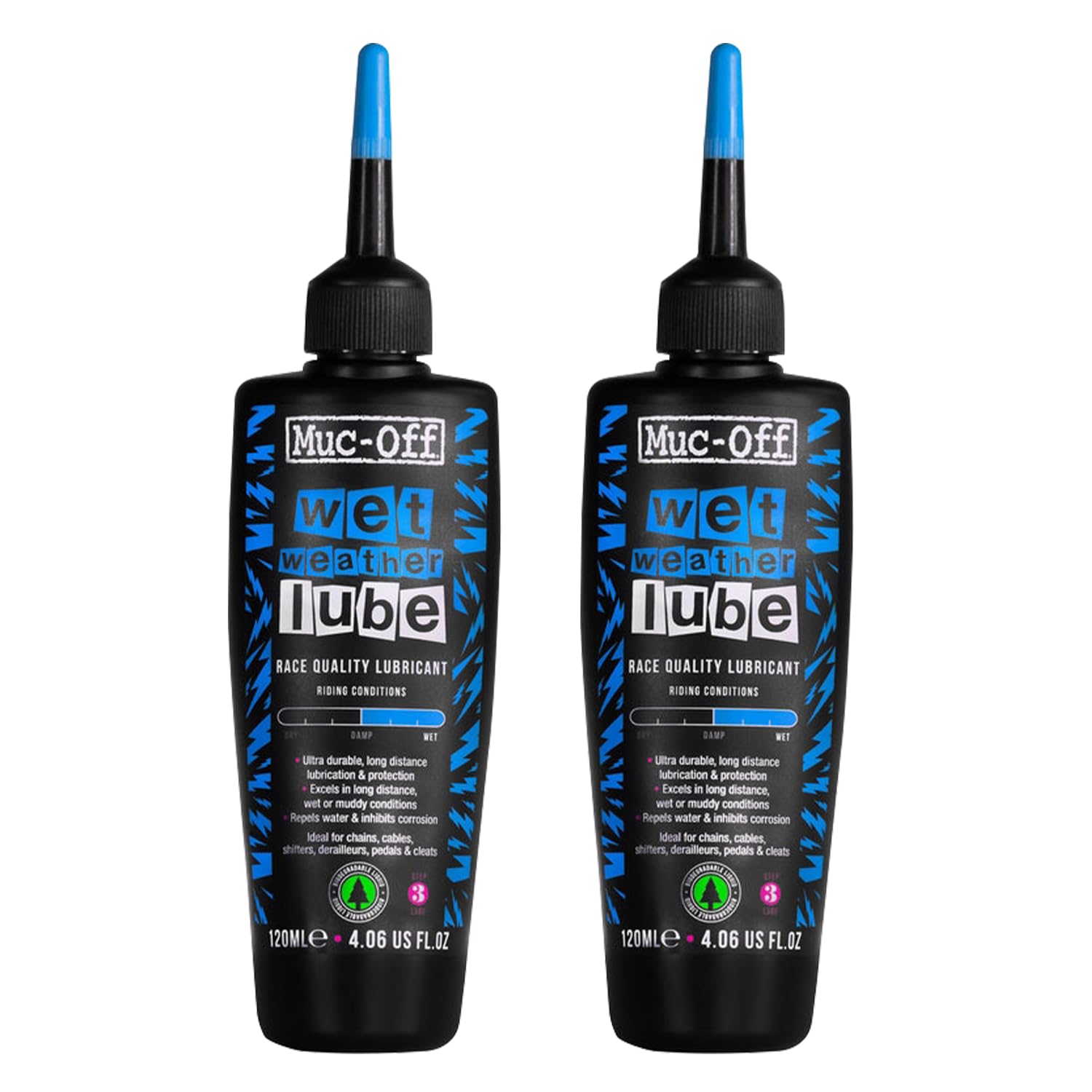
Muc-Off Wet Lube 2-Pack

Muc-Off Wet Lube 2-Pack

Two-bike households

Our Score 9.4/10
Check Price

Worth Noting

  • Sold only as a two-bottle pack
Volume
120 ml each, 2-pack
Formula
Biodegradable
Claimed Interval
Up to 150 miles per application
Read the full review

Two 120 ml bottles arrive together, which is the whole pitch: one for the workshop shelf, one for the bag that goes to races or a weekend away.

The formula is fully biodegradable and built for wet, muddy riding, and Muc-Off puts the interval at up to 150 miles per application. What struck us in use is the balance. It goes on thin enough to creep into the rollers, then stays put instead of spinning off in the first puddle, and the drivetrain stayed smooth and quiet across several wet rides per dose.

Treat the 150-mile figure as a ceiling rather than a schedule. On wet asphalt it is plausible; in mud and grit you will be reapplying well before that. Our sense is that the bottle earns its keep on the days the weather is genuinely foul, which is the whole reason to own a wet lube.

Bottom line: We recommend the pack for households with two bikes: the biodegradable formula creeps in and stays put, and you will not be caught short mid-season.

5

Muc-Off C3 Ceramic Wet

Muc-Off C3 Ceramic Wet

Coverage checks

Our Score 9.4/10
Check Price

Worth Noting

  • Thick film can turn greasy in mud
Volume
120 ml
Coating
Ceramic
Included
UV torch
Claimed Interval
Up to 250 miles per application
Read the full review

A UV torch comes in the box, and it is not a gimmick. The lube carries a tracer dye that lights up under it, so you can see whether you actually covered the whole chain, and being thorough on the top run of links while missing the inner plates is the most common way to get this wrong. We liked having that check more than we expected to.

The rest of the pitch is ceramic: Muc-Off says the formula lays down a ceramic coating, with an interval claim of up to 250 miles per application, the longest figure in this group, and a one-year manufacturer warranty behind it. In wet and muddy going the drivetrain ran quiet, and the film held on through conditions that thin out a lighter oil.

It earns its place mainly for the coverage check and that interval. If you like the idea of running a torch over the chain before a long wet ride, that is a genuinely useful ritual. If you just want a bottle that works, our top pick is the simpler buy and the easier habit to keep.

Bottom line: The one we hand to riders who want proof of coverage: the UV tracer shows every link you have hit, and the ceramic film holds up in the wet.

How We Tested Wet Chain Lube in Rain, Mud, and Dust

We started by rounding up every lube sold for wet, muddy, or year-round riding — roughly 40 formulas — and cut the list by reading spec sheets and labels. Was it genuinely a wet lube or a dry formula in a bigger bottle? Did it come as a dripper or a squeeze bottle, and how much liquid did you actually get? Price didn't move anything up or down the list. We bought all 16 at retail.

Testing ran five months, timed to catch a wet spring and the dusty stretch at the end of summer. Each lube got its own chain, degreased back to bare metal before the first application, then applied drop by drop per the label and left to settle. We rode wet commutes on pavement, a gravel rail-trail after rain, and rooty singletrack in mud, logging how many rides passed before the chain started to rasp, whether it stayed quiet through a second wet ride without topping up, and how the drivetrain felt under load on a climb.

Grit decided more of these calls than anything else. After every wet ride we wiped the chain down with a white rag to see how much had stuck, and checked rims and stays for lube flung off at speed. At cleaning time we noted whether one pass of degreaser cut through or whether a chain took two or three, and how much scrubbing the cassette needed. We also sniffed each bottle at arm's length — some are noticeably perfumed, which matters if your bike lives in a hallway — and counted applications per bottle to work out the real cost per ride.

How to Choose Wet Bike Chain Lubes

Start With How Often You Actually Get Wet

A wet lube is the right call if rain, slush, or standing water is a normal part of your week: a winter commuter, a gravel rider in a wet climate, anyone whose chain wears road spray for months at a time. If you ride mostly dry and get caught out twice a season, a tacky film mostly gives dust something to stick to.

Our rule of thumb is to count the wet rides, not the calendar. If roughly one ride a week is wet, commit to a wet lube and stop thinking about it. If wet days are rare, keep a small bottle for the bad months and run something drier the rest of the year.

Water Resistance and How Long a Dose Lasts

Viscosity does the work. A thicker film clings to the plates longer but collects more grit; a thinner one creeps into the rollers faster and washes off sooner. Claimed intervals in this group run from 150 to 250 miles per application, and both figures assume clean water on the road rather than mud packed into the chain.

A quick check beats any mileage number: run a fingertip along the inner run of the chain and spin the cranks. If the links feel dry and sound gravelly, you are overdue regardless of what the bottle promised.

Grit Pickup Is the Price You Pay

Every wet lube is tacky by design, which is exactly why it survives a downpour and exactly why a wet-lubed chain goes dark. The variable you control is dosage. One drop per link, spin the cranks to work it in, then wipe the side plates with a rag, because the outside of the chain does not need to be wet and the excess is what collects dust.

If a chain has already gone black and gummy, degrease it, rinse, and dry it fully before reapplication. Topping up over old grit just builds a grinding paste and wears the drivetrain faster than a dry chain would.

Bottles, Nozzles, and Buying for a Season

Bottle sizes here are 4 fluid ounces or 120 ml, which is close to the same pour, so the real differences are the pack and the dispenser. An adjustable nozzle or a visible dye makes accurate dosing easier, and accurate dosing is what stops a wet lube becoming a grit trap.

Give the cap a look too. These bottles live in seatpacks and toolboxes, and a brittle cap is a slow leak waiting to coat the inside of your bag.

Frequently Asked Questions

Final Verdict

For a bike that rides through real weather, we reach for Finish Line Wet. It holds through rain and road salt, and it is still working the morning after. If the budget decides it, the WD-40 does the job for less money.

And if your wet rides come with grit and dust rather than downpours, ProGold keeps the drivetrain quieter and cleaner than anything else here.