Components

Best Bike Brake Calipers of 2026

A brake caliper has one job: clamp a spinning rotor or rim and turn speed into control. The problem is that the gap between a caliper that feels solid and one that feels vague, noisy, or fussy to set up rarely shows up on a spec sheet. The right one gives you predictable stopping power, straightforward installation, and quiet running—so you spend your time riding, not adjusting.

Over the past nine months, our team has installed and ridden 14 different calipers on commuter, road, gravel, and mountain bikes, and the pattern is clear: value and performance don't always line up the way you'd expect. One quick piece of advice: check your frame and fork mounts before you buy, because fit is half the battle. The picks below are the ones that earned a permanent spot on our bikes.

1

Shimano M375 Caliper

Top Pick
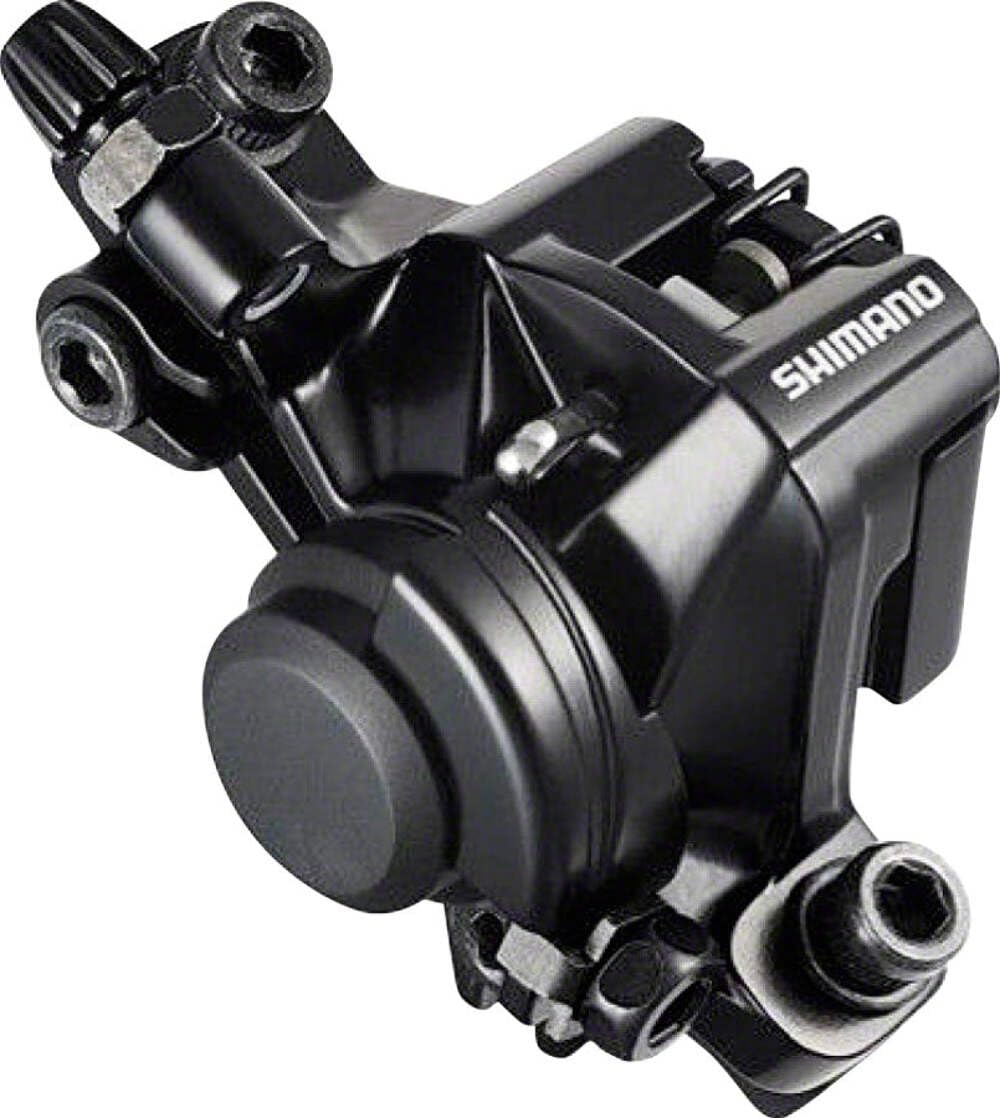
Shimano M375 Caliper

Mechanical disc replacement

Our Score 9.2/10
Check Price

Worth Noting

  • Rotor and mounting adaptors sold separately
  • One caliper only
Pads
B01S resin included
Mount
74mm post mount
Actuation
Cable-actuated mechanical
Rotor And Adaptor
Not included
Read the full review

Two numbers decide whether a caliper is worth ordering: the bolt spacing on your frame or fork, and the rotor you already run. This Shimano is a 74mm post-mount caliper, a common fitting on mechanical-disc bikes, and it arrives with a pair of B01S resin pads already in the body. The rotor and any adaptor stay on your shopping list, so a 51mm IS frame or a jump to a 180mm disc means adding the adaptor to the same order.

Setup is the part we appreciated most. The caliper slides on its mounting slots for alignment, and the stationary pad adjuster screw takes up pad wear from the outside without pulling the wheel or the caliper. That screw is the detail separating a mechanical disc brake that stays crisp for a season from one that rubs and squawks by August.

Stopping is the other half of the case. Cable discs carry a reputation as the poor relation of hydraulics, and this one mostly ignores it: the pads are big, the bite is firm, and it hauls a laden bike down with more authority than the price bracket suggests. It also runs quiet once bedded in, which is not a given at this end of the market.

What you're buying is one caliper. A front-and-rear refresh doubles the order and makes the two-caliper kits here look like better arithmetic. Buy it for a single failed caliper or a fork upgrade, where the adjuster and the quiet running are worth more than the bundle saving.

Bottom line: We recommend it as the default mechanical disc caliper: it fits the most common mount, comes with pads, and stops with a firmness that makes the swap worthwhile.

2

LOOEEL Mechanical Disc Pair

LOOEEL Mechanical Disc Pair

Budget pair

Our Score 9.2/10
Check Price

Worth Noting

  • Single-piston action limits modulation
  • Front and rear calipers aren't interchangeable
Set
Front and rear pair
Mount
51mm IS and 74mm post
Rotor Fit
Front 180/160mm, rear 160/140mm
Read the full review

At the bottom of the price range in this guide, this is the pair we hand to people who need two calipers and don't want to think about it: front and rear units, mounting screws included, and both 51mm IS and 74mm post spacing drilled into each body.

The offsets are the catch worth knowing. The front unit is built for 180mm or 160mm rotors at a 0mm offset; the rear takes 160mm or 140mm at 20mm. They're not swappable end to end, and bagging them separately before you start saves a confusing ten minutes at the bench.

Performance is honest rather than impressive. It's a single-piston, one-way pull design, so modulation is coarse — you feel the pads bite in stages rather than swell smoothly. Against a worn rim brake that's a clear gain; against a hydraulic it plainly isn't. For a folding bike, a commuter or a kids' build ridden at moderate speed, that's a fair trade.

Treat them as consumables. At this money, replacing a pair every couple of seasons still costs less than one of the branded calipers here, and the simple mechanical action means there are no seals to weep and nothing to bleed.

Bottom line: We see it as the value pair: two calipers, both common mounts, and enough stopping power for a commuter or folder at the lowest price here.

3

TEKTRO MD-M300

TEKTRO MD-M300

E-bike OEM swap

Our Score 9.2/10
Check Price

Worth Noting

  • Rotor sold separately
  • Requires long-pull linear-pull levers
Body
Single-piece aluminum
Rotor
Sold separately
Weight
7.2 oz
Lever Type
Linear-pull (long-pull)
Read the full review

Open the box and there's a caliper and not much else — the rotor is sold separately, and the body is a single machined piece of aluminum rather than two halves bolted together. That one-piece construction is the reason to care: under a hard pull there's less flex, so more of your lever travel reaches the pads instead of bending the caliper.

The other specification to check is your levers. This caliper is designed for linear-pull brake levers, the long-pull type on most flat-bar bikes; paired with a short-pull road lever it gives a spongy, underpowered brake no matter how carefully you adjust it. Get that match right and setup is a five-minute job on existing posts.

We rate it highest for e-bike riders who simply want the brake they had. It's a straight replacement on RadRunner Plus and Himiway Cruiser models, so the mounting and the cable run are already right and there's no adaptor to source. On a heavy bike that lives outdoors, that predictability matters more than an extra fraction of bite.

It's still a mechanical caliper, so there's no hydraulic feel and no self-adjustment — you'll be winding the pad adjuster as the pads wear, and cable stretch wants a barrel adjuster's worth of attention in the first month. That's ordinary maintenance on any cable brake, and it's the price of never bleeding a line at the side of the road.

Bottom line: For riders replacing a worn OEM e-bike caliper, this is the cleanest swap we've come across in this set, with a stiff body and no adaptor juggling.

4

PETCHOR HB-100 Calipers

PETCHOR HB-100 Calipers

More stopping power

Our Score 9.0/10
Check Price

Worth Noting

  • Seal and piston life is the open question
Set
Front and rear pair
Body
Aluminum
Finish
Red
Actuation
Cable-pull hydraulic
Read the full review

The idea behind a cable-pull hydraulic caliper is simple and slightly strange: your existing cable still does the pulling, but inside the caliper that pull drives a hydraulic piston instead of a mechanical arm. You keep your levers, your housing and your cable routing, and you get a firmer, more consistent squeeze at the pads. The HB-100 is the version of that idea we see work most often.

Braking is where these earn their keep. Bite is noticeably harder than a tired mechanical caliper, and the lever stays light rather than wooden — the sort of change you notice on the first steep descent rather than the first squeeze in the driveway. The red finish is loud, in a good way, and it doesn't read as a cheap part up close.

Installation is a bolt-on job, and one instruction matters more than the rest: leave the yellow spacer between the pads until the caliper is on the rotor, and never pull the lever with nothing in there. Squeezing a cable-hydraulic dry can push a piston out past its seal, and that's a caliper you can't bleed back to life at home.

What keeps it off the top step is the long game. Seals are the part of any hydraulic that decides how many seasons you get, and this design has a shorter record than a plain mechanical caliper — worth knowing if you ride through salt and grit all winter.

Bottom line: Our pick if you want hydraulic bite but aren't ready to swap levers and hoses — the calipers bolt on and the difference is obvious from the first squeeze.

5

Shimano BR-R451

Shimano BR-R451

Road rim brakes

Our Score 9.0/10
Check Price

Worth Noting

  • Rear only
  • Best matched to Super SLR levers
Pads
Cartridge type
Type
Mid-reach road caliper
Position
Rear
Lever Match
Super SLR STI and brake levers
Read the full review

Rim brakes haven't vanished; they've just stopped being sold to you. On a road frame with 27-inch wheels, or a classic steel bike being kept alive, a mid-reach caliper is what decides whether the arms reach the rim and whether a mudguard fits underneath. Short-reach racing calipers come up short here; this one doesn't.

Two details make it pleasant to live with. The shoes adjust for toe-in, so you can dial out the squeal that plagues badly set rim brakes, and the pads are cartridge type — you slide the insert out rather than buying a whole shoe. It's also the lightest caliper here by a wide margin, which matters if you're the one carrying the bike up stairs.

Lever pairing is where it rewards a little homework. It's built for Super SLR-enabled STI and brake levers — the 105, Tiagra and Dura-Ace generations among them — and with that match the action is light and the power arrives early in the stroke. Bolt it to a mismatched lever and a well-made caliper suddenly feels wooden.

It's sold as a rear caliper, so a full rebuild means buying the front separately. And the reach that clears a 27-inch wheel with a mudguard can leave a gap on a tight modern frame: measure from the brake bolt to the middle of the rim before ordering. If the arms have to come in past their slots to touch the rim, the caliper is wrong for the frame, not badly adjusted.

Bottom line: Rim-brake riders are the reason this one is here, and we rate it for mid-reach frames where a short-reach caliper simply won't clear the rim.

6

TOBWOLF Cable Disc Kit

TOBWOLF Cable Disc Kit

Full mechanical refresh

Our Score 8.8/10
Check Price

Worth Noting

  • Fasteners can come up short or badly cut
Mount
74mm post and 51mm IS
Includes
Two calipers, two 160mm rotors
Caliper Weight
180g each
Rotor Thickness
2mm
Read the full review

We keep coming back to this kit for one reason: two calipers, two 160mm stainless rotors and the rotor bolts arrive in a single order, at a price that undercuts buying branded calipers and rotors separately. If your mechanical discs are worn, scored or simply outclassed, it's the shortest route back to a working setup.

The fit details are the ones to check before you buy. Both calipers are drilled for 74mm post and 51mm IS spacing, and the pair is offset — 0mm at the front, 20mm at the rear — so the two units aren't interchangeable. The rotors are 2mm thick with a 44mm inner diameter on a standard six-bolt pattern, and the sawtooth outer edge is there to cut squeal rather than to save weight.

Installation is a spanner job rather than a workshop job: bolt each caliper up, centre it on the slots, set the fixed pad, squeeze and check. Everything needed to hang the calipers and the rotors is in the box, and the stopping power afterwards is a clear step up from tired cable discs — firm at the lever, with enough modulation to avoid locking a front wheel on gravel.

Including rotors matters more than it sounds. A warped or dished rotor makes a brand-new caliper feel terrible, and it's the usual culprit when a brake that was fine last month now pulses. The kit assumes 160mm rotors, so a 180mm front end needs adaptors of its own — worth ordering at the same time rather than discovering at the workstand.

Bottom line: We keep this kit in the guide for one job: replacing both calipers and both rotors on a mechanical disc bike in a single order.

7

Farbetter Disc Brake Kit

Farbetter Disc Brake Kit

Colour-matched kit

Our Score 8.6/10
Check Price

Worth Noting

  • Braking is adequate rather than strong
  • Front and rear take different rotor sizes
Finish
Red
Adjuster
Tool-free pad adjuster
Includes
Two rotors, two calipers, rear cable
Rotor Fit
Front 160/180mm, rear 140/160mm
Read the full review

The red is the first thing you notice, and it's a better finish than the price suggests — closer to anodized crimson than the plasticky red that turns up on cheap components. If your bike already has a red hub or a frame accent, this is the rare budget part that looks chosen rather than settled for.

Underneath the paint the layout is sensible: a front caliper for 160mm or 180mm rotors, a rear for 140mm or 160mm, two rotors, a rear cable, twelve rotor screws and a disc adjuster in the box. Note the asymmetry — the two calipers aren't the same part, which catches people out when both bags get opened on the bench at once.

The feature we actually use is the tool-free pad adjuster. You can back the pads off or take up wear with a twist, and the pads come out through the top of the caliper without unbolting it from the frame. For a mid-ride rub or a trailside pad swap, that's worth more than a gram count.

Where it lands is a good-looking, easy-to-live-with kit whose braking is competent rather than exciting. It stops a trail bike fine and won't transform a heavy e-bike the way a hydraulic will. The pads are the part to plan on replacing — they're the cheapest component in the box and they set the ceiling on bite, so a better set makes the whole kit make more sense.

Bottom line: We point to this kit for the finish and the tool-free pad changes; braking is decent rather than dramatic, and the pads are the first thing to upgrade.

How We Chose and Tested Bike Brake Calipers

We started by pulling together a shortlist of calipers that covered the major mounting standards—flat mount and post mount—along with different pad types and price points, from budget-friendly options to higher-end models. We filtered out anything with widespread reports of missing hardware or poor seal quality, then bought 14 calipers ourselves so no brand could send us a ringered test unit. Testing ran for nine months.

Each caliper went onto one of our own bikes: a daily commuter, a road bike, a gravel rig, and a mountain bike. We installed every unit solo in a home garage, timing the job and noting whether we needed extra tools, a bleed, or a trip to the shop. We checked each box for complete hardware—bolts, pads, adapters—because a missing small part can stall an install. On the road, we did repeated emergency stops from 15 mph on the same dry stretch, then repeated them in the rain. On gravel and trails, we listened for squeal, rubbing, and howling, and noted how much lever travel it took to get strong braking.

We also paid attention to the slow stuff: how modulation felt at walking pace in traffic, whether pads wore evenly after months of use, and if pistons stayed free of grime. Value came down to performance per dollar, not just the sticker price. We re-checked bolt torque and pad thickness at the three- and six-month marks, and we noted any caliper that developed a spongy feel or a persistent rub. The ones that made the list are the ones that stayed quiet, stopped hard, and needed the least fiddling.

How to Choose Bike Brake Calipers

Fit comes first: mounts, reach and rotor size

No amount of careful adjustment fixes the wrong mount. Post mounts use two bolts at 74mm spacing; IS mounts use 51mm spacing and generally need an adaptor to take a post-mount caliper. Rotor size is the second half of that: a caliper doesn't care whether it's squeezing a 160mm or a 180mm disc, but your frame and fork have opinions, and adaptors are how you reconcile them.

Rim-brake frames add a third measurement — reach, taken from the mounting bolt to the middle of the braking surface. Mid-reach calipers exist for 27-inch wheels and mudguard clearance; if a caliper's arms have to be pulled in past their slots to touch the rim, it's the wrong part rather than a badly set one.

Mechanical, cable-hydraulic or full hydraulic

Mechanical calipers pull a cable and squeeze a fixed pad against a moving one, and you can adjust them at the roadside with a screwdriver. Cable-pull hydraulics keep the cable but turn that pull into hydraulic pressure inside the caliper — more bite, no bleeding at the lever, but a sealed unit you can't service when it eventually weeps. Full hydraulic systems need matching levers, hoses and a bleed kit.

Whichever you pick, check the pull ratio. Long-pull levers suit most flat-bar and V-brake setups; short-pull levers suit road calipers; mixing the two makes a good caliper feel wooden. It's the most common reason a brand-new brake disappoints.

Read the box before you compare what's included

Compare boxes, not headline prices. Two calipers, two rotors and a bag of bolts cost more than a single caliper, so a pair only makes sense when both ends are worn. Watch for what quietly doesn't arrive: adaptors, rotor bolts, and enough cable or hose to reach a rear brake on a long-wheelbase e-bike, since kit lengths are sized for a conventional frame.

Pads are usually included, but pad shape is not universal. Before you commit to a cheap kit, check that refills exist in the compound you want — otherwise the saving disappears at the first pad change.

Pads, wear and keeping the brake sharp

Pad compound shapes feel as much as the caliper does. Resin pads run quieter and are kinder to rotors; sintered pads last longer and bite harder in wet grit but chew through discs. Cartridge shoes let you slide in a new insert; one-piece pads mean buying the whole pad.

Then there's adjustment. Mechanical calipers need the fixed pad wound in as the pads thin, while hydraulics self-adjust until the fluid or the seals say otherwise. A caliper with an external pad adjuster, like the Shimano M375, is easier to keep quiet between services than one that has to come off the frame.

Frequently Asked Questions

Final Verdict

For most mechanical-disc bikes, the Shimano M375 is our answer: it fits the common mount, ships with pads, and the pad adjuster keeps it sharp between services.

If both ends need replacing at once, the arithmetic changes — the TOBWOLF kit puts two calipers and two rotors in a single order. And if you want hydraulic bite without new levers, the PETCHOR HB-100 is the upgrade that changes how the bike stops.