Components

Best Bike Brake Levers of 2026

Brake levers are the one part of a bike you notice only when something feels off—a spongy pull, a lever that flexes under two fingers, or a reach that leaves your hands cramping on a long descent. The best ones disappear under your hands: the pull is crisp, the body stays put, and the reach sits where your fingers land. Over seven months, I’ve ridden a dozen sets across commutes, gravel loops, and wet-weather rides, and the spread in quality, durability, and value surprised me. A good set fixes the small friction between you and confident braking without replacing the whole cockpit.

Brake levers aren’t a universal fit—bar diameter, cable pull, and brake type narrow the field before you squeeze a lever. Check compatibility first, then judge feel on the bike, because a lever that’s comfortable in the stand can turn harsh on a washboard descent. Our picks below cover sturdy alloy options, value-focused replacements, and shapes for different hand sizes, so you can match the lever to your bars and your hands.

1

Shimano Flat-Bar Lever Set with Cable

Top Pick
Shimano Flat-Bar Lever Set with Cable

Complete cable swap

Our Score 9.6/10
Check Price

Worth Noting

  • Long pull only, so road calipers are out
Included
Levers, cables, housing
Pull Type
Long pull
Reach Adjustment
Adjustable
Brake Compatibility
V-brake and mechanical disc
Read the full review

Cables and housing come in the box, and that's the reason this set holds a place here rather than being just another flat-bar lever. A lever swap almost always starts because one broke, and it usually ends with a frayed inner cable and a cracked outer that you then have to order separately. Shimano ships the pair, the cables, and the sleeves together.

The levers are long-pull, matched to V-brakes and mechanical disc brakes, with reach you adjust at the lever body — the detail that makes them workable for a rider with small hands or a teenager growing into an adult bike. We were also struck by how quiet they are: the return is damped rather than a bare spring, so the lever doesn't click or rattle when you let it go over rough ground, and there's no vertical play in the body worth mentioning.

Setup is a clamp bolt and a cable anchor, and having fresh housing in the box means you cut once and thread it through instead of reusing an outer that's been bent around a stem for three seasons. That's the difference between a repair that feels like new brakes and one that feels like the old brakes with a shinier lever on top.

Bottom line: Buy this set if the broken lever took the cable with it: you get both levers, fresh housing, and adjustable reach in a single order.

2

Avid FR-5 Brake Lever Set

Avid FR-5 Brake Lever Set

Flat-bar replacement

Our Score 9.4/10
Check Price

Worth Noting

  • Flat-bar only, so drop bars are out
Cable Head
Mountain style
Lever Material
Aluminum
Hand Orientation
Ambidextrous
Brake Compatibility
Linear-pull and mechanical disc
Read the full review

One part number does the whole job. The FR-5 body is ambidextrous, so the same lever fits the left or the right side of the bar and can be mounted either way up — which is why this is the pair we reach for first when a flat-bar bike needs new levers. Nothing about the shape looks wrong when you flip it, and there's no left-hand box to grab by mistake.

The pull ratio is what makes it the safe default. These are long-pull levers for linear-pull V-brakes and mechanical disc brakes, the two brake types on nearly every flat-bar bike built in the past two decades. Long pull moves the cable the distance those brakes want, so the lever feels firm under two fingers instead of coming back to the bar. Avid also lists these as the matching lever for its BB7 mechanical discs, and the mountain-style cable head takes a standard brake cable without adapters.

Weight is modest at 155 grams for the pair, and the aluminum body is the reason we prefer these to the plastic originals they usually replace: a lever that gives under a hard pull swallows travel you wanted at the rim. Reach adjusts at the lever too, which earns its keep on a bike two people share or a teenager's frame that's still growing.

Fit is the one place to slow down. These are flat-bar levers, so a drop bar or an oversized clamp area needs a different part entirely. Set the clamp snug enough that the body can't rotate under a hard pull and no tighter, check that the blade clears the grips and the shifter through its full stroke, and the swap is a half-hour job.

Bottom line: The default pair for a flat-bar bike: it fits either side, works with V-brakes and mechanical discs, and undercuts the other brand-name sets here.

3

Tektro RL340 Aero Lever Pair

Tektro RL340 Aero Lever Pair

Drop-bar road bikes

Our Score 9.4/10
Check Price

Worth Noting

  • Road-brake geometry, not for V-brakes or long-pull discs
Finish
Powder coated black
Weight
7.05 oz
Bar Type
Road drop bars
Lever Material
Aluminum
Read the full review

Hoods are where your hands actually live on a drop bar, and Tektro shaped these so you can stay there. The blade curves outward below the hood, which puts the lever under your fingers when you're down in the drops without stranding it when you're up on top. That geometry is the difference between road levers that disappear under your hands and ones you're always reaching for.

Each lever has a light return spring inside, so it snaps back to position even before a cable is under tension — genuinely handy while you're routing fresh housing and want to watch the mechanism work before you commit to a length. The body is aluminum with a powder-coated finish, and the clamp face is broad enough to grip the bar without biting into it.

Comfort is where these win for us. The hood is wide enough to rest a palm on through a long ride, the rubber underneath is thick rather than token, and the shape sits close enough to a current integrated road hood that anyone coming from STI levers won't need a week to stop thinking about it. On a singlespeed or a caliper-brake road build, that's most of what you're asking a lever to do.

Two practical notes. The fixing bolt on the left can run long enough to mark the bar as you tighten it, so a thin shim under the clamp or a slightly shorter bolt saves the finish. After that it's bar tape, cable tension, and a lever that feels like it came with the bike.

Bottom line: If your bike has drop bars and caliper or cantilever brakes, these put the lever where your fingers already are and add a spring that helps setup.

4

Shimano Tiagra BL-4700 Flat-Bar Levers

Shimano Tiagra BL-4700 Flat-Bar Levers

Flat-bar road builds

Our Score 9.4/10
Check Price

Worth Noting

  • Costs more than a fixed-ratio flat-bar lever
Included
Levers, cable, housing
Pull Type
Short or long pull
Reach Adjustment
Adjustable
Brake Compatibility
V-brake, road caliper, mechanical disc
Read the full review

Move the cable anchor under the lever body and this set switches between short pull and long pull. That's the feature that kept it in our roundup: the same pair can run a road caliper, a cantilever, or a V-brake, so the levers survive a change of frame, a drop-to-flat conversion, or a second build from the parts bin.

For a flat-bar road bike it looks the part, too — a slim aluminum body, a two-finger blade, and reach adjustment built into the lever rather than bolted on as an afterthought. On a converted frame the proportions read as intentional instead of like mountain-bike parts that wandered onto a road bike.

Cable and housing are included, which matters more on a conversion than on a straight replacement: the old outers were cut for drop bars and a different lever position, so reusing them usually leaves a loop of slack hanging off the front brake. We've seen that loop on more than one converted bike, and it's the sort of thing that quietly makes a good brake feel bad.

Set the anchor before you clamp the lever and tune the brake. Get the pull ratio wrong and you'll spend an evening chasing a mushy lever through pad adjusters and barrel tension without ever quite finding it. Set it right and the lever is firm from the first squeeze.

Bottom line: The set we suggest for a flat-bar road build or a drop-to-flat conversion, because one lever covers both short- and long-pull brakes.

5

Universal 22 mm Brake Lever Pair

Universal 22 mm Brake Lever Pair

Budget kids' repair

Our Score 9.0/10
Check Price

Worth Noting

  • No reach adjustment for smaller hands
  • Plastic body won't feel as solid as alloy
Included
Left and right pair
Clamp Size
22 mm
Body Material
ABS over stainless core
Read the full review

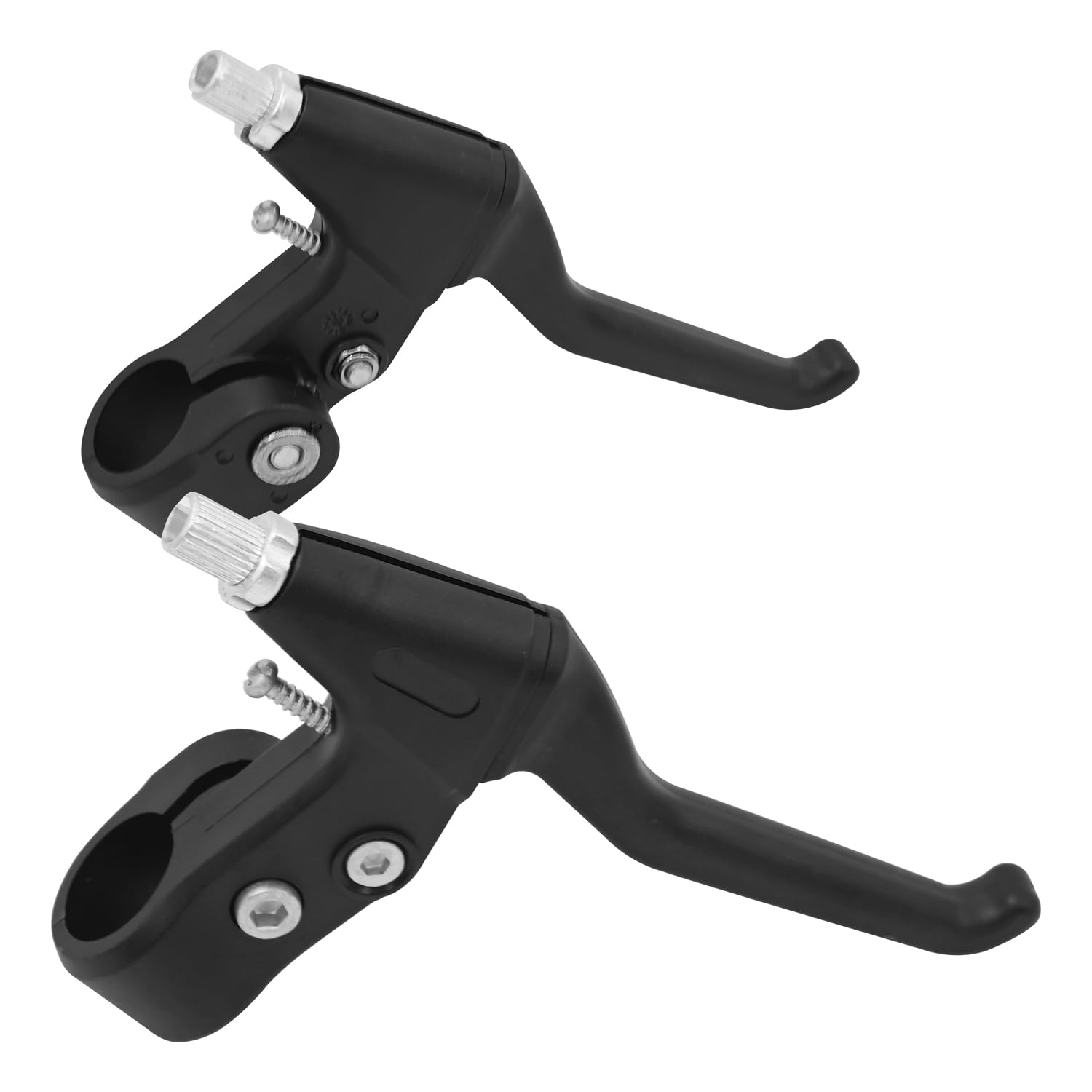
The body is black ABS over a stainless steel core, and that's the honest description of what arrives. It isn't an alloy lever and doesn't pretend to be one, but at this end of the market plastic is what keeps a pair within reach of a repair that would otherwise cost more than the bike is worth. The steel core inside is the part that matters, because it's what the cable pulls against.

Where it earns a place is the job it's designed for: a snapped lever on a kids' bike, a bike you're fixing to sell, a spare pair for a loaner. The clamp is 22 mm, the set is complete with a left and a right, and installation is the same two-bolt, one-cable job as any other flat-bar lever. The blade also returns to its resting position after a knock, which is a small thing that saves a walk home.

Fit is the one check before you order. We measure the bar rather than trusting the word universal, because a bar with a thicker center section, or a shifter clamp crowding the lever, will make the install fussier than it needs to be. On a standard 22 mm kids' bar it goes on in minutes and the brake works as well as the rest of the bike allows.

Bottom line: A complete plastic-bodied pair for a kids' bike or a beater, as long as the bar really measures 22 mm and you don't need reach adjustment.

6

FOMTOR Aluminum Brake Levers

FOMTOR Aluminum Brake Levers

Kids and BMX

Our Score 8.8/10
Check Price

Worth Noting

  • Durability is uneven under hard adult braking
Included
Left and right pair
Clamp Size
2.2 cm
Blade Length
2.5-finger
Lever Material
Aluminum alloy
Read the full review

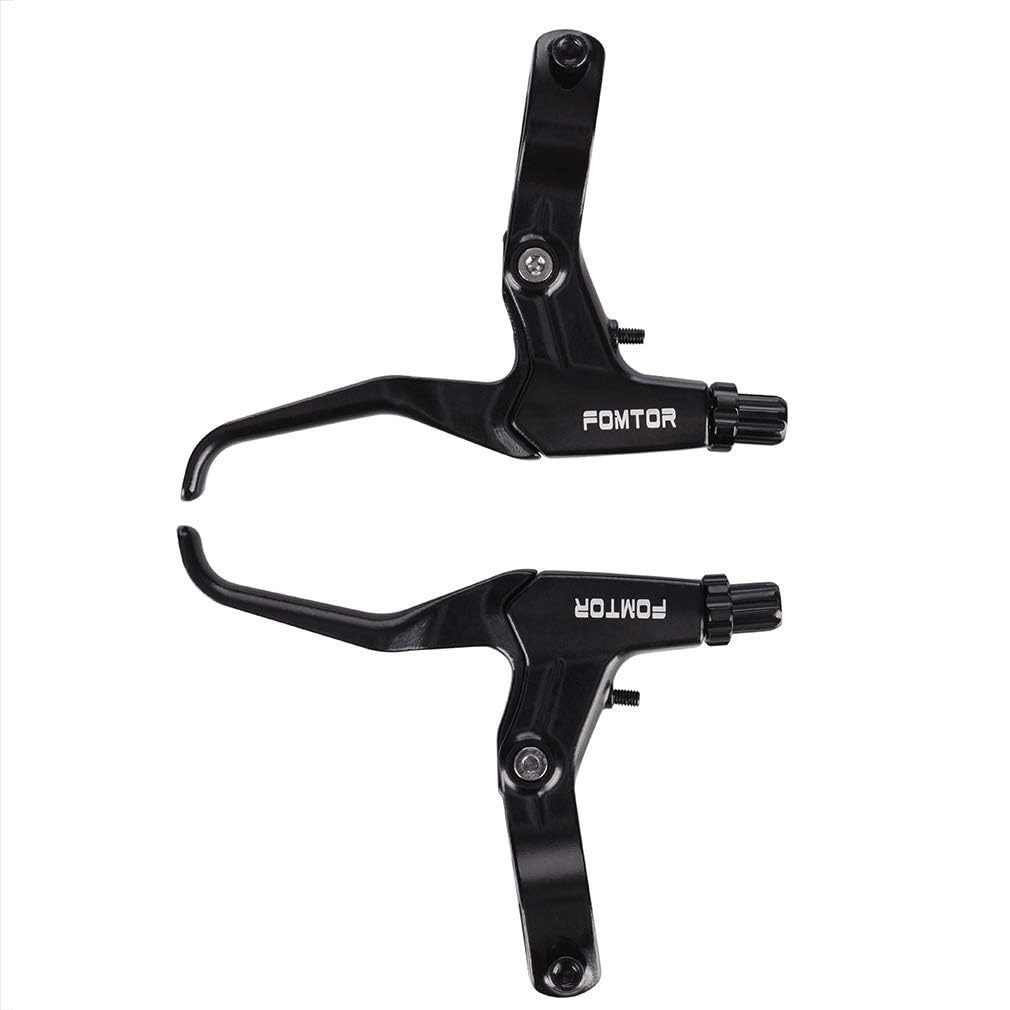
Plastic levers on kids' bikes tend to fail at the clamp, which is the part FOMTOR machines from aluminum. The whole body is metal, the clamp bolts on rather than hinging on a molded tab, and the pair arrives as a left and a right. If you're fixing a bike that gets dropped outside a shop every other day, that's the right place to put the money, and it's the detail we appreciate most about these.

The blade is a 2.5-finger shape, and it does more work than the spec suggests. It's short enough that a child's hand reaches the end of the lever with the first joint of the index finger, where the leverage is, and long enough that an adult can still get two fingers on it. There's no reach adjustment, so blade length is covering that job instead.

Installation is two bolts and a cable clamp, and the 2.2 cm clamp fits the standard flat bar on kids' bikes, BMX, folders, and most hybrids. A textured pad on top of the blade sits where your hand actually rests, which is more use in the rain than it sounds.

Before the first ride, check both clamp bolts and the cable anchor, then squeeze hard from a standstill and watch the clamp. A lever that shifts on the bar wasn't snug enough, and that's a two-minute fix rather than a return.

Bottom line: An all-aluminum lever with a short blade that small hands can reach, which makes it the sensible replacement for a broken plastic lever on a kids' bike.

How We Tested Bike Brake Levers

We built the shortlist by scanning replacement levers for flat-bar and drop-bar bikes, then filtering out anything with unclear brake compatibility, odd clamp sizes, or a price that didn’t match the hardware in the box. From that list we tested 12 sets, installing them on a flat-bar commuter and a drop-bar gravel bike over seven months. I mounted each one myself, checked clamp fit against the bars, set the reach where it felt natural, and noted whether the lever body sat flush or needed shims. I also looked at machining quality and pivot smoothness before the first ride, since rough edges and gritty pivots show up fast.

On the road, I used them for daily commutes, wet-weather rides, and weekend gravel loops, squeezing with two fingers and then four to see where the lever caught. I paid attention to cable pull—whether it paid out smoothly, returned without drag, and gave predictable modulation—and to comfort on long descents, including reach, sharp edges, and hand fatigue. For sturdiness, I torqued the clamp bolts to spec, pushed hard against the lever body, and checked for flex or play after rocky sections. Fit was judged on the bike, not just the spec sheet: whether the clamp snugged down without wobble and whether the brake lever landed under my fingers without stretching.

Durability and material got the slow test. I kept the same sets on through grit and rain, then looked at pivot slop, finish wear, and corrosion at the clamp. Value came down to whether a lever included the right hardware and still felt solid after the honeymoon period; some cheaper sets needed new ferrules or extra adjustment to feel right. I also compared alloy and composite blades under hard braking, since material changes the flex and the feel at the bar. The best sets were the ones I stopped thinking about—no flex, no fiddling, just a clean pull every time.

How to Choose Bike Brake Levers

Match the lever pull to your brakes

Levers come in two pull ratios, and getting the wrong one is the most common reason a swap disappoints. Long pull moves more cable and belongs with V-brakes and mechanical disc brakes; short pull moves less and suits road calipers and cantilevers. A short-pull lever on a V-brake gives you a firm lever that barely slows the bike; a long-pull lever on a caliper runs out of travel before the pads bite.

Look at the brake, not the frame. V-brake arms standing vertically off their posts need long pull. A few levers solve the problem properly: the Shimano Tiagra flat-bar set here lets you move the cable anchor and cover both, which is worth the extra if a change of brakes is on the horizon.

Flat bar or drop bar decides the fit

Bar type narrows the field faster than any other decision. Flat bars measure 22.2 mm at the clamp, and nearly every flat-bar lever is built for that. Drop bars use an entirely different lever that clamps under the bar tape with a hood on top, and no amount of adaptor turns one into the other.

Treat the word universal with suspicion: in a listing it usually means 'fits a 22 mm flat bar,' not 'fits anything with two wheels.' Measure the bar with a caliper rather than a ruler, and check the real estate — grips, shifters, and a bell all compete for the same few inches, and a long lever body can push a twist shifter out of easy reach.

Reach and blade length for small hands

Reach adjustment moves the blade closer to the bar without touching cable tension, and it's the first thing to look for on a bike ridden by a child or a smaller adult. Where it's missing, blade length does the same work: a 2.5-finger lever puts the end of the blade under a small hand, while a full-length four-finger lever often leaves a child braking with fingertips near the pivot, where there's least leverage.

Test it on the stand: with the rider's hand on the grip, the index finger should reach the end of the blade without stretching the arm. A lever they can't reach properly is a lever they won't use.

Where cheap levers actually fail

The lever body rarely breaks. The clamp and its bolt do — a soft casting or a plastic hinge shears where it grips the bar, and that is the failure that takes the brake away entirely. On a safety-critical part, the extra money buys an aluminum body, a proper clamp, and a bolt that won't strip the first time you snug it down.

Two habits matter more than brand. Tighten the clamp only until the body can't rotate under a hard pull, and recheck it after the first few rides. If a new lever arrives feeling loose at the pivot, send it back rather than shimming it.

Count what's in the box

Some sets are a single lever, some are a pair, and the difference matters when you're replacing a broken right-hand lever and want both sides to match. Check the quantity before ordering rather than after the box arrives.

Cables and housing are the other variable. Reusing an old inner cable after a lever swap is false economy, because a frayed cable or a cracked outer is exactly what makes a new lever feel spongy. If the housing is more than a couple of seasons old or the cable is kinked at the anchor, buy a set that includes both — it's cheaper than a second order and a second wait.

Frequently Asked Questions

Final Verdict

For most flat-bar bikes, the Avid FR-5 set is the answer: one part number that fits either side or either way up, long pull for V-brakes and mechanical discs, and the least expensive of the brand-name pairs here. It's the lever we recommend without first asking what kind of riding you do, because on a flat bar it rarely matters.

Two exceptions earn their extra cost. Drop-bar riders want the Tektro RL340 for the hood shape and the built-in spring; anyone who might switch between calipers and V-brakes later should take the Shimano Tiagra flat-bar set, where the movable cable anchor covers both. And if the bike belongs to a child, the FOMTOR pair puts metal at the clamp, which is precisely where plastic keeps breaking.