Tools & Maintenance

Best Bike Floor Pumps of 2026

A floor pump is one of those things you don't think about until the morning of a ride, when the gauge says one thing, the tire says another, and the valve head pops off at 80 psi. You want a pump that stands still while you push, clamps on the first try, moves enough air per stroke, and tells the truth about pressure. I've limped along with a hand-me-down that needed two hands and a foot; replacing it was less about spending up than knowing which details matter.

For four months, we've tested 12 floor pumps on the weekly routine: topping off road tires before early rides, seating a mountain bike tire after a trailside repair, and checking each gauge against a separate digital reader. Differences showed up fast—some heads needed two hands, some bases crept across the garage floor, and a few gauges drifted enough to make a 90-psi tire feel uncertain. The best made the job boring, which is exactly what you want. A good pump is buy-once garage equipment, and the picks below earned their spot.

1

SKS Rennkompressor

Top Pick
SKS Rennkompressor

Buy-once premium

Our Score 9.4/10
Check Price

Worth Noting

  • Premium price
  • No ball or bladder needles included
Feet
Folding steel
Weight
6.31 lb
Valve Head
MV Easy, all valve types
Maximum Pressure
16 bar / 230 psi
Read the full review

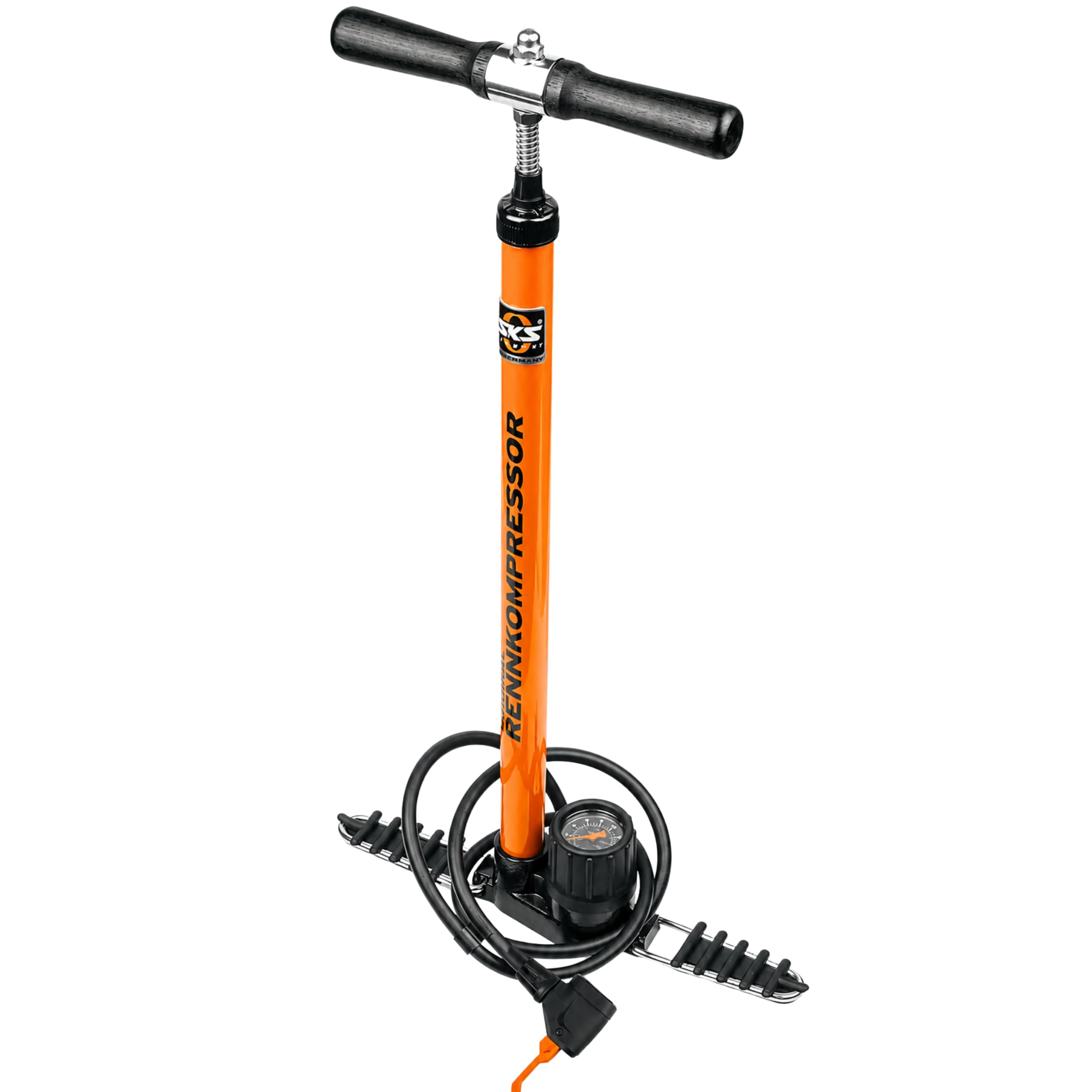
The Rennkompressor looks like it belongs in a bike shop that has been there since the 1970s: a metal tube, a cast base with folding steel feet, and a black wooden handle that feels warmer than any plastic grip. The MV Easy head is designed for all valve types, and the 16-bar / 230-psi ceiling is far beyond what a bicycle tire needs. That headroom is not the point for most riders; the point is that the pump feels like it will outlast the bike.

The folding steel feet are a clever touch. They give the base a wide stance when you are pumping and fold in when you need to move the pump or store it flat. The wooden handle is comfortable in the hand, and the long hose gives you room to work. At 2,860 grams, this is not a pump you carry upstairs with one finger; it is a garage fixture, and the cast base makes that clear.

We treat the Rennkompressor as the buy-once pick. If you want the pump that feels most solid underfoot and you like the idea of a mechanical object that ages well, this is the one we recommend. It is a pump for someone who keeps tools for decades, not for someone who wants the lightest thing on the shelf. We were also struck by how much the wooden handle changes the feel of the pump in the hand—it is a small detail, but it is the one we remember.

Bottom line: A buy-once floor pump for riders who want a cast-metal base, a wooden handle, and pressure headroom beyond any bicycle tire.

2

Topeak JoeBlow Sport III

Topeak JoeBlow Sport III

Everyday high-pressure fills

Our Score 9.2/10
Check Price

Worth Noting

  • Gauge reads in 5-psi increments
  • Head can need a firm push to seat
Gauge
3-inch mid-mount
Weight
3.7 lb
Air Flow
318 cubic centimeters per second
Maximum Pressure
160 psi
Read the full review

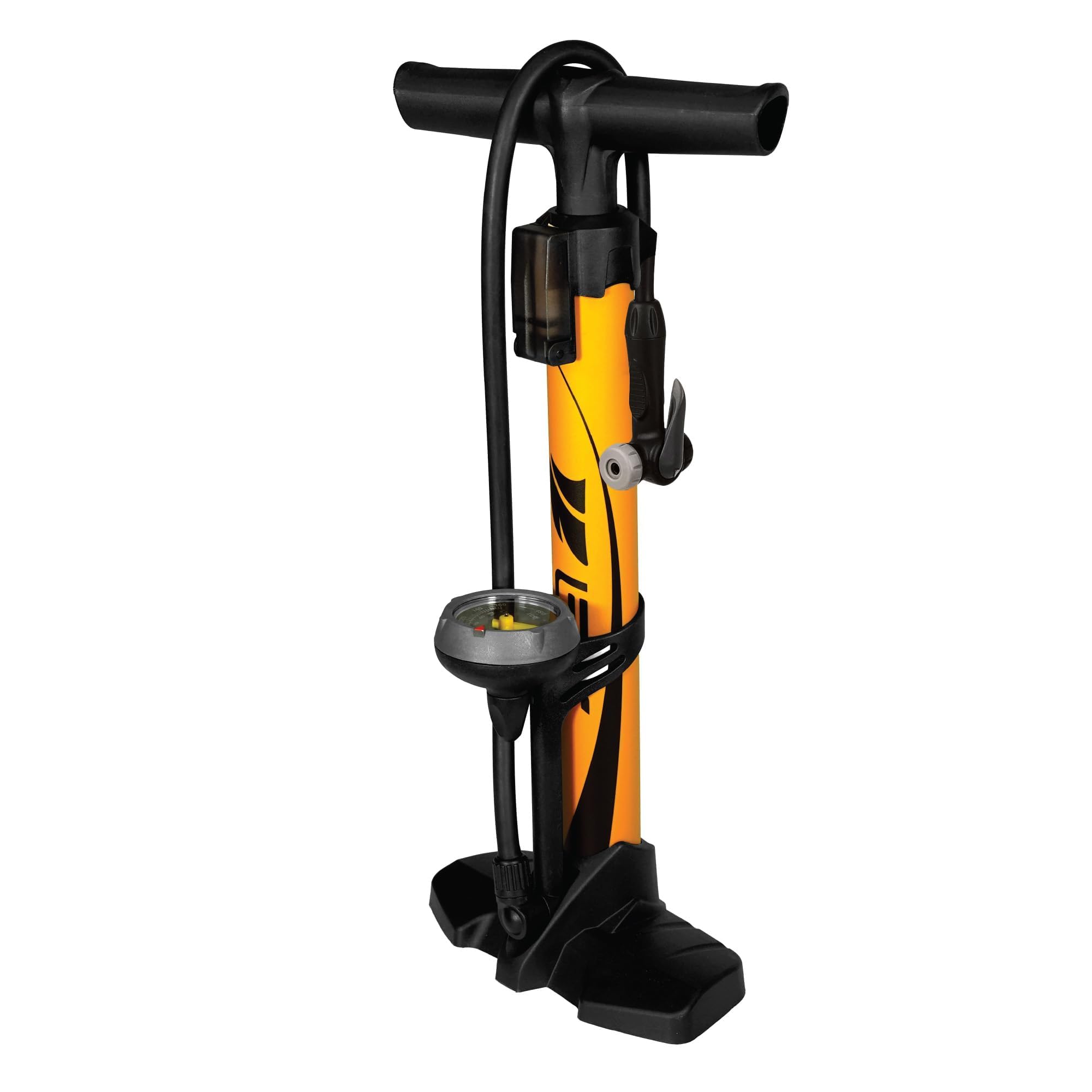
The JoeBlow Sport III is the pump we reach for when a tire needs a precise high pressure and we do not want to fight the head. Its 3-inch mid-mount gauge is the easiest to read in this group, and the steel barrel and broad base keep the pump planted when you push past 100 psi. The TwinHead DX5 is a hammer-style head that fits Presta, Schrader, and Dunlop without swapping parts, and the extra-long hose lets you stand beside the bike instead of crouching over it. It is a garage pump rather than a travel pump, but that is the role we want it for.

What separates it from the cheaper picks is how the details support the main job. The padded handle gives you something to hold when the last 20 psi get stiff, and the hose dock keeps the head from flopping around between uses. The broad steel base is the part we appreciate most: it does not skate when you put your weight into a high-pressure tire.

The Topeak is not the smallest pump here, and it is not the cheapest. It earns the top spot because it makes the whole job feel routine: seal the head, watch the gauge, finish the stroke, and move on. The included ball and bladder needles are a small bonus, but the real reason it stays by the door is that it makes 100 psi feel ordinary.

Bottom line: For most riders, this is the floor pump to buy: stable, easy to read, and quick to seal on Presta or Schrader.

3

BV Bicycle Floor Pump

BV Bicycle Floor Pump

Budget commuter pump

Our Score 9.0/10
Check Price

Worth Noting

  • Gauge can be inconsistent
  • Head can take a few tries to seal
Height
16.25 inches
Weight
16 oz
Valve Head
Reversible Presta/Schrader
Maximum Pressure
160 psi
Read the full review

A budget floor pump often feels like a compromise: a short barrel, a head that fights the valve, and a gauge that is more decoration than instrument. The BV avoids the worst of that. It stands 16.25 inches tall and weighs 16 ounces, so it tucks beside a shelf or comes out to a bike in a hallway without feeling like a chore. The reversible head switches between Presta and Schrader by swapping the internal parts, and the 160-psi ceiling is more than most riders need.

We like the BV for the rider who wants a simple pump for a commuter or kids' bike and does not want to spend much. The short stroke takes more pumps than the Topeak, but the effort is manageable at commuter pressures, and the light weight makes it the easiest pump here to move around. The handle is comfortable enough for a quick top-off, and the base is stable as long as you are not leaning on it.

For mountain bike tires and casual around-town use, those compromises are acceptable. For a road rider who wants a more substantial pump, the BV is not the one we reach for first. It earns its place as the budget pick because it gets the basic job done and is easy to live with, not because it matches the premium pumps stroke for stroke. It is the pump we hand to a neighbor who just wants to top off a commuter tire and not think about it again.

Bottom line: A light, inexpensive 160-psi pump for commuters and kids' bikes, and the easiest budget pick to live with.

4

Bell Bicycle Pump

Bell Bicycle Pump

High-volume tires

Our Score 9.0/10
Check Price

Worth Noting

  • Stiff, small locking lever
Gauge
Bottom-mount
Weight
2 lb
Air Flow
630 cubic centimeters per second
Maximum Pressure
100 psi
Read the full review

The Bell Bicycle Pump is built around a wide barrel and a 630-cubic-centimeter-per-second airflow figure, which is the highest in this group. That makes it the pump we reach for when a mountain bike, cruiser, or kids' bike tire is completely flat and we want to get air in fast. The 100-psi ceiling is enough for those tires, and the dual head fits both Presta and Schrader without an adapter.

The wide barrel is the reason to choose it, but it also makes the pump feel different from a road pump. Each stroke moves a lot of air, so you fill a fat tire in fewer pushes, but the effort rises quickly as you approach the top of its range. We like it for garage use on low-pressure tires; we do not reach for it when a road tire needs 90 psi. The bottom-mounted gauge gives you a reading while you work, though you have to bend or crouch to see it.

The Bell is not the most refined pump here, and the bottom gauge is a reminder of that. It is the high-volume specialist: quick for mountain and cruiser tires, simple to use, and a good fit for a garage with more than one bike. The wide barrel is the reason it stays in that garage.

Bottom line: A fast-filling floor pump for wide, low-pressure tires, and the one we choose when a mountain bike is completely flat.

5

Toolitin Floor Bike Pump

Toolitin Floor Bike Pump

High-pressure value

Our Score 9.0/10
Check Price

Worth Noting

  • Valve head can take several tries to seal
  • Gauge can read off
Weight
2.2 lb
Material
Aluminum
Accessories
Ball and inflatable needle
Maximum Pressure
160 psi
Read the full review

The Toolitin's party trick is the accessory box: a small compartment on the pump that holds the ball needle and inflatable adapter so they do not disappear into a drawer. That is the kind of detail we notice after living with a pump for a while, and it makes the Toolitin feel more considered than its price suggests. The one-piece metal barrel and wide, thick base give it a sturdier stance than the short BV, and the 160-psi ceiling puts road and gravel pressures within reach. The gauge gives you a reading while you inflate, so you are not guessing.

We like the Toolitin as a high-pressure pump for someone who wants metal construction without paying premium money. The handle is comfortable, the base stays put, and the accessory box is genuinely useful. The 160-psi ceiling is more than most riders need, but it means the pump has headroom for a road bike.

For a mixed garage—commuter, hybrid, kids' bikes, and the occasional basketball—the Toolitin is a practical choice. The metal barrel gives it a more substantial feel than the cheapest pumps here, and the accessory box keeps the pump ready for more than tires. It is the one we pull out when we want a sturdy pump and do not want to worry about where the adapters went.

Bottom line: A metal-bodied 160-psi pump for riders who want a sturdy feel and tidy accessory storage without a premium price.

6

Schwinn Air Center

Schwinn Air Center

Basic occasional use

Our Score 8.6/10
Check Price

Worth Noting

  • No pressure gauge on basic model
  • Large head can be tight between spokes
Barrel
21 inches
Valve Head
Presta/Schrader
Hose Length
27 inches
Maximum Pressure
120 psi
Read the full review

The Schwinn Air Center is a straightforward floor pump: a 21-inch barrel, a steel base, a soft-grip handle, and a dual head for Presta and Schrader. The longer barrel gives it a more relaxed stroke than the short BV, and the steel base keeps it from wandering across the garage floor. It also comes with a ball needle and inflation cone, so it can handle more than bike tires.

We like it as a simple pump for hybrids, kids' bikes, and the odd basketball. The 120-psi ceiling is enough for most casual riding, and the dual head seals on both valve types without an adapter. The handle is comfortable for a basic pump, and the 27-inch hose is long enough to reach a bike without dragging the base.

The simple build is the point. It is the pump we leave in the garage for the kids' bikes and the occasional basketball, and the one we do not mind lending to a neighbor. The long barrel and steel base make it feel more substantial than a basic pump has any right to.

Bottom line: A simple 120-psi floor pump for hybrids and kids' bikes, with a long barrel and a stable steel base.

How We Tested Bike Floor Pumps

We started with a shortlist of 12 floor pumps, reading specs and owner feedback, then filtering out models with vague gauge markings, flimsy-looking valve heads, or bases that seemed too narrow to stay planted. Four months of testing followed, with each pump living where a floor pump actually lives: beside a garage workbench, near the front door for quick top-offs, and on the driveway before weekend rides.

To judge airflow and pressure, we inflated a road tire from flat to 90 psi, a mountain bike tire to 25 psi, and a hybrid tire to 60 psi, counting strokes and noting where the effort spiked. We checked each gauge against a separate digital reader at 30, 60, and 90 psi, then rechecked after the tire sat for ten minutes to see whether the reading held. Valve connectivity got its own workout: we switched between Presta and Schrader, clamped and unclamped the head one-handed, and listened for leaks at the valve.

Ease of use came down to details: whether the hose reached a bike in a stand, whether the gauge was readable from standing height, and whether the handle returned smoothly after each stroke. For sturdiness, we pushed and pulled hard enough to see if the base walked across concrete, then dropped each pump from waist height onto its side and checked for cracks or a bent gauge. Value wasn't about the sticker alone—we noted which pumps had replaceable parts, tidy hose storage, and a head that didn't make us curse in the driveway.

How to Choose Bike Floor Pumps

Get the valve head right first

A floor pump is only as good as its connection to the valve. Presta and Schrader heads come in two broad styles: a dual head with separate ports, or a smart head that accepts either. A smart head is faster when one pump serves several bikes, but it needs a positive lock and a firm push to seal. Check the head against a recessed Presta stem, because a bulky head can foul the rim or spokes. If you switch bikes often, choose a dual or TwinHead design; if you have one bike, a simple compatible head is enough.

Read the gauge, then verify it

Gauge size matters more than the number printed on the dial. A 3-inch mid-mount gauge is easy to read from standing height, while a bottom-mount gauge forces you to bend. Analog gauges can drift, and coarse markings make exact road pressure harder to hit. For road riding, choose a large gauge and check it against a trusted digital gauge; for mountain biking, a simple gauge is enough. The Topeak's 3-inch dial is the easiest read here, but even that one is marked in 5-psi steps.

Pressure ceiling and air volume are different jobs

A 160-psi rating tells you the pump can reach high pressure, not that it does so easily. Wide-barrel pumps move more air per stroke for fat tires, while narrow-barrel pumps are better at pushing past 80 psi. Match the pump to the tires you actually ride: 100 psi is plenty for cruisers and many hybrids, while road tires need a pump that stays efficient at 90 to 110 psi. The Bell's wide barrel is the high-volume choice here; the Topeak is the better all-rounder.

Stability, storage, and wear parts

At high pressure, a broad steel base and a comfortable handle matter more than a light pump. Taller pumps give you a longer stroke but take more floor space; short pumps like the BV stow easily. Look at the hose, head, and gauge as wear parts—a replaceable head or hose extends the life of the pump. Store the pump indoors and keep the head clean. If the pump lives in a damp shed, a metal barrel and base are worth prioritizing.

Decide whether accessories matter

Ball needles and inflatable cones are handy, but they should not drive the purchase. If you only inflate bike tires, put the money into the head and gauge. If the pump lives in a family garage, an accessory box or included needles earns its keep. The Toolitin's storage box is a good example of a small convenience that keeps the adapters where you need them.

Frequently Asked Questions

Final Verdict

The Topeak JoeBlow Sport III is the pump we recommend to most riders because it makes the routine parts of inflation feel handled: the head seals, the gauge reads, and the steel base stays put. If you want to spend less, the BV is the budget pick for commuters and kids' bikes. If you want a pump to keep for decades, the SKS Rennkompressor earns its premium with a cast base and a 230-psi ceiling. For a garage full of wide tires, the Bell Bicycle Pump moves more air per stroke.