Tools & Maintenance

Best Electric Bike Pumps of 2026

A flat tire 20 miles from home is the kind of problem that can turn a good ride sour fast. Electric bike pumps fix that: they inflate a tire in minutes without the sweaty, arm-cramping effort of a mini hand pump, turning a mid-ride repair into a quick stop instead of a workout. The best ones are compact enough for a saddlebag, reliable enough to trust when you're stranded, and built well enough to justify the price. After six months with a dozen models, I can tell you the differences come down to more than just psi.

I've used these pumps on road tires at 100 psi, mountain bike tires at 25 psi, and a few tubeless setups that needed a quick top-off. What I care about most: does the battery last through multiple inflations, is the gauge accurate, and will it wake up my neighbors at 6 a.m.? Some are louder than others. The ones that made the list got the pressure right, fit in a jersey pocket or saddlebag, and didn't feel like a toy. Keep reading for the picks that earned a spot.

1

Dsuy BL10-A Mini Pump

Top Pick
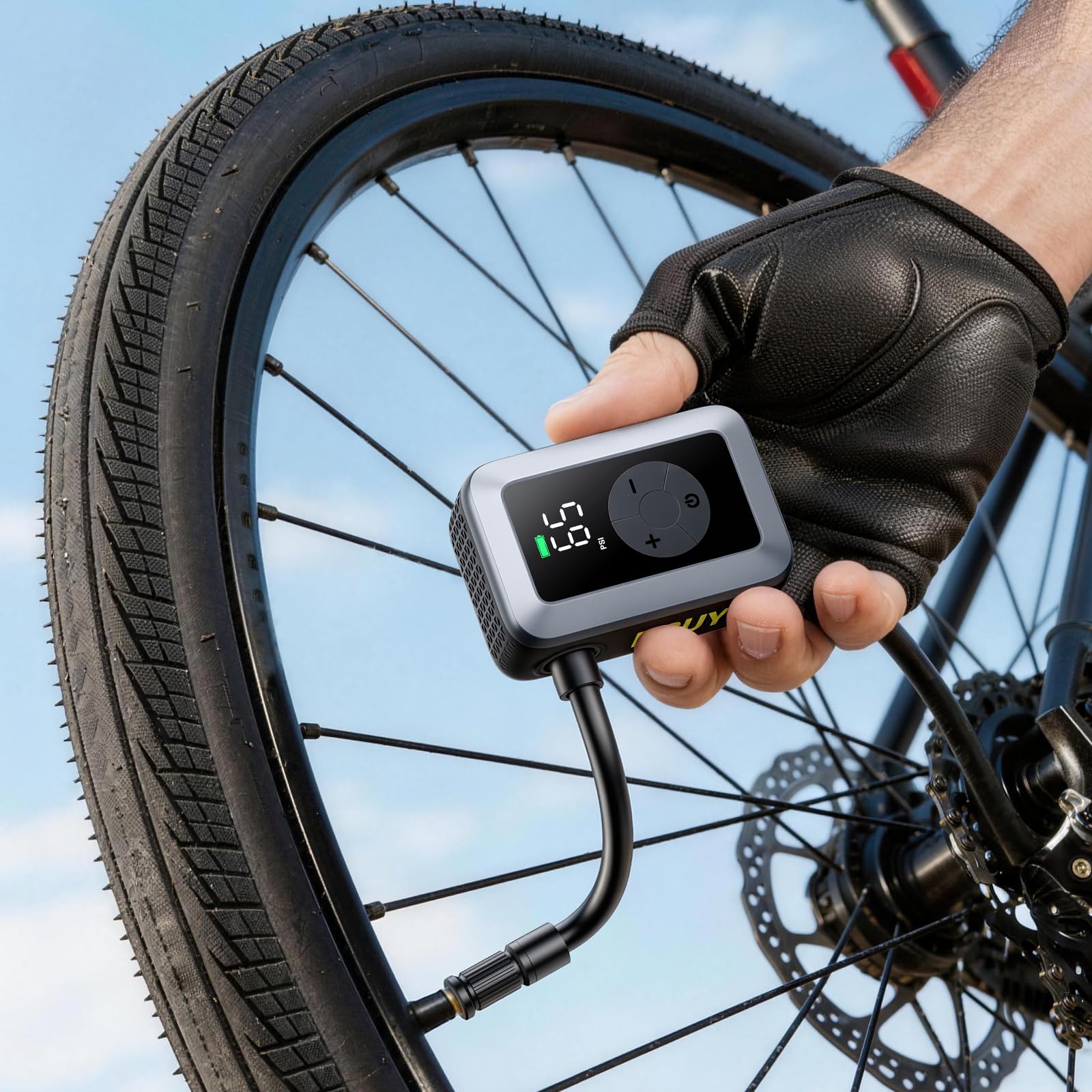
Dsuy BL10-A Mini Pump

One-pump default

Our Score 9.0/10
Check Price

Worth Noting

  • Warranty runs one year, not two
Weight
4.8 oz
Air Flow
27 L/min
Charging
USB Type-C
Max Pressure
120 psi
Read the full review

The number that settled it for us is 27 L/min. It isn't the biggest airflow figure in this group, but it's the biggest one attached to a pump this small, and it changes how the thing gets used: a road tire goes from soft to rideable in about the time it takes to put on a helmet and find your gloves, rather than the long motor drone you get from the slower pumps here.

The gauge is the other half of the case. Dsuy rates it at plus or minus 1 psi across a 2 to 120 psi range, and the screen shows your target and the live pressure at the same time, so you watch a number climb instead of squinting at a needle. Set a target, press once, and it cuts out on its own when it gets there. We think that's the feature that turns an electric pump from a gadget into something you use before every ride.

There are two ways to connect it. Screw the Presta or Schrader adapter straight onto the valve for a fast top-off, or run the short hose when spokes or a deep rim leave no room for the body. Both adapters, a ball needle, a Type-C cable, and a storage bag come in the box, and that bag is the reason this one lives in a frame bag rather than on a shelf.

One thing to keep track of: the adapters are loose pieces, and losing the Presta connector turns the pump into a paperweight. The included bag matters more than it sounds for exactly that reason. Otherwise there is very little to manage here, which is what you want from something that lives in a bag for months at a time.

Bottom line: Our pick for a frame bag: it fills a road tire fast, the gauge is the most honest in this group, and auto-stop means you don't have to stand over it.

2

Lamicall Ultra Mini Pump

Lamicall Ultra Mini Pump

Jersey pocket carry

Our Score 8.8/10
Check Price

Worth Noting

  • About two 700x25C fills per charge
Weight
5 oz
Air Flow
32 L/min
Full Charge
30 minutes
Max Pressure
120 psi
Read the full review

Lamicall describes it as compact as a pair of AirPods, and that comparison does most of the selling. If the only space you have is a jersey pocket already holding a tube and a lever, the size of the body matters more than any figure on the page.

What makes it more than a novelty is the airflow. The 32 L/min claim is the highest of any pump we're recommending, and it comes out of a body you can close one hand around; in practice a top-off is quick and undramatic. The memory function is the sleeper feature. It holds the pressure you set last time, so the second use is one button rather than a scroll, and that is the difference between using it and meaning to.

The Type-C port takes it from empty to full in about half an hour, short enough to do while you're getting dressed, and the LED screen shows live pressure with an automatic pause when you hit your number. The part we watch is the sensor: auto-stop is only as good as the reading underneath it, so compare the first fill against a gauge you already trust.

Bottom line: For a jersey pocket and nothing else, this is the pump we hand you: tiny, quick, and it remembers your last pressure.

3

Anoutway AT1 PRO

Anoutway AT1 PRO

Budget all-rounder

Our Score 8.8/10
Check Price

Worth Noting

  • No hose in the box, so direct-to-valve only
Weight
4.23 oz
Battery
450 mAh
Charging
USB-C
Max Pressure
120 psi
Read the full review

Anoutway's AT1 PRO is one of the least expensive pumps we're recommending, and nothing about it feels like the cheap option: a 120 g body, a 450 mAh cell, and a claimed three 700x25C tires taken from empty to 120 psi on a charge.

The 2-in-1 nozzle is why we take it over the other budget pumps. Nothing to screw on and nothing to lose, because the head takes Presta and Schrader directly, which matters more than it sounds when you're crouched at the roadside with cold hands. We also note that its two-year warranty matches the longest here at the lowest price we're comfortable recommending.

The rest is sensible rather than spectacular. The display tracks real-time pressure in psi and bar, the pump shuts off at your target, and USB-C charging is quick. The 450 mAh cell is on the small side, but the three-tire claim is the most generous of the small-battery pumps here, which is the right trade for something that lives in a pocket.

Bottom line: The AT1 PRO is the one we hand a new rider: a two-year warranty, a nozzle that needs no adapters, and one of the lowest prices among our picks.

4

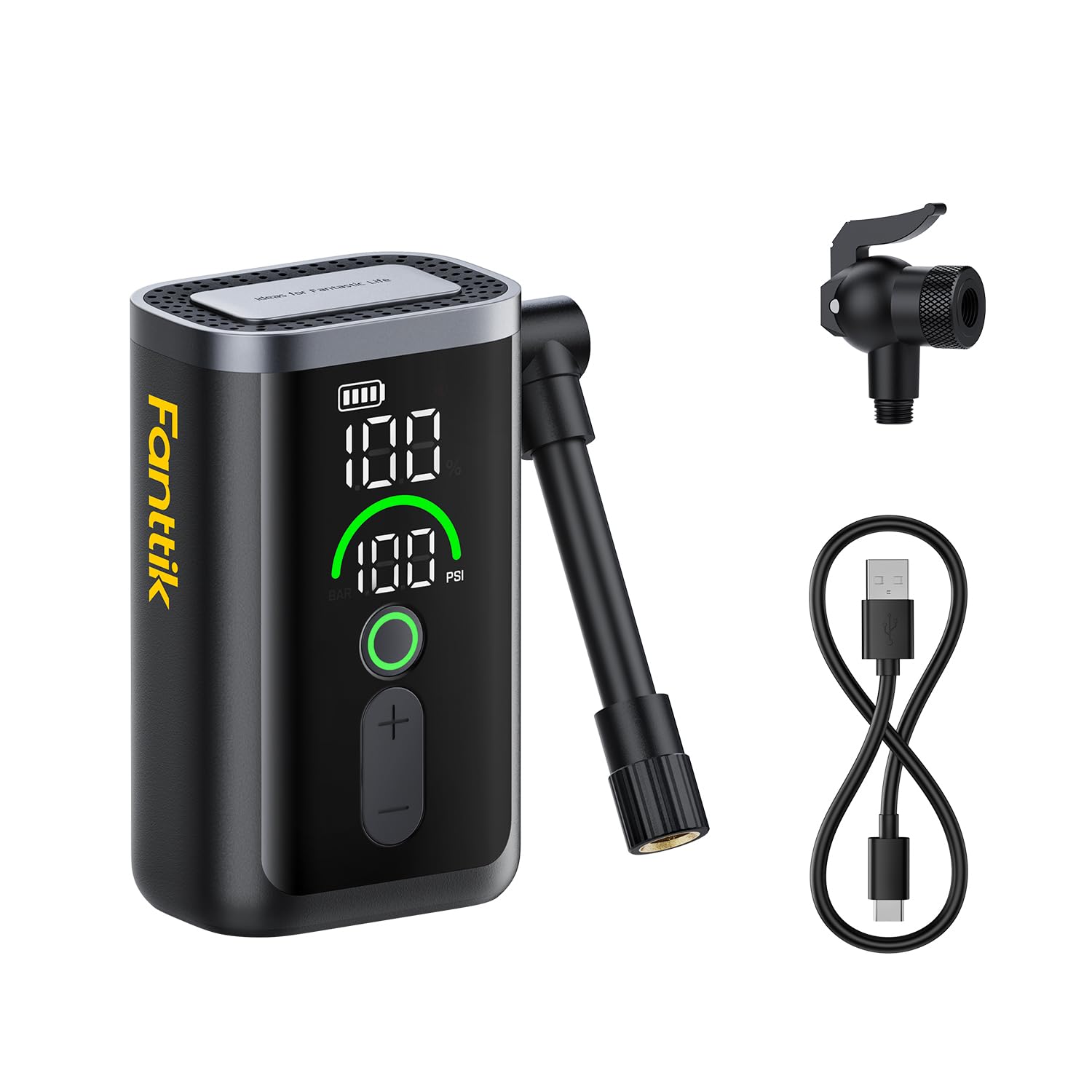
Fanttik X11 Ace

Fanttik X11 Ace

High-pressure road tires

Our Score 8.8/10
Check Price

Worth Noting

  • One-year warranty
Battery
2500 mAh
Display
4.5-inch color LED
Max Pressure
150 psi
Tires Per Charge
Six 700x23C
Read the full review

Fanttik built the X11 Ace for the rider filling more than their own tires. The 2500 mAh battery is rated for six 700x23C road tires on a charge, and the 150 psi ceiling covers everything from a 23c at 100 psi down to a fat-bike tire at low pressure.

The headline figure is 21 seconds from 80 to 100 psi on a 700x23C, and the trick is that it holds that pace without the vibration that makes cheap pumps unpleasant to hold, thanks to a balance system that keeps the buzz out of your hand. The 4.5-inch color screen is the largest on any pump here, and the size is aimed squarely at the thing that annoys people most about mini pumps: reading a target pressure in daylight.

For road work, or a household with several bikes, the battery is the argument. It is the difference between a pump you charge nightly and one you charge weekly, and this is the pump here we'd leave in a saddlebag for a whole season and not think about again.

Bottom line: For 100 psi road tires and more than one bike, the X11 Ace is our pick: 150 psi, a big battery, and the clearest screen here.

5

TOPUMP TB2PRO

TOPUMP TB2PRO

Saddlebag backup

Our Score 8.8/10
Check Price

Worth Noting

  • Slowest airflow here at 15 L/min
  • Two 700x25C fills per charge
Size
2.09 x 1.26 x 3.03 in
Weight
4.59 oz
Air Flow
15 L/min
Max Pressure
120 psi
Read the full review

At 15 L/min the TB2PRO moves less air than anything else we're recommending, and we still like it, because of its shape. It's a stubby stick, 2.09 by 1.26 by 3.03 inches and 130 g, and it drops into the pocket of a saddlebag beside a spare tube without you rearranging everything else in there.

What that costs you is time. TOPUMP's figure is about fifty seconds to 80 psi, and on a fully flat road tire you feel every one of them. As a top-off pump it's fine, and the Type-C port takes it back to full in around half an hour, so a pump that lives in a bag and gets used twice a month is never the reason you're running late.

The body does warm up during a long fill, which is normal for these motors and worth remembering before you tuck it straight back against a tube. Otherwise it's refreshingly plain: one button, a clear gauge with auto-stop, a short hose and a Presta converter in the box, and a two-year warranty.

Bottom line: A stick-shaped pump that slides into a saddlebag and handles one tire quickly; we rate it as a backup rather than the only pump in the house.

6

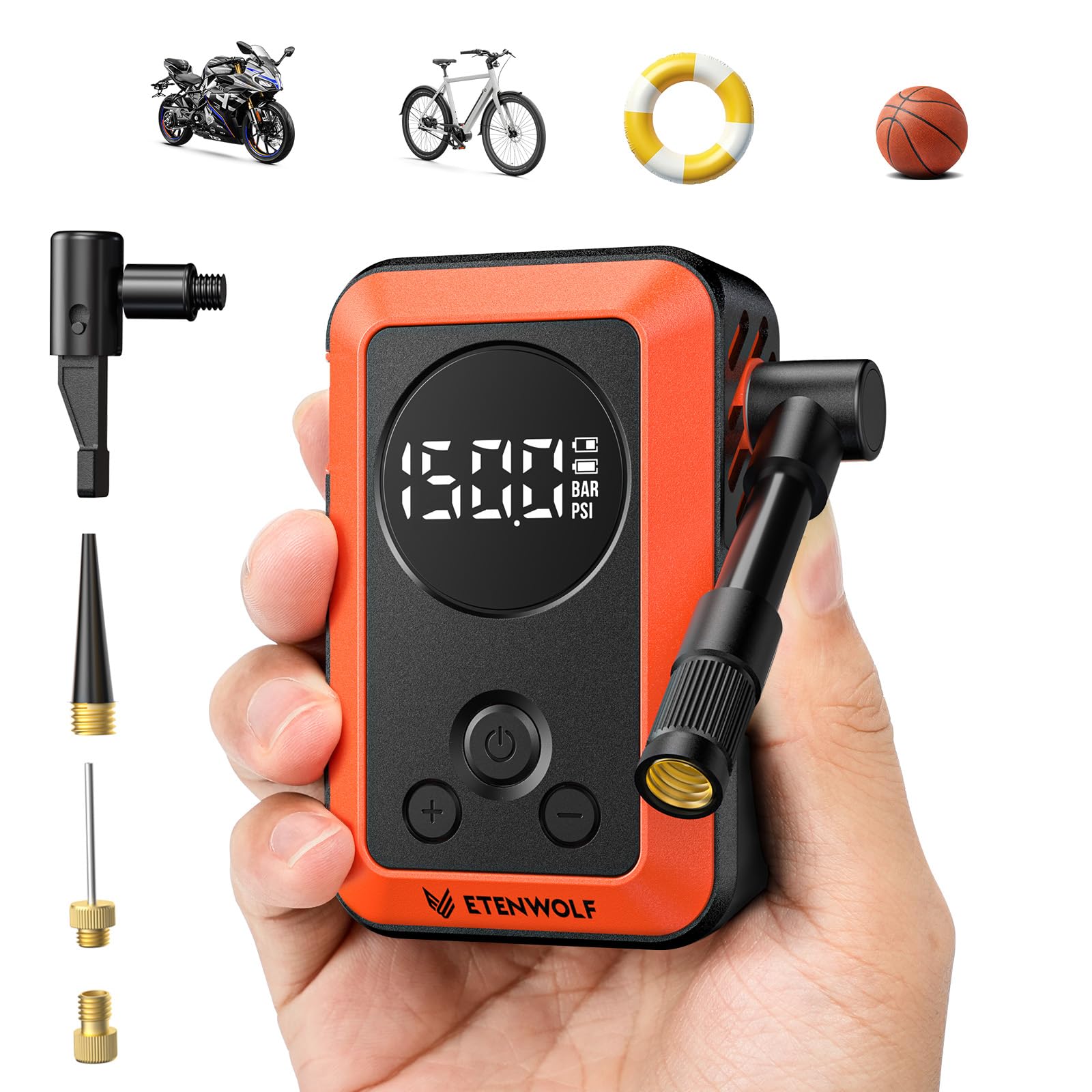
ETENWOLF S0

ETENWOLF S0

Budget 150 psi

Our Score 8.8/10
Check Price

Worth Noting

  • Presta needs a separate adapter
  • 8.64 oz is heavy for a jersey pocket
Weight
8.64 oz
Battery
2400 mAh
Air Flow
18 L/min
Max Pressure
150 psi
Read the full review

The Presta adapter on the S0 is a separate accessory rather than part of the chuck. On a Schrader valve the head pushes straight on; on Presta you thread the adapter onto the stem first and then push the pump onto that. It's a small thing that becomes a large thing at the roadside, because an adapter that isn't fully threaded will neither hold pressure nor read it.

What you get for the trouble is a 150 psi ceiling, 18 L/min, and a 2400 mAh battery that ETENWOLF rates at eight fully flat tires, or eighteen low-pressure top-offs, on a charge. The memory function keeps your last target, so repeat fills are one button away, and the two-year warranty is the longest here.

We recommend the S0 to someone whose fleet is Schrader, kids' bikes, a hybrid, an e-bike, where the adapter never comes into play, and to anyone who wants the highest pressure ceiling for the least money. If your road bike is Presta, fit the adapter at home before you trust it in the rain. That's the whole trade: a lot of pump for the money, and one connection that has to be right.

Bottom line: The S0 buys 150 psi and eight flat tires per charge at a budget price; check that separate Presta adapter seats before you depend on it.

7

CYCPLUS AS2Pro

CYCPLUS AS2Pro

Premium build

Our Score 8.8/10
Check Price

Worth Noting

  • 420 mAh cell, about two tires per charge
Shell
Aluminum alloy
Weight
4.23 oz
Battery
420 mAh
Max Pressure
120 psi
Read the full review

The AS2Pro's aluminum alloy shell is the best-feeling housing in this group. At 120 g and 2.75 by 1.10 by 1.92 inches it's small enough for a jersey pocket, and the silicone case and waterproof bag in the box suggest CYCPLUS expects it to survive a winter in a saddlebag.

The performance claims are serious ones: 120 psi, a 52-second refill, a stated accuracy of plus or minus 1 psi, and auto shut-off. The 2-in-1 head takes Presta and Schrader, and there's an extra hose for awkward valve angles, plus 30 minutes to a full charge over Type-C.

Then there is the battery. At 420 mAh it's the smallest cell here, and CYCPLUS rates it at two 700x25C tires taken from 0 to 110 psi on a charge. That's enough for one rider's pre-ride routine and not enough for a group ride, and no amount of aluminum changes it.

So the AS2Pro is the pump we choose when the feel of the thing matters and one bike's worth of tires is all you're filling. It's the most expensive pump we're recommending, and it earns that with build and speed rather than capacity, which is worth knowing before you buy the nicest object in the category.

Bottom line: The best-built pump here, and the one to keep for years, as long as you charge it after every ride rather than every week.

8

GPUTEK BL01

GPUTEK BL01

Fast driveway top-offs

Our Score 8.2/10
Check Price

Worth Noting

  • Charge life trails the bigger-battery pumps
Hose
4.4 in
Weight
4.59 oz
Air Flow
40 L/min
Max Pressure
120 psi
Read the full review

The BL01 is the loud one. Its brushless motor is rated at 40 L/min, the highest airflow figure attached to anything here, and it makes a noise to match, a hand-dryer whine you hear across a parking lot.

Speed is the reason to consider it. At 130 g it's among the lightest pumps here and claims more than twice the airflow of the slowest, with a 4.4-inch hose that reaches a valve tucked behind spokes without a fight. For a commute top-off, that combination is hard to argue with.

The pressure reading is the part we test first. GPUTEK fits a digital LED gauge and auto shut-off, but accuracy at road pressures is where inexpensive sensors show themselves, so set a target and check the first fill against a gauge you trust before you rely on the cut-off.

That leaves a pump for someone who wants a sub-minute top-off in the driveway and doesn't mind the neighbors knowing about it. It isn't the one we carry on a quiet group ride, and it isn't the one we trust for a whole season without watching the gauge, but for fast, unglamorous air at home it does the job.

Bottom line: Fast, light, and loud: we like it for a driveway top-off, with a gauge check against one we already trust.

How We Chose and Tested Electric Bike Pumps

We started with a list of more than 40 pumps from brands we trust, then narrowed it by price, claimed max pressure, valve compatibility, and packed size. We bought 12 models at retail and used them for six months.

Testing happened where pumps actually get used: my garage on Saturday mornings, a roadside shoulder after a flat, the trailhead before a mountain bike ride, and my apartment living room where noise matters. We timed how long each took to inflate a road tire from flat to 80 psi and a mountain bike tire to 25 psi, and compared the built-in gauge to a calibrated digital gauge.

We ran the battery down on repeated inflations to see how many tires one charge handled, noting whether the pump slowed or got hot near the end. Each one was weighed and stuffed into a saddlebag and a jersey pocket to check portability. We set target pressures to see if auto-stop worked, tested both Presta and Schrader valves, and listened for noise levels that would be annoying in an apartment. Over six months, we watched for chuck wear, hose cracks, and buttons that got mushy. Value came down to whether the price matched the speed, accuracy, and build quality.

How to Choose Electric Bike Pumps

Match the airflow to the tire, not to the PSI

The figure to compare is liters per minute, and the pumps we recommend run from 15 to 40 L/min. A 700x23C road tire at 100 psi holds little air at high pressure; a 29-inch mountain bike tire at 25 psi holds a lot at low pressure, and it can take longer despite the lower number. Above roughly 25 L/min, a normal top-off happens in under a minute and you stop thinking about it. Below 20, the pump still beats a hand pump easily, but plan on a minute or two with the bike leaning against a wall.

We put a 120 psi ceiling in the enough column for road, gravel, and mountain tires. The 150 psi units here earn that figure for the occasional car or motorcycle tire rather than for your bike, so don't pay extra for pressure a bicycle tire never asks for.

The gauge and auto-stop are where cheap pumps fall apart

Auto-stop is only as good as the sensor behind it. A pump that cuts out five psi early, or keeps running past your target, is worse than a manual pump you can feel with your thumb. Look for a stated accuracy, plus or minus 1 psi is the best claim in this group, and a screen that shows target and live pressure at the same time so you can see the number move.

Then verify it once. Fill a tire with the electric pump at home, check it with a gauge you already trust, and note the difference. If the pump reads consistently high or low, set your target by that amount and the auto-stop becomes reliable again.

An integrated valve head beats a bag of adapters

There are two designs here. A 2-in-1 head takes Presta and Schrader directly, so there is nothing to screw on and nothing to lose. The alternative is a chuck with a separate Presta adapter you thread onto the stem first: more flexible, and one more connection that has to seat properly. If it doesn't, the pump won't read or hold pressure, which is the most common way a Presta fill goes wrong.

Know which one you're buying before you need it in the rain. If all your bikes are Presta and the pump uses an adapter, fit it once at home and practice the sequence. If you're buying for a household with mixed valves, an integrated head removes a step from every fill.

Carry style decides more than the weight

A 120 g cube and a 130 g stick weigh almost the same and carry completely differently. A short, squat body with a hose suits a frame bag or a jersey pocket, where it sits against a tube; a longer, thinner body slides into a saddlebag alongside levers and a multitool. Compact in a listing describes the body, not your bag, so check the dimensions against whatever you actually carry.

Weight still matters, because a 245 g pump is noticeable in a jersey pocket in a way a 120 g one isn't, but it's the second question. Where the pump rides comes first.

Read the charge spec as a tire count

Milliamp hours are hard to compare across motors, so read the tire claim instead: the pumps here run from about two 700x25C fills to six. Two is a pump for one rider topping off before a ride; six is what you want if you're helping other people or riding several bikes. Both are sensible purchases, they're just different jobs.

Charging has settled at USB-C with a full charge in roughly half an hour, which is the difference between a pump that lives in a bag and one that lives on a charger. If a pump takes two hours to fill, the small cell is a bigger problem than the number suggests.

Frequently Asked Questions

Final Verdict

Buy the Dsuy BL10-A. It's the pump we reach for first: fast enough that a top-off isn't a chore, accurate enough that the auto-stop does the job you bought it for, and small enough to live in a frame bag next to a multitool.

If pocket space is the constraint, the Lamicall Ultra Mini is the one that disappears; if you're spending as little as possible, the Anoutway AT1 PRO pairs a two-year warranty with a head that needs no adapters. Road riders filling 100 psi across several bikes should look at the Fanttik X11 Ace for its battery and screen.