Tools & Maintenance

Best Mini Bike Pumps of 2026

A flat tire at mile 18 is where a mini bike pump proves itself, or where a flimsy one turns a five-minute fix into a roadside wrestle. The right pump is small enough for a jersey pocket or frame mount, easy to seat on the valve with tired hands, and honest about pressure when its gauge is all you have. Over six months, my team and I rode with 14 mini pumps, from palm-sized manuals to battery-powered inflators, on commutes, gravel loops, and weekend errands.

The best models earn their place by disappearing into a bag, then inflating a tire in fewer strokes than expected. We weighed build quality, airflow, valve fit, mount security, battery life on electric versions, and value, because a pump that rattles, whines, or dies early is not a bargain. If you have ever limped home on a soft tire, the picks below are the ones we would trust again.

1

Lezyne Sport Drive HP

Top Pick
Lezyne Sport Drive HP

Road and gravel

Our Score 9.2/10
Check Price

Worth Noting

  • Narrow barrel makes road pressure slow going
Length
190 mm (small)
Valves
Presta and Schrader flex hose
Weight
76 g (small)
Maximum Pressure
120 psi
Read the full review

At 76 grams in the small size, this is the pump we reach for on a road bike. It disappears into a jersey pocket in a way the aluminum frame pumps here do not, and the CNC-machined barrel and piston feel like a tool rather than a tube with a handle. The overlapping handle extends your grip without lengthening the body, and a flex hose takes Presta or Schrader at the end of it.

The hose has one quirk worth knowing before it costs you a tube: screwed onto a Presta valve, it can walk a loose core out with it when you pull free, leaving you with a flat you did not have. Snug the core with a valve tool before you head out, and pull the hose straight off rather than twisting. The bottle-cage mount is included and tucks the pump alongside the cage, which is where it belongs — the point of a pump this light is to stop noticing it.

Where it lands: for a rider chasing 90 psi on 25s and counting grams, the money over our top pick buys the weight saving and the machined feel, and the small is the size to get — the medium adds length and grams for more volume. For a mountain biker or anyone topping off big tires, the narrow barrel makes this the wrong tool for the job.

Bottom line: We point road and gravel riders here: at 76 grams it vanishes into a jersey pocket, and the machined barrel takes real pressure without feeling like a toy.

2

Tiakia Mini Bike Pump

Tiakia Mini Bike Pump

Mixed valve types

Our Score 9.0/10
Check Price

Worth Noting

  • 7.8 inches long, so frame or bag rather than pocket
Length
7.8 in
Valves
Presta, Schrader and Woods
Weight
205 g (5.3 oz)
Maximum Pressure
260 psi
Read the full review

The 260 psi figure on the box is roughly double what any bicycle tire will take, so treat it as headroom rather than a target. What the number buys is an easier time at the pressures you do use: the barrel is rated far past 100 psi, and Tiakia claims about 44 milliliters of air per stroke, which is generous for a high-pressure pump.

The reason to pick this over our top pick is valve coverage. It is rated for Presta, Schrader and Woods, and Woods — the old Dunlop valve still found on city bikes and plenty of kids' bikes — is the one most pumps here do not mention at all. The aluminum body is anodized and rated IPX4, the head needs no adapter change between the two common valves, and the bracket bolts under a bottle cage or onto a rack.

Filling a road tire to 90 psi takes genuine work with a barrel this narrow, and 44 milliliters a stroke does not change that — expect to swap hands before you are finished. The extra pressure rating buys margin at the top of the range, not speed getting there.

If you have ever hunted for a Presta adapter in the grass at the side of a trail, the valve coverage is worth the size. It is the pump we hand someone with three mismatched bikes in the garage.

Bottom line: Buy this if your bikes do not agree on valves: Presta, Schrader and Woods all fit, and 260 psi of headroom means you are never near the limit.

3

Dsuy Mini Bike Pump

Dsuy Mini Bike Pump

Fast electric top-offs

Our Score 9.0/10
Check Price

Worth Noting

  • One-year warranty, the shortest of the electrics here
Weight
4.8 oz
Airflow
27 L/min
Gauge Accuracy
Plus or minus 1 psi
Maximum Pressure
120 psi
Read the full review

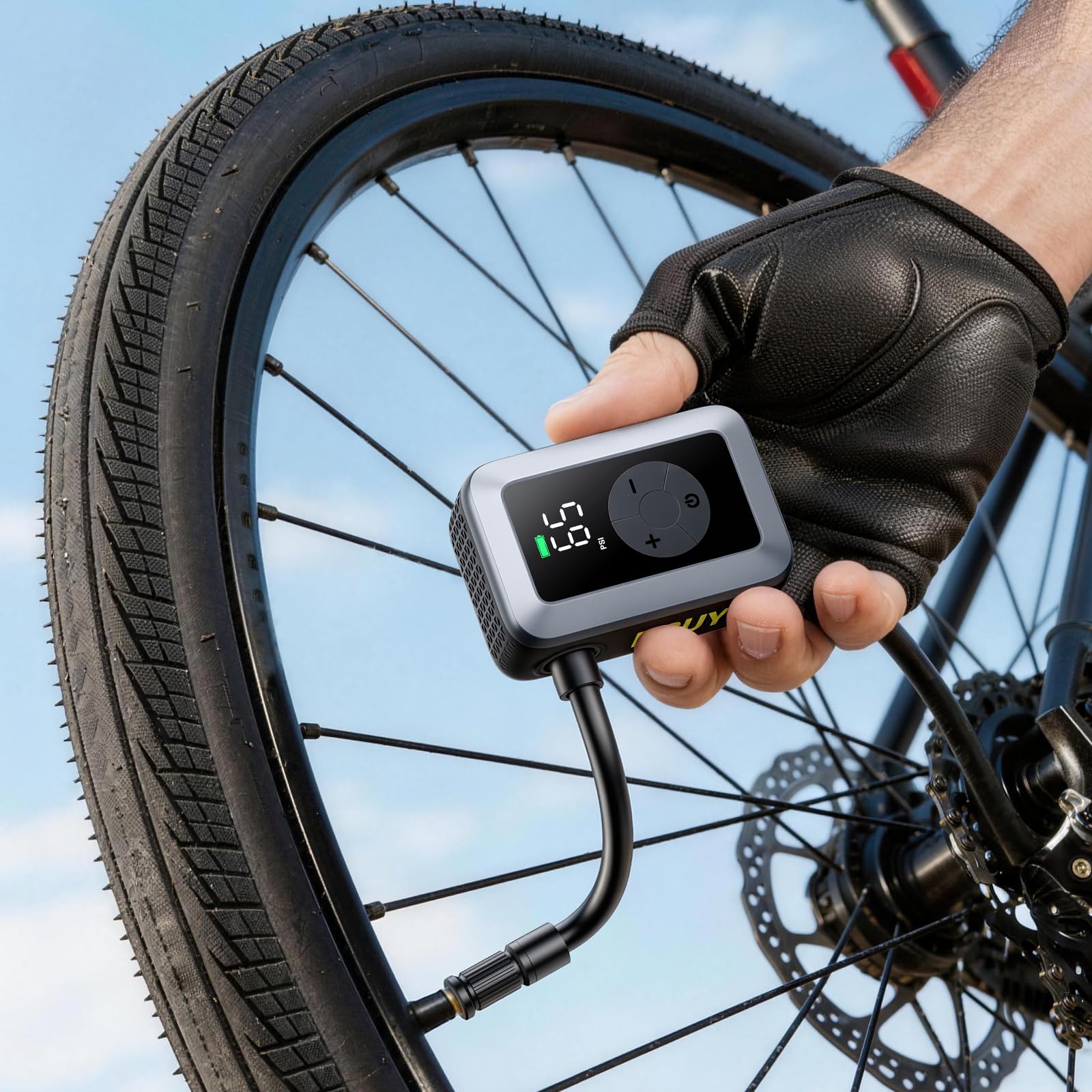
Twenty-seven liters per minute is the highest airflow figure in this group, and it comes from a brushless motor in a body about two inches square. That is the number that matters when you are late: the claim is a road tire from flat in around 20 seconds, and on a pump this size the gap between 15 and 27 liters per minute is the difference between watching a gauge crawl and being done.

The gauge reads 2 to 120 psi with a stated accuracy of plus or minus 1 psi, and the auto-stop works off that number, so you set 85 and put the pump down. Check it once against a gauge you trust — the reading is only ever as good as the sensor feeding it.

Capacity is claimed at 14 road tires per charge between 80 and 100 psi, more than most riders will use between charges, and the 136-gram body drops into a saddle bag beside a tube. The plastic shell is the compromise, and the warranty is one year, the shortest among the electrics here.

Where it makes sense: someone who tops off before every ride, or who has already been let down by a slower electric. Where it does not: anyone who wants the smallest possible object in a jersey pocket, where the 108 and 120-gram pumps here win outright.

Bottom line: For a rider who tops off before every ride and wants it over with, this is the electric we reach for: the highest stated airflow here and a gauge that holds a setting.

4

Vibrelli Mini Bike Pump

Vibrelli Mini Bike Pump

Everyday frame pump

Our Score 8.8/10
Check Price

Worth Noting

  • Not rated for tubeless or stroller tires
Mount
Bottle-cage bracket with Velcro strap
Valves
Presta and Schrader, no swap
Weight
4.3 oz (140 g)
Maximum Pressure
120 psi
Read the full review

Two screws replace the ones holding your bottle cage, a Velcro strap folds over the barrel, and the pump rides under the cage instead of rattling around a saddle bag. That mounting hardware is the least interesting thing in the box and the reason this pump stays on the bike — ours has been under a cage through a summer of rough pavement without shifting. The rest of it is a 4.3-ounce aluminum barrel rated to 120 psi.

What tips it to the top of this group is the valve head. It takes Presta and Schrader without an insert to swap or an adapter to hunt for, which matters at the roadside in the cold when your patience is already thin. Build quality is where this pump is strongest against the rest of these picks: the barrel feels solid rather than hollow, the handle has no play in it, and the five-year warranty is the longest stated here.

Pumping to 100 psi with a barrel this size is work, and we hold it by both ends to keep the stroke straight. What we do not ask of it: tubeless tires, which Vibrelli explicitly excludes, or a fat bike tire at low pressure, where the volume is against you. It is a top-off and get-home pump, not a replacement for the floor pump in the garage.

The price makes a second one easy to justify, and the second one is the point. A pump you never have to remember to move between bikes is the pump that is there when you need it.

Bottom line: We tell most riders to buy this one: it takes Presta and Schrader without swapping parts, straps under a bottle cage, and weighs little enough to leave on the frame all season.

5

CYCPLUS AS2 Pro

CYCPLUS AS2 Pro

Pocket electric

Our Score 8.8/10
Check Price

Worth Noting

  • Battery may stop taking a charge within a year
  • Gauge can read several psi off
Weight
120 g (4.23 oz)
Battery
420 mAh, USB-C, 30-minute charge
Maximum Pressure
120 psi
Tires Per Charge
Two 700x25C, 0 to 110 psi
Read the full review

Charging a pump before a ride sounds like one more thing to remember, and it is. What you get for the trouble is 120 grams of aluminum that disappears into a jersey pocket, a claimed 52-second refill, and a pump that stops on its own when the gauge reaches your preset number while you stand there with clean hands.

The screen is the part that makes it feel worth the money: preset and live pressure on the same display, automatic shut-off, and 120 psi available from something smaller than two CO2 cartridges. A short hose comes in the package, which matters more than it sounds — running through a hose keeps the pump body away from spokes and deep rims where a straight chuck will not fit.

Where we are cautious is the battery and the gauge. These can stop accepting a charge within a year, and the pressure reading can sit several psi away from a known-good gauge, so check the first few fills against a pump you trust. The motor is loud enough that heads will turn at the trailhead. Neither problem is fatal; both are worth knowing before you spend this much.

For a rider who hates pumping, or who owns one bike with a valve buried behind a rotor, this is the pick that changes the job rather than doing it slightly better. Just charge it the night before.

Bottom line: If pumping is the part of bike maintenance you avoid, this is the upgrade: pocket-sized, preset to your pressure, and finished before your hands get cold.

6

HOTO Electric Bike Pump

HOTO Electric Bike Pump

Multi-bike households

Our Score 8.8/10
Check Price

Worth Noting

  • Presta adapter is a separate piece to keep track of
  • 8.96 oz is heavy for a jersey pocket
Hose
360-degree rotating
Weight
8.96 oz
Maximum Pressure
10.34 bar (150 psi)
Tires Per Charge
Up to eight flat tires
Read the full review

Eight flat tires on a single charge is the claim, and for a household with four bikes that is roughly a month of Sunday-morning top-offs without thinking about the charger. It weighs 8.96 ounces — heavier than the pocket electrics here — but it is still smaller than a smartphone, so a jersey pocket or a seat bag swallows it.

Two details make it pleasant to live with. The hose rotates a full 360 degrees, so you can reach a valve tucked behind a chainstay or a rotor without fighting the body of the pump, and the memory holds two preset pressures, one for the road bike and one for the commuter. Flip to start, set the number, walk away.

The Presta setup is the part to learn before you are crouched at the roadside. The adapter is a separate piece and has to be screwed onto the valve first, then the quick-connect chuck goes onto the adapter; do it the other way round and you will chase a leak that is not there. The gauge can also sit several psi away from a known-good one, so check it once against a pump you trust.

Our verdict: for a garage with several bikes and a car that needs topping off, the capacity is worth the extra weight over the pocket electrics, and the price sits mid-pack rather than premium. If you are counting grams on a road bike, it is the wrong nine ounces to carry.

Bottom line: The electric to buy when one pump serves a whole household: eight tires per charge, two saved presets, and a hose that reaches awkward valves.

7

West Biking Mini Pump

West Biking Mini Pump

Spares and budget

Our Score 8.8/10
Check Price

Worth Noting

  • Tops out at 100 psi, short of high-pressure road setups
  • Short barrel means more strokes than longer pumps
Body
Aluminum
Length
22.5 cm
Valves
Presta and Schrader dual head
Maximum Pressure
100 psi
Read the full review

The least expensive pump in this group is also the simplest bargain: an aluminum barrel, a dual Presta and Schrader head with no insert to swap, a frame bracket with screws, and a ball needle plus two balloon needles in the box. If you want a pump on the kids' bikes, the commuter and in the trunk, this is the one to buy in multiples.

It measures 22.5 centimeters with a 100 psi ceiling. That is plenty for a hybrid, a mountain bike or a cruiser, and fine for most road riders — but if you run a 25c tire close to 100 psi, you will be pumping right at the ceiling every time with nothing in reserve. The short barrel also means more strokes than the longer Tiakia or the Lezyne.

Ours lives in the trunk next to a patch kit, which is the least demanding job a pump can have and one it does without complaint. The aluminum body shrugs off being wedged against a jack, and the dual head means you never have to remember which bike takes which valve.

Bottom line: Buy this if you want a working pump on every bike without spending much: aluminum body, both valve types, and a needle for the ball in the garage.

8

VEEAPE Tiny Pump

VEEAPE Tiny Pump

Budget electric

Our Score 8.6/10
Check Price

Worth Noting

  • Plastic shell instead of aluminum
  • Presta adapter is a separate piece to keep track of
Weight
3.81 oz
Airflow
15 L/min
Battery
4000 mAh, USB-C
Maximum Pressure
120 psi
Read the full review

At 108 grams this is the lightest electric pump in the group, which is the whole argument for it: it adds less to a saddle bag than a spare tube, and it still claims 120 psi and 15 liters per minute from a 4000 mAh cell. The body is 2.79 by 1.77 by 1.25 inches, so it sits flat in a bag rather than rolling around.

The kit is fuller than you expect at this end of the range — a Presta adapter, a Schrader adapter and a short hose, plus a lanyard and a storage bag. The separate adapter plus hose arrangement is the one we prefer on an electric: the pump body never hangs off the valve stem, so there is no leverage bending a Presta core. Power is a three-second press of the button, deliberate enough that it will not switch on inside a bag.

What keeps it out of the top tier is the shell. It is plastic rather than the aluminum the premium electrics use, and it feels it in the hand. The upside is that a plastic body does not gouge a frame the way a metal one can when it shares a bag with tools. If you want electric convenience without committing to a premium pump, this is the one to start with.

One habit to build: top up the charge before a long ride rather than trusting whatever is left in the cell from last month. An electric pump that arrives flat is the one failure that undoes the whole idea.

Bottom line: The electric we point to when a premium pump feels like too much: 108 grams, both valve adapters in the box, and a display that shows exactly where you are.

How We Tested the Best Mini Bike Pumps

We started by pulling together a shortlist from shop shelves and online listings, then narrowed it by valve compatibility, stated maximum pressure, mounting options, and price. From that pool, we tested 14 mini pumps over six months. The lineup included manual frame pumps, pocket-sized telescoping models, and a few battery-powered inflators, so the results would reflect what cyclists actually carry.

Most testing happened where a pump gets used: on the side of a paved trail, in a garage before a commute, and on weekend rides. We deflated a 700c tire to 20 psi and timed how long each pump took to reach 80 psi, counting strokes on manuals and noting airflow, including whether the first 20 strokes felt productive or mostly heat. For battery models, we ran a full charge and logged how many tire fills it managed before dying. We also listened for whine loud enough to be awkward in a quiet hallway.

We installed every frame mount on round and oval tubes, rode over curb cuts, and checked for rattles, then stuffed each pump into a jersey pocket and a hip pack to judge portability. We compared each built-in gauge against a digital floor pump at 40, 60, and 80 psi, then asked three riders to attach, switch valve types, and inflate while wearing gloves. Finally, we dropped each pump from waist height onto pavement and ran 50 connect-disconnect cycles, watching for cracked chucks, bent levers, and loose seals.

Value came last: we weighed price against build quality, included mounts, and how well the pump disappeared into a bag or frame. The pumps that rose to the top were the ones we would actually carry, compact, sure-handed, and quick enough that a flat did not become the whole ride.

How to Choose Mini Bike Pumps

Hand pump or electric pump

Start with whether you want to pump at all. The hand pumps here run from 76 to 205 grams, need no charge, and keep working as long as the seals hold. An electric pump adds a battery, a motor and a preset gauge, and hands you a tire at the right pressure without effort — our electric picks run from a 108-gram pocket unit to a 9-ounce one built for a whole garage.

If you ride a few times a week and top off at home, a frame pump does everything you need. If pumping is the chore that keeps you off the bike, or one pump has to look after four bikes, an electric earns its weight. The trap with electrics is storage: one that sits in a saddle bag for months can be flat when you reach for it, so put a monthly top-up on your phone.

Pressure ceiling versus air volume

Two numbers describe a pump and they pull against each other. Maximum pressure is the ceiling; air per stroke decides how long it takes to get there. The 260 psi pump here has a narrow barrel and moves about 44 milliliters a stroke, which is comfortable at 90 psi and slow on a fat bike tire. A 100 psi pump with a wider barrel fills volume faster but runs out of range on a road bike.

Match the ceiling to the tires you actually run. Most road and gravel setups sit under 100 psi, mountain bike tires in the low twenties, and anything at the top of that road range leaves a 100 psi pump with no margin.

Valve heads, hoses and bent cores

Three head designs turn up here and they behave differently on a Presta valve. A dual head has two holes and no parts to lose. A flex hose screws or clamps on and keeps the pump body clear of spokes and rotors. A separate adapter plus quick-connect chuck, which most electrics use, is the fussiest to learn and the gentlest on the valve once you have the routine.

The order matters with that last type: adapter onto the valve first, chuck onto the adapter. Screw-on hoses can walk a loose core out with them, so snug your cores with a valve tool before a long ride and pull the hose straight off rather than twisting.

Carrying it: bracket, bag or pocket

A bracket that reuses the bottle-cage bolts is the most secure way to carry a pump, and the Velcro strap over the barrel is doing real work — a clip on its own lets go on rough ground eventually. No room on the frame? Anything under roughly 200 grams and 8 inches will live in a jersey pocket or a saddle bag.

This is where the weight spread in this group shows up. Seventy-six grams and 140 grams feel identical in your hand and very different at mile 60, so decide before you buy whether the pump lives on the bike or comes with you.

Frequently Asked Questions

Final Verdict

The Vibrelli is the pump we point most riders to. It takes Presta and Schrader without an adapter, straps under a bottle cage where you will actually find it, and weighs little enough that leaving it on the frame is the obvious choice.

If you ride road at 90 psi and count grams, the Lezyne is worth the step up for its machined barrel and 76-gram small size. If you would rather not pump at all, the CYCPLUS AS2 Pro does the work and stops at your number — just charge it before you leave.