Tools & Maintenance

Best Bike Pumps of 2026

Every bike pump is a compromise between speed and portability. A floor pump takes a road tire from flat to 100 psi in under a minute, but it weighs a few pounds and stays in the garage. A mini pump disappears into a jersey pocket and then asks for 300 strokes to do the same job. A good one closes that gap: it hits the right pressure fast, holds the valve without a fight, and doesn't leave you guessing whether you're at 85 psi or 110.

I've wrecked my share of Presta valves, and I've ridden home overinflated because the gauge on my old pump was optimistic. Over the past six months, my team and I have been living with 13 pumps, and the ones worth keeping all seal easily and read honestly. One thing first-time buyers don't realize: the maximum pressure rating is mostly marketing, since a pump stamped 160 psi that takes four minutes to reach 90 is worse than one rated at 100 that gets there in 45 seconds. The picks below are sorted by where you'll actually use them.

1

Topeak JoeBlow Sport III

Top Pick
Topeak JoeBlow Sport III

Road and mixed

Our Score 9.2/10
Check Price

Worth Noting

  • Costs more than budget picks
Gauge
3-inch analog
Weight
3.7 lb
Valve Fit
Presta, Schrader, Dunlop
Maximum Pressure
160 psi
Read the full review

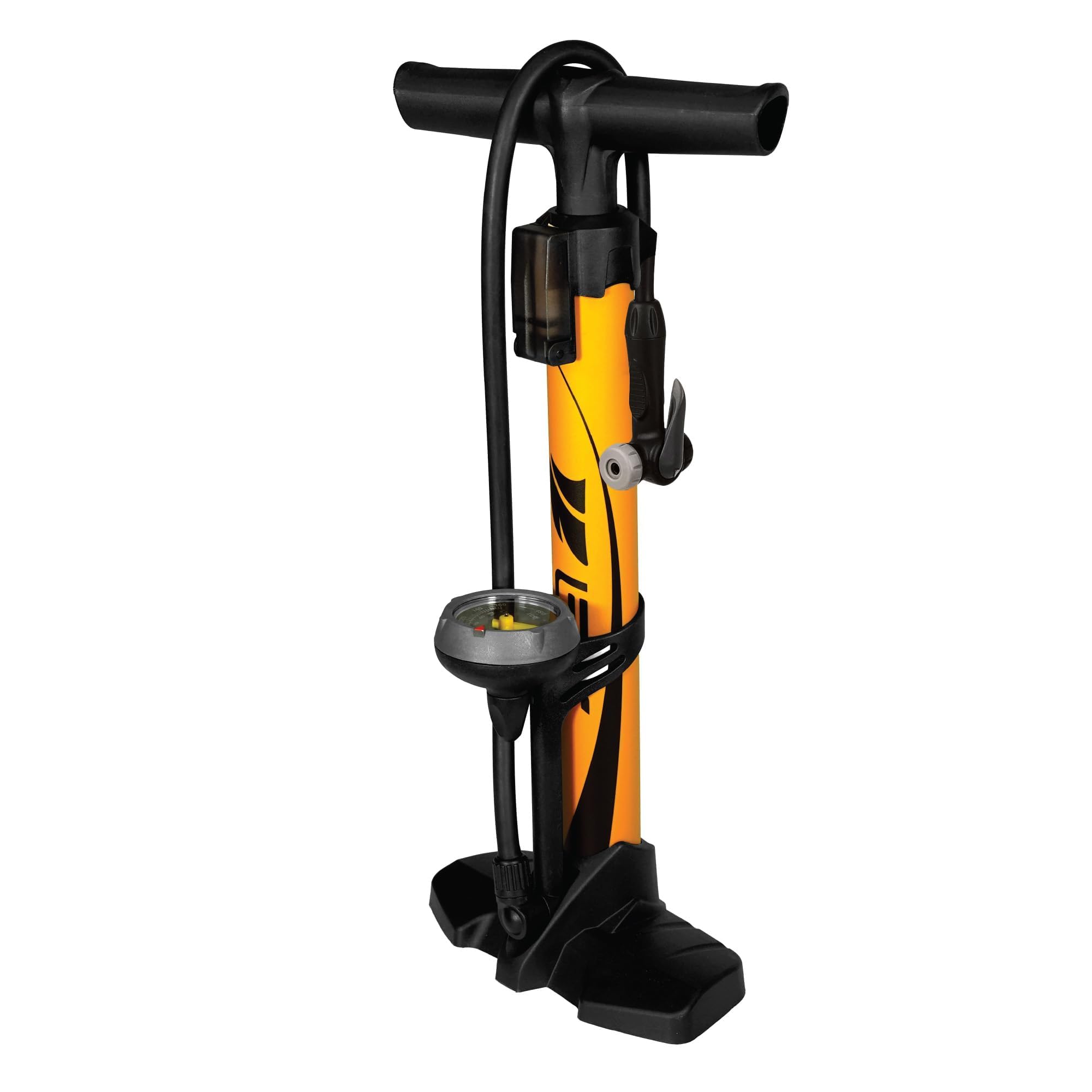
The detail that defines the JoeBlow Sport III is the gauge: a 3-inch analog dial mounted where you can read it while standing over the pump. The steel barrel and wide base give it a planted feel, and the 360-degree hose reaches a valve without twisting the bike. On road and mixed-surface tires, the 160-psi ceiling leaves room for the pressures this pump is built to handle.

This is the floor pump we recommend first for most riders. The TwinHead DX5 accepts Presta, Schrader, and Dunlop without an adapter, and the padded handle is comfortable enough for a long top-off. We appreciate the long hose more than we expected: it lets you stand beside the bike rather than crouch over the valve. The package includes ball and bladder needles, though the pump's main job is tires.

The head is the one part that asks for attention. It works with all three valve types, but it needs a firm, square push to seat, and a recessed valve can take a second try. That is a small habit to learn, not a reason to pass. The gauge is marked in 5-psi increments, which is fine for most riders but not for anyone chasing a precise pressure. For a home pump that gets used before every ride, the stability and readability are worth the premium.

Bottom line: Our top pick for most riders: the 3-inch gauge and steel base make high-pressure fills stable, and the TwinHead fits every common valve. It is the pump we buy when we want one floor pump to last.

2

LEZYNE Sport Drive HP

LEZYNE Sport Drive HP

Premium road/gravel

Our Score 9.2/10
Check Price

Worth Noting

  • Premium price for a mini pump
Hose
Flex hose
Weight
2.68 oz
Valve Fit
Presta and Schrader
Maximum Pressure
120 psi
Read the full review

The Lezyne feels like a machined tool rather than a plastic accessory. The CNC aluminum barrel and piston give it a solid, smooth stroke, and the overlapping Composite Matrix handle extends the grip without making the pump bulky. At 76 grams in the small size, it disappears into a jersey pocket or a frame mount.

The flex hose is the feature that makes it pleasant to use on awkward valves: it takes the strain off the valve stem and lets you move the pump away from the wheel. The 120-psi ceiling is aimed at road and gravel tires, and the high-pressure stroke is deliberate rather than fast. The hose can unscrew a Presta valve core when you remove it, so check the core is tight before a ride and unthread the head slowly.

This is the premium mini we choose for road and gravel riders who want a hose and a more durable feel. It costs more than the Vibrelli, but the machined body and flex hose are the reasons. The pump is not for high-volume tires, and the valve-core habit is worth learning. If you already carry a small tool kit, this is the pump that fits the same pocket.

Bottom line: A premium mini for road and gravel riders who want a flex hose and a machined feel; the price is the main hurdle, not the performance.

3

BV Floor Pump

BV Floor Pump

Budget home pump

Our Score 9.0/10
Check Price

Worth Noting

  • Gauge can be hard to trust
Height
16.25 inches
Weight
16 oz
Valve Fit
Presta and Schrader
Maximum Pressure
160 psi
Read the full review

The BV floor pump is the one we recommend when you want a real floor pump without spending much. It reaches 160 psi, which is enough for road and commuter tires, and the reversible head switches between Presta and Schrader without a loose adapter. At 16.25 inches tall, it stores more easily than a full-height shop pump.

The short body is the trade-off. You will take more strokes than with a taller pump, especially near the top of a road tire's range. The valve head can also need a second attempt to seat, particularly on a recessed Presta valve. Those are the compromises that come with the lower price.

For a commuter or a rider who checks pressure once a week, they are easy compromises to live with. The compact height is a genuine advantage in a small apartment, and the 160-psi ceiling means the pump is not limited to low-pressure tires. We kept it as a second pump for a road bike and never felt under-equipped. The reversible head is the feature that makes it easy to live with: nothing to lose, nothing to swap.

Bottom line: A budget floor pump that gets road and commuter tires to pressure without an adapter; we recommend it when the Topeak's price is more than you want to spend.

4

Bell Bicycle Pump

Bell Bicycle Pump

High-volume tires

Our Score 9.0/10
Check Price

Worth Noting

  • 100-psi ceiling limits road use
Gauge
Bottom-mount
Weight
2 lb
Valve Fit
Presta and Schrader
Maximum Pressure
100 psi
Read the full review

The Bell is built around volume. Its wide barrel and 630 cm3 of air per stroke are meant for mountain, cruiser, BMX, and kids' tires, where you want a lot of air at low pressure rather than a high psi number. The bottom-mounted gauge is easy to see when you are standing over the pump, and the dual head fits Presta and Schrader.

The locking lever is the part that takes getting used to. It is stiff and small, and it can bend a Presta valve if you rush the attachment. The high-volume barrel also makes the last few psi more work than a narrow floor pump.

It earns a place as a high-volume specialist for fat tires, cruisers, and kids' bikes. The included ball needle and inflation cone add useful versatility, and the price is reasonable for a floor pump. If your stable is all low-pressure and wide, the Bell is a sensible choice.

Bottom line: A high-volume floor pump for mountain, cruiser, and kids' tires; it moves air quickly but stops at 100 psi.

5

Tiakia Mini Bike Pump

Tiakia Mini Bike Pump

High-pressure backup

Our Score 9.0/10
Check Price

Worth Noting

  • Long-term durability is uncertain
Length
7.8 inches
Weight
5.3 oz
Valve Fit
Presta, Schrader, Woods
Maximum Pressure
260 psi
Read the full review

A 260-psi rating on a pump that weighs 5.3 ounces and measures 7.8 inches is the kind of claim that makes you look twice. The Tiakia is an aluminum mini with a dual head for Presta, Schrader, and Woods valves, plus a frame bracket and a ball needle. It is built to be carried, not to replace a floor pump.

The 44-ml stroke is the number that matters. It is enough to get a road tire back to pressure, but you will pump a lot of times to do it, and a wide mountain bike tire will feel like a workout. The aluminum body and anodized finish give it a more durable feel than a plastic mini, and the IPX4 rating is useful if you ride in wet weather.

The dual head is convenient because it accepts three valve types without an adapter, and the 7.8-inch length fits under a bottle cage or in a frame bag. The 260-psi ceiling is more headroom than most riders need, but it makes the pump a useful spare for a high-pressure road bike.

It earns a place as a light backup for road riders who want a high-pressure ceiling and do not mind a long stroke count. It is not the mini we choose for a fast roadside fill on a wide MTB tire. The frame bracket and low weight make it easy to keep on the bike, and the aluminum body is the reason we prefer it to a plastic mini.

Bottom line: A light, high-pressure mini for road riders who want a backup pump; the small stroke and uncertain long-term durability are the trade-offs.

6

Vibrelli Mini Bike Pump

Vibrelli Mini Bike Pump

Roadside road use

Our Score 8.8/10
Check Price

Worth Noting

  • Not rated for tubeless use
Weight
4.3 oz
Warranty
5 years
Valve Fit
Presta and Schrader
Maximum Pressure
120 psi
Read the full review

The first thing we check in a frame pump is whether it needs a valve swap mid-flat. The Vibrelli doesn't: the head accepts Presta and Schrader without changing parts, and it locks on without an adapter to lose. At 120 psi and 4.3 ounces, it is built for road and commuter tires, and the aluminum body feels more substantial than the price suggests.

This is the mini we recommend for most riders who want a light backup. The no-swap head is a real convenience when you are crouched at the side of the road, and the 120-psi ceiling is enough for road tires. The included velcro mount fits bottle-cage holes and holds the pump firmly. It is a top-off pump, not a floor-pump replacement: high-volume tires will take a long time.

The five-year manufacturer warranty is the detail that makes it easy to keep on the bike. We also appreciate that the pump is small enough to drop in a jersey pocket when the mount is not an option. For the money, it is the least fussy way to carry pressure with you.

Bottom line: The mini we recommend for road and commuter riders: light, no valve swapping, and a five-year warranty. It is a top-off pump, not a floor-pump replacement.

7

Schwinn Foot Operated Bike Pump

Schwinn Foot Operated Bike Pump

Tight spaces

Our Score 8.8/10
Check Price

Worth Noting

  • Slower for high-pressure road tires
Gauge
Air Zone gauge
Weight
3.1 lb
Hose Length
23 inches
Maximum Pressure
120 psi
Read the full review

The Schwinn foot pump is the one we reach for when floor space is tight. Its steel feet fold out for stability and fold back into a compact shape, so it can live on a shelf or in a closet without taking over. The 120-psi ceiling and 23-inch hose are enough for casual bike tires, strollers, and the occasional sports ball.

The foot-operated rhythm is different from a floor pump. You step down rather than lean over, which leaves your hands free to steady the valve and the hose. The Air Zone gauge sits where you can read it, and the folding feet make the pump feel more stable than its compact footprint suggests. For a kid's bike or a cruiser, that is a pleasant trade.

For a household with mixed bikes and limited storage, it is a sensible compromise. The folding feet are the detail that earns it a place, and the hands-free stroke makes it easy to use with a child holding the bike. It is not the fastest way to add air, but it is one of the easiest to tuck away.

Bottom line: A space-saving foot pump for casual riders and tight garages; the folding feet and hands-free stroke make it easy to live with.

How We Tested 13 Bike Pumps, From Garage Floor to Roadside

We started by gathering every pump that met a few baseline specs: a stated max pressure appropriate to its type, a hose long enough to reach a valve without tipping the base over, and a head that switches between Presta and Schrader without a loose adapter rattling around in a drawer. We dropped anything with a plastic chuck that owners repeatedly described as cracking, and anything from a brand with no replacement parts or warranty path, since durability was the loudest complaint in the customer reviews we read. We also weighed price against what the money actually bought, whether that was a metal base, a rebuildable head, or a gauge with real numbers on it. That left 13 pumps, which we used for six months.

Most of the work happened in a garage through a cold, wet winter and spring, on a 700x25 road tire and a 27.5-inch mountain bike tire, the two extremes of pressure. We timed every floor pump from completely flat to 100 psi, then compared its built-in gauge against a separate digital gauge and recorded how far off it read. We inflated a trailer tire and a fat bike tire at low pressure too, because a pump that feels efficient at 100 psi can be useless when you need 8 psi on the nose.

The mini and frame pumps got a roadside simulation: deflate the tire, then count strokes and time the run to 80 psi with the pump braced in one hand and the wheel in the other. We swapped heads between valve types a few dozen times on each pump and noted which ones demanded two hands, hissed at the seal, or started bending the valve core. We weighed and measured each compact pump folded, then checked whether it genuinely fit a jersey pocket or frame mount on a ride. Every pump was dropped onto concrete from waist height and checked afterward for cracked handles, gritty seals, and hoses separating at the crimp.

How to Choose Bike Pumps

Match the Pump to Where You Ride

A floor pump is the default for home because the wide base and long barrel let you push high pressure with less effort. A mini pump is for the ride, not for routine inflation: its small stroke takes many pumps, so choose one for emergency top-offs rather than weekly maintenance. A foot pump sits between the two, with a smaller footprint and a hands-free stroke, but it is slower at high pressure. If you can store only one pump and you ride road tires, make it a floor pump.

Pressure Ceiling and Air Volume

Buy for the tires you actually ride. A road or gravel bike needs a pump that can reach the pressure on the sidewall, which is why a 160-psi floor pump like the Topeak or BV makes sense. A mountain bike, cruiser, or kids' bike needs volume more than a high ceiling; a wide-barrel pump such as the Bell moves more air per stroke and is easier on fat tires. The trap is buying a 260-psi mini and expecting it to fill a wide tire quickly: high pressure and high volume are different jobs.

Valve Fit and a Secure Head

Presta and Schrader are the two valve types you will meet, and a pump that handles both without a loose adapter is easier to live with. The head matters as much as the valve list: it should seat with a firm, square push and lock without leaking. A flexible hose lets you move the pump away from the wheel and avoids side strain on the valve. If you switch between bikes, a twin-head or reversible head saves time; if you only own one bike, a dedicated head is fine.

Gauges: Readable and Trustworthy

A gauge is only useful if you can see it and believe it. A large dial mounted high on the pump is easier to read than a bottom-mounted gauge, especially when you are leaning over the bike. The scale matters too: 5-psi increments are fine for most riders, but a road rider chasing a precise pressure may want finer markings. If the gauge and the tire feel disagree, check with a separate gauge before you trust the pump. A built-in gauge is a convenience, not a calibration certificate.

Portability, Mounts, and Long-Term Cost

For a pump that lives on the bike, weight and length matter more than pressure ceiling. A 4- to 5-ounce mini with a frame mount disappears on the bike; a 76-gram pump is even easier to carry, but it will take more strokes. Check that the mount clears your bottle cage and that the strap holds the pump firmly. Durability is the weak point on inexpensive mini pumps, especially at the head, so a warranty and a metal barrel are worth paying for. A floor pump costs more up front but replaces the most frequent pumping job.

Frequently Asked Questions

Final Verdict

For most riders, the Topeak JoeBlow Sport III is the pump we recommend buying first. The 3-inch gauge, stable steel base, and TwinHead make high-pressure fills easier to repeat, and the build quality is the reason to spend more if you pump at home several times a week.

If that price is more than you want to put into a pump, the BV floor pump is the value choice for road and commuter tires. If you have no floor space, the Schwinn foot pump is the compact alternative. For the ride itself, the Vibrelli is the light, no-fuss mini; the Lezyne is the upgrade for road and gravel riders who want a flex hose and a machined feel.