Helmets

Best BMX Helmets of 2026

A BMX helmet has one job, and you usually find out whether it's up to it at the worst possible moment. But the helmet that actually protects you is the one you forget you're wearing — the one that fits your head shape, doesn't press on your temples, and doesn't turn your neck into a noodle after an hour at the park. Get the size wrong and even a good helmet slides around; get the shape wrong and you'll leave it in the car. The right one lets you commit to the trick instead of thinking about your head.

The thing I kept noticing while testing: the helmets that felt safest on paper weren't always the ones I reached for. Over six months, my team and I rode in 14 different BMX helmets — at the skatepark, on dirt jumps, and through plenty of parking-lot sessions — and the differences came down to a few unglamorous things. A helmet that shifts when you shake your head won't stay put in a crash, no matter how thick the shell looks. Here's what earned a spot in the rotation.

1

Triple Eight Certified Sweatsaver

Top Pick
Triple Eight Certified Sweatsaver

Park and street

Our Score 9.6/10
Check Price

Worth Noting

  • No dial; the size is set by the pads
Liner
Sweatsaver fabric, two pad sets
Sizes
XS/S to XL/XXL, from 51 cm
Weight
1.1 lb
Certification
CPSC bicycle plus two ASTM standards
Read the full review

Sweat running into your eyes on the roll-in is the small failure that wrecks a session, and the Sweatsaver liner is why this is the helmet we recommend first. It puts moisture-wicking fabric against your forehead instead of bare foam, and it sits inside a shell that is triple-certified, the CPSC bicycle standard included. Plenty of helmets here will protect your head; this one is also the least annoying to wear while it does it.

Fit is done with foam rather than a dial. Two full sets of Sweatsaver pads come in the box, and they're deliberately snug when new, settling after an hour or two of wear — which is how a hard shell ends up feeling like it was made for one head. Four sizes start at 51 cm and the bands overlap by a centimeter at the edges, so a head reading 53 or 54 cm falls into two of them. Measure around the widest part of your head with a soft tape, then use the second pad set to close whatever gap is left.

The rest is deliberately plain: a hard ABS shell over EPS foam, a matte finish, 0.5 kg on the head, and a 181-day manufacturer warranty. It's a touch heavier than the lightest shells in this group, and once the pads settle you stop noticing it, which is the only weight test that matters.

What you're buying is a helmet you don't have to think about mid-session: no strap to re-tension between runs, just a shell that hasn't moved since you put it on. The pads are also the part that ages first, so treat the fit as something to maintain rather than something you set once.

Bottom line: The helmet we recommend to most BMX riders: triple-certified, pad-fitted, and lined with fabric that keeps sweat out of your eyes on long, hot sessions.
2

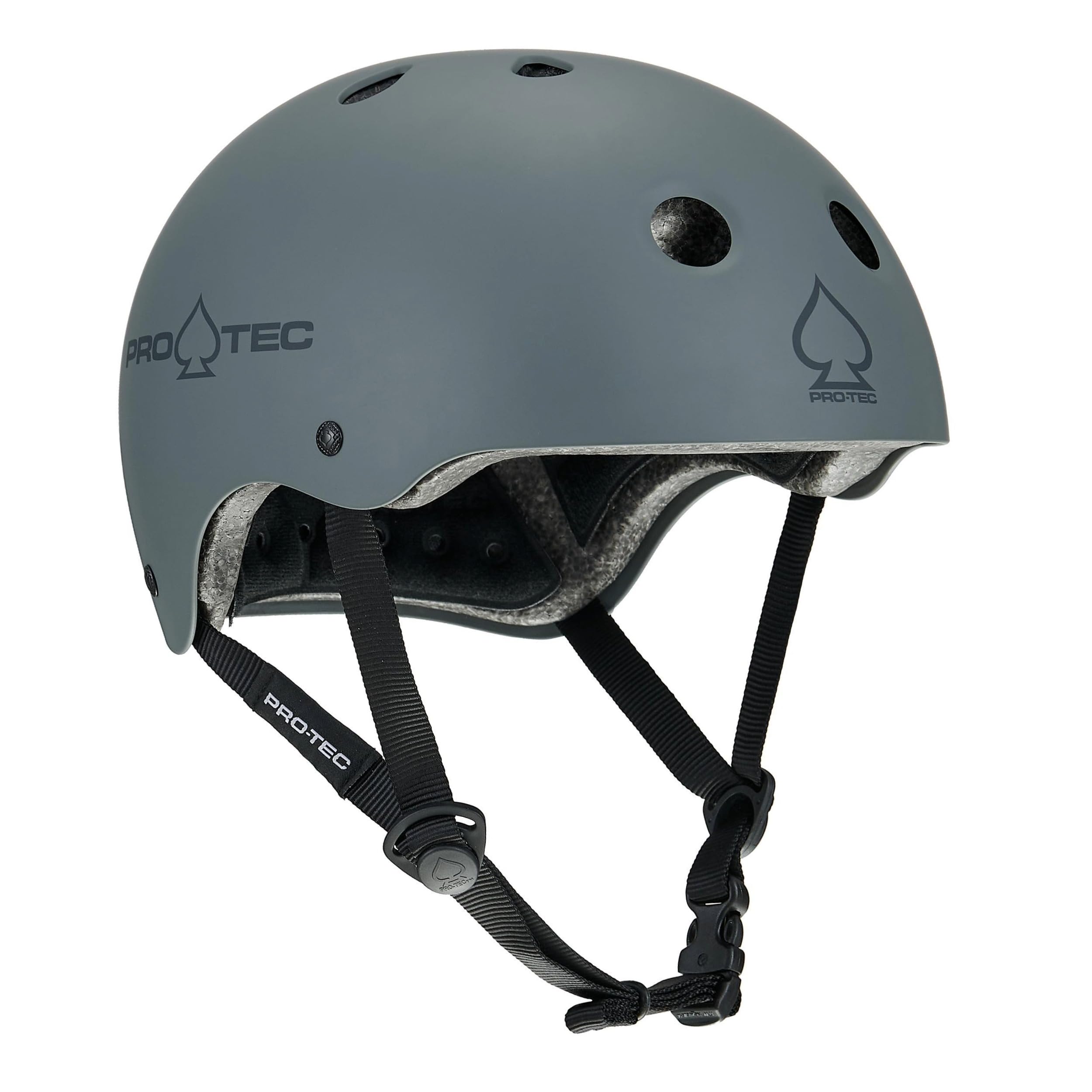
Pro-Tec Classic Certified

Pro-Tec Classic Certified

Classic skate style

Our Score 9.4/10
Check Price

Worth Noting

  • Runs small against the size chart
Liner
Compression-molded padding
Vents
11
Weight
1.1 lb
Certification
CPSC bicycle plus two ASTM standards
Read the full review

This and our top pick land at about the same money, and both are hard-shell, triple-certified helmets, so the choice comes down to the shape inside. Pro-Tec's padding is compression-molded and sits generously around the crown, which suits rounder head shapes that find swappable-pad helmets fussy to settle into.

We keep it on the list for two reasons. The first is that it's the shape most people picture when they hear skate helmet, and that matters more than it should — a helmet a teenager won't argue about is a helmet that gets worn. The second is that the ABS shell and its eleven open vents handle a real park session: padding that holds, air that moves, and a shell that takes scrapes without complaint.

Sizing is the thing to get right. It runs small against its own chart, so if your measurement lands on a boundary, go up, and give the padding a week to compress before you decide it's wrong. At 1.1 lb it sits on the heavier side of this group, which you notice picking it up and forget once it's on.

Bottom line: We point riders here when they want the classic hard-shell look and a rounder interior — just order a size up and take the fit seriously.

3

80Six Triple-Certified Multisport

80Six Triple-Certified Multisport

Kids and teens

Our Score 9.4/10
Check Price

Worth Noting

  • Age labels on the box mislead buyers
Shell
ABS over EPS foam
Sizes
Three bands, 49–58 cm
Weight
14.1 oz
Certification
CPSC bicycle plus two ASTM standards
Read the full review

The lowest-priced helmet here is also the one that covers the most young riders: three triple-certified shells spanning 49 to 58 cm, built the same way as helmets selling for twice as much. That's why it's our pick for kids and teenagers — and why the age printed on the box is the least useful number on it.

The bands are labeled 5+, 8+ and 14+, but the centimeters are what count. A head at 52 or 55 cm sits in two bands at once, a tall 10-year-old belongs in the 14+ shell, and a small 14-year-old may not. Measure around the widest part of the head, buy the band that contains the number, and don't size up for growth: the fit is pad-based and meant to be snug from day one, with the foam conforming over the first few weeks. At 400 g it's one of the two lightest shells here, which is why kids stop noticing it by the second lap.

Bottom line: Our pick for younger riders: triple-certified, light, and sized by centimeters rather than the ages printed on the box.

4

OUWOER Skateboard Helmet ZL-B007

OUWOER Skateboard Helmet ZL-B007

Hot weather parks

Our Score 9.4/10
Check Price

Worth Noting

  • Rear adjuster and straps are the wear points
Sizes
Three sizes, from 51 cm
Vents
12
Liners
5 mm and 8 mm sets
Certification
CPSC bicycle standard
Read the full review

Twelve vents is the highest count stated on any helmet here, and vent count isn't everything — but on a still afternoon at the park it's the difference between a warm head and a headache. The channels run along the top and the sides, the liner is soft against the skin, and the shell comes in matte finishes rather than gloss.

Everything else is the standard recipe done properly: ABS over EPS, a 360-degree dial at the back with adjustable side straps, and two liner sets at 5 mm and 8 mm so you can tune the volume rather than just the tightness. Sizes start at 51 cm and the medium band runs 55 to 58 cm, and it arrives with a carry bag.

For a rider who overheats, or a kid who complains about every helmet, this is the one we reach for first in summer. It carries the CPSC bicycle standard and sits in the middle of this group on price, which makes it an easy second helmet for a household that already owns a good one.

Bottom line: The most ventilated helmet here, with a dial fit and two liner thicknesses — a sensible match for hot parks and long summer sessions.

5

TurboSke Skateboard Helmet

TurboSke Skateboard Helmet

Budget adult rides

Our Score 9.2/10
Check Price

Worth Noting

  • Only two shell sizes for the whole range
Sizes
Two sizes, S/M and L/XL
Vents
11
Weight
1.01 lb
Certification
CPSC 1203 and CE EN 1078
Read the full review

The least expensive helmet here is also the only one that carries a European certification alongside the U.S. one: this is built to 16 CFR 1203 and CE EN 1078. At this price the certification is the whole argument, and it's a good one — everything else about the helmet is convenience.

The fit gear is better than the price suggests. A dial at the back expands or closes a semi-flexible ring around your head, the chin strap adjusts on its own, and two extra sets of foam pads change the feel without changing the size. Eleven vents and 0.46 kg put it alongside helmets much further up this list.

Ours has been the spare that lives in the truck and the first helmet for a growing kid, and it does what a far pricier shell does: certified, adjustable, and light enough for a full session. It's also the one we hand to a friend who forgot theirs, because the dial fits a borrowed head in about five seconds.

Bottom line: The least expensive helmet here, and it still carries U.S. and European certification; just know your measurement before you order.

6

innamoto Skateboard Helmet

innamoto Skateboard Helmet

Thick hair, volume

Our Score 9.2/10
Check Price

Worth Noting

  • One medium band listed, 54–58 cm
Size
Medium 54–58 cm
Liners
Two removable sets
Weight
1.12 lb
Certification
CPSC 1203 and ASTM 1492
Read the full review

A helmet can match your tape measurement and still be a fight to put on once there's hair in the way. This one has the roomiest interior in the group: it clears a full head of curls or braids without riding up at the back, and the fit gear explains why — two removable liner sets in different thicknesses, a dial behind the head, and nylon side straps you can re-route rather than just shorten.

It's certified to CPSC 1203 and ASTM 1492, weighs 0.51 kg, and comes with a padded chin strap and a storage bag — small things that make it feel like more helmet than the price suggests. The chin pad in particular is the kind of detail you appreciate on a cold morning, and the extra liner set means the fit can change as a haircut does.

Bottom line: If every helmet you've tried has squeezed, the roomy interior and two liner sets are exactly why we kept this one.

7

OutdoorMaster Skateboard Helmet

OutdoorMaster Skateboard Helmet

Shared family use

Our Score 9.2/10
Check Price

Worth Noting

  • No safety standard named on the listing
Fit
Rear dial and chin strap
Shell
ABS with EPS foam
Liners
Two removable sets
Weight
13.9 oz
Read the full review

One helmet, three riders, one Saturday: this is the model that survives that arrangement. Everything about the fit can be changed in seconds without tools, which is exactly what a shared helmet needs and exactly what a fixed-pad shell can't do.

The shell is ABS over thickened EPS, the shape is a rounded skate cut, and at 13.86 ounces it's the lightest listed weight in this group. You feel that on a long session, and more than the numbers suggest.

Two removable liners come in the box, both washable, so the padding that sits against a sweaty forehead is the padding you can rinse. The dial at the back and the chin strap take the shell from one rider to the next in the time it takes to hand it over; the large is the size listed here, so measure before ordering, because a dial closes a gap rather than creating room.

As a family helmet or a loaner that lives in the garage, it does more than a fixed-pad design can, and at 13.86 ounces it's the one people actually reach for. Riders who want a single dialed-in fit and nothing to fiddle with are better served by a pad-based shell; anyone sharing a helmet is not.

Bottom line: The helmet we pass around a household: a dial and two washable liners cover several head sizes, and it's the lightest listed here.

8

Retrospec Dakota

Retrospec Dakota

Everyday adult riding

Our Score 9.0/10
Check Price

Worth Noting

  • Fit runs tight
Vents
10
Weight
16 oz
Padding
Removable, washable
Warranty
Limited lifetime
Read the full review

Padding that comes out is padding that gets washed, and that's the quiet appeal here: pull the liner, rinse it, and the shell stops smelling like last August. For a helmet that spends its life in a hot car between rides, that's not a small thing.

The rest is a simple ABS shell over EPS with ten vents, 16 ounces on the head, and adult sizes starting at 51 cm. Retrospec backs it with a limited lifetime warranty, the longest coverage on this list, though like every warranty here it covers defects rather than crash damage.

The listing doesn't name a safety standard, which is the one thing to settle before your first ride: check the sticker inside the shell when it arrives. Every helmet here that names a certification carries that label, and if it's missing, send it back.

As an adult helmet for commuting, cruising, and the odd park visit, it's a sensible buy — simple, washable, and easy to live with. It isn't the one for a rider chasing the deepest coverage or the most vents; it's the one for someone who wants a good helmet and doesn't want to think about it again. What we appreciate most is how little it asks of you.

Bottom line: A straightforward adult helmet with washable padding and long warranty coverage, as long as you size it right the first time.

How We Tested 14 BMX Helmets

We started by pulling together every BMX helmet we could find that was actually available in a full run of sizes, then filtered by certification, price, and whether replacement pads were sold separately. That left 14 helmets, which we rode for six months across skateparks, dirt jumps, pump tracks, and everyday street sessions. Each one was worn by at least two riders with different head shapes, because a helmet that fits one person perfectly can rattle on someone else.

Sizing got its own round of testing. We measured every tester's head circumference and checked it against each brand's chart, noting where the chart ran a size small or large. We swapped in thinner or thicker pads where the brand offered them, cycled the fit dials until they stopped clicking smoothly, and wore each helmet for a 20-minute session before adjusting anything, to see where it pressed. Then we shook our heads side to side and pushed the helmet from front and back while it was strapped, to see how much it moved.

Protection and build quality came down to inspection and repetition: we checked the shell-to-foam bonding, tugged on strap anchors, opened and closed buckles dozens of times, and washed the liners to see whether the padding survived. Every helmet went on a kitchen scale, and we noted neck fatigue after long sessions. For appearance, we photographed each one in profile and with goggles, and asked riders whether they'd wear it without being paid to. The helmets that scored well on all of it — not just the ones that looked tough — are below.

How to Choose BMX Helmets

Start With the Certification, Not the Shell

BMX is bicycle riding, so the standard that counts is the CPSC bicycle helmet standard, 16 CFR 1203. Plenty of skate-style helmets also list ASTM standards for skating and roller sports; those are welcome, but they don't replace the bicycle certification, and a helmet certified only for skating isn't certified for riding.

Check the label sewn or stuck inside the shell rather than trusting the product page, because a listing that never names a standard leaves you nothing to compare. Order with that in mind: if the sticker isn't there when the box arrives, send it back before the first ride.

Shell Shape and How Much Head It Covers

Skate-style helmets pair a hard ABS shell with EPS foam and come down further at the back and sides than a vented road helmet. For BMX that coverage is the point — park and street falls are often slow and land you on the back of your head, which is exactly where a short road shell stops.

The hard shell also shrugs off scrapes and knocks that chew up a thin road lid. It doesn't make the helmet reusable after a real hit; EPS still crushes once, however tough the outside looks.

Fit Is Measured, Not Guessed

Run a soft tape around the widest part of your head, about an inch above the eyebrows, and keep that number. Then buy the band that contains it. Age labels on youth helmets are a rough guide at best: a head at 52 or 55 cm often falls into two bands, and a tall 10-year-old can need the teen shell.

Two fit systems dominate. Swappable foam pads give a precise, set-and-forget fit and won't loosen on their own; a rear dial is faster to adjust and easier to hand between riders. Neither is better, but they suit different households — and neither works if you buy big for growth.

Ventilation, Liners, and Sweat

Vent counts on these helmets run from ten to twelve, and the real difference between them is smaller than the numbers suggest. What you feel on a hot day is what sits against your skin: a fabric liner wicks, bare foam doesn't, and a liner that comes out can be washed.

If you ride in a warm climate or keep the helmet on for hours, put the liner ahead of the vent count. If you mostly ride short sessions, take the vents and worry less about the rest.

After the Crash, and the Warranty

The foam liner is designed to crush once. After a hard impact the helmet has done its job and should be replaced, even if the shell looks fine — so budget for the replacement as part of the purchase rather than as a surprise.

Warranties in this group run from 180 days to a limited lifetime, and they cover manufacturing defects rather than crash damage. If you're buying for a growing kid, that's an argument for spending less on the first helmet and putting the money into the second one.

Frequently Asked Questions

Final Verdict

For most BMX riders, the Triple Eight Certified Sweatsaver is the helmet to buy. It carries the CPSC bicycle standard along with two ASTM certifications, the two pad sets let you fit it properly rather than approximately, and the Sweatsaver liner is the difference between a full session and a session cut short by sweat in your eyes.

Change one requirement and the answer changes. If one shell has to cover several riders, the OutdoorMaster's dial and two washable liners handle that better. If you're buying for a kid, the 80Six starts at 49 cm and costs the least here. And if your measurement lands at the top of a band, read the sizing paragraph twice — that's where most returns come from.