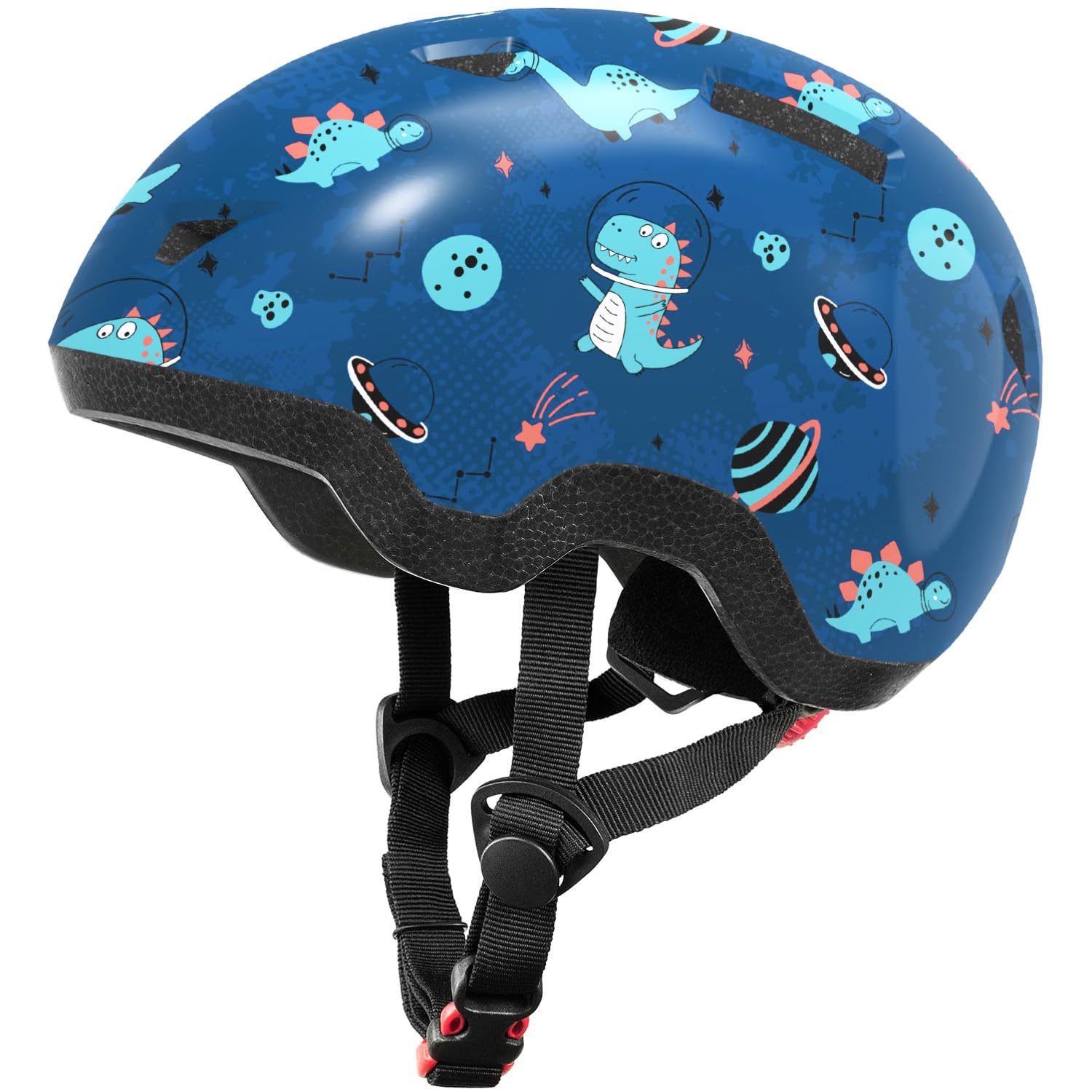
Helmets

Best Kids Bike Helmets of 2026

A helmet that sits too far back on a kid's head is barely better than wearing nothing at all, and that's how most kids end up wearing one — tipped back, straps dangling, because it never fit right. What you want is a helmet that covers the forehead, cinches down in seconds, and survives being handed to a wriggling toddler who has decided today is the day they won't wear it. Get that right and the helmet stops being a daily negotiation — and you can finally watch a wobbly ride down the driveway without holding your breath.

Something nobody tells you: helmets are outgrown by head circumference, not age, so the size on the box is only a starting point. We spent six months putting 14 helmets on kids from toddler through big-kid sizes, and the ones we kept reaching for were the ones that adjusted without a fight and didn't look babyish to the kid wearing them. Appearance counts for more than most parents expect when the wearer is four — the picks below earned their spot by the front door.

1

Schwinn Thrasher Youth Helmet

Top Pick
Schwinn Thrasher Youth Helmet

Older kids

Our Score 9.6/10
Check Price

Worth Noting

Size
55-58 cm
Vents
20 air vents
Fit System
Dial and straps
Suggested Ages
8-14 years
Read the full review

Once a child is past the character-helmet stage, the fit range matters more than the graphics. The Schwinn Thrasher is sized for 55-58 centimeter heads and aimed at ages 8 to 14, a stretch where a lot of kids' helmets stop just short. We recommend it first for that older group because the dial system gives a repeatable fit, the shell has deeper rear coverage, and the 20 vents make it a realistic choice for a child who rides to school or joins a weekend trail ride.

The full-coverage padding wraps around the head, and the side and chin straps are there to fine-tune the fit after the dial is set. At 13.12 ounces, the Thrasher is not the lightest helmet in this group, but the weight is spread over a larger youth shell, so it reads as substantial rather than bulky. The visor gives a little shade without dominating the look, and the black finish is easy to live with.

What we like most is that it treats an older kid like an older kid. There is no cartoon shell and no toddler-scale padding; the helmet looks like real cycling gear, which matters to a 10-year-old who has opinions about being seen in public. It is a straightforward, well-fitting youth helmet, and the dial means it can keep fitting through at least one growth spurt.

Bottom line: If your rider has outgrown the 54 cm shells, the Thrasher is the youth helmet we point to first, with a dial fit and 20 vents for the 8-14 set.

2

Radio Flyer Kids Helmet

Radio Flyer Kids Helmet

Toddlers 2-5

Our Score 9.6/10
Check Price

Worth Noting

Size
One size
Fit System
Interior adjuster and chin strap
Suggested Ages
2-5 years
Safety Standard
U.S. bicycle helmet standard
Read the full review

The 2-5 age label on the Radio Flyer is broader than the helmet behaves. This is one size, with an interior adjuster and chin strap, and it is a better match for a 3- or 4-year-old than for a small 2-year-old. That is the first thing we check: if your child is still in the lower half of the toddler size range, the Schwinn Classic is the more reliable starting point.

What we appreciate is how straightforward the Radio Flyer is. The red matte shell has a clean, classic look, the interior adjuster gives a useful amount of growth room, and the chin strap is easy to operate. It passes the U.S. bicycle helmet standard, which is the baseline we want, and the polycarbonate shell and foam liner give it a solid, planted feel on a small head.

In a category full of cartoon graphics and add-on features, we appreciate a helmet that simply looks like a helmet. The Radio Flyer is the one we hand to a cautious 3-year-old who needs a comfortable, uncomplicated fit, and it has enough coverage to feel like proper protection rather than a padded hat. The 14.4-ounce weight is on the heavy side for a toddler, though the shell sits securely once the interior adjuster is set. That is a fair trade for a first helmet that does not need a manual.

Bottom line: For a first bike or balance-bike helmet, the Radio Flyer is a sturdy, simple 2-5 pick with a classic look and an easy interior adjuster.

3

Raskullz Mohawk Helmet

Raskullz Mohawk Helmet

Reluctant wearers

Our Score 9.6/10
Check Price

Worth Noting

  • LED fin runs only a few minutes
Size
50-54 cm
Feature
LED mohawk fin
Suggested Ages
5-8 years
Safety Standard
CPSC, age 5+
Read the full review

The light-up mohawk is the reason a kid will ask for this helmet by name. Five LEDs in the fin switch on with a button, and the auto-shutoff is a small mercy for parents who forget. It is pure theater, not a substitute for a bike light, but it does make the helmet feel like a toy a child wants to wear rather than a rule imposed from above.

The rest is a solid 50-54 centimeter child helmet: a PVC shell over EPS foam, adjustable straps, cooling vents, and CPSC certification for ages 5 and older. The 13.28-ounce weight is heavier than the lightest helmets here, and the fin adds visual bulk, but it is not a helmet a 6-year-old will complain about on a short ride. The adjustable straps let you set the fit once and leave it alone.

We like this one most for the child who resists helmet time. The mohawk gives them a reason to put it on, and the straps are simple enough that the fit can be set once and left alone. It also gets comments from other kids at the bike rack, which, frankly, is part of getting a 6-year-old to wear it without a fight. The effect is not subtle, and that is the point.

Bottom line: The light-up mohawk is a genuine kid magnet, and underneath it is a CPSC-certified 50-54 cm helmet that makes the daily helmet negotiation shorter.

4

BURSUN Kids Bike Helmet

BURSUN Kids Bike Helmet

Everyday riding

Our Score 9.4/10
Check Price

Worth Noting

Size
48-54 cm (Small)
Weight
12 oz
Suggested Ages
3-8 years
Safety Standard
CPSC certified
Read the full review

The 48 to 54 centimeter range is the busiest slice of the kids' helmet market for a reason: it covers the preschool years and most of early grade school. The BURSUN Small is built for that span, with an ABS shell over an EPS liner, CPSC certification, and 11 vents across the top and sides. The vents are not a decorative detail; they are the difference between a helmet a child forgets about and one that comes off sweaty at the playground.

We chose it as the top pick because it gets the practical parts right without charging a premium. The rear dial gives a clear range of adjustment, the straps and chin buckle can be set to keep the shell level, and the padding takes up the remaining slack. At 340 grams it is not the lightest helmet here, but it is reasonable for a shell this size, and the ventilation makes the weight less noticeable on a warm ride.

The fit is not universal. A child already measuring near 54 centimeters needs a youth helmet, and a very small 2-year-old can still rattle around inside the Small. We treat it as a helmet for roughly 3- to 7-year-olds whose heads measure in the low-to-mid 50s, and we check the front edge and chin strap before every growth spurt. If you need a first helmet for a 1- or 2-year-old, the Schwinn Classic is the more sensible starting point.

Bottom line: For most families, this is the kids bike helmet we recommend first: a CPSC-certified 48-54 cm shell, easy dial fit, and 11 vents make it the most broadly useful pick here.

5

Schwinn Classic Toddler Helmet

Schwinn Classic Toddler Helmet

Smallest toddlers

Our Score 9.4/10
Check Price

Worth Noting

  • Inner Velcro headband can shift or detach
Size
48-52 cm
Weight
4.64 oz
Fit System
360-degree dial
Suggested Ages
1-3 years
Read the full review

At 4.64 ounces, the Schwinn Classic is the sort of helmet a toddler can forget they are wearing. The 48-52 centimeter shell is sized for roughly ages 1 to 3, with a 360-degree dial at the back and full-range padding to take up the gap as a small head grows. We recommend it first for that age because the proportions are right: the shell sits low without swallowing the face, and the lower molded edge adds rear coverage.

The dial is the feature that makes this practical. It is quick to adjust on the child's head, and the full padding means a 1-year-old and a 3-year-old can share the same helmet without it feeling like a loose bucket. The integrated visor is useful for sun, and the CPSC certification for age 1 and older is the baseline we expect. The pink and orange wave finish is cheerful without being a character costume.

The Classic is not the helmet for a child who is already near 52 centimeters at 2 years old; it will be outgrown before the dial has much room left. But for a small toddler, that close fit is exactly the point. We set the dial, check that the front edge clears the eyebrows, and leave it alone between rides.

Bottom line: For the smallest toddlers, the Schwinn Classic is the rare 48-52 cm helmet with a dial fit and a genuinely light shell.

6

Bell Rally Child Helmet

Bell Rally Child Helmet

Lightweight rides

Our Score 9.4/10
Check Price

Worth Noting

  • Visor can snap off
Size
52-56 cm
Weight
10.4 oz
Fit System
True Fit and Pinch Guard
Suggested Ages
5-8 years
Read the full review

A visor and a pinch-free buckle sound like small things until you are wrestling a helmet onto a 5-year-old. The Bell Rally has both, plus a 52-56 centimeter shell aimed at ages 5 to 8 and a listed weight of 10.4 ounces. That combination makes it one of the easier helmets here to live with on a school run or a short neighborhood ride.

The True Fit system is meant to make adjustment a one-step habit, and the Pinch Guard buckle is a genuinely useful detail for a child who is learning to fasten their own helmet. The shell has a low-profile shape with decent coverage, and the visor gives a little shade without turning the helmet into a fashion statement. The interior padding is basic but adequate for short to medium rides.

The Rally is also a good reminder that a kids' helmet does not need every feature to be useful. The low-profile shell covers the back of the head without looking like a motocross lid, and the straps are easy to find in a hurry. We keep it in the bag for short trips because it is light enough to grab without a second thought.

We keep coming back to the Rally for the weight and the buckle. At 10.4 ounces, it is light enough that a child who complains about helmet bulk is less likely to notice it, and the pinch guard removes one of the small frustrations that turns into a daily fight. For a 5- to 8-year-old with a steady head size, that combination is easy to recommend.

Bottom line: A lightweight 52-56 cm helmet with a pinch-free buckle and a visor, the Rally is a smart everyday pick for 5- to 8-year-olds who need a simple, light lid.

7

MOUNTALK Toddler Helmet

MOUNTALK Toddler Helmet

Preschoolers 3-6

Our Score 9.4/10
Check Price

Worth Noting

Size
50-54 cm (Small)
Fit System
Rear dial and straps
Suggested Ages
3-6 years
Safety Standard
CPSC and ASTM F1447
Read the full review

MOUNTALK sells this helmet in two size bands, but the listing we recommend here is the Small, which fits 50-54 centimeters and is aimed at roughly ages 3 to 6. That is a narrower brief than the title suggests, and it is the right one for a preschooler who has outgrown a toddler bucket but is not ready for a youth shell.

The safety story is straightforward: the helmet is listed as compliant with the CPSC bicycle standard and ASTM F1447, with an ABS shell and EPS liner. The rear dial, side straps, and chin buckle give you several ways to take up slack, and the 11 vents and breathable padding are aimed at keeping a small head from overheating. The Dino print is cheerful without being a cartoon billboard, which is a useful middle ground for a child who has opinions.

The straps are easy to find and the dial is reachable with the helmet on, which matters when a child is trying to do it themselves. The shell sits level without a lot of fuss, and the padding is soft enough that a preschooler is not constantly pushing the helmet back off their forehead. It is a tidy, practical helmet rather than a feature-heavy one.

What holds it back is the size band: 50-54 centimeters is a narrow window for a helmet aimed at ages 3 to 6, and a child with a smaller head needs the XS version rather than this listing. For a preschooler who measures in the middle of that range, it is a solid, tidy choice with the certifications we want.

Bottom line: The current Small is a tidy 50-54 cm helmet for 3- to 6-year-olds, with CPSC and ASTM certification and a rear dial that makes a snug fit easy to reach.

How We Tested the Best Kids Bike Helmets

We started by narrowing a field of roughly 40 helmets to 14, cutting anything with a single narrow size range, straps that had to be rethreaded every time a kid grew, or a price that didn't match what you actually got. Then we handed them to families with riders from about 18 months to nine years old and lived with them for six months — the after-school ride, the sidewalk loop to the park, balance-bike laps in the cul-de-sac, and a few genuine tumbles nobody wants to repeat.

Fit was the first thing we judged, because it's the thing that fails. We measured every kid's head before we started and again at the end, checked where the front rim sat (roughly two fingers above the eyebrows is the target), and shook each helmet gently side to side with the chin strap fastened to see whether it stayed put or slid around. We timed how long it took a parent to dial in a good fit the first time, then checked whether the straps were still where they'd been set after a week of a kid ripping the helmet off by the buckle. On toddler sizes we noted pinch points and whether a squirming two-year-old could be buckled in without a fight.

Appearance we partly left to the riders: each kid picked from the helmets in their size, and we tracked which ones actually got reached for. Durability got tested the unglamorous way — dropped from waist height onto the driveway, scuffed along a curb, wiped down with a damp cloth, then checked again for cracked shells, frayed straps, and pads gone flat. On the helmets with built-in rear lights, we ran the light from full charge until it died and noted whether it held through a week of evening rides. Value came down to how many years of head growth the size range really covered.

How to Choose Kids Bike Helmets

Measure the head before you read the age range

Age labels are a rough guide, not a size. A helmet's real range is the head circumference printed on the listing, and a child can be two sizes away from the age on the box. Measure around the widest part of the head, just above the eyebrows and ears, then match that number to the shell. A 48-54 cm helmet like the BURSUN covers a different child from a 55-58 cm youth shell like the Schwinn Thrasher, even though both are sold as kids' helmets. If the measurement lands at the top of a range, size up rather than hoping the dial takes up the slack.

Look for a fit system that stays put

A rear dial is the easiest system to live with because it takes up slack without rethreading straps every time. Full padding helps a smaller head share the shell, but the pads need to stay attached; check them when the helmet comes off. A helmet should sit level, with the front edge just above the eyebrows, and it should not rock forward when you press the front. The chin strap should be snug enough that the helmet stays put when the child opens their mouth wide. If the shell lifts or slides, the fit is wrong, not the helmet's color.

Weight and ventilation change how often it gets worn

A heavy helmet is a helmet a child notices. For toddlers, a very light shell like the Schwinn Classic's 4.64-ounce build is easier to keep on a small neck; for older kids, a 10- to 13-ounce youth shell is normal and the fit matters more than the number. Vents matter on warm days and on rides where a child works hard. We put more value on a helmet a child will wear than on one extra vent, and a playful design can do real work here: the Raskullz mohawk gives a reluctant wearer a reason to put the helmet on.

Certification, coverage, and parts that take abuse

For biking, look for compliance with the U.S. CPSC bicycle helmet standard. That is the baseline, not a premium upgrade. A skate-only helmet is not a substitute for a bike helmet, even if it looks sturdier. Check the coverage at the back of the head and the fit around the temples, especially on a toddler. Then look at the parts that stick out: visors and decorative pieces are the first to take abuse, and a broken visor changes how the helmet sits and feels.

Frequently Asked Questions

Final Verdict

Start with the BURSUN Kids Bike Helmet for a preschooler through early grade school: its 48-54 cm range, dial fit, 11 vents, and CPSC certification make it the most broadly useful choice here. If your rider is already past 54 cm, the Schwinn Thrasher is the better youth purchase. For a first toddler helmet, the Radio Flyer is the simpler, sturdier-feeling option. The right answer is the one that fits today and stays on without a fight.