Tires & Tubes

Best Cross Country Mountain Bike Tires of 2026

Cross-country tires live in a tug-of-war: the fast-rolling tread that feels quick on smooth singletrack can wash out when a corner turns loose, while a grippier tire can make every climb feel like you left the brakes on. I’ve spent enough mornings chasing friends up rooty climbs to know the right tire is less about one heroic spec and more about how it behaves when you’re tired, off-line, and asking for traction anyway. A good one fixes the quiet stuff: it holds its shape when you lean, bites on loose-over-hard, and doesn’t leave you guessing about pressure or fit.

Over eight months, our team tested 14 cross-country mountain bike tires on local singletrack, gravel connectors, and race-pace laps. Differences showed up in grip and traction first, then in the unglamorous details: how evenly a casing seated, whether it held pressure overnight, and how much tread remained after repeated rides. Value isn’t just the sticker—it’s how many good miles you get before the side knobs look tired. The picks below balance performance, durability, and ride quality without feeling sketchy.

1

Maxxis Rekon Race EXO

Top Pick
Maxxis Rekon Race EXO

Dry XC racing

Our Score 9.4/10
Check Price

Worth Noting

  • Mud and wet roots are beyond its tread
Size
29 x 2.35 inches
Setup
Tubeless ready, EXO sidewall
Tread
Semi-slick, low profile
Weight
1.77 lb
Read the full review

Short, tightly packed blocks and a near-continuous center strip: the Rekon Race uses the lowest tread in Maxxis's cross country line, and the profile is the whole pitch. On dry hardpack and loose-over-hard it rolls like something much slicker, then the shoulder blocks catch when you lean it over — a semi-slick that doesn't go vague mid-corner. That combination is why it's the tire we kept coming back to whenever the ground was fast, and it's the best dry-course race profile in this group.

The build backs the tread up. Dual compound puts two rubber hardnesses in the tread, one biased toward rolling resistance and one toward grip, and the EXO layer adds cut and abrasion resistance to the sidewalls — the part of a race tire that ends a day early on a rocky course. It's tubeless ready and E25 rated for light pedal-assist bikes, and it runs 805 g in the 29 x 2.35 version here. We noted that the weight sits in the casing rather than the tread, which is what we want from a tire that has to survive a full season and not just a start line.

What surprised us is how much the shoulder blocks give back on dry ground. Most semi-slicks feel like they're about to let go the second you commit, and this one settles instead, which is worth more on a loose-over-hard corner than another gram of tread ever would be.

Bottom line: For dry, fast cross country riding, this is our pick: quick-rolling, tubeless ready, and stable when you lean it over into a corner.
2

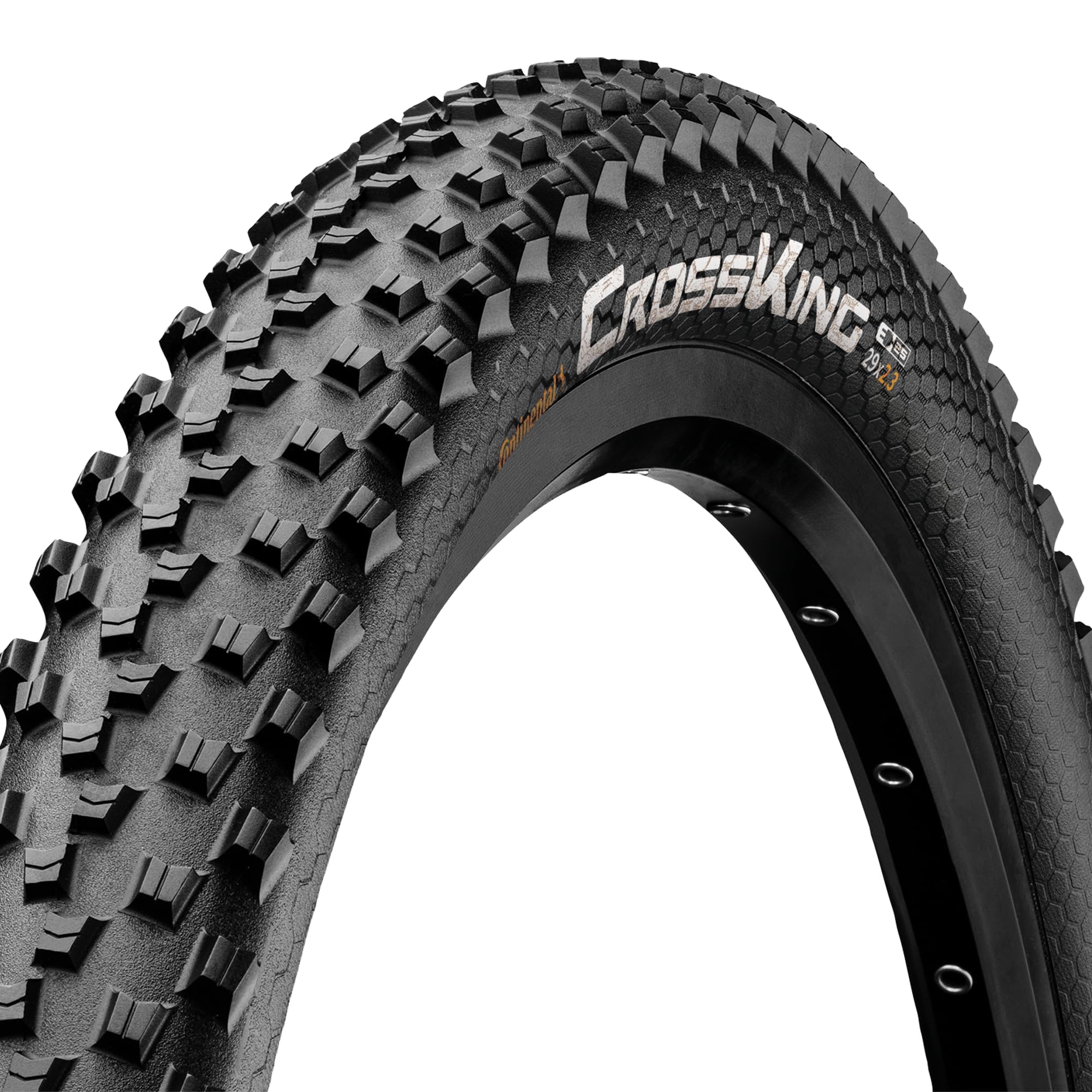
Continental Cross King

Continental Cross King

Mixed, damp trail

Our Score 9.0/10
Check Price

Worth Noting

  • Wire bead clincher
  • Rubber knobs can tear loose on rocky ground
Size
29x2.20 (ETRTO 55-622)
Setup
Wire bead clincher, tube-type
Casing
Three-ply
Pressure
26-58 PSI
Read the full review

An intermediate tread is what you want when the ground can't make up its mind, and the Cross King's knobs are spaced about right for that: wide enough to find an edge in loose dirt and damp roots, tight enough that a fire-road climb doesn't drag. It's a 29 x 2.20 built on Continental's three-ply casing, with a 26 to 58 PSI window to play with.

That casing is what we appreciate most. Squeeze it beside a race tire and the sidewall feels noticeably sturdier, which is the difference between finishing a rocky loop and babying the bike around it. It's also the honest trade: this isn't the liveliest tire here when you sprint out of a corner, and on smooth hardpack the Rekon Race is quicker. For a rider whose local dirt is damp half the year, the grip is worth more than the rolling speed.

Around corners the round profile steers predictably rather than falling in, which suits a tire that's going to live on the bike all season rather than show up for a race weekend. Continental also approves it for e-bikes up to 15.5 mph, which tells you how much casing they expect it to survive.

Bottom line: For damp, mixed trail conditions, the Cross King is the one we reach for: an intermediate tread that stays composed when hardpack turns tacky and roots get slick.

3

Schwalbe Rapid Rob

Schwalbe Rapid Rob

First 26-inch XC

Our Score 9.0/10
Check Price

Worth Noting

  • Rear-specific
Size
26 x 2.10
Tread
XC profile, low rolling resistance
Weight
16 oz
Protection
K-Guard puncture belt
Read the full review

First mountain bike, or a 26-inch frame that's been in the garage a while: the Rapid Rob is aimed at exactly that rider, and we think it's the right kind of tire for the job. The XC profile uses low, closely set knobs for low rolling resistance, there's a K-Guard puncture belt under the tread, and this version is a 26 x 2.10.

The belt is the part worth understanding. K-Guard sits under the tread, which is where most cross country flats come from — glass, thorns, flint — rather than out on the sidewall, so it's protection for the riding a newer rider actually does. At 16 ounces it won't turn a climb into a chore either.

Where the Rapid Rob runs out of talent is anything steep, loose or wet. The blocks are small and square, which is exactly why it rolls, and exactly why it packs up in clay and skates on wet roots. If your riding is dry hardpack, fire road and the sort of loop you can ride on a hardtail, that trade never comes up.

Bottom line: A first XC tire we're happy to recommend for 26-inch bikes on hardpack and fire road, with puncture protection matched to that kind of riding.

4

Michelin Country Dry 2

Michelin Country Dry 2

Dry hardpack rides

Our Score 9.0/10
Check Price

Worth Noting

  • 26 x 2.00 only in this version
  • Dry-biased tread gives little in mud
Size
26 x 2.00
Setup
Wire bead clincher
Casing
30 TPI
Pressure
29-58 PSI
Read the full review

Dry ground is the brief, and the name on the sidewall says so. The Country Dry 2 is a 26 x 2.00 wire-bead clincher with a shallow, dry-oriented tread and a 30 TPI casing. That thread count is the interesting part: fewer, thicker threads make a casing that's more compliant and more durable than a 120 TPI race build, and it's why this one rides smooth over gravel and hardpack instead of skittering.

What we like is how much rubber it keeps on the ground. The blocks are small and tightly packed, so on hardpack and packed dirt you get a broad, stable contact patch, and the same tread stays composed on gravel and the paved mile to the trailhead. That makes it the most versatile tire here for a rider who isn't racing, and a sensible choice for a 26-inch bike that does a bit of everything on dry ground.

Bottom line: For a 26-inch bike on dry hardpack and packed dirt, the Country Dry 2 is a smooth-riding, sure-footed choice that stays composed on gravel.

5

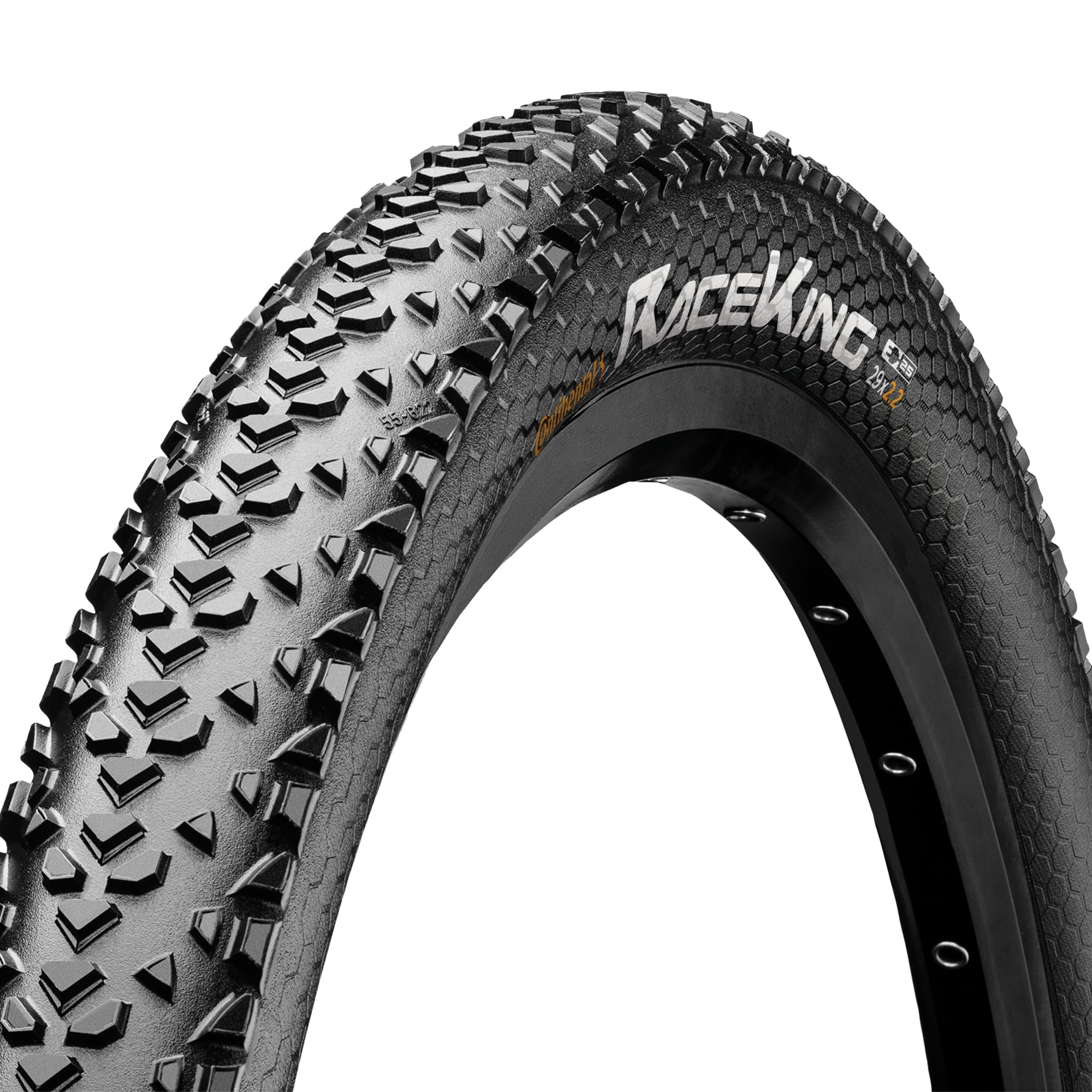
Continental Race King

Continental Race King

Hardpack race days

Our Score 8.8/10
Check Price

Worth Noting

  • Wire bead and tube-only
Size
29x2.20 (ETRTO 55-622)
Setup
Wire bead clincher, tube-type
Weight
1.1 lb
Pressure
26-58 PSI
Read the full review

World Cup cross country and marathons is what Continental designed the Race King for, and the tread carries that pedigree lightly: a near-continuous center ridge with small, low shoulder knobs, the shape that makes a tire feel quick before you've turned a crank. It's the purest race profile in this group, and the closest thing here to what a cross country start line actually looks like.

Mounting is where we spent the most patience. The bead is tight, and a tight wire bead on a narrow rim goes on far easier with levers and a warm garage than with cold hands at a trailhead. Spin the wheel and check the bead line against the rim before the first ride; a tire that seats unevenly is much easier to sort on the stand than out on course.

Once it's on, the ride is quick. The low, tightly packed blocks carry speed on hardpack and the tire feels eager to accelerate, which is why it has a following among riders racing on tube-type wheels. It's also the least forgiving tread here in the wet: shallow blocks don't clear mud and they don't bite on wet roots, so a damp race day is the wrong day for it.

Bottom line: We point XC racers on tube-type wheels to the Race King: the purest race tread here, and the quickest of the Continentals on dry hardpack.

How We Tested Cross-Country Mountain Bike Tires

We narrowed a longer list to 14 cross-country tires, filtering by tread pattern, casing style, and price, then mounted each on the same 29-inch wheelset with a 25mm internal rim. We noted whether it seated with a floor pump or needed a compressor, checked that the bead sat evenly, and watched for overnight pressure loss before the first ride. That installation step matters: a tire that fights the rim or won’t hold air is a hassle you feel every time you swap setups.

Our eight-month loop mixed a rooty local singletrack after rain, a steep loose climb, a hardpack cornering loop, and a gravel connector that punished sidewalls. We climbed the loose pitch at a steady effort and noted where rear tires broke traction; we braked hard into the same rooty corner and watched for the point where a tire washed or the sidewall folded. We also dropped pressure in small steps to see how much stability each casing offered before it started to squirm.

Durability got checked the unglamorous way: after each block of rides, we inspected tread wear, sidewall scuffs, and whether the casing had started to weep sealant. We kept notes on how each tire felt new versus worn, and whether the wear after eight months felt reasonable for the grip and rolling speed it delivered. We also compared how easily each tire re-seated after a trailside tube swap, since fit and installation are part of the ownership experience, not just setup day.

How to Choose Cross Country Mountain Bike Tires

Tread Depth Decides Where You're Fast

Cross country tread runs from a near-slick — the Rekon Race uses the lowest blocks in Maxxis's XC line — to an intermediate pattern like the Cross King's. The slick rolls faster on hardpack and loose-over-hard; the intermediate digs in when the ground turns damp, loose or rooty. Be honest about your regular loop rather than the course you're training for. If most of it is dry hardpack, a low-profile tire is free speed. If it stays tacky through the season, that speed costs you cornering grip you'll notice on the first wet root.

Tubeless Depends on Your Rims, Not the Tire

A tubeless-ready tire is only half a setup: the rim needs a tubeless profile and a valve, and the tire needs sealant. The Rekon Race is tubeless ready; the Cross King, Race King and Country Dry 2 are wire-bead clinchers that take a tube, and no amount of sealant changes that.

If you're staying on tubes, a wire bead is fine and simpler to live with. If you want to race tubeless, buy the tubeless version of the tire you want rather than fighting a conversion in the garage the night before.

Casing, Weight and Sidewall Protection

The tires here add protection in three different ways: Maxxis's EXO layer on the sidewall, Continental's three-ply casing on the Cross King, and Schwalbe's K-Guard belt under the tread. Sidewall protection matters on rocky XC courses; a tread belt matters more where thorns and glass are the local hazard. Each one costs weight and ride feel — the Rekon Race carries 805 g in its 2.35 size, and the Cross King's casing feels stiff in the hand beside a race tire. Match the protection to your terrain rather than chasing the lightest figure on the box.

Wheel Size and Frame Clearance

Widths here run from 2.0 to 2.35 inches across 26-inch and 29-inch wheels, and both dimensions have to clear the frame before anything else matters. Check the chainstays, the fork crown and the mudguard you actually run. Inner rim width decides how a wide tire sits as well: a 2.35 pinched onto a narrow rim rolls onto its sidewall in corners instead of its tread, which is slower and less predictable than the narrower tire it replaced.

Frequently Asked Questions

Final Verdict

The Maxxis Rekon Race is the tire we recommend first for cross country riding: a semi-slick that rolls like a race tire on hardpack, holds its edge when you lean it over, and arrives tubeless ready with EXO sidewalls for the rocky parts of the course.

If your trails stay damp through the season, or your rims aren't tubeless, the Cross King is the better choice — an intermediate tread on a stiffer casing that gives away some speed and takes back grip. On a 26-inch bike ridden mostly on dry hardpack, the Rapid Rob is the easy, protected answer.