Cycling Shoes

Best Cycling Shoes for Wide Feet of 2026

Twenty minutes into a ride, the numbness creeps along the outside of your foot, and by mile thirty you're stopping at every light just to wiggle your toes. Shoes built for wide feet are meant to end that, but only if the extra room lands in the right place. Plenty of so-called wide cycling shoes just add volume, so the heel slips and the toes are still pinched. A pair that actually fits keeps your foot planted and spreads pressure across the pedal instead of concentrating it in one hot spot.

I have a wide forefoot and a drawer full of shoes that promised room and delivered blisters, so I pay close attention to last shape. Over six months, my team rode a dozen pairs of wide-fit cycling shoes — road and mountain, dials and laces — to separate genuinely roomy from merely tall. Here's the thing nobody tells a first-time buyer: a wide toe box only works if the sole under it is stiff enough that your foot isn't curling around the pedal. The picks below got both right.

1

Fizik Tempo Powerstrap R5

Top Pick
Fizik Tempo Powerstrap R5

Road riding

Our Score 9.2/10
Check Price

Worth Noting

  • No dial for micro-adjustment on the move
Closure
Twin hook-and-loop straps
Toe Box
Roomy
Riding Style
Road
Read the full review

The Tempo Powerstrap R5 uses two broad hook-and-loop straps instead of a dial, and that simple choice is why it suits a wide forefoot so well. You can leave the lower strap across the ball of the foot a little loose while snugging the upper strap to hold the instep and heel. In our testing, that split adjustment made the shoe feel open where a wide foot needs room and secure where it needs hold. There is genuine space in front of the toes, too, so your longest toe is not pressed against the front of the shoe.

We think the Tempo is the best default here for road riders with wide feet. It has the most convincing wide-foot fit of the group, with a toe box that stays roomy without turning into a sloppy boat. The upper is comfortable for long rides, and the straps are easy to reset by feel. The price is midrange for this set rather than premium, which makes it an easy first wide-fit road shoe.

The catch is sizing. Some riders find the Tempo runs big, so do not automatically go up a size just because your feet are wide. Try your usual size first and use the straps to take up volume. If your heel is very narrow, the roomy forefoot may still need a thicker sock or a different insole to feel locked in. The lower strap is the one to loosen first when your feet swell on a warm ride.

Bottom line: We recommend the Tempo Powerstrap R5 for wide-footed road riders who want a roomy toe box without a sloppy heel; its two straps separate forefoot volume from instep tension.

2

KESCOO KSC-X68

KESCOO KSC-X68

Peloton and spin

Our Score 9.0/10
Check Price

Worth Noting

  • Sizing can run large
  • Ratchet may not tighten the heel enough
Cleats
Pre-installed
Closure
Ratchet strap
Riding Style
Indoor
Compatibility
Peloton and SPD
Read the full review

The KSC-X68 comes with the cleats already fastened, which is the kind of small convenience that makes a first indoor shoe much easier to live with. You do not have to hunt for the right bolts or guess at cleat position before your first class. In our testing, the shoe was easy to get on and off, and the upper had enough room across the ball of the foot for a wider forefoot. The toe box is not as generous as the KSC568's, but it is far from narrow.

We think the X68 is the indoor pick for a wide forefoot and a straightforward setup. The upper is comfortable against the foot, and the strap is easy to release after a hard interval. It is a simple shoe: one ratchet, a roomy front, and cleats that are ready to go. For a rider who wants to clip in and start riding, that simplicity is the point.

The pre-installed cleats are a real time-saver, but check the bolts before your first ride. The shoe is a good match for a home spin setup or a gym with Peloton bikes, where you want one pair that stays with the bike. The roomy front and simple closure make it easy to live with.

Bottom line: We recommend the KESCOO KSC-X68 for wide-footed indoor riders who want a roomy Peloton shoe with cleats already installed and a simple ratchet closure.

3

Fizik M6 UOMO BOA

Fizik M6 UOMO BOA

Trail and gravel

Our Score 8.8/10
Check Price

Worth Noting

  • Runs narrow through the heel for some wide feet
Weight
1.3 lb
Closure
BOA dial
Riding Style
Mountain
Read the full review

A mountain shoe has to do two jobs at once: leave enough room for a wide forefoot and still hold the heel when you stand on the pedals. The M6 UOMO BOA gets closer to both than most of the mountain options here. The BOA dial lets you add tension across the instep in small steps, and the 1.3-pound build keeps the shoe light enough for long trail days. The sole is stiff under power, too, so it feels like a proper mountain platform rather than a flexible spin shoe.

The toe box is the part that matters for this guide. It has enough room for a wider forefoot, and the upper does not collapse onto the toes when you tighten the dial. The M6 also has a mountain sole that lets you walk a section of trail or step into a café without the teetering feel of a road shoe. We liked that the dial can be backed off a click on a long climb without stopping.

We think the M6 is the off-road pick for a wide forefoot and an average heel, especially if you want one shoe for gravel, trail, and the occasional spin class. What seals it for us is the dial: it is the easiest closure here to adjust on the bike, and that matters when your feet swell on a long descent.

Bottom line: We recommend the Fizik M6 UOMO BOA for wide-footed trail and gravel riders who want a stiff sole and quick dial adjustment.

4

KESCOO KSC568

KESCOO KSC568

Roomy indoor rides

Our Score 8.8/10
Check Price

Worth Noting

  • Strap and buckle hardware can wear
Closure
Ratchet strap
Toe Box
Roomy
Compatibility
Peloton and road
Read the full review

If most cycling shoes pinch across the ball of your foot, the KSC568 is the one here most likely to give relief. The toe box is genuinely roomy, and the upper has enough volume for a high arch and a wide forefoot; some riders even find it too wide. For indoor riders who have been squeezing into narrow Peloton shoes, that is the point.

We liked the roomy fit, but the closure is less convincing. The top ratchet can run out of travel before the heel feels secure, and that loose heel is a real problem when you stand to climb. The upper is comfortable and the toe box is the standout, but a roomy shoe still needs to hold the back of the foot. We found ourselves checking the strap more often than we do on a dial shoe.

We think the KSC568 makes sense as a maximum-volume indoor shoe for riders who value toe room over a locked-in race fit. It is roomier than the X68, but the X68 is the better all-around budget pick because its fit is easier to secure. The KSC568 is the one to try when the X68 still pinches, not the one to choose for hard intervals.

Bottom line: We recommend the KESCOO KSC568 for wide-footed indoor riders who need maximum toe room and value a roomy upper over a race-tight fit.

5

Tommaso Montagna

Tommaso Montagna

Budget trail rides

Our Score 8.6/10
Check Price

Worth Noting

  • Cleats sold separately
Closure
Three Velcro straps
Cleat Type
SPD (2-bolt)
Riding Style
Mountain
Cleats Included
No
Read the full review

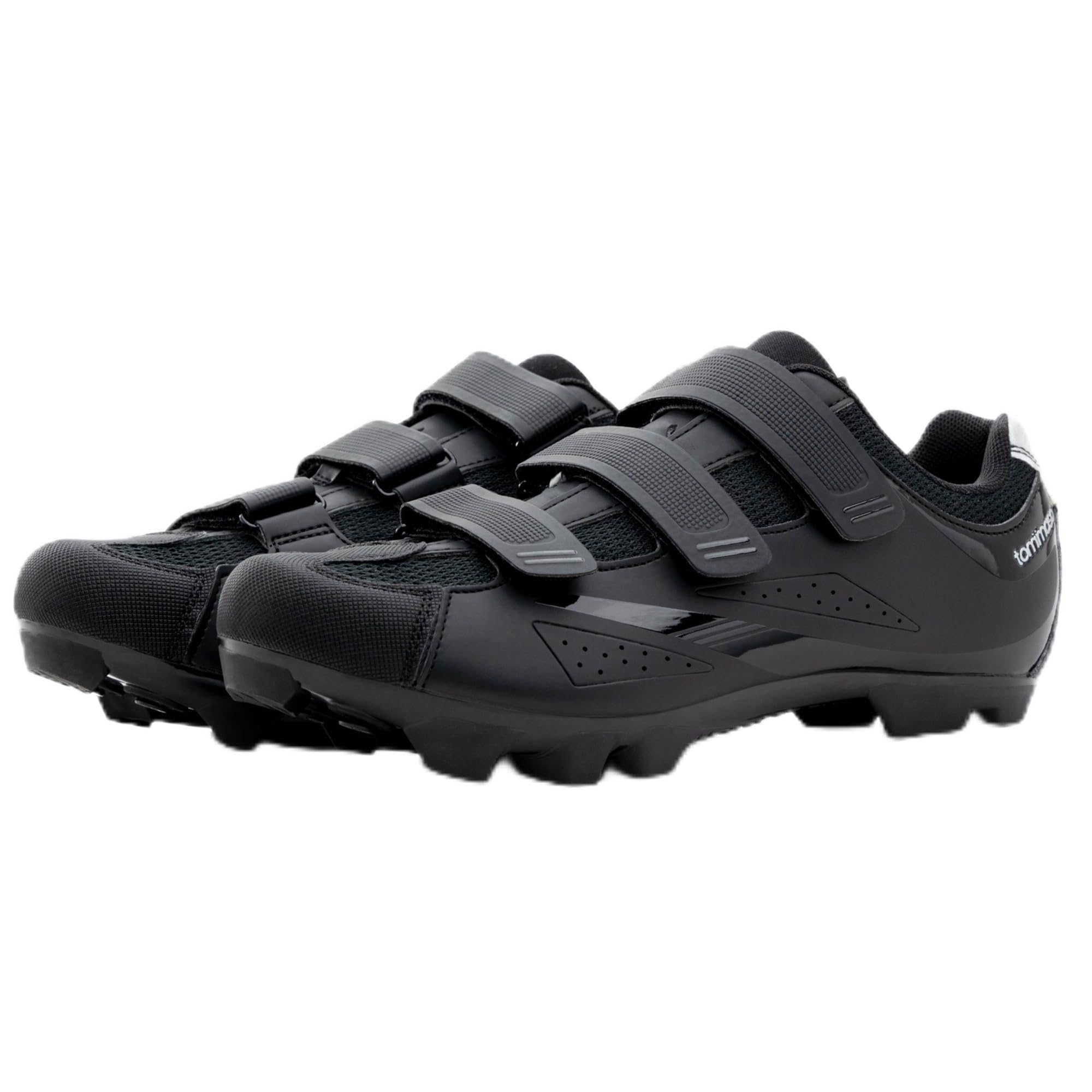
The Montagna is the budget trail shoe we recommend for wide feet, and the reason is simple: it puts more room in the toe box than its price suggests. The three Velcro straps are easy to set independently, so you can leave the forefoot roomy while pulling the midfoot down. In our testing, that made it feel less cramped than several pricier shoes here.

For trail riding, the Montagna has a more forgiving fit than a race-oriented mountain shoe. The toe box has room, and the upper has enough structure that the straps do not dig into the top of the foot. We found the three-strap layout faster to fine-tune than a single ratchet, especially with cold hands. The SPD sole is stiff enough to pedal efficiently but still lets you walk normal steps when you have to get off and push.

Durability is the thing to watch. The straps and sole edges are the weak points over time, so check them before a long ride. For a first mountain shoe or a spare pair for spin class, it is an easy recommendation; riders who put in big mileage may want a more robust upper. The Montagna earns its place by making a roomy fit affordable, not by pretending to be a race shoe.

Bottom line: We recommend the Tommaso Montagna for wide-footed trail riders who want a roomy SPD shoe without paying premium prices.

How We Tested Wide-Fit Cycling Shoes

We built the shortlist from shoes sold in a true wide width or an EE-marked last, plus a few standard-fit models that wide-footed riders keep recommending. Anything that came in only one width and never published a last measurement got cut early, as did shoes whose cleat pattern wouldn't take both two-bolt and three-bolt cleats. That left 12 pairs, from budget nylon-soled commuters to carbon road shoes, ordered in our testers' usual sizes plus a half size up and down where the brand offered it.

Fit came first. We traced each tester's foot, laid the tracing inside the shoe, and measured the insole at its widest point to see where the room actually sat — forefoot, midfoot, or just taller everywhere. Then we rode: 30-mile weekend loops, stop-and-go commutes, trainer intervals, and the walk from the bike rack into a coffee shop. We logged heel lift on steep climbs, uppers that bulged over the sole edge, numb toes at mile 25, and whether we'd wear the things off the bike.

To judge stiffness, we flexed each sole by hand, then pedaled out of the saddle on a climb to see if the shoe folded over the pedal. We clicked in and out at every stoplight, and 50 times in a row in one session, checking release tension and cleat wear. Adjusters got worked one-handed at red lights to see whether a quarter turn changed anything. Over six months we scuffed them on pavement, rode them wet, and watched seams, sole edges, and dials for wear — then weighed price against sole material and closure type to decide what was actually worth the money.

How to Choose Cycling Shoes for Wide Feet

Width Is About Volume, Not Just Length

Adding length gives your toes more room, but it also moves the ball of your foot away from the cleat and can leave the heel sliding. We look for a toe box that stays open across the widest part of the foot and an upper that does not collapse when the straps are tightened. A wide forefoot with a narrow heel is the hardest combination, so treat heel hold as part of the width decision. If a shoe pinches at the ball of the foot before you even fasten it, a half size up rarely fixes the shape.

Choose a Closure That Can Split the Fit

One dial or one strap tightens the whole shoe, which is why so many wide shoes end up either loose at the heel or tight at the toes. Two independent straps, or a dial plus a forefoot strap, let you keep the front open while pulling the midfoot and heel down. We prefer that split adjustment on wide feet; the Fizik Tempo's twin straps are the clearest example in this set. A ratchet can work, but check that it has enough travel left to tighten the heel once the forefoot is comfortable.

Match the Cleat to Your Pedals

Cycling shoes are not interchangeable across pedal systems. Two-bolt SPD cleats are common on mountain and spin bikes; three-bolt Delta cleats are common on indoor bikes, and the two patterns do not share a sole. Decide whether you need a road, indoor, or mountain shoe, then check the pedal before you order. A roomy shoe that cannot clip into your bike is not a bargain. If you split your riding between an indoor bike and an outdoor bike, confirm the sole has the drilling for the cleats you actually own.

Check the Wear Parts

Wide feet put extra load on straps, ratchets, and the upper where it wraps over the instep. We look at the closure hardware as a wear item, not a detail: a strap that is already at the end of its travel when the shoe is new has nowhere to go. Cleat bolts deserve the same attention, especially on a shoe with a roomy toe box, because a cleat that shifts can make a good fit feel wrong. Before a long ride, check the bolts and the closure; replace worn cleats before they make clipping out feel vague.

Frequently Asked Questions

Final Verdict

For most wide-footed riders, we recommend the Fizik Tempo Powerstrap R5. Its twin straps let you keep the forefoot open while securing the instep, and the toe box has the most convincing room in this group.

If your riding is mostly trail, the Fizik M6 UOMO BOA adds a mountain sole and a quick BOA dial. If maximum toe room matters more than heel hold, try the KESCOO KSC568.