Cycling Shoes

Best Flat Pedal Mountain Bike Shoes of 2026

A flat pedal shoe has one job: keep your foot where you put it while the trail tries to knock it off. Sticky rubber grabs the pins, a stiff shank keeps the pedal from digging into your arch, and a tread that looks aggressive on the shop floor can be exactly the wrong shape once it's packed with mud. I've skated a full beat on a wet root, and I've ridden a pair so flexy my arches ached by the second hour — both were the build, not the rider.

Over the past eight months, my team and I have ridden 12 pairs on rock gardens, loamy singletrack, bike park laps, and plenty of wet pavement. The differences show up fast: how a sole wears around the pins, whether a heel stays locked on a steep descent, whether a shoe still feels snug in month six. One warning worth having: the grippiest rubber is also the softest, so a pair that feels glued to the pedal in April will look worn by September. The picks below are the ones we kept reaching for anyway.

1

Five Ten Freerider

Top Pick
Five Ten Freerider

Trail and town

Our Score 9.4/10
Check Price

Worth Noting

  • Stiff sole takes a few rides to get used to walking
Fit
Narrow through the midfoot
Sole Feel
Firm and stiff
Riding Focus
Trail and gravel
Listed Weight
2.45 lb
Read the full review

Five Ten's Freerider is the shoe we point people to first when they ask about flat pedals, and it holds that spot because of how it behaves rather than how it looks on paper. The sole is firm enough that your foot stays on top of the pedal instead of curling around the spindle, and the rubber holds its place on pins through dust, loose rock, and the rooty sections where a running shoe starts to skate.

What separates it from the pricier shoes here is how little it asks of you once you are off the bike. It reads as a sneaker, comfortable enough for the drive home and a stop for coffee, and it is the pair in this group most likely to get worn on a day you never touch a bike.

Fit is the place to slow down. The Freerider runs narrow through the midfoot and the toe box is snugger than the shape suggests, so if you have a wide forefoot or you sit between sizes, order two and send one back. The firm sole is the other adjustment: it is stiffer underfoot than a skate shoe, and the first few rides feel like walking in a cycling shoe until your feet get used to it.

The thing that surprised us most is where the grip comes from. There is no aggressive lug pattern to look at; the sole is almost plain, and the hold is all rubber. If you have been riding trail in old skate shoes, that is the difference you feel within the first few pedal strokes.

Bottom line: Our top pick: the Freerider grips hard on pins, stays firm underfoot on rough ground, and passes as a sneaker once the ride is over.

2

Five Ten Freerider Pro Mid

Five Ten Freerider Pro Mid

Ankle coverage

Our Score 9.2/10
Check Price

Worth Noting

  • Too warm for hot summer riding
Height
Mid-top ankle cuff
Season
Cooler weather
Closure
Hook-and-loop straps
Listed Weight
2.45 lb
Read the full review

The elastic cuff that rises over the ankle is the whole point of the Freerider Pro Mid, and it changes which rides you take it on. Crankarms, frame tubes, and the thorny edge of an overgrown trail all find that spot, and a mid-top puts fabric and padding there instead of a bare sock.

Below the cuff it is the Freerider formula: a flat sole that pins sit into, a stiff platform under the arch, and a snug fit that does not slide forward when the trail points down. The closure is hook-and-loop straps rather than laces, which is genuinely welcome on a cold morning with gloves on, and there is no loop to catch in a chainring.

We reach for this pair in the shoulder seasons and on any ride where we expect to be off the bike on rough ground. It is warmer than the low-tops here, which is a gift in November and a drawback in July, and the sock-like upper looks more like riding kit than the plain Freerider does. If your ankles have been losing arguments with your crankarms, this is the most direct fix in the group.

Bottom line: We recommend the Pro Mid for cold mornings and scrappy trails: the ankle cuff and straps make it the most weather-ready shoe in this group.

3

Fox Union Canvas

Fox Union Canvas

Rocky trail riding

Our Score 9.0/10
Check Price

Worth Noting

  • Not water resistant
  • Premium price for a canvas upper
Upper
Canvas
Outsole
Ultratac rubber
Toe Protection
Molded toe cap
Water Resistance
Not water resistant
Read the full review

Fox's Union Canvas sits at the top of the price range in this group, and it is the one shoe here that feels like riding equipment rather than a tough sneaker. There is a molded stiffening plate inside the sole, a molded toe cap where the rocks arrive, and the Ultratac rubber outsole is the most purpose-built sole we rode in this set.

That plate is the reason to pay. Standing through a chattery descent, the shoe stays flat and quiet underfoot instead of folding over the spindle, and the low-profile EVA midsole keeps enough cushioning that walking back to the car does not feel like a punishment.

The canvas upper is where it gives ground: comfortable, good-looking in black, and not water resistant, so a wet, gritty ride leaves it looking tired until it dries out. Fit runs narrow and a touch short, which makes the Giro Tracker below the better call for anyone with a wide forefoot.

Listed at 2 pounds, it is the lightest shoe here, and that is part of why it feels quick on the bike. The detail we keep coming back to is the toe cap, though. It is the one feature you notice at the exact moment a rock comes off a tire in front of you.

Bottom line: We recommend the Union Canvas to riders who want the stiffest, most protected shoe here and don't mind paying for it.

4

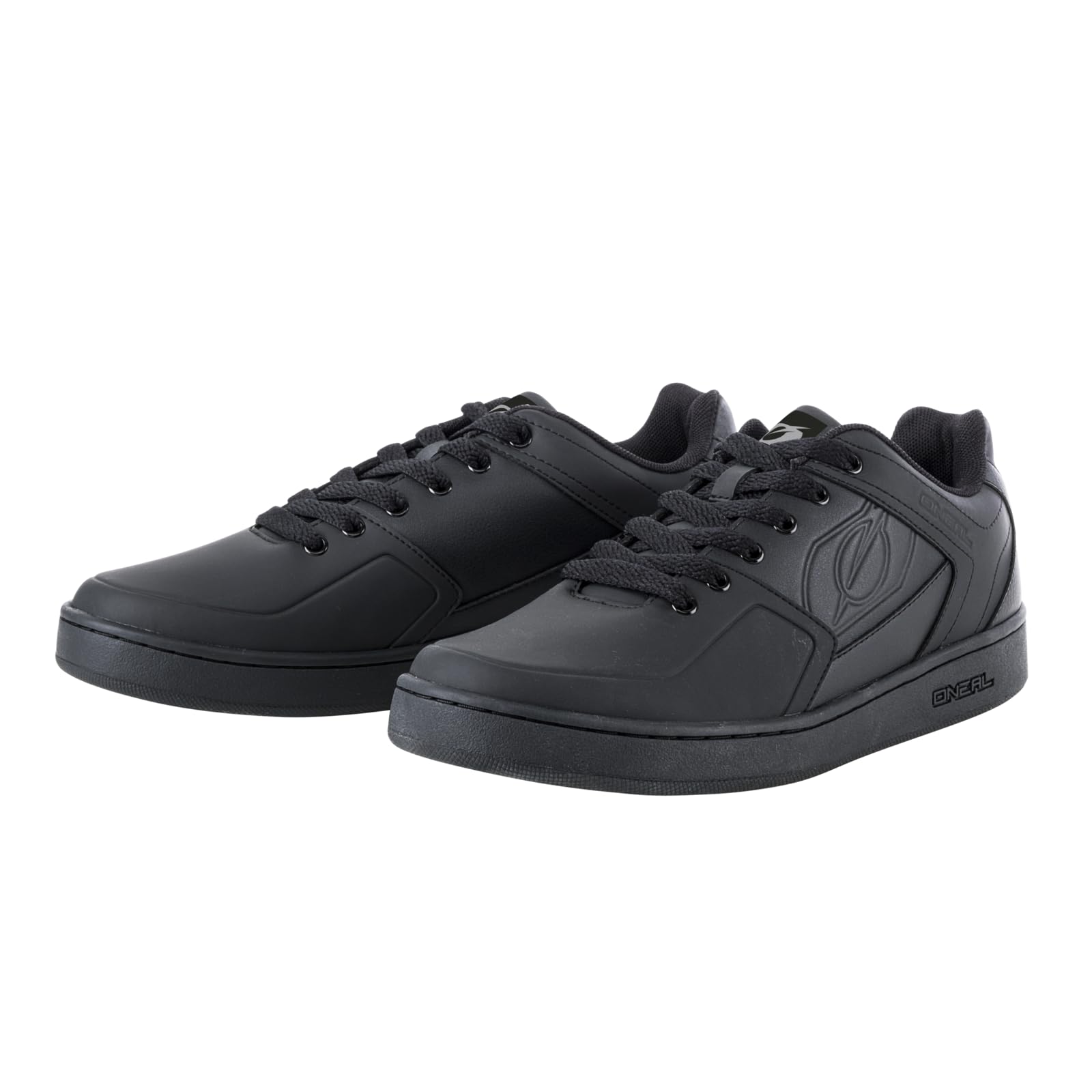
O'Neal Pinned

O'Neal Pinned

First flat pedals

Our Score 9.0/10
Check Price

Worth Noting

  • Casual upper, not an armored trail build
Department
Unisex
Pedal Type
Flat
Retailer Category
Fashion sneakers
Read the full review

The Pinned is the cheapest shoe here by a wide margin, and that is the whole reason to look at it. O'Neal builds a flat-pedal shoe with a simple upper and a flat sole and charges a fraction of what the rest of this group costs, which makes it the low-risk way to find out whether pinned pedals suit you.

We think of it as a first pair or a second pair: something to learn on, or something to sacrifice on wet, gritty days when you would rather not trash a shoe you paid real money for. What you are buying is a shape and a price rather than a specification sheet. O'Neal's own description does not go much past the name, and it is sold alongside fashion sneakers instead of cycling shoes, which tells you the upper is casual rather than armored.

That is fine for green trails, gravel paths, and around town; it is not the shoe we reach for when the ride turns rocky. Fit is the other unknown, since it is unisex with no published width guidance — buy somewhere with easy returns and compare the length against a street shoe you already trust before the first ride.

Bottom line: The cheapest way into flat pedals here, and a sensible first pair if you want to try pinned pedals without committing to an expensive shoe.

5

Giro Tracker

Giro Tracker

Wide feet

Our Score 8.8/10
Check Price

Worth Noting

  • Grip is a step behind our top picks
Fit
True to size
Closure
BOA dial
Toe Box
Wide and roomy
Sole Feel
Stiff
Read the full review

A wide forefoot and a roomy toe box are the first things you notice about the Giro Tracker, and for anyone who normally sizes up in cycling shoes just to stop the pinching, that is most of the argument made. Our pair had room to spread the toes without the heel feeling loose.

The BOA dial is the other reason it earns a place. Turn it, feel the shoe close evenly across the instep, and forget about it — there is no lace end to tuck and nothing to retie with cold fingers. Underneath, the rubber sole grips flat pedals well, and the gaps in the tread let pedal pins sit down into the rubber rather than skating over it, though it does not bite quite like the Five Ten or the Fox.

Where the Tracker gives ground is at the hard end of riding. The sole is stiff and supportive and easy enough to walk in, but the shoe as a whole feels less armored than the trail picks here, so we treat it as our commuter, rail-trail, and errand shoe rather than something for rocky descents. Riders who want one pair for everything will be happier with the Freerider.

Bottom line: If your feet feel cramped in most cycling shoes, start here: the wide toe box and BOA dial make it the roomiest, easiest shoe in this group to live with.

6

Crankbrothers Stamp Lace

Crankbrothers Stamp Lace

Riding and errands

Our Score 8.8/10
Check Price

Worth Noting

  • Runs small; order at least a half size up
Sizing
Runs small; size up
Closure
Laces with stash pocket
Sole Feel
Sturdy but walkable
Riding Focus
Trail and off-bike
Read the full review

A small stash pocket on the tongue takes the tied lace ends, and that is the detail we ended up appreciating most on the Stamp Lace: nothing flapping against the crankarm, nothing to double-knot, nothing to catch. It is a small thing that speaks to a shoe designed by people who ride.

The rest of the build backs it up. The sole is broad and flat with rubber that stays put on pinned pedals, the midsole is sturdy enough that the pedal edge does not fold it over, and there is enough flex that walking to the car is not a chore. In navy with a gum sole it is also the best-looking shoe in this group, and it passes in jeans on the way home.

We treat the Stamp Lace as the pair for riders who ride hard and then live in their shoes: it covers a trail lap and the errands after it without looking like race kit, and it cleans up with a brush and a wet rag.

Bottom line: We like the Stamp Lace as the pair that rides hard and then blends into ordinary life off the bike, lace pocket and all.

How We Tested Flat Pedal Mountain Bike Shoes

We built the shortlist from what's actually on shop floors and in race pits, then filtered for three things: a rubber compound made for flat pedal pins, a shank stiff enough to spread pedal load across the whole foot, and a size run that includes half sizes and at least one wide option. Twelve pairs went into rotation for eight months, ridden by testers who measured their feet first and then swapped shoes so every model saw the same rocky climb, the same tight rock garden, and at least one lift-served day.

Grip was judged on wet roots, a mossy wooden bridge, and loose-over-hard corners — we noted whether a foot stuck when we shifted weight mid-corner or skated a beat before catching. For sole stiffness, we paid attention to the arch on long climbs, whether the pedal spindle was still noticeable after an hour, and how the shoe walked on a hike-a-bike push. Sizing and fit meant riding in thin summer socks and thick wool ones, watching for heel lift on punchy climbs, and comparing toe box room across wide and narrow feet.

Comfort showed up over hours, not minutes: hot spots, lace or dial pressure, how breathable the uppers felt in July. After each ride we hosed the shoes down and let them dry, which is how we judged appearance and quality — how the colorways held up, where stitching frayed first, whether the toe cap scuffed through or a sole began to peel. Ease of use got scored with gloves on, including how much mud a closure collected and whether we could snug a shoe one-handed at the top of a climb.

How to Choose Flat Pedal Mountain Bike Shoes

Grip Is Rubber Against Pins, Not a Tread Pattern

A flat pedal shoe works because the sole is flat and the rubber is soft enough for the pins to press into it. Deep hiking lugs sit on top of the pins instead of settling around them, which is why a trail runner can feel skittery on a pinned pedal despite an aggressive tread. Set a candidate shoe on your own pedal and rock your foot side to side — if you can feel the pins seated in the rubber, you have the right sole.

Softer rubber grips better and wears faster, so check the patch under the ball of your foot every few months. When it is worn smooth or the tread has gone, the shoe has stopped doing the job even if the upper still looks fine.

Decide How Stiff You Want the Sole

Stiffness is the biggest difference between one flat shoe and another. A stiffer sole spreads your weight across the platform instead of letting the spindle dig into your arch, which matters most when you are standing and descending. Too stiff, and the shoe clumps along on foot — the Fox Union Canvas uses an internal plate to get the support, while the Crankbrothers and Giro shoes stay comfortable to walk in and give up a little under the pedal.

If most of your riding is commuting or rail-trail with stops along the way, choose walkability. If you stand a lot on rough ground, choose the plate.

Fit: Width First, Then Length

These shoes run all over the place. The Crankbrothers Stamp Lace runs small, the Fox Union Canvas runs narrow, and the Giro Tracker is the roomiest of this group. Measure your foot at the end of the day, when it is at its biggest, and leave about a thumb's width — roughly half an inch — between your longest toe and the end of the shoe.

If you are between sizes and the shoe has laces, size up. A snug shoe that pinches on the downstroke ruins a ride faster than a slightly roomy one.

Protection and Closure

Where you ride decides how much shoe you need. A molded toe cap earns its keep on rocky ground, and a mid-top cuff like the one on the Five Ten Freerider Pro Mid protects the ankle bone that crankarms and trailside brush keep finding. Closure is mostly preference: laces are simple and replaceable, a BOA dial adjusts with one hand and cannot come untied, and straps suit cold-weather riders in gloves.

If you ride in long pants or overgrown trail, a lace stash pocket keeps loops away from the drivetrain and the crankarm.

Frequently Asked Questions

Final Verdict

Buy the Five Ten Freerider if you want one shoe that does the whole job: it grips a pinned pedal, stays firm under a standing descent, and looks normal enough to wear for the rest of the day.

Pay for the Fox Union Canvas if your trails are rocky and fast and you want the molded toe cap and stiffening plate. Go to the Five Ten Freerider Pro Mid if your ankles need covering, and to the Giro Tracker if width is what usually stops you buying cycling shoes at all.