Cycling Shoes

Best Mountain Bike Shoes of 2026

Mountain bike shoes are asked to do two contradictory things at once: put power into the pedals like a stiff road shoe, then hike up a washed-out climb without sliding off wet rock. Most pairs are good at one and quietly compromise the other, so shopping can feel like picking which annoyance you'd rather live with. The right pair shrinks that tradeoff until you stop noticing it, which is the entire point — feet you're not thinking about at mile 20.

I've ridden in soggy lace-ups, ratchet-strap hand-me-downs, and carbon race shoes, and the pattern holds: money buys stiffness and weight savings, not fit. Over six months my team and I rode 12 pairs on rocky singletrack, gravel connectors, and lift-served park laps, and sizing swung so much between brands that the number on the box mattered far less than how the heel cup and toe box actually held us. Buy for fit and grip first; everything else is a bonus. The pairs below earned their spot by the door.

1

Five Ten Freerider

Top Pick
Five Ten Freerider

Flat-pedal trail grip

Our Score 9.4/10
Check Price

Worth Noting

  • Flat pedals only
Weight
2.45 lb
Outsole
Sticky rubber
Pedal Type
Flat
Read the full review

Grip is the whole job of a flat-pedal shoe, and nothing else here does it as well as the Freerider. The rubber sole bites on pedal pins and stays there; on rough descents where a thinner, harder shoe lets your foot skate, this one keeps it planted. That confidence is worth more than any other feature on the list.

It's the flat shoe we put on first for technical ground. The upper is padded where rock strikes land, the sole is stiff enough to push a hard gear without turning walking into a chore, and the whole thing feels built for the job rather than adapted from a sneaker. It's also the flat shoe here that looks most at home off the bike — a skate-style silhouette that doesn't advertise itself as cycling gear.

The fit is snug through the toe box, so if you're between sizes or wide across the forefoot, go up half a size rather than hoping it gives. Otherwise there's very little to negotiate. It's a flat-pedal shoe, it grips like it means it, and it's the pair we hand to a beginner and a seasoned rider alike.

Bottom line: If you ride flat pedals, start here: the Freerider's rubber grabs the pins and holds on rough ground better than any other flat shoe we tested.

2

Giro Code

Giro Code

All-round trail riding

Our Score 9.0/10
Check Price

Worth Noting

  • Runs small and narrow
Weight
1.55 lb
Closure
Laces
Cleat Compatibility
2-bolt SPD
Read the full review

The most useful thing about the Giro Code is the hole under the ball of your foot. The two-bolt cleat sits recessed into the sole, so it never clicks across a café floor, and you can walk out of the trailhead car park, into a shop, or up the hill to the trail without the heel-down shuffle that gives clipless shoes away. Even with no cleat fitted it looks like a casual sneaker rather than something that arrived from a wind tunnel.

That everyday quality is why it's our top pick. It covers the widest spread of riding here: clipped in on singletrack, grinding up a fire road, then standing in a queue afterward without feeling like you're still wearing equipment. The sole is stiff enough to pedal efficiently and forgiving enough that walking to the trailhead isn't a chore, which is the balance most trail riders are actually looking for.

What you give up is adjustment on the move. Laces spread pressure evenly across the instep and never jam, and they're easy to replace when they fray, but you can't reach down at the base of a climb and snug one strap with a gloved hand. For trail riding and knocking around town after, that's a fair trade — it's the reason the Code works as an only pair of cycling shoes rather than a race-day-only purchase.

Bottom line: For most riders, this is the one: the Code clips in, walks quietly, and looks normal off the bike, so it covers trail days and the ride into town.

3

Crankbrothers Stamp Lace

Crankbrothers Stamp Lace

Premium flat-pedal trail

Our Score 8.8/10
Check Price

Worth Noting

  • Runs small
  • Sole can separate at the toe
Sole
Stiff platform
Closure
Laces with lace pocket
Pedal Type
Flat
Read the full review

A lace pocket sounds like a marketing line until a loop of shoelace wraps itself around a crank arm mid-descent. The Stamp tucks the bow into a stash under the tongue, and it's the kind of detail that tells you the people who designed it actually ride.

Grip is the main reason to buy it. The flat sole sits on the pedal and stays there, the platform is stiff enough to push a hard gear without flexing your effort away, and the shoe is comfortable enough to wear off the bike — one of the few here that looks as good with jeans as it does with pads.

There's real structure in the sole, too. It's stiff enough for a full day of pedaling but not so stiff that walking to the trailhead becomes a chore, and the toe box has enough room that you're not cramming your feet in. The upper is well made, and the sole feels solid underfoot in a way that cheaper flat shoes don't.

Where the Stamp earns its premium is the whole package: grip, a stiff platform, and detailing that's been thought through down to the lace stash. It's the flat shoe we buy when we want one pair for park laps and the ride home, and the one we hand to a rider who wants their gear to look as considered as it performs.

Bottom line: Our premium flat pick: the Stamp grips hard, hides its laces, and looks sharp off the bike — just order a size up and check the toe seam.

4

O'Neal Pinned

O'Neal Pinned

Budget flat-pedal riding

Our Score 8.8/10
Check Price

Worth Noting

  • Not water resistant
Sole
Honeycomb rubber
Weight
1.98 lb
Closure
Laces
Pedal Type
Flat
Read the full review

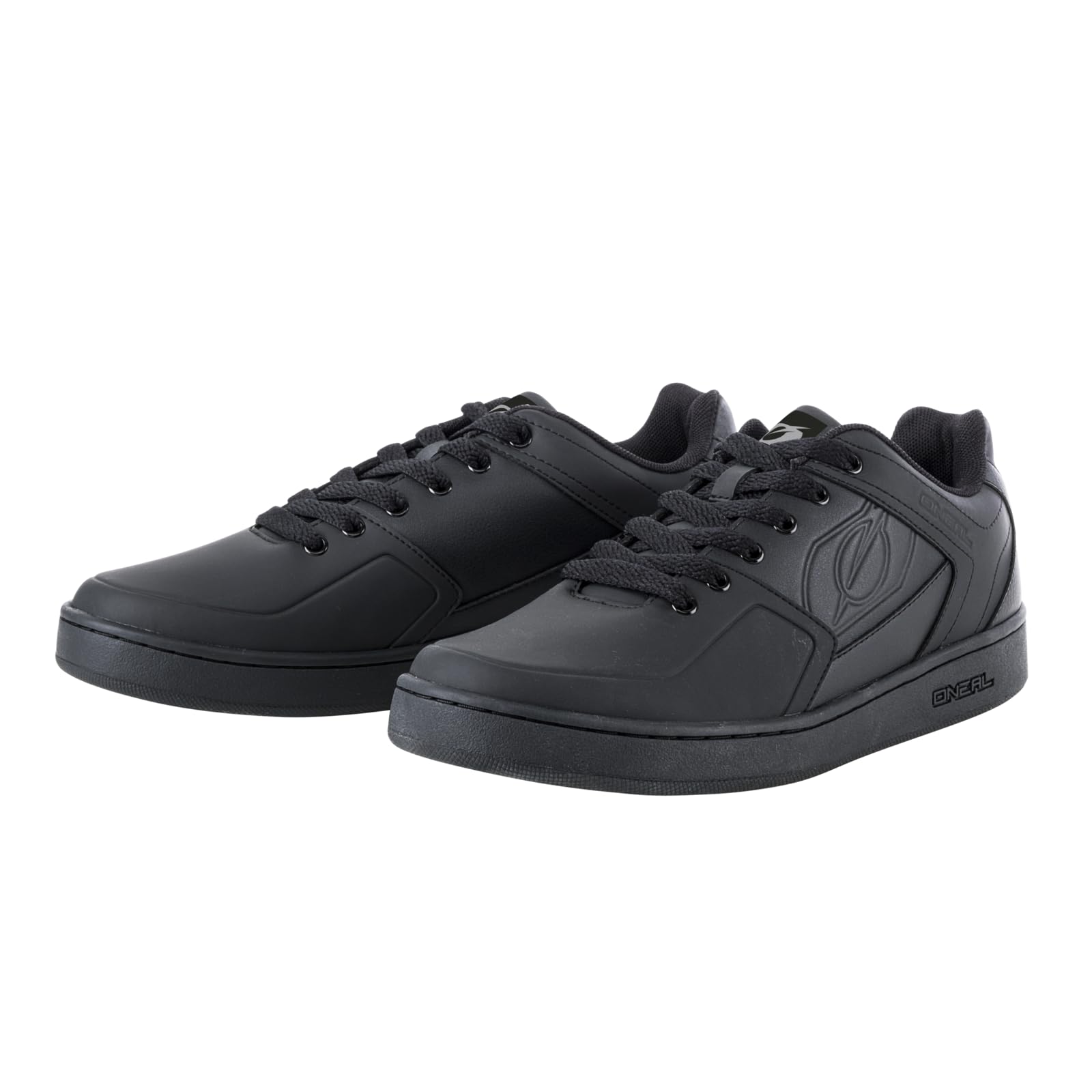
The Pinned is the least expensive way into a purpose-built flat-pedal shoe here, and it doesn't feel like a compromise on day one. The honeycomb sole is flexible enough to walk in, the footbed comes out so you can drop in your own insert, and the lace-up upper is simple to live with.

Grip is where it gives ground. The rubber holds on clean, dry pedals, but it doesn't bite like the Freerider's, and on a wet or worn pedal you feel your foot shift where the Five Ten holds it. For smooth, dry trail centers and pump tracks that's perfectly survivable; for wet-root season it isn't the shoe we choose.

It's also a substantial shoe at 0.9 kg, which you notice on a long climb and mostly forget on the descent. What you get is a tough, simple shoe that protects your foot from pins and rock strikes and won't make you wince when it gets scuffed — a reasonable first flat shoe for a rider who isn't sure how much they'll ride.

Bottom line: The cheapest flat-pedal shoe here, and a solid first pair: the Pinned walks well and takes a beating, though its grip trails the Freerider on wet, worn pedals.

5

Giro Ranger

Giro Ranger

Budget clipless trail

Our Score 8.6/10
Check Price

Worth Noting

  • Runs narrow through the midfoot
  • Top strap can press on a high instep
Weight
1.4 lb
Closure
Three Velcro straps
Water Resistance
Water resistant
Cleat Compatibility
2-bolt mountain
Read the full review

Three Velcro straps is an old idea, and the Ranger shows why it survives. There are no laces to fray, tuck, or catch in a chainring, no ratchet to fill with grit, and you can loosen the whole shoe one-handed at the top of a climb when your feet swell. It's the fastest shoe here to get on and off, which matters more than it sounds when you're standing in a cold car park.

Underneath the closure there's more shoe than the price suggests. A nylon plate gives you a firm platform to pedal against, the dual-injected rubber outsole grips when you're pushing the bike up something steep, and the upper is water resistant — a small thing on a road bike, a large one on a mountain bike, where puddles, wet roots, and stream crossings are part of the route.

Then there's the value. The Ranger is one of the least expensive cleated shoes here, and it doesn't feel like a cut-corner purchase: plate, rubber, water-resistant upper, three straps that hold. If you're building a first clipless setup, or you want a second pair for wet winter riding so your good shoes stay dry, this is the one we point you toward.

Bottom line: For a first clipless shoe or a wet-weather second pair, the Ranger is the value pick: three straps, a nylon plate, and a water-resistant upper.

6

KESCOO MTB Shoe

KESCOO MTB Shoe

First clipless setup

Our Score 8.6/10
Check Price

Worth Noting

  • Sole can separate at the toe
Closure
Ratchet and Velcro
Toe Box
Wide
Cleat Compatibility
2-bolt SPD
Read the full review

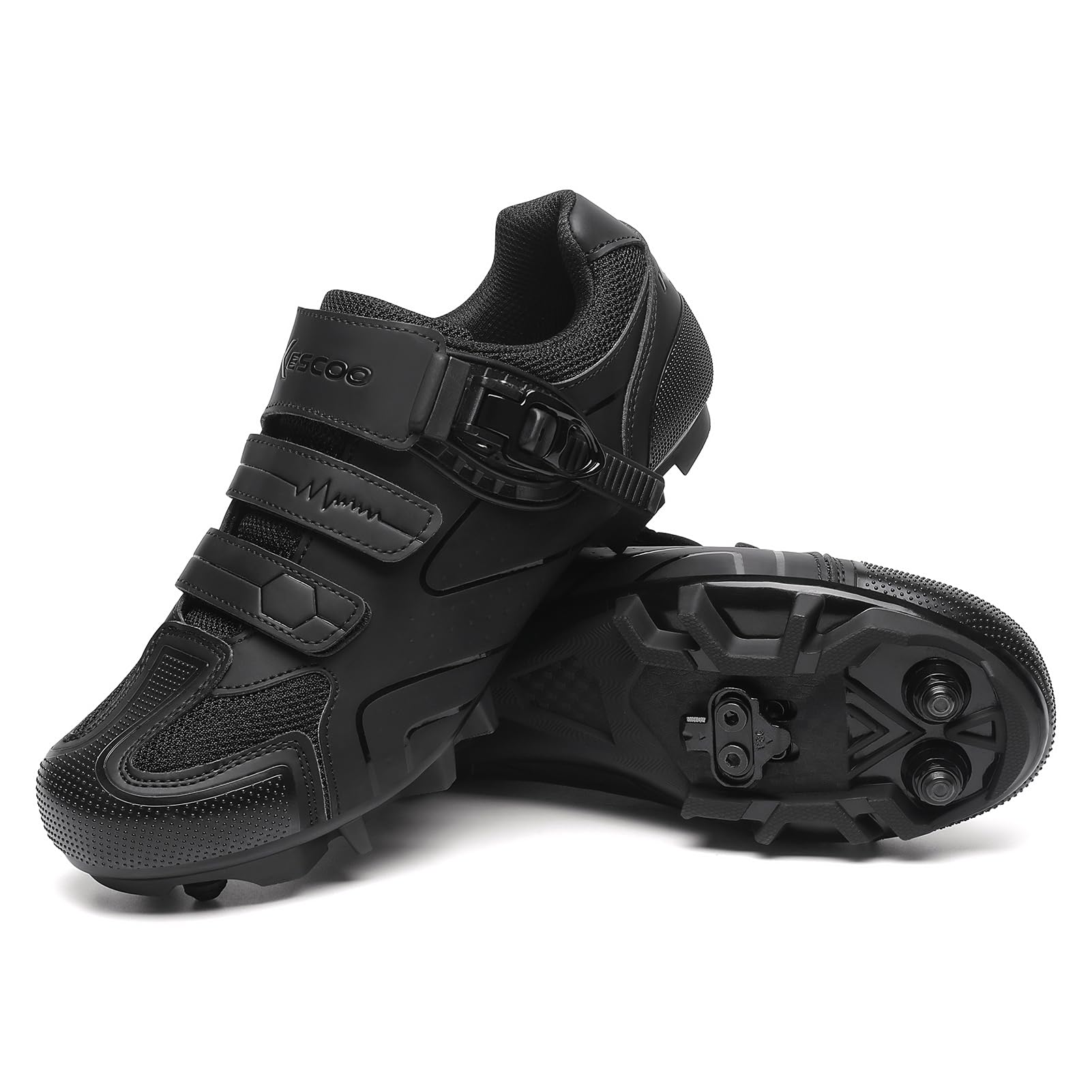
The KESCOO is a beginner's shoe with a racer's closure. There's a ratchet on the top strap and two Velcro straps below it, so you can crank the shoe down for a climb and back it off with one hand. The toe box is roomier than most of the cleated shoes here, which is the first thing we check when someone is coming from sneakers.

It takes a standard two-bolt cleat, the sole is stiff enough to pedal without hot spots, and the shoe goes on and off easily — two things a new clipless rider notices immediately and a lot of cheap shoes get wrong. It's also one of the least expensive cleated shoes on this page, which is most of the argument for it.

The top ratchet is the weak link. It can be stiff to release and fussy to tighten, so crank it gently and don't force it when it binds. Even so, for a first season on clipless pedals the KESCOO does the job: roomy, simple, and cheap enough that a scuff isn't a tragedy.

Bottom line: A cheap, roomy first clipless shoe: the KESCOO is easy to get on and comfortable straight away, though the ratchet and toe seam are where it shows its price.

7

Shimano SH-MX100

Shimano SH-MX100

Commuting and walking

Our Score 8.2/10
Check Price

Worth Noting

  • Runs narrow, and the size chart is unreliable
  • Velcro straps run short
Closure
Velcro straps
Intended Use
Off-road multi-use
Cleat Compatibility
2-bolt SPD
Read the full review

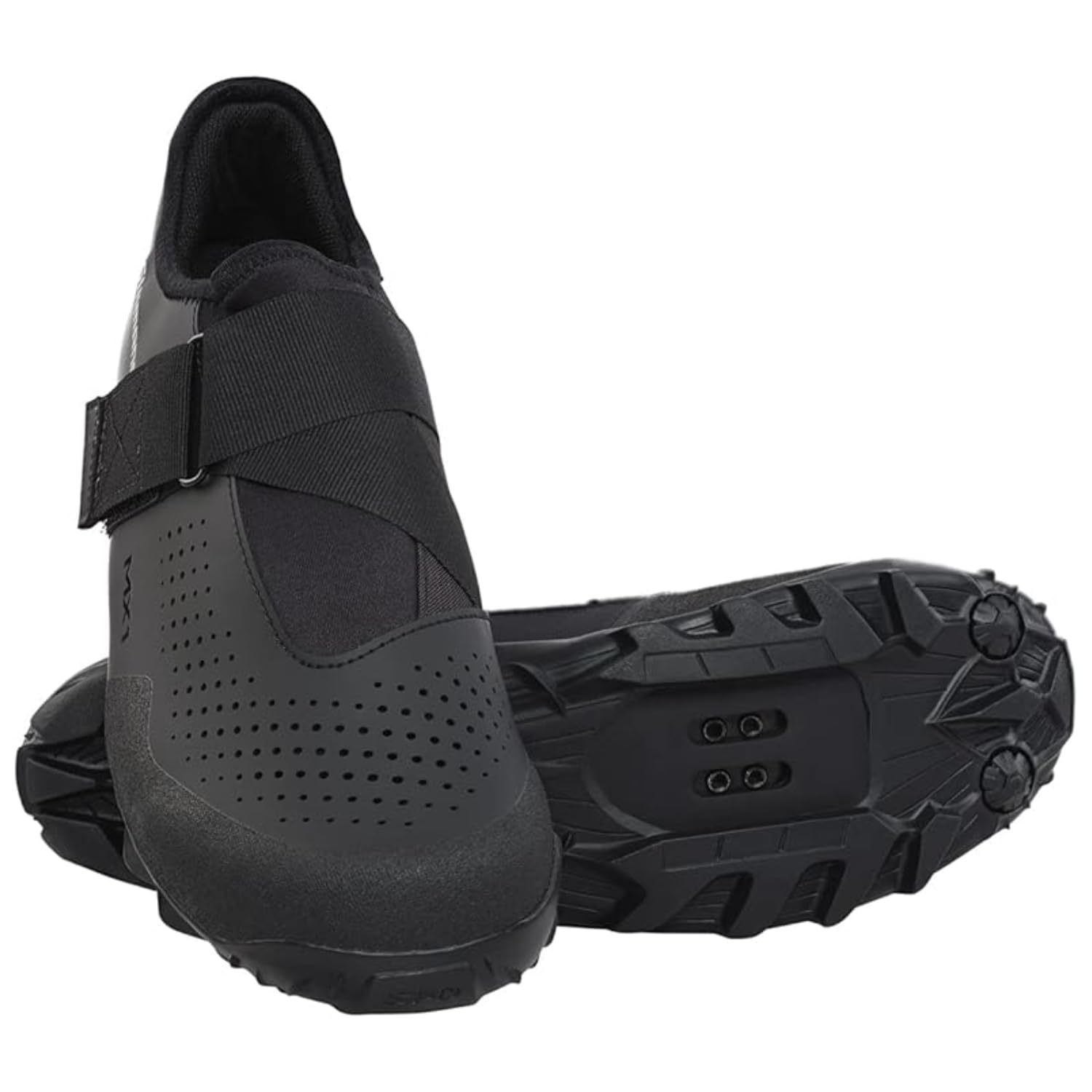
Most cleated shoes make you walk like a duck; the MX100 doesn't. The cleat sits deep enough in the sole that you can walk to the trailhead, push the bike through a rock garden, or do the post-ride lap of the car park without metal skittering on pavement. It's the shoe here we pick when a ride is as much walking as pedaling.

That makes it the most versatile cleated shoe in this group and the easiest one to recommend for mixed use — commuting, rail trails, gravel, and light trail riding where you're off the bike as much as on it. It's comfortable over long days, the closure is simple enough to adjust without looking down, and there's nothing fussy to break in.

Value is the other reason it's here: you get a light, comfortable, walkable cleated shoe for less than most of the cleated picks on this page. It isn't the shoe for a rider chasing maximum stiffness or a snug race fit — it's the one for the rider who wants to clip in, ride, and get off again without thinking about their feet.

Bottom line: If your rides involve walking — a hike-a-bike, a train home, a long coffee stop — the MX100 is the cleated shoe we reach for, as long as you size up.

How We Tested Mountain Bike Shoes

We started by pulling spec sheets for roughly 40 pairs and comparing what the money actually bought: sole stiffness, lug depth and rubber, closure hardware, claimed weight, and whether replacement lugs or insoles were available. From there we narrowed to 12 pairs spanning budget lace-ups to stiff race shoes, deliberately including a couple of brands known for running narrow and a couple known for running wide.

Every pair went on the same rides over six months: a rocky, pedal-heavy loop where we could feel the sole flex under hard efforts; a wet, root-covered descent and a steep hike-a-bike section where we walked uphill in the shoes on slick rock and roots to see what slipped; and a handful of lift-served park days. Multiple testers with different foot shapes wore the same size in each model, which is how we caught the half-size gaps between brands.

Mid-ride, we adjusted every closure with gloves on and one hand, then again with muddy fingers at the trailhead. We noted heel lift on long climbs, hot spots after three-hour rides, and how toe caps and stitching survived rock strikes. We also wore the shoes off the bike — a coffee stop, a grocery run — to see how they scuffed and how they looked doing it. After six months, we compared wear patterns across the lineup and asked whether the price gap between two similar shoes bought anything a rider would actually feel.

How to Choose Mountain Bike Shoes

Start With Your Pedals

A clipless shoe has a two-bolt mount and a stiff plate under the ball of the foot, so the pedal does the holding. A flat-pedal shoe has no mount at all and relies on sticky rubber and a flatter sole that settles over the pedal pins. If you already own SPD pedals, you need a cleated shoe; if you ride flats, buy a flat shoe.

The trap is assuming you can switch later. You can't add a cleat mount to a flat shoe, and while a cleated shoe will sit on a flat pedal, the hard sole and recessed metal are a poor match for pins, especially in the wet. Sneakers are worse still: soft rubber slides, the sole flexes over the pedal, and there's no toe protection.

Fit Comes Before Everything Else

Cycling shoes are built on narrower lasts than running shoes, and most of the shoes here run small or narrow. Don't order your sneaker size and hope. Measure your foot in centimeters at the end of the day, match it against the brand's EU chart, and go up if you land between sizes.

Wide feet have the hardest time: the Shimano MX100 and the Giro Ranger both run narrow with no wide option, while the KESCOO's roomier toe box is the exception in this group. Buy somewhere with easy returns, and try shoes on with the socks you actually ride in. A snug toe box rarely stretches enough to matter.

Stiffness, Walkability, and the Hike-a-Bike

A stiff sole spreads pressure across the pedal and stops your arch curling over it on long descents; a flexible sole walks better but can hot-spot on a big day. Most trail riders land in the middle, which is the ground a nylon plate and a rubber outsole cover — that's the Ranger and the Code.

If you get off the bike often, prioritise a recessed cleat and a tread with some depth, and consider studs for mud. If you never walk further than the car, a stiffer, lighter shoe is the better trade.

Closures: Laces, Straps, Ratchets and Dials

Laces spread pressure evenly, never jam, and are easy to replace, but they take two hands and can catch in a chainring — the Stamp's lace pocket is a neat fix. Velcro straps are cheap, fast, and grit-tolerant, though they wear and can press on a high instep. Ratchets hold a precise fit, but they clog with mud and a stripped ratchet can end a shoe's life.

Match the closure to how often you adjust on the move. Commuters and tourers do fine with straps; riders who tinker mid-climb get more from a ratchet or a dial, and should accept that a broken dial is the most expensive thing to replace.

Frequently Asked Questions

Final Verdict

Start with the pedal you actually ride. For clipless riders, the Giro Code is the shoe we recommend first: it clips in, walks quietly, and looks normal enough to wear all day. If you ride flat pedals, the Five Ten Freerider is the better buy, because grip is the difference between a confident descent and a nervous one. And if the budget is tight, the Giro Ranger gives you a cleated trail shoe for less than most of the field.