Indoor Training

Best Indoor Bike Trainers of 2026

A trainer's job sounds almost too simple: hold your bike upright so you can pedal indoors. The problem is that everything that makes one good — a heavy flywheel, a wide base, a hub that clamps down hard — is also what makes it loud, heavy, and awkward in a spare room. What the right one fixes is the whole reason you bought it in the first place: a ride that feels like riding, in whatever space you've got, without a twenty-minute fight to get your bike mounted. My team spent six months with nine trainers, and the differences were not subtle.

First-timers fixate on flywheel weight, but mounting and fit decide whether you'll actually use the thing. If the thru-axle adapter doesn't line up, or the instructions are one exploded diagram and no torque spec, a perfectly solid trainer becomes a clothes rack by February. Noise matters just as much as resistance, especially if anyone lives below you. The picks below run from wheel-on to direct-drive, and every one of them earned its place.

1

Garmin TacX Neo 2T

Top Pick
Garmin TacX Neo 2T

Quiet premium training

Our Score 9.4/10
Check Price

Worth Noting

  • Heavy at 47.4 pounds
  • Premium price tier
Weight
47.4 lb
Max Power
2,200 watts
Connectivity
ANT+, Bluetooth
Resistance Type
Magnetic, 32 magnets
Read the full review

The Neo 2T is the trainer we reach for when the ride needs to feel like the road, not a spin class. Its 32 neodymium magnets and 2,200-watt ceiling give it a huge resistance range, and the road-feel function adds texture that the wheel-on units cannot match. The substantial frame also sits planted in a way that makes out-of-the-saddle efforts less nervous.

What surprised us was how little fuss there is around it. It connects over ANT+ and Bluetooth, includes axle adapters for common QR and thru-axle setups, and comes with a front wheel block. Once it is in place, it has a solid, planted feel that makes long sessions easier to settle into. It is a dedicated indoor setup rather than a trainer you move from room to room.

If quiet is the deciding factor in an apartment, the Neo 2T is the answer here. We like it most for long Zwift climbs and steady tempo sessions, where the stable frame and realistic resistance curve do the work. It is more trainer than a casual rider needs, and that is fine: the CORE 2 is the better value for most, while the Neo 2T is for the rider who wants the most polished ride in this set.

Bottom line: For the quietest, most road-like premium ride here, we point to the Neo 2T—if you have a dedicated space for a heavy direct-drive unit.
2

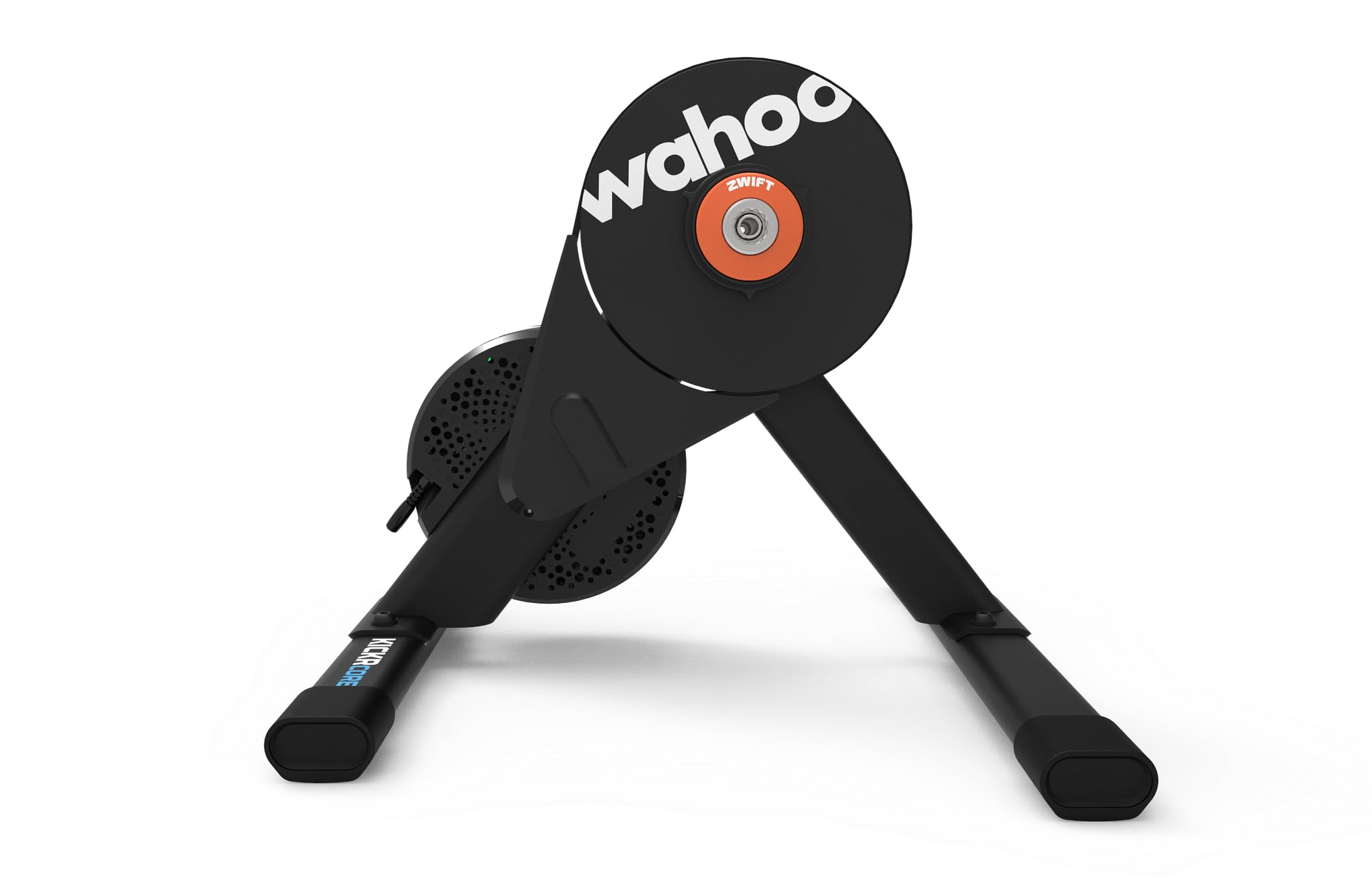
Wahoo KICKR CORE 2 Zwift

Wahoo KICKR CORE 2 Zwift

Structured indoor training

Our Score 9.0/10
Check Price

Worth Noting

  • 2.4 GHz-only WiFi can complicate setup
Weight
30 lb
Connectivity
WiFi
Resistance Type
Electronic direct-drive
Axle Compatibility
QR, 12x142, 12x148 thru-axle
Read the full review

The Zwift Cog and Click bundle is what makes the KICKR CORE 2 feel less like a project and more like a trainer you can live with. There is no cassette to source or derailleur to index before the first ride: the Cog goes on the direct-drive freehub, the Click shifters pair with Zwift, and the bike is ready. We mounted a road bike and were pedaling without the usual pile of spare parts on the floor.

The direct-drive design also removes the rear-wheel roller, so there is no tire squeal, no rubber dust, and no tension guesswork. Electronic resistance responds quickly, and the 13.6 kg frame stayed composed when we stood for a climb. WiFi pairing is built in, and the two-year warranty is a useful cushion at this price tier.

It is not the trainer for someone who wants the absolute most realistic road feel. The Neo 2T has the edge there, and it also has a higher resistance ceiling. The CORE 2 is the more practical smart trainer: it costs less, sets up faster, and handles the virtual shifting that most Zwift riders actually use.

For a rider who follows a training plan, races on Zwift, and wants a dedicated indoor setup, this is the trainer we recommend first. We kept coming back to it because the ride was quiet enough to use in a spare room and the shifting never left us hunting for a cassette tool.

Bottom line: Our pick for structured indoor training, the KICKR CORE 2 Zwift brings direct-drive feel and app control without the premium Neo 2T's price.

3

Elite Novo Force

Elite Novo Force

Small-space wheel-on

Our Score 9.0/10
Check Price

Worth Noting

  • Thru-axle needs optional adapter kit
  • Setup directions are thin
Weight
21.8 lb
Max Power
690 watts at 40 km/h
Wheel Fit
24–29 inches
Resistance Type
Magnetic, 8 levels
Read the full review

The Novo Force is the wheel-on trainer for a small apartment or a bike that has to come inside after every session. It folds down, weighs 21.8 pounds, and has a wide footprint for stability. We liked that it does not demand much floor space when it is not in use; the trade-off is a wheel-on design, so the rear tire still meets a roller.

Eight magnetic levels and a claimed 690 watts at 40 km/h give it more range than the budget stands here. The resistance changes are progressive enough for intervals, and the frame stays composed when you push. For a rider who wants a compact, folding trainer without paying direct-drive money, the Novo Force is the most sensible wheel-on in this set.

It is not the quietest wheel-on trainer in this group—no wheel-on is truly silent—and the ride feel is a step behind the direct-drive units. We still kept it set up for winter base miles because it folded away in seconds when guests arrived. That combination of compact storage and usable resistance is what earns it a place here.

Bottom line: We like the Novo Force for small-space riders: it folds compactly, offers eight magnetic levels, and costs less than a direct-drive setup.

4

Alpcour Fluid Trainer

Alpcour Fluid Trainer

Fluid endurance rides

Our Score 8.8/10
Check Price

Worth Noting

  • Assembly instructions are thin
Frame
Stainless steel
Included
Front riser and bag
Load Capacity
300 lb
Resistance Type
Fluid, progressive
Read the full review

Fluid resistance is the reason to look at the Alpcour fluid trainer. Instead of a handlebar dial with six clicks, the impeller inside the unit spins in liquid and resistance rises as you pedal harder. We found that makes easy spins feel natural and hard efforts build smoothly, though it also means you cannot soften the resistance mid-interval without shifting your bike's gears.

The stainless steel frame, dual-lock system, and front wheel riser gave us a planted feel, and the included bag is a nice touch if the trainer lives in a closet between rides. The weak spot is the top end: the fluid unit adds resistance smoothly, but it runs out before a very strong rider will be satisfied. Plan to use your bike's gears for the hardest efforts.

For a rider who wants a smoother wheel-on experience without jumping to direct-drive, this is a solid choice. It is heavier and more expensive than the budget magnetic stands, but the progressive feel is worth it if you ride steady endurance miles. We do not choose it for sprint intervals; the direct-drive units are better there.

Bottom line: We choose the Alpcour fluid trainer for smooth, progressive resistance and a stable frame, provided your hard efforts come from gearing rather than a resistance dial.

5

Sportneer Fluid Trainer

Sportneer Fluid Trainer

Set-and-forget endurance

Our Score 8.8/10
Check Price

Worth Noting

  • Poor assembly instructions
Frame
Stainless steel
Weight
24.3 lb
Wheel Fit
26–29 inches & 700C
Resistance Type
Fluid, progressive
Read the full review

The Sportneer fluid trainer takes a different approach: there is no handlebar resistance dial, because the fluid unit sets resistance by how fast you spin. We liked that for tempo rides—the effort builds in a smooth, road-like way—and the simplicity is appealing. You shift your bike's gears to change difficulty, which feels natural once you are riding.

The stainless steel frame feels solid, the 26–29-inch wheel fit covers most road and mountain bikes, and the fluid unit runs more smoothly than the budget magnetic stands here. At 24.3 pounds, it is a bit heavy to move around, but the frame feels substantial rather than flexy. It is the kind of trainer that rewards a steady rhythm more than a punchy interval.

As a set-and-forget trainer for steady indoor miles, the Sportneer fluid is a good value. It is not as connected as the direct-drive picks, and the resistance is not adjustable from the bars, but that simplicity is the point for endurance rides. The fluid unit was quiet enough that we stopped noticing it after the first few minutes.

Bottom line: We suggest the Sportneer fluid trainer for quiet, road-like endurance miles, not for interval sessions that need on-the-fly resistance changes.

6

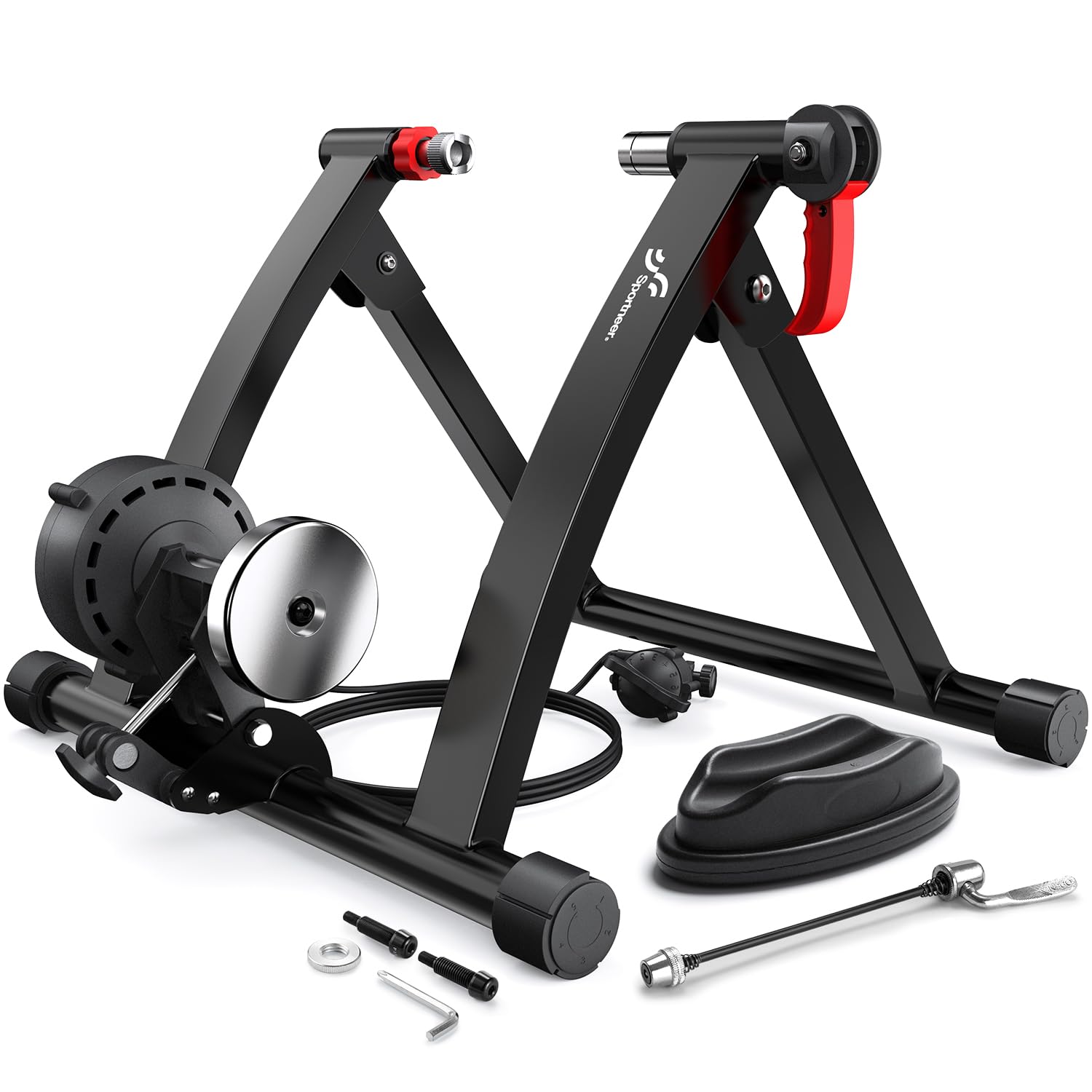
Sportneer Magnetic Trainer

Sportneer Magnetic Trainer

Easy spin sessions

Our Score 8.6/10
Check Price

Worth Noting

  • Weak resistance at the top end
  • Noisy with knobby tires
Weight
19.3 lb
Wheel Fit
26–28 inches & 700C
Load Capacity
300 lb
Resistance Type
Magnetic, 6 levels
Read the full review

The Sportneer magnetic trainer is the least expensive way into this set, and it still gives you a handlebar remote with six resistance levels. We used the remote constantly on easy spins, and the press-down lever makes it quick to pull the bike out for an outdoor ride. The 300-pound capacity and 19.3-pound frame are reasonable for the budget tier.

The wide base and front wheel riser help it feel settled during steady seated efforts, and the quick-release clamp is easier to operate than the bolt-on designs on some cheap stands. It is best for easy spinning and recovery sessions, where you are not asking the roller to hold a hard surge. The remote is the feature that keeps it pleasant: you can back off without unclipping or reaching for a dial.

We kept the Sportneer for short recovery spins, where the bar remote let us change effort without breaking rhythm. It is a low-cost entry point for a rider who wants to keep the legs moving on rainy days, and it does that job without taking over the room.

Bottom line: We see the Sportneer magnetic trainer as a low-cost entry point for easy spinning, not a serious interval tool.

7

BalanceFrom Bike Trainer

BalanceFrom Bike Trainer

Budget indoor miles

Our Score 8.4/10
Check Price

Worth Noting

  • Loud with knobby tires
  • Diagrams-only instructions
Warranty
2 years
Wheel Fit
26–28 inches & 700C
Load Capacity
330 lb
Resistance Type
Magnetic, 8 settings
Read the full review

The BalanceFrom trainer is the one we point to when the goal is simple: get the bike inside, spin, and not spend much. It has 8 magnetic settings, a 330-pound load capacity, and a two-year warranty, which is a lot of trainer for the budget tier. We found the wide base and low stance keep the bike steady during normal seated efforts.

The compromises show up in the resistance: the eight clicks are useful, but the top end is modest, and strong riders will spend most of their time in the hardest gear. For casual fitness rides, that is fine. It is a good first trainer for a rider who wants to test whether indoor riding sticks before spending more.

We recommend the BalanceFrom for a rider who wants a durable, high-capacity stand for steady winter miles and does not care about app control. It is not the trainer for structured intervals, but it gets the basic job done at the lowest price tier in this group.

Bottom line: Casual riders who want a high-capacity, simple stand without app control are exactly who we recommend the BalanceFrom for.

How We Tested Nine Indoor Bike Trainers

We started with every trainer we could find from the brands that dominate the category, then filtered by price band, axle compatibility, and drive type so the shortlist covered wheel-on and direct-drive models rather than one flavor. That left nine trainers, which we bought at retail and set up in a spare bedroom and a garage for six months — roughly the length of an indoor season.

Assembly came first, and we did it the way a new owner would: alone, with only the tools in the box, timing each step and noting where the instructions went quiet. We mounted a quick-release road bike, a thru-axle gravel bike, and a small-frame bike with disc brakes, then timed how long a swap took once we knew the routine. Trainers that required an adapter sold separately, or that shipped with no torque spec and a single diagram, lost ground right there.

Once a bike was on, we rode. That meant 5 a.m. sessions with someone asleep in the next room, out-of-the-saddle sprints to watch for rocking, and long steady efforts where a small wobble turns unbearable. We took noise readings at handlebar height and from the room next door, stepped through every resistance change to see how quickly it answered, and compared cadence and power readings against a separate meter. Sturdiness got a cruder test: a hard sprint, then a shove at the handlebars while we watched the base.

We kept tracking value through the season — what came in the box, what cost extra, and whether each unit still felt tight after months of hard use.

How to Choose Indoor Bike Trainers

Wheel-On or Direct-Drive?

A wheel-on trainer clamps the rear axle and presses a roller against the tire. It is the cheaper, lighter, more portable route, and the Elite Novo Force and BalanceFrom show why it remains popular: the bike goes on in minutes, the stand moves aside, and you do not need a cassette or freehub. The cost is tire wear, roller slip, and more noise, especially with a knobby tread.

A direct-drive trainer removes the rear wheel and runs the chain on a cassette or, in the Wahoo's case, a Zwift Cog. That is the better choice for frequent structured training: the ride is quieter, the resistance is electronic, and there is no tire to wear out. We recommend wheel-on for casual riders and tight spaces, direct-drive for anyone who trains indoors more than occasionally.

Check the Bike Before the Trainer

The trainer has to meet your rear axle, not the other way around. Quick-release bikes are the easy case; thru-axle bikes need the right adapters, and several trainers here include them for common sizes while others sell them separately. The Elite Novo Force includes a QR adapter but needs an optional kit for thru-axle. Wahoo and Garmin include a broader set of adapters, which is one reason they cost more.

Check wheel size too. The wheel-on picks cover 26 to 29 inches and 700C in different combinations, and a 29-inch mountain bike can be the edge case. Before ordering, confirm your dropout width, axle type, and brake clearance; if you ride a direct-drive unit, confirm the cassette or Zwift Cog path you want.

Resistance, Noise, and the Room You Ride In

Magnetic resistance is the budget standard: a dial or remote moves the roller closer to the wheel, and the steps are easy to understand. Fluid resistance is smoother and progressive, building effort as you spin faster, which suits steady endurance rides. Electronic direct-drive is the most responsive and the quietest at the trainer, though the bike's drivetrain still makes noise.

For an apartment, the tire matters as much as the trainer. A smooth road tire on a wheel-on unit is far quieter than a knobby mountain bike tire, and proper roller tension reduces slip without squashing the tire. If noise is the deciding issue, choose a direct-drive unit such as the Wahoo or Garmin, or a fluid wheel-on unit such as the Alpcour.

Stability, Setup, and Storage

A wide base and low stance matter more than a long list of features when you are pedaling hard. The direct-drive trainers here are heavy for a reason: they stay planted when you stand, but they are a fixture rather than something you fold into a closet. Wheel-on trainers are lighter and easier to move, but the bike can rock if the clamp and roller tension are not set correctly.

Folding is useful for storage, not for carrying a trainer up stairs. The Elite Novo Force folds compactly and weighs 21.8 pounds; the Alpcour fluid includes a bag but is still a deliberate two-handed carry. Measure the floor space with the bike attached, not just the trainer footprint, and leave room behind the rear wheel.

Smart Features and What They Add

A smart trainer changes resistance automatically when an app tells it to, which is what makes Zwift climbs feel different from a flat road. The Wahoo uses WiFi and includes Zwift Click and Cog for virtual shifting; the Garmin connects over ANT+ and Bluetooth. Wheel-on trainers can still use apps, but they need sensors and do not control resistance.

Decide whether you want that interactivity before you pay for it. A magnetic or fluid trainer is enough for steady miles and intervals by feel; a direct-drive smart trainer is worth it if you follow a training plan, race on Zwift, or want the trainer to hold a target wattage. Check the app's device support and whether you are willing to keep a subscription going.

Frequently Asked Questions

Final Verdict

For most riders, the Wahoo KICKR CORE 2 Zwift is the trainer we recommend first. It brings direct-drive quiet, electronic resistance, and a cassette-free Zwift setup into a package that costs less than the premium Neo 2T. If you follow a training plan and want the bike to stay set up, this is the default.

Choose the Garmin TacX Neo 2T if the most realistic road feel and quiet operation matter more than value, and choose the BalanceFrom if you want a simple, high-capacity stand for casual miles. The right answer changes with how often you ride indoors, not with the longest feature list.