Indoor Training

Best Indoor Cycling Fans of 2026

A fan that makes indoor training bearable has to move a serious volume of air, and the ones that do tend to sound like a leaf blower in a closet. That's the tradeoff nobody flags when you're shopping: too little airflow and you're dripping onto the top tube by the second interval, too much noise and you can't hear your workout app or anyone else in the house. What you're actually buying is a column of air that reaches your chest and face, and that you can adjust without unclipping.

I spent one miserable season with a box fan propped on a step stool, nudging it with my foot mid-interval, and I don't recommend it. Over the past six months my team and I have ridden through 12 fans built for the bike, from compact floor models to blower-style units, and the gap between a good one and a bad one shows up in the first ten minutes. Two things first-timers miss: aim matters more than blade size, and a remote you can't read from the bars is decoration. The picks below are the ones we kept plugging back in.

1

Lasko U15617 15-Inch Pivoting Blower

Top Pick
Lasko U15617 15-Inch Pivoting Blower

Hard trainer intervals

Our Score 9.4/10
Check Price

Worth Noting

  • No remote, so speed changes mean reaching the dial
  • One-year warranty is short at this price
Noise
57.6 dB
Weight
12 lb
Airflow
375 CFM
Cord Length
10 ft
Read the full review

Plenty of fans in this guide are at their best on their top setting. This one earns its place on the bottom one. On the first of its three speeds the 15-inch blower still pushes a steady band of air out past the bars, which is why our sessions ended with the dial left alone at low far more often than not. A trainer fan has to be tolerable for an hour, and this is the one we stopped noticing.

Aim does the rest. The head pivots far enough that the fan can sit on the floor in front of the bike and throw at your chest instead of your shins, and you can swing it up for a sprint set without moving the base. Two grounded outlets sit on the housing — a workshop feature that turns out to be genuinely useful when you want to charge a phone or clip on a small light — and the 10-foot cord reaches a wall socket from most garage layouts.

Twelve pounds and a housing the size of a milk crate mean it wants a permanent spot on the floor, which is where it belongs anyway. That weight buys stability: it sits still through an hour of intervals without wandering or needing to be re-aimed. Nothing about it is clever, and after a winter of use that is exactly the appeal.

Bottom line: For most riders this is the fan to buy: 375 CFM through a pivoting head, and the least objectionable noise of the big blowers here.

2

XPOWER P-80A Mini Mighty Air Mover

XPOWER P-80A Mini Mighty Air Mover

Dedicated training rooms

Our Score 9.4/10
Check Price

Worth Noting

  • Narrow stream needs careful aim
  • Highest power draw in this group
Power
138 watts
Airflow
600 CFM
Warranty
1 year
Aim Positions
4
Read the full review

Six hundred CFM out of a housing that measures 11.5 by 9.3 by 12.3 inches is the entire pitch. This is a centrifugal air mover built for drying carpet, and that job — forcing a large volume of air through a small opening at speed — happens to be the same job as cooling a rider.

The stream is fast and tight. Four positions, from flat through 20 and 45 degrees to straight up, let you lay it on the floor and aim at your chest, and the body sits low enough to stay clear of the front wheel. There is a carry handle, the units stack, and the 10-foot cord wraps around the housing for storage. Dual thermal protection and an ETL/CETL listing are the kind of detail you want on a fan running two hours in a damp room.

Where it wins for us is the dedicated room. On low it is a soft rush that does not compete with a workout playlist, and 138 watts is a rounding error next to a trainer and a TV. If the fan lives against the same wall all winter, this is the one we leave plugged in; if you want to change speeds without standing up, it is not.

Bottom line: The pick for a permanent pain cave: 600 CFM from a box you can carry in one hand, and the easiest of these to live with on low.

3

Vacmaster AM201R Aero Air Mover

Vacmaster AM201R Aero Air Mover

Remote speed changes

Our Score 9.2/10
Check Price

Worth Noting

  • Remote can arrive dead or stop working
Noise
61 dB
Airflow
550 CFM
Warranty
2 years
Air Speed
32 mph
Read the full review

The strap is the reason to care about this one. Vacmaster puts a small remote on a loop that wraps around your handlebars, so going from a whisper on the recovery interval to full blast for the last set takes a thumb rather than a dismount. On a workout assembled out of intervals, that is worth more than another hundred CFM.

It helps that the fan underneath is a proper air mover: 550 CFM and 32 mph through three speeds, with three fixed angles — flat, 45 degrees and straight up. Parked against the front wheel at 45 degrees, it puts air on your chest from about a foot off the floor. Of everything here, this is the fan we reach for when the session has structure, because the remote is the difference between riding the plan and abandoning it somewhere in the second set.

Two years of coverage is the longest here after Vornado, and the housing — roughly 13 by 12.6 by 10.4 inches — tucks under a bike stand between sessions. It also has a smaller footprint in front of the bars than any of the Lasko blowers, which matters in a room where the trainer already takes up the floor.

The stream is narrow, so aim does the work: this is a column of air rather than a wash, and it wants pointing at your torso, not your face. At 61 dB it carries the loudest published rating in the group, which is background noise in a garage and the loudest thing in the room in a spare bedroom.

Bottom line: Buy this one if your sessions are built on intervals: the handlebar remote is worth more than the extra airflow a bigger blower brings.

4

Lasko U12104 12-Inch Utility Fan

Lasko U12104 12-Inch Utility Fan

Small apartments

Our Score 9.2/10
Check Price

Worth Noting

  • Least airflow of the blowers here
  • Loud on high for its size
Noise
59.3 dB
Weight
7.5 lb
Airflow
289 CFM
Cord Length
10 ft
Read the full review

Take the 15-inch Lasko, shrink the housing, take out about four and a half pounds, and you have this one: 289 CFM rather than 375, on the same pivoting head and the same pair of grounded outlets. It keeps the 10-foot cord too, which matters more than it sounds when the only free socket is behind a shelf.

At two or three feet from the bars, 289 CFM is enough for steady endurance work, and the 270-degree pivot gets air onto your chest from the floor without any propping. This is the one for a spare bedroom or an apartment where the bike comes out of the corner and the fan goes back in it — 7.5 pounds and a 12-inch housing move easily in one hand. What it gives up is headroom for sprint intervals, and high speed is loud for its size.

Bottom line: The apartment-sized version of our top pick: enough directed air at close range, and light enough to pack away after every session.

5

Vornado 630 Air Circulator

Vornado 630 Air Circulator

Year-round circulation

Our Score 9.2/10
Check Price

Worth Noting

  • Won't hit a rider like a blower
  • Costs more than stronger fans here
Speeds
3
Weight
5.8 lb
Warranty
5 years
Blade Size
9 inches
Read the full review

Start with what this is not. The 630 is a room circulator, not a blower: it will not hit you in the chest the way the Laskos or the Vacmaster do, and anyone buying it as a trainer fan will be disappointed. What it does is move the air in the whole room rather than a column of it.

The 9-inch fan sits on a small base — 8.25 by 12 by 13.6 inches, under six pounds — with a tilting head, three speeds and a grill that lifts off for cleaning. Pointed at a wall or into a corner, it stirs a room without claiming floor space in front of the bike, and the six-foot cord is enough for a shelf or a desk.

It carries the longest warranty here at five years, which is the strongest argument for it if the same fan has to be a bedroom fan in November and a training fan in January. Whether that is worth the money is the open question, because it costs more than several stronger fans in this group. For a rider who wants one fan to serve the room all year, the premium buys peace of mind; that is a different purchase from the one the rest of this list is about.

Bottom line: Buy this one for the room rather than the bike: five years of coverage and quiet circulation, with less direct cooling than the blowers.

6

Dreo DR-HAF002 Air Circulator

Dreo DR-HAF002 Air Circulator

Shelf or wall

Our Score 9.2/10
Check Price

Worth Noting

  • Not enough air for hard efforts alone
  • Bulkier than a typical desk fan
Tilt
120 degrees
Noise
25 dB
Weight
5.5 lb
Air Throw
70 ft
Read the full review

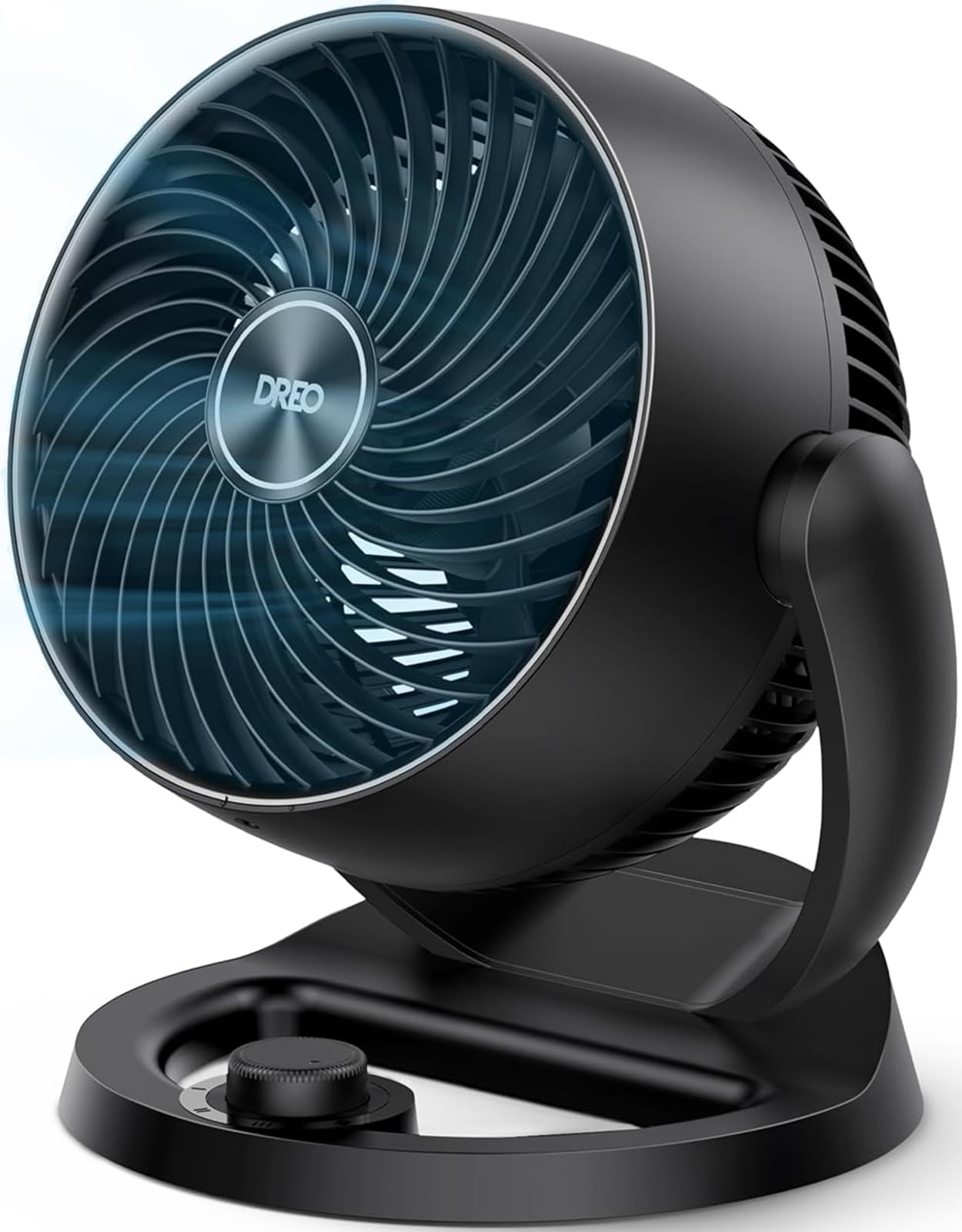
Most tabletop fans stir the air within arm's reach. Dreo builds this one to push a throw across a room — the listing claims 70 feet — using a 12-inch housing and pitched blades, so it behaves more like a small circulator than a desk fan.

It is very quiet. The 25 dB figure is the lowest in this group, and on the low and middle speeds it is the sort of soft hum you can hold a conversation over. Three speeds run off a back-mounted knob, the head tilts through 120 degrees, and it draws 35 watts.

The wall bracket is the detail that makes it useful on a bike. Two screws and it hangs at chest height in front of the bars, aimed down at your torso, off the floor and out of the sweat zone. It is also bigger than the photos suggest — around 14 inches tall — so measure the shelf before you commit to one.

As a second fan it is excellent: quiet, aimable and inexpensive enough to add without much thought. As the only fan for a hard interval session it runs out of air, because 35 watts and a 7-inch blade only go so far. Pair it with a blower rather than asking it to replace one.

Bottom line: A quiet second fan rather than the main one: hang it at chest height and let it handle your face while a blower does the rest.

7

Honeywell HT-900 TurboForce

Honeywell HT-900 TurboForce

Desk-side cooling

Our Score 9.2/10
Check Price

Worth Noting

  • Not much air compared with the blowers
Speeds
3
Weight
2.6 lb
Airflow
185 CFM
Mounting
Tabletop or wall
Read the full review

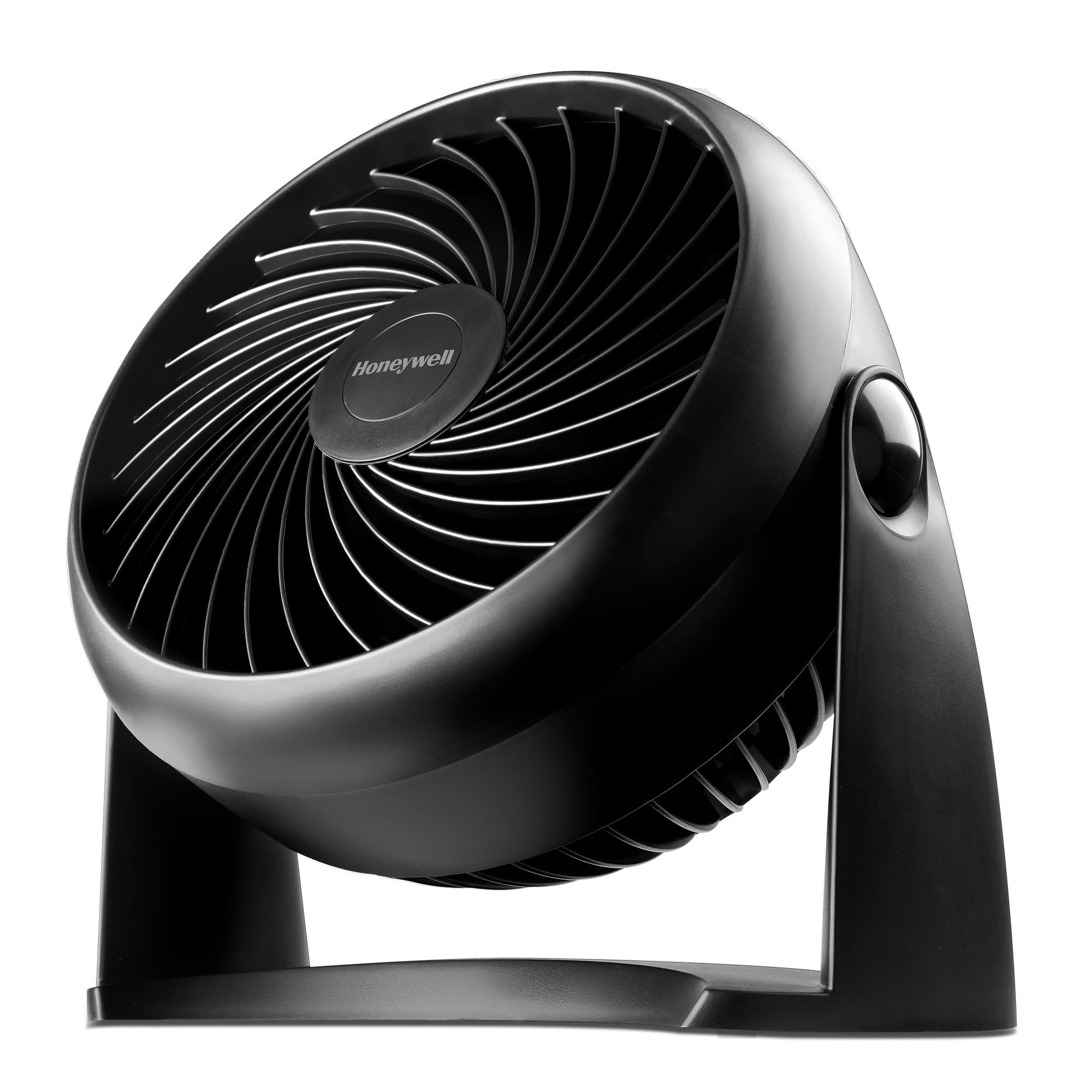
Two things make this little fan worth a look for a bike setup: a 90-degree pivoting head and a wall-mount option. Hang it at face height, aim it down at your head and shoulders, and it does the one job a small fan is genuinely good at — a steady breeze exactly where you want it, with no floor unit in the way of the front wheel.

At 2.6 pounds and 35 watts it is easy to live with: two fingers to move, almost nothing on the meter, and 185 CFM across three speeds. The long-term record is where it gives ground — some units quit inside a year — so treat it as a cheap fan rather than a buy-once fan. Pointed at your face while a blower handles your torso, that is a trade worth making.

Bottom line: A face-height fan for very little money, best bought as the second fan in a setup that already has a blower.

8

Hurricane Classic 20-Inch Box Fan

Hurricane Classic 20-Inch Box Fan

Budget big air

Our Score 8.8/10
Check Price

Worth Noting

  • No tilt, so you prop it to aim up
  • Loud enough to hear from the next room
Power
55 watts
Weight
7 lb
Airflow
2400 CFM
Blade Size
20 inches
Read the full review

This is the cheapest way to move a wall of air, and nothing else here comes close on airflow per dollar. A 20-inch box fan rated at 2,400 CFM on 55 watts asks a fraction of what the blowers cost, and the money goes into a stamped housing and five plastic blades instead of a pivoting head or a remote.

The shape is the catch. A box fan pushes a flat sheet of air straight out, so sitting on the floor it hits your shins, where it does the least good. There is no tilt mechanism at all, which means getting air to your chest involves propping the thing on a chair, a crate or a stack of books. In a garage that is a two-minute fix; in a living room it is furniture you did not plan for.

It is also loud enough to hear from the next room, which is the trade for all that air. The frame is only 3.5 inches deep, so it stores flat against a wall, but the 5-foot cord is short and the handle is the part to be careful with — the housing is where these crack when they get knocked around.

For a garage, a basement or a barn where the fan stays in one place and nobody minds the racket, it is the value play: 55 watts, a wide sheet of air, and enough output to take the edge off a hot room. In a spare bedroom, the fan you can hear over your headphones is the fan you switch off after twenty minutes.

Bottom line: Buy it for a garage where nobody minds the noise: the widest sheet of air here for the least money, if you prop it up.

How We Tested the Best Indoor Cycling Fans

We started by pulling every fan marketed to cyclists, along with a few blower and shop-style units riders keep recommending to each other, and compared claimed airflow, housing and blade size, control options, and price. Anything too wide to sit between the front wheel and the wall got cut, as did anything whose speed control lived only on the unit itself. That left 12 fans, which spent six months parked beside a trainer in a garage.

Each one ran the same rides: 45-minute endurance spins, 3x8-minute threshold sets, and sprint sessions where you're too gassed to think about where the air is coming from. We held an anemometer at chest height three feet out, then again at six feet, to see how much air actually reached the rider, and tilted each head to check whether the stream landed on the face and chest or just the shins.

Noise went on a decibel meter at ear height, where a rider's head actually sits, since a fan that's quiet against the wall can be loud at the bars. We changed speeds mid-interval, hands on the hoods, to see whether the remote was reachable and readable without sitting up. And because this is a wet environment, we wiped every housing down after sessions and checked grilles, switches, and seams for corrosion or stickiness, then weighed what each fan cost against what it delivered.

How to Choose Indoor Cycling Fans

Where the fan sits matters more than what it costs

Distance is the biggest lever you have. Airflow falls away fast with every foot between the grill and your chest, so a modest fan two feet away will out-cool a bigger one across the room. Before you shop, move what you own a foot closer and see what changes.

Height matters next. A blower on the floor can be tilted up at your chest, but anything that only blows straight ahead needs to be raised — a chest-high shelf, a wall bracket, or a crate under a box fan — before you judge whether it is strong enough.

Match the shape to the job

Three shapes dominate this category and they behave nothing alike. A pivoting blower or air mover pushes a tight, fast column from the floor and can be aimed, which is the shape most riders end up wanting. A box fan throws a broad, flat sheet and does not aim at all. A room circulator stirs the air in the space instead of hitting you.

So: blower for a garage or a dedicated room, circulator if the fan has to double as a bedroom fan and look normal doing it, and a small tabletop unit on a wall bracket when floor space in front of the bike is tight.

Judge noise at the speed you will ride

Published decibel figures are a rough guide. They are often quoted at the lowest setting, and the character of the sound matters as much as the number. The question that actually decides a purchase is whether the fan moves enough air on its quiet setting to carry an easy endurance block.

The two Lasko blowers do. A 20-inch box fan generally does not. If you ride with headphones, follow a class, or share a wall with someone, low-speed performance is worth more than a bigger maximum you will only touch for sprints.

Controls, cords and outlets

Where the controls sit decides how often you touch them. A rotary dial on the housing means leaning down mid-interval; a remote clipped to the bars means a thumb. Neither is wrong, but be honest about which one you will use when your heart rate is at threshold.

Cord length is the quiet dealbreaker. Ten feet reaches most garage sockets from the middle of the floor; five feet usually needs an extension lead across the one place you walk. Built-in outlets, like the pair on the Lasko blowers, are handy for a phone or a light but do not change where the fan itself sits.

Buy for the hours, not the peak

Trainer fans run for one or two hours at a stretch in a warm, humid room, which is harder on a motor than occasional summer use. Coverage in this group ranges from one year to five, and the fan with the longest warranty is not the one that moves the most air.

If the fan will run daily from October to March, longer coverage or a simpler, better-cooled design is the cheaper decision across three winters. If it comes out twice a week for short sessions, spend the difference on airflow instead.

Frequently Asked Questions

Final Verdict

Buy the Lasko U15617 and park it three feet in front of the bars. It moves enough air on its lowest setting to carry a whole session, aims where you need it, and is the quietest of the big blowers on paper — which is what keeps it switched on in week six rather than week two.

If changing speed without reaching down matters to your workouts, the Vacmaster AM201R and its handlebar remote are worth the trade in refinement. If the bike lives in a garage and noise is not a factor, the Hurricane box fan moves a wider sheet of air for a fraction of the money.