Components

Best Mountain Bike Grips of 2026

Halfway down a rooty descent, your hands are the only thing between you and a bad line. Good mountain bike grips keep your palms locked to the bar when things get damp and chattery, and they spread vibration out so your hands don't go numb before the trail ends. The wrong pair can feel slick with sweat, chew up gloves, or turn installation into a wrestling match. Over the past six months, my team and I rode 14 different sets on rocky singletrack, muddy morning laps, and a few bike-park days, and the differences in grip feel, comfort, and installation were clear from the first ride.

Color and appearance matter more than I expected—a mismatched set is hard to unsee. We watched for durability, checked that every box had the right plugs and bolts, and noted how each profile felt after hours of hand time. A thicker grip quiets trail buzz; a thinner one feels more precise. The best ones made me forget I was gripping anything; the picks below earned that.

1

PNW Components Loam

Top Pick
PNW Components Loam

Trail and enduro

Our Score 9.6/10
Check Price

Worth Noting

  • XL pair adds 30 g over the Regular
Clamp
Single lock-on
Weight
~90 g / ~120 g per pair
Diameter
30 mm or 34 mm
Warranty
Lifetime
Read the full review

Two diameters is the whole decision. The Loam comes in a 30 mm Regular and a 34 mm XL, and choosing between them matters more than anything else on this page: the Regular keeps the slim, locked-in feel most riders are used to, while the XL fills the palm and gives big hands something to wrap around. Start from what your current grips measure — if your fingertips press into your palm, size up.

Both sizes use the same ultra-tacky compound and a dual pattern: thin horizontal strips under the fingers for a supple feel, plus a thicker block that supports the heel of the palm. That tackiness is what we noticed first. You don't have to squeeze hard to stay connected, which is the entire point of replacing a stock grip, and sweaty hands don't turn a descent into a forearm workout.

Mounting is a single clamp and a closed end, so there's no bar plug to lose and no hairspray wrestling match. The Regular pair runs about 90 g and the XL about 120 g; the extra volume is the only place the weight goes, and it buys real relief for cramping hands.

The lifetime warranty is the detail we keep coming back to. A grip is a wear item — scraped on rock, dropped in a parking lot, left in a hot car — and a lifetime claim on a part like this is unusual at the price. For trail and enduro riding, that's the argument for spending a little more than the budget picks ask.

Bottom line: These are the grips we point trail and enduro riders toward: choose your diameter, clamp them on, and the tacky compound does the rest.

2

ESI Grips Chunky

ESI Grips Chunky

Vibration damping

Our Score 9.4/10
Check Price

Worth Noting

  • Silicone can tear in a hard crash
  • Slip-on fit needs alcohol and set time
Mount
Slip-on, no clamp
Length
130 mm, can be cut
Diameter
32 mm
Read the full review

There's no clamp on the Chunky — just a silicone sleeve you slide onto the bar with a splash of rubbing alcohol and leave to set. That install is the first thing to understand about them, because it explains both why they're lighter than any lock-on here and why a hard crash can hurt them.

Once they're on, the payoff shows up on the first root section. At 32 mm they're plush without feeling vague, and the silicone takes the high-frequency chatter out of a rough line in a way rubber lock-ons don't quite manage. We're pleasantly surprised by how much difference the material makes to hand fatigue over a couple of hours, and by how firmly they stay put once the alcohol has evaporated.

The trade is longevity. Silicone is soft, and a scrape along rock or a bar-first crash can tear a chunk out of it where a firmer rubber grip would only scuff. Set against that, they can be trimmed to length with a blade, and a color change costs a splash of alcohol rather than a new pair.

Bottom line: If numb hands are your problem and you don't mind a clamp-free install, these are the most comfortable grips we tested.

3

ODI Rogue Lock-On

ODI Rogue Lock-On

Big hands

Our Score 9.4/10
Check Price

Worth Noting

  • 113 g pair is heavy beside the lightest here
  • Too large for smaller hands
Clamp
Dual lock-on
Length
130 mm
Weight
4 oz
Padding
Extra-large raised pads
Read the full review

If your fingers wrap all the way around a standard grip until your fingertips dig into your palm, the Rogue is the one to try. It's the thickest, most padded profile in this group, with extra-large raised pads running the length of the grip and enough diameter to fill an XL glove.

The pattern does the practical work. Deep grooves give mud and grit somewhere to sit instead of polishing the surface, and the raised pads spread vibration across the whole palm rather than concentrating it on two or three pressure points. A clamp at each end means no rotation at all.

Weight is the cost: 4 oz, about 113 g, for the pair. That's heavy beside the lightest lock-ons here and irrelevant on a downhill or enduro bike, where the padding is doing the work. The compound is firmer than the soft silicone and budget rubber in this set, and firm rubber is what survives contact with rock — these are the pair we trust on a rocky descent. They also ship with snap caps, so a missing bar plug isn't a reason to leave the bar end open.

Bottom line: For big hands and rough ground, we haven't found a more secure-feeling grip in this roundup: thick pads, twin clamps, no rotation.

4

Ergon GA3

Ergon GA3

Wrist support

Our Score 9.4/10
Check Price

Worth Noting

  • Wing angle must be set and it pins your hand in one spot
Size
Large
Clamp
Single aluminum lock-on
Shape
Ergonomic wing
Weight
3.53 oz
Read the full review

The wing looks like a marketing shape until you spend an hour climbing with it. We wondered whether the GA3's raised platform would get in the way on technical descents; it does the opposite, putting the heel of your palm on something solid and taking pressure off the outside edge of your hand.

Everything else is sensible: a single-sided aluminum clamp that goes on in a minute, UV-stable soft rubber, and enough colors to match a frame. At 100 g a pair they're light enough to forget about on a trail bike, and the wing is subtle enough that you don't feel like you're riding a touring bike.

Two things to know. The wing has to be rotated to your wrist angle — a few degrees either way changes where the pressure lands — and it does hold your hand in one place, which is the trade for the support. If you shift your hands around a lot on long fire-road climbs, a round grip suits better. A hard lip at the inner end stops the grip before it slides too far onto the bar, a small detail we appreciated at install time.

Bottom line: The wing earns its place: we recommend the GA3 to riders whose wrists ache long before their legs do.

5

Wittkop 3-Zone

Wittkop 3-Zone

Palm support

Our Score 9.4/10
Check Price

Worth Noting

Size
Medium
Shape
3-zone ergonomic
Includes
Allen key
Warranty
1 year
Read the full review

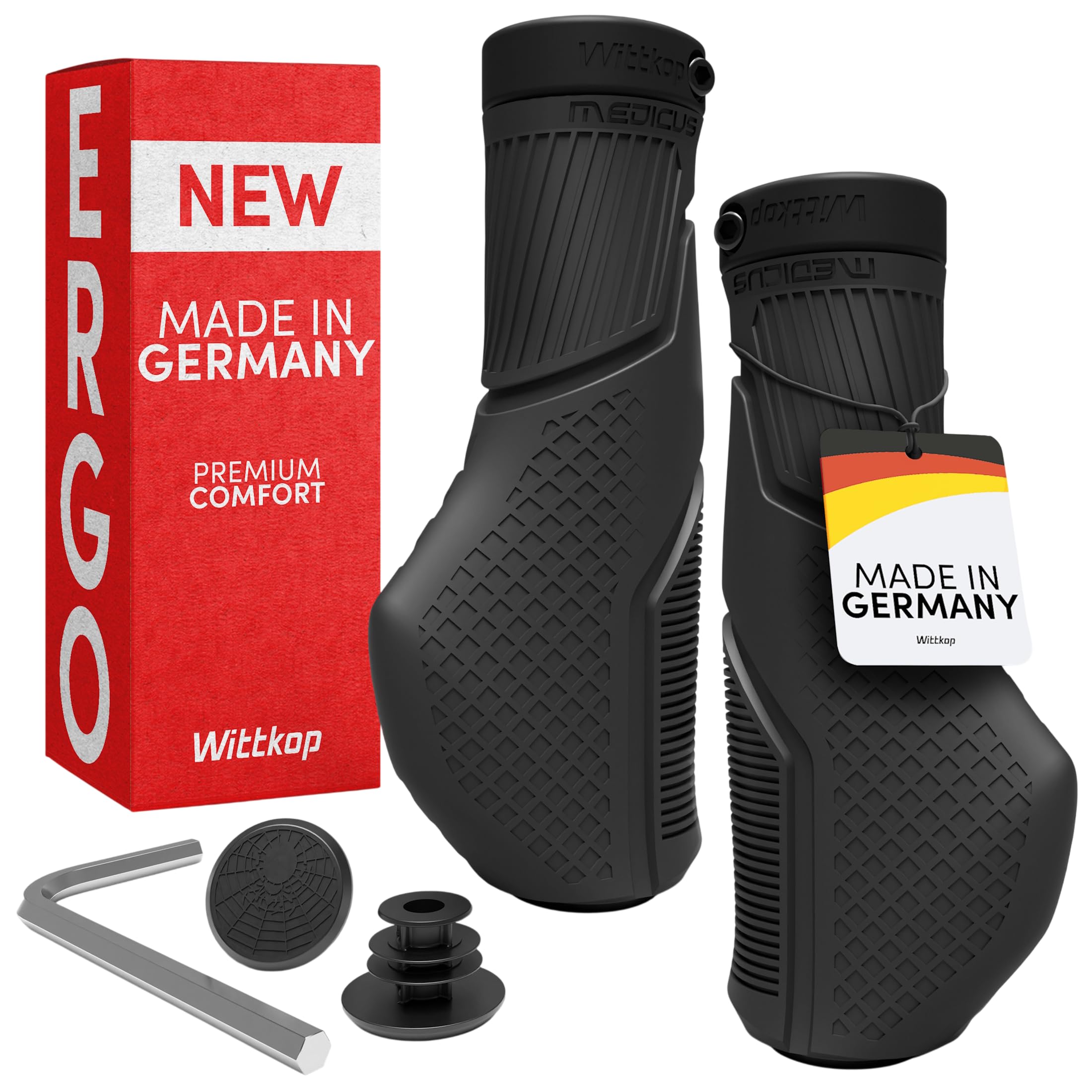
If the Ergon name is what's been keeping you off a winged grip, the Wittkop is the cheaper way in. It does the same basic job — a raised platform supporting the palm — in a German-made grip that undercuts the Ergon alternatives.

The 3-zone design splits the surface into a non-slip area under the fingers, a softer comfort zone, and an EFC zone at the outer edge. It feels firmer in the hand than silicone and more shaped than a round grip, and we found the rubber has enough flex to take the sting out of a rigid bar. It comes in medium, and the Allen key is in the box.

Setup matters more than with a round grip: the platform has to sit under the palm, not across it, so roll it until the flat lands where your hand naturally rests. Once it's right, the rubber is bonded to a hard inner core and doesn't twist on the bar.

Where the Wittkop gives ground is precision. The platform is shaped rather than fitted to your hand, and riders who move around on the bar will find it more restrictive than a round grip. If wrist pain is the reason you're shopping and you want it fixed for less, this is the sensible first stop.

Bottom line: A well-made, cheaper route to palm support — we recommend it to riders with wrist pain who don't want to pay Ergon money.

6

Marque Grapple

Marque Grapple

Budget trail

Our Score 9.2/10
Check Price

Worth Noting

  • Texture wears faster than firmer compounds
Clamp
Single aluminum collar
Length
130 mm
Bar Fit
20–23 mm outer diameter
Material
TPR rubber
Read the full review

Budget grips usually give themselves away with a hard, plasticky feel. The Grapple doesn't. Its TPR rubber is soft and slightly tacky, with microcavities in a slim profile that holds a glove without feeling sticky.

The rest is standard lock-on practice: a single aluminum collar at the inner end, 130 mm of grip, and fitment for bars measuring 20–23 mm across. Installation is a two-minute job with one Allen key, and the end plugs seat deeper than most, so a bar-end dig into dirt doesn't punch them straight out.

Rubber this soft has a lifespan, and the Grapple's is shorter than the firmer grips here — the texture smooths out with hard, regular use well before the grip itself fails. We think the trade is fair at the price, because you aren't giving up trail feel to save money. It's the pick for a first upgrade, a second bike, or anyone who replaces grips every season anyway.

Bottom line: The budget pick we're happiest with: soft TPR, a collar that locks, and a real upgrade over stock for very little money.

7

Funn Hilt

Funn Hilt

XC racing

Our Score 9.2/10
Check Price

Worth Noting

  • Thin cushioning on long descents
  • Compound wears within a season or two
Clamp
Single lock-on
Length
5.12 in
Weight
3.39 oz
Bar Fit
22.2 mm inner diameter
Read the full review

Ninety-six grams a pair puts the Hilt among the lightest lock-ons here, and the profile matches: slim, 5.12 in long, with a surface that feels tacky rather than squishy under the hand.

For cross-country and any build where grams matter, that's the appeal. The single clamp is simple and secure, the end is closed so you don't need bar plugs, and there's enough bite that gloves aren't mandatory. We like that the grip stays firm — this is a grip you feel the trail through, not one that muffles it.

The trade is cushioning and wear. Slim means less material between your palm and the trail, which is fine for an hour of XC and less welcome on a long descent, and the soft compound shows its age within a season or two of regular rocky riding. Budget for replacement and it's still good value for a light, direct-feeling grip.

Bottom line: For XC and gram-counting builds, the Hilt is the light lock-on we point to, with a direct feel and a short service life.

8

corki Double Lock-On

corki Double Lock-On

Spare bikes

Our Score 9.2/10
Check Price

Worth Noting

  • Rubber goes sticky and breaks down with age
  • Clamp bolts strip if overtightened
Clamp
Double lock-on
Length
130 mm
Weight
110 g per pair
Bar Fit
20–22 mm outer diameter
Read the full review

Two clamps on a grip this cheap is the reason the corki is here. Most budget grips give you one collar; these have a lock ring at each end, which spreads the clamping force and means the grip isn't relying on a single bolt to stay put.

The dimensions are conventional — 130 mm long, 110 g a pair, sized for bars measuring 20–22 mm — and the TPR rubber has a soft, slightly springy feel that takes the edge off trail chatter. Colors are loud and plentiful, which matters if you're matching a frame.

What you don't get is longevity. The rubber is the weak point: it can go sticky and start to break down with age, and the clamp bolts are soft enough that a heavy hand on the Allen key can strip them. Treat them gently, check the grip by twisting rather than by adding more force, and they'll do a job.

We see these as a spare-pair grip — the set that lives on the second bike or the build you're still piecing together — rather than the one you put on a bike you ride hard every weekend. At this price, that's a fair role.

Bottom line: We keep these as a spare-pair pick: twin clamps for very little money, provided you go easy on the bolts and expect the rubber to age.

How We Tested Mountain Bike Grips

We started with a shortlist drawn from rider forums, shop recommendations, and spec sheets, then narrowed it to 14 sets that covered lock-on and slip-on designs, common diameters, and a range of rubber textures. Over six months, I rotated those grips onto my trail bike and rode them on local rocky singletrack, repeated muddy morning laps, and a few bike-park weekends. My team also swapped them onto a second bike so we could compare back-to-back on the same climb and descent.

Before each install, I emptied the box and counted every plug, bolt, and clamp, noting any missing parts before I touched the bar. We timed how long each set took to fit, whether it slid on dry or needed soapy water, and whether lock-on collars snugged down without slipping. Then we rode—bare-handed on dry days and gloved in the wet—paying attention to whether the grip felt secure or greasy once mud and sweat built up.

Comfort showed up on longer rides: we noted when hands started tingling, where pressure points formed, and whether a thicker profile quieted chatter or felt vague. Durability got checked every few weeks for wear at the thumb shelf, polished spots, or torn edges. We also mounted every color option we could get and looked at how scuffs showed up, because a grip that looks sharp on the bike can look tired after one muddy month.

How to Choose Mountain Bike Grips

Lock-On or Slip-On

Lock-on grips use one or two aluminum collars to pinch the bar, so they go on and come off with an Allen key and won't rotate once snug. Slip-on grips, usually silicone, rely on friction and a splash of alcohol; they're lighter and more compliant, but they can creep in the wet and tear in a crash.

Choose lock-on if you swap bars, travel with the bike, or ride wet roots a lot. Choose slip-on if maximum damping matters more than convenience. One trap: a collar won't save a greasy bar, so wipe the clamp area clean before you fit anything.

Diameter and Hand Size

Grips here run from 30 mm to 34 mm, and the right one is the size your hand can close around, not the biggest you can buy. A larger diameter spreads load across the palm and helps with cramping; go too large and your fingers can't wrap it, which makes arm pump worse rather than better.

Test it on the bike you have: if your fingertips dig into your palm, size up, and if your hand feels stretched open, size down. The PNW Loam's choice of a 30 mm Regular or 34 mm XL is the clearest example of a maker getting this right.

Round or Winged

A winged grip adds a platform under the heel of the palm, which is the shape that helps when pain arrives after an hour of seated climbing. It also holds your hand in one spot, and riders who shift around on technical descents tend to notice that restriction.

Round grips suit riders who move their hands; winged grips suit riders with wrist or palm pain and a fairly consistent position. Wing angle is adjustable, so set it under your palm before you decide the shape isn't for you.

Compound, Wear, and Price

Soft, tacky rubber feels wonderful and wears quickly; firmer compounds last longer and transmit more buzz. Silicone damps best and tears most easily. A soft compound is not a durability upgrade, so don't read a plush feel as a sign you'll get extra seasons out of a set.

None of these grips is a lifetime purchase in the way a stem is, and a set that lasts a couple of seasons of regular riding is doing well. Paying more buys consistency and better clamp hardware, not more grip.

Frequently Asked Questions

Final Verdict

For most mountain bikers, the PNW Loam is the grip we recommend. Pick the 30 mm if you want a slim, familiar feel and the 34 mm if your hands cramp or you wear XL gloves; the tacky compound and the lifetime warranty cover everything else.

If vibration is the enemy rather than fit, the ESI Chunky damps chatter better than anything else here, provided you accept a slip-on fit and a silicone sleeve that can tear. Riders whose wrists ache on long descents should start with the Ergon GA3 instead.