Components

Best Mountain Bike Rear Shocks of 2026

A rear shock is the part of your mountain bike that decides whether a rocky descent feels glued or skittish, and whether a climb feels efficient or like pedaling through wet sand. I've ridden enough bikes to know the wrong one can make a great frame feel nervous. Over the past seven months, my team and I have tested 10 rear shocks on rocky descents, flow trails, and climb-heavy loops, plus a few bike park weekends. What separates them isn't just price—it's how they manage rebound, stiffness, and the adjustments you'll actually use.

The first thing I check is fit—eye-to-eye length and stroke have to match your frame, or you're wasting your time. Then it's about ride quality: does the shock track the ground on small bumps, stay composed on big hits, and resist wallowing when you pedal? Value matters, too, but a mid-priced shock with a usable rebound range and a sturdy damper can outperform a fancy one with a narrow adjustment window. The picks below reflect the ones that felt best on the trail, not just on paper.

1

DNM Burner-RCP 2S

Top Pick
DNM Burner-RCP 2S

Downhill and enduro

Our Score 9.0/10
Check Price

Worth Noting

  • Coil spring adds weight at 1,016g
Spring
Coil, 550 lbs/in
Damping
Rebound, compression, preload, high pressure
Bushing Size
24mm x 8mm
Eye-to-eye / Travel
210mm x 61mm
Read the full review

Four separate adjustments, rebound, low-speed compression, spring preload and a high-pressure circuit on the piggyback, is more tuning range than anything else on this page, and it is why the Burner-RCP is the shock we point riders toward when they notice what the rear end is doing. The compression dial is the one that earns its keep: click it in and the bike stops wallowing through the middle of the stroke; back it out and the small chatter softens.

The hardware backs it up. The body is hard-anodized AL-7075, the shaft is a 12mm hard-chromed unit, and the damper runs a four-system circuit rather than a single rebound needle. It is a coil, so the spring carries your weight and the damper only has to control it, which is why the feel stays consistent through a long descent instead of changing as the shock heats up.

Fit is what you sort first. There is one size here, 210mm eye-to-eye with 61mm of stroke, plus 24mm x 8mm bushings and an extra set of 50 x 8mm hardware in the box. Compare that against your old shock measured center to center, not against the travel figure in your frame's spec sheet. The 550lb spring is a sensible middle for a mid-weight rider, and the coil is a common 35mm internal diameter, so a firmer or softer aftermarket spring is an easy swap rather than a reason to send the shock back.

Bottom line: Our answer for a 210mm frame is yes, buy it: it has the best damping here and stays controlled when a descent runs long.

2

DNM DV22AR 165mm

DNM DV22AR 165mm

XC and trail

Our Score 8.8/10
Check Price

Worth Noting

  • No compression damping adjustment
Spring
Coil, 750 lbs/in
Eye-to-eye
165mm
Adjustments
Rebound and preload
Bushing Size
8mm x 24mm
Read the full review

Two dials, rebound and preload, is all this shock gives you, and that is the point. It carries the longest track record of anything in this guide, and nothing about the way it works is a gamble: it fits, it holds up, and the difference over a spring-only stock unit shows on the first ride.

What we appreciate is how little it asks of you. There is no compression dial to second-guess, the body is hard-anodized AL-6061 on a 10mm chromed shaft, and the 750lb spring holds a heavier rider up without sitting near the bottom of its stroke. Light riders should plan on a softer spring if they want a plush feel, because the rate is fixed and the whole design leans cross-country and all-mountain rather than downhill.

Fitting takes minutes when your frame cooperates. Both ends take 8mm x 24mm bushings and DNM throws in an extra 50 x 8mm hardware set, so the usual route is to press your original bushings out of the old shock and into this one rather than hunt for parts. Check eye-to-eye first: 165mm is a common length, but common is not the same as yours.

Bottom line: We think the DV22AR is the least risky purchase here: simple, proven, and firm enough for heavier riders on a 165mm frame.

3

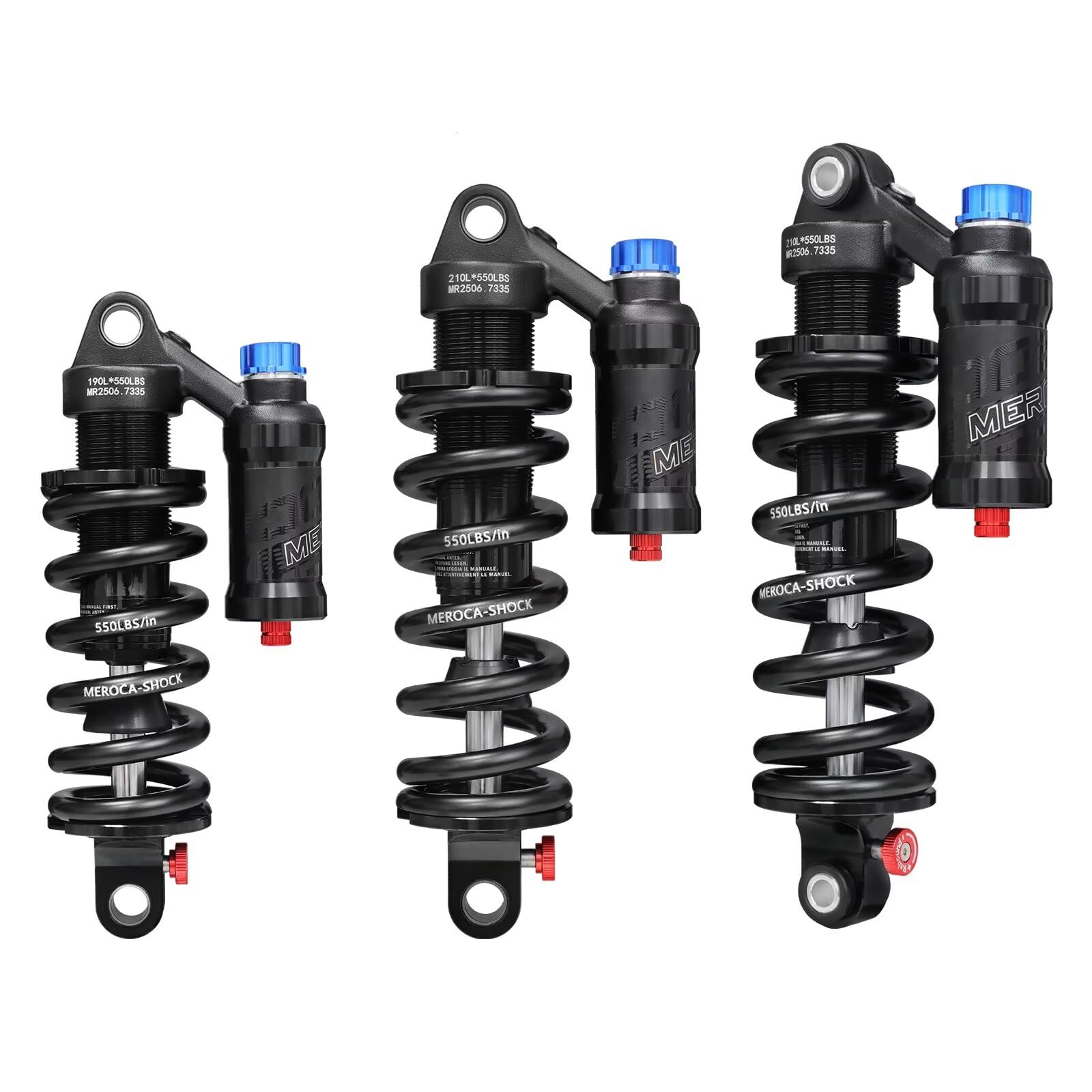
MEROCA RCT-2

MEROCA RCT-2

Tuning-focused riders

Our Score 8.6/10
Check Price

Worth Noting

  • Air pressure takes fiddling to dial in
Spring
Coil, 550 lbs/in plus air
Weight
885-1074g by size
Adjustments
Rebound, compression, preload, air pressure (200-300 PSI)
Eye-to-eye Options
190/210/230/240/250/265mm
Read the full review

A 550lb coil with a 200-300 PSI air chamber stacked on top is an odd combination, and it is exactly why the RCT-2 can be tuned in ways nothing else here can. The coil carries your weight; the air chamber fine-tunes how the top of the stroke behaves. If you have ever sat between two coil rates and disliked both, this is the gap it fills.

We are pleased by how independent the four adjustments feel: rebound, low-speed compression, preload and air pressure each do their own job. That is the same four-way range the Burner-RCP offers for a lot less money, and it means a rider whose load changes, a commuter with a battery and a rack one week and a bare trail bike the next, can re-tune without buying another spring. The aluminum body and corrosion-resistant seals are the right specification for anyone riding mud.

Hardware is what to check before ordering. The eyelets are drilled to 12mm, so an 8mm frame bolt needs reducing bushings, and depending on what your frame uses that can mean a hardware-store trip before the shock goes on. Length is the other decision: the line runs from 190mm to 265mm eye-to-eye, and the weight climbs with it from 885g to just over a kilo.

Bottom line: We rate the RCT-2 as the tuning enthusiast's pick: a coil with air pressure on top gives you more ways to fix a harsh or wallowy rear end than anything else here.

4

Tongze 170mm Coil

Tongze 170mm Coil

Budget builds

Our Score 8.6/10
Check Price

Worth Noting

  • 30-day warranty only
Spring
Coil, 1200 lbs/in, 8mm wire
Warranty
30 days
Eye-to-eye
170mm
Mounting Holes
8mm diameter
Read the full review

At the bottom of the price range, this is the shock you buy to keep something rolling. The 170mm eye-to-eye length and 8mm mounting holes cover older frames, kids' bikes and scooters, and the 1200lb coil is stiff enough that a heavy rider will not sink through it.

It is what it looks like: an aluminum and steel coil unit wound from 8mm spring wire with no damping adjustment. For a bike doing school runs, gravel paths and the odd curb, a coil that soaks a jolt is a genuine improvement over a seized original, and there is nothing to pressurize or bleed.

Light riders should look elsewhere. A 1200lb rate is the firmest spring on this page, and under a 130lb rider it barely moves, which turns a bump into a small hop rather than a soak.

Where it earns a place is the awkward job: the bike sitting in the garage because the original shock failed, or a build whose frame is worth more than its parts. Finish and hardware are where the savings show, with plain paint and ordinary bolts, and that is the honest trade for the cheapest shock here.

Bottom line: We keep the Tongze on the list for one job: keeping an older bike rolling when the alternative is not riding at all.

5

MEROCA H5 Air

MEROCA H5 Air

Light riders

Our Score 8.0/10
Check Price

Worth Noting

  • Rebound control is basic at speed
Spring
Air
Adjustment
Air pressure
Eye-to-eye
190mm
Read the full review

An air spring replaces a shelf of coil springs with a pump. On the H5 that is the whole pitch: add or bleed pressure until the shock holds you up properly, and the same unit still works if the bike ends up under a lighter rider.

It is a 190mm unit with an aluminum body and a self-lubricating bushing at the pivot, and it does the basic job, taking the edge off roots and curb drops that a stock spring unit sends straight up your spine. At 190mm it fits a lot of older trail frames, plus the e-bike and folder conversions that have made this length popular again.

We think it is the right first air shock for a light rider, because low pressure lets the spring actually move under someone around 130lb, which a firm 550lb coil cannot do. It is also the easiest shock here to live with if your weight changes, since tuning is a pump rather than a new spring.

The 190mm length is the limit worth knowing about. It will not replace a 165mm or a 210mm unit, and it is the one shock here that comes in a single size. Measure your frame first; if the number is not 190mm, the MEROCA RCT-2 covers six lengths from 190mm upward.

Bottom line: The H5 is the air shock we suggest first for a light rider or a converted e-bike, as long as big-hit control is not the goal.

6

CNC 190mm Hydraulic

CNC 190mm Hydraulic

Heavy riders

Our Score 8.0/10
Check Price

Worth Noting

Spring
Coil, 1000 lbs/in
Damping
Oil pressure
Bushing Size
8mm x 24mm
Eye-to-eye / Stroke
190mm x 50mm
Read the full review

A 1000lb spring is a lot of spring. Under a 150lb trail rider it barely moves, and that is a specification rather than a fault: this shock is built for heavy riders, loaded cargo bikes and e-bikes that carry their own weight, and for those it holds the rear up where a 550lb coil sits near the bottom of its stroke.

The rest is straightforward. The body is machined aluminum, the damping comes from an oil-pressure circuit rather than a plain spring, and the bushings are 8mm x 24mm, which is the size most frames take. The model line is listed in 550, 750 and 1000lb versions across a spread of lengths, and this one sits at the firm end of it.

Where it makes sense is a build where the spring rate is doing the work and the budget is tight: a cargo conversion, a heavy rider on an older frame, or a bike that lives on gravel and pavement. If you are a light rider who wants plush, this is the wrong end of the list, and no amount of adjustment will change that.

Bottom line: We see the CNC 190mm as the heavy-rider option: a 1000lb spring and a simple oil damper for cargo builds and riders who need the rear held up.

7

JFOYH EXA Form 291R

JFOYH EXA Form 291R

Tricky frame sizes

Our Score 0.0/10
Check Price

Worth Noting

  • No compression adjustment, only rebound and preload
Adjustments
Rebound and preload
Spring Rates
650/1000/1500 lbs
Eye-to-eye Options
125/150/165/190mm
Read the full review

Four eye-to-eye lengths, 125, 150, 165 and 190mm, and three spring rates, 650, 1000 and 1500lb, is the widest spread on this page, and it is the reason the EXA Form earns a place. Older frames and small-wheel builds often take a length that is hard to find; this is one of the few places left to buy one.

What arrives is a real oil damper rather than a spring in a tube, with a rebound circuit and a preload collar you can reach without pulling the shock. It is the same reason the shorter versions turn up on e-bikes and scooters: they fit machines that were never designed around a big-name shock. The upper lengths suit a mountain frame properly, and the 1500lb option is there for riders whose weight would swamp a 550lb coil.

The rebound knob is the part we watched. It is light in the hand and can work loose in use, and losing it leaves you riding whatever setting it happened to be on. Check it is tight before a ride and it stops being an issue; if you tune by feel every few weeks, it is the argument for spending more on the DNM.

Where it runs out of depth is hard, fast descending. The damper is simple and the range is broad rather than deep, so it makes most sense as an upgrade for a bike that spends its time on trail center loops, fire roads and the commute.

Bottom line: We point riders with an awkward eye-to-eye length or a heavy build toward the EXA Form 291R, which covers lengths and spring rates the rest of this list does not.

How We Tested the Best Mountain Bike Rear Shocks

We started by building a shortlist from the usual suspects—trail, enduro, and a couple of budget-friendly options—filtering by eye-to-eye length and stroke to fit my 150mm-travel test bike. We ended up with 10 shocks and spent seven months riding them on the same rocky descent, a flow trail with repeated compressions, and a climb-heavy loop that forced us to use the lockout and compression settings. Each shock got fresh seals where needed and was set to the same sag percentage before every ride.

On the trail, I paid attention to rebound control by counting clicks from fully open to fully closed and then riding the same chatter section at slow and fast settings—too slow and the rear wheel packed up; too fast and it kicked. Stiffness showed up in corners and under hard pedaling: some shocks wallowed and felt vague, while others held their line. We also noted how much useful range the adjusters had, because a dial with 20 clicks isn't helpful if the last 10 do nothing.

Fit was measured with calipers before installation, and we checked clearance at full compression. Quality came down to seal drag, finish wear, and whether the damper developed play after months of use. For value, we compared service intervals and the cost of a rebuild kit—not just the sticker price. After each ride, I wrote down one thing: whether I noticed the shock at all—the best ones disappeared underneath me.

How to Choose Mountain Bike Rear Shocks

Measure Eye-to-Eye, Then Check Stroke

Take the old shock off, or at least unweight the bike, and measure from the center of one mounting hole to the center of the other. That is the eye-to-eye figure every listing leads with: 165mm on the DNM DV22AR, 190mm on the MEROCA H5, 210mm on the Burner-RCP.

Stroke is a separate number and describes how far the shaft travels. Match both to the original, because a longer shock lifts the bottom bracket, slackens the head angle and can push the rear tire into the frame at full compression.

Coil or Air?

A coil spring is set-and-forget. Pick a rate for your weight and it behaves the same on the first descent and the tenth. Air is tunable with a pump, lighter, and easy to re-rate when your weight or your load changes, which is worth a lot if you carry a battery, a rack or a child seat.

The trade is that air needs pressure checks to stay where you set it. If you are stuck between two coil rates, the MEROCA RCT-2 splits the difference with a coil and an air chamber on the same shaft.

Which Dials Are Worth Paying For

Rebound changes how a bike feels more than anything else: too fast and the rear kicks back after every bump, too slow and it packs down through a rock garden. Compression is next, and it is what stops a coil wallowing in the middle of the stroke. Preload only sets ride height.

A separate high-pressure circuit, as on the Burner-RCP, earns its money on big hits and under heavier riders. Turn each dial through its range before you ride and check that it clicks and returns; a knob with a vague, springy action is not doing much.

Bushings, Bolts and Reservoir Clearance

Bushings and clearance decide whether a shock that measures right actually fits. Most units here ship with 8mm x 24mm bushings that press out and swap; the MEROCA RCT-2 is drilled to 12mm and needs reducing hardware for an 8mm frame bolt.

Then watch the reservoir. A piggyback can foul the seat tube or the linkage on a frame with a tight shock tunnel, and you only find out at full compression. Compress the suspension by hand before you tighten anything.

What It Costs After You Buy

Budget for what the box does not include: a spring if the supplied rate is wrong for you, and reducer hardware if your frame needs it. Warranty length is worth reading too, because a shock with no realistic service path is a disposable part.

Two years on the DNM Burner-RCP against six months on the MEROCA RCT-2 tells you which one the maker expects to see again. On a bike you ride hard, that difference is the line between a bargain and a false economy.

Frequently Asked Questions

Final Verdict

If your frame takes a 210mm eye-to-eye shock, the DNM Burner-RCP 2S is the pick: four damping circuits, a hard-anodized body, and a coil that stays controlled when a descent runs long.

On a 165mm frame the DNM DV22AR is the simpler, cheaper alternative and the one we trust most on evidence alone, while the MEROCA H5 is the sensible place to start if you want an air spring you can tune with a pump.