Components

Best Mountain Bike Saddles of 2026

Every saddle feels fine in the parking lot. The test comes at mile 20, when you've been on the same patch of foam for an hour and it starts relaying every root through your sit bones — bruising, numbness, chafing, pressure in exactly the wrong place. A mountain bike saddle is one of the least expensive changes you can make to a bike, and the right one turns a ride you were enduring into one you're enjoying. That's why I spent five months riding 12 of them on the same trails.

Here's what nobody tells a first-time buyer: padding is not the same as comfort. A thick, pillow-soft saddle often feels great in the shop and turns into a pressure point by hour two; shape and width do far more for you than another half-inch of foam. My team and I logged every ride, including wet days when the bike went on the garage trainer, and the saddles that won were the ones we stopped noticing. They're below, sorted by who each one suits.

1

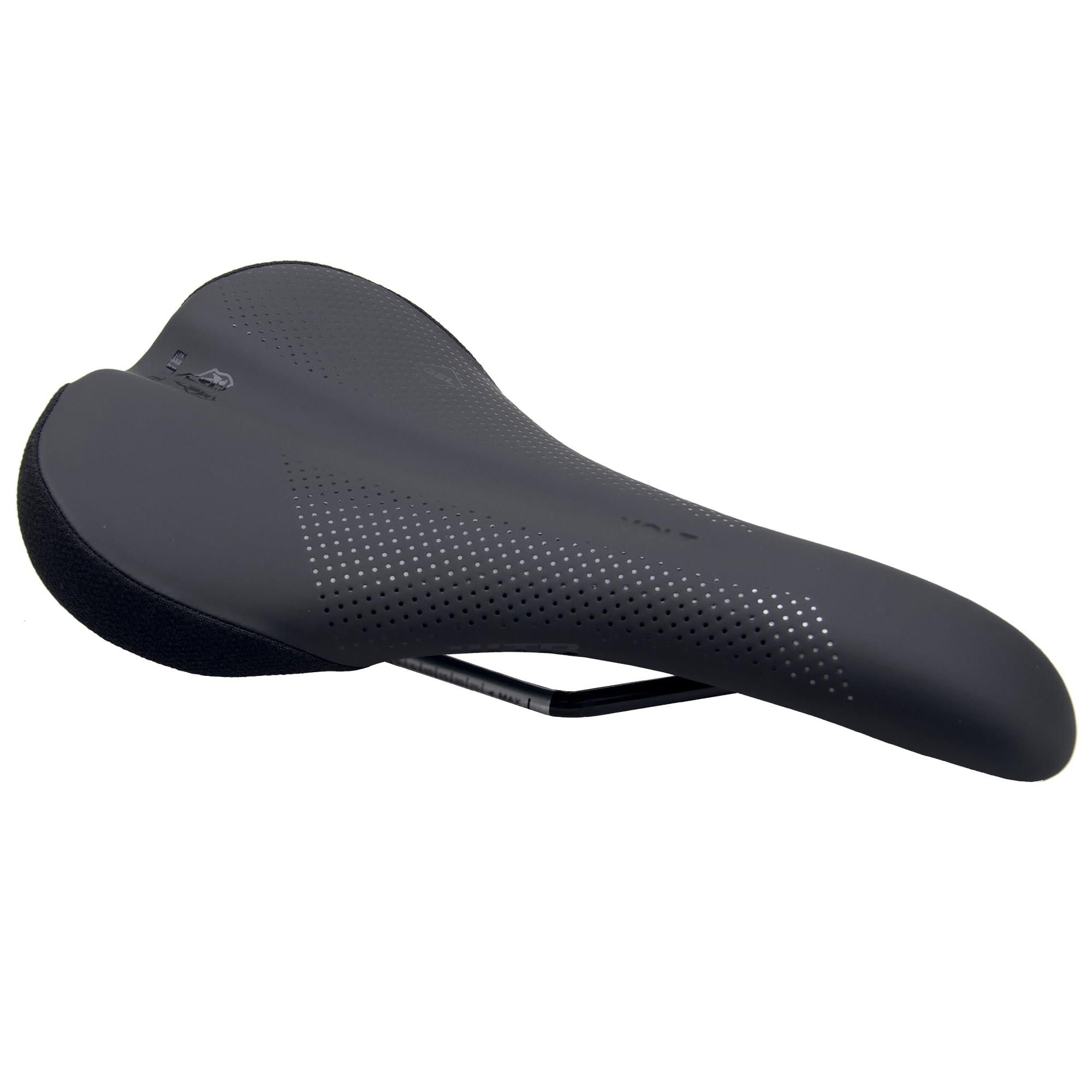
WTB Volt

Top Pick
WTB Volt

Trail riding

Our Score 9.4/10
Check Price

Worth Noting

  • Firmer foam than riders expecting a plush seat
Weight
11.1 oz
Widths
Three widths
Padding
Medium DNAx foam
Pressure Relief
Cutout plus center channel
Read the full review

Three widths is the reason this is our default. WTB builds the Volt in narrow, medium and wide, and matching the shell to your sit bones changes more about the ride than any padding upgrade: when the platform sits under the bony points instead of beside them, you pedal instead of squirm. Almost every other saddle here comes in one size and asks you to hope.

It's a trail saddle first and a comfortable one second. Medium-thickness DNAx foam sits over a shell with a cutout under the soft tissue and a channel running from the rear to within about 50 mm of the nose. At 315 g on steel rails it's light enough to forget about on a climb, and the microfiber cover has just enough grip to keep you planted when the trail tilts down and you shift your weight back. WTB rates it to 265 lb and covers it for two years.

What we noticed over a few weeks of trail riding is how rarely we thought about it, which is the compliment a saddle should earn. The profile is flat enough to slide forward on a steep climb and long enough to move back on a descent, and the grip in the cover makes that movement deliberate rather than a slow slide. Pressure relief is where the design pays off on long seated climbs.

For a single saddle on a single trail bike, this is the one we fit. It isn't the cheapest thing here, but the width options, the cutout and the foam add up to the least risky purchase in the group. Order the size that matches your sit bones, ride it for a month, and change the width before you change the saddle.

Bottom line: Our default trail saddle: three widths let you buy to your sit bones, and the cutout, grippy cover and supportive foam handle everything from fire-road climbs to rocky descents.

2

Ergon SM Pro

Ergon SM Pro

XC and racing

Our Score 9.2/10
Check Price

Worth Noting

  • Priciest saddle in this guide
Rails
TiNox
Width
5.83 in
Weight
14.1 oz
Max Rider Weight
220 lb
Read the full review

The sides of this saddle are finished so your inner thighs slide rather than rub, and that's the detail we didn't expect to care about. Ergon calls them friction-reducing flanks. On a long climb, with your knees tracking close to the top tube, there's a real difference between a cover that grabs at your shorts and one that lets them pass.

The rest of it is a race saddle: a nylon composite shell, TiNox rails, a microfiber cover and orthopedic AirCell foam with OrthoCell pads, at 400 g and rated to 220 lb. It's firm and purposeful rather than cushioned, and the reward is a platform you can push against when you're driving hard on the pedals. For cross-country pace and riders who shift around on descents, it's the one we fit first from this group.

What it won't do is cosset you. Sit upright on a fire-road grind with all your weight going straight down and the shape feels uncompromising; the Volt's broader platform is kinder there. The SM Pro is built for a forward, aggressive position where you're on the pedals as much as the saddle, and that's exactly the rider it serves.

Bottom line: For riders who pedal hard and move around, the friction-reducing flanks, firm race shell and light rails justify the highest price in this group.

3

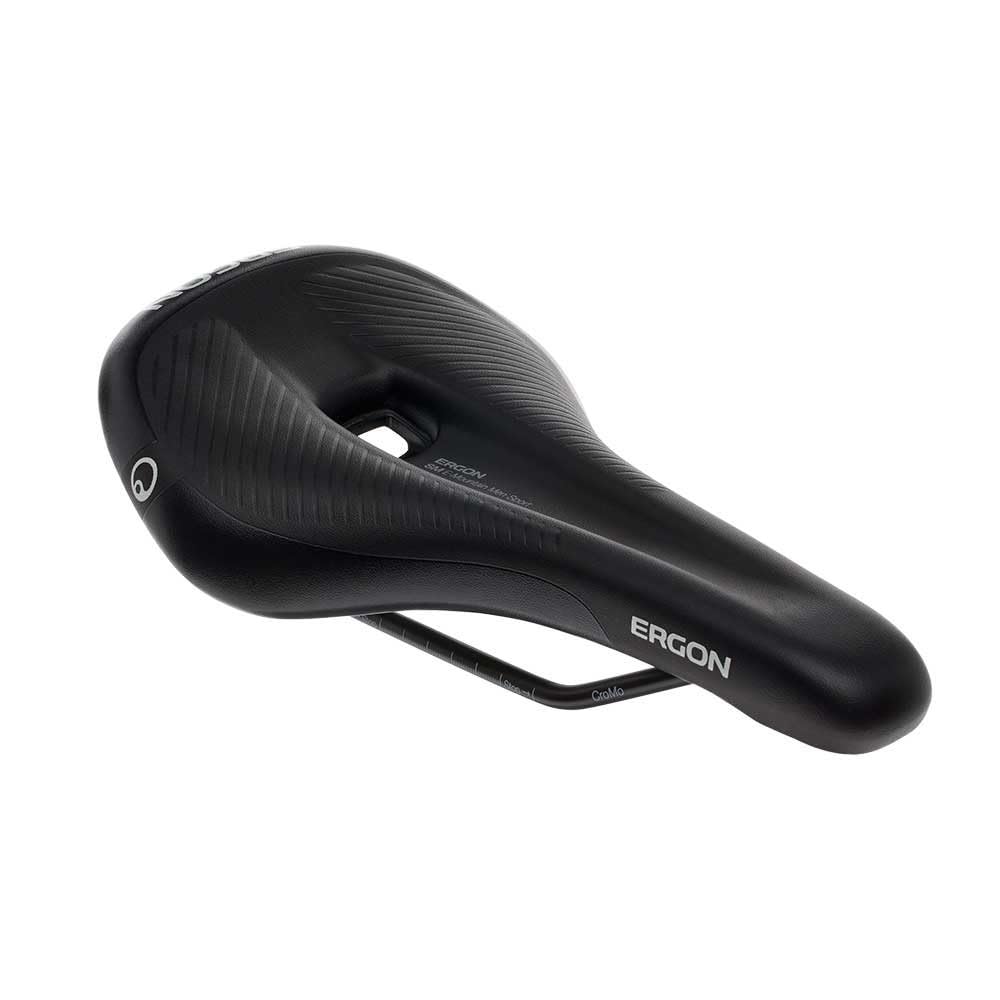
Ergon SM E-MTB Sport

Ergon SM E-MTB Sport

Steep seated climbs

Our Score 9.2/10
Check Price

Worth Noting

  • Wide shell can catch the inner thigh when descending
Cover
Microfiber
Width
7.48 in
Weight
14.1 oz
Padding
OrthoCell comfort foam
Read the full review

Ergon built this one for climbing that keeps you in the saddle: long, steep and grindy. The rear of the shell rises and cups, so when your weight tips back on a loose pitch there's something to push against, and the shape is wide enough to carry your sit bones while you keep turning the pedals.

At 7.48 inches it's the widest saddle we're recommending for trail use, with orthopedic comfort foam, OrthoCell inlays and a microfiber cover at 400 g. The padding is softer than the SM Pro's, which suits a saddle you sit on rather than hover over. For e-MTB riders and anyone whose local trails are mostly up, it's the most comfortable way to spend a long seated climb in this group.

A motor changes the arithmetic. On an e-MTB you stay seated and pedaling through terrain you'd normally stand for, which is precisely when the extra width and the softer foam stop being compromises and start being the point.

Bottom line: For e-MTB riders and steep, seated climbs, the wider shell and softer foam make long grinds comfortable in a way the race saddles here don't.

4

Charge Spoon

Charge Spoon

Mixed riding

Our Score 9.2/10
Check Price

Worth Noting

  • Narrow profile won't suit wider sit bones
Rails
CrMo
Weight
12 oz
Padding
High-density foam
Pressure Relief
Center channel
Read the full review

The Spoon is the saddle we suggest when someone wants a real trail saddle without paying premium prices. It's been in the range for years, the dark brown faux leather looks a good deal better than it costs, and the shape is the one we come back to when a bike needs a saddle that just works.

Under the stitching it's a CrMo-railed saddle with high-density foam, a pressure-relief channel and a slim profile, at 12 ounces. The slimness is the point: enough padding to take the edge off roots, not so much that you sink into it, and a narrow waist that lets your thighs move without catching. We found the firmness sits right in the middle, soft enough for a two-hour ride and firm enough to push against on a climb.

It's also the pick for a mixed fleet. The Spoon has been at home on road bikes, cross bikes and hardtails alike, so if you're fitting one saddle to a bike that does commutes and trail sessions, it's a low-risk answer. The cover has held up well on the bikes we've run it on, and it still looks like a saddle rather than a worn-out sponge.

Bottom line: A slim, firm, good-looking all-rounder that suits road bikes and hardtails alike, and costs less than most of the trail saddles here.

5

Moocci MTB Gel Saddle

Moocci MTB Gel Saddle

Short rides

Our Score 9.2/10
Check Price

Worth Noting

  • Bulkier and heavier than a trail saddle
Size
11.02 x 6.3 in
Weight
1.19 lb
Padding
Gel and foam
Pressure Relief
Hollow center
Read the full review

Gel sounds like more comfort, and on a cheap saddle it's usually a lot of soft material exactly where you want support. The Moocci gets closer to right than most bargain seats: the gel sits over high-density foam rather than replacing it, and the middle is hollowed out instead of padded solid.

The rest is sensible. It runs 11.02 inches long and 6.3 inches wide, with dual stainless steel rails and a waterproof cover over a hollow centre shaped to move air as well as pressure. The waterproofing earns its keep more than you expect, since you can hose the bike down after a muddy ride without a second thought about the saddle.

Where it earns a place is cushioning for the money. If your rides run under an hour, mostly on smooth trail or gravel, and the saddle on your bike is a plank, this is the cheapest fix here that still has a real cutout in the middle. Past that, the money is better spent on shape than on more soft material.

Bottom line: A soft, waterproof gel saddle for short rides and smooth trail, where the low price and the cutout matter more than weight or a racy shape.

6

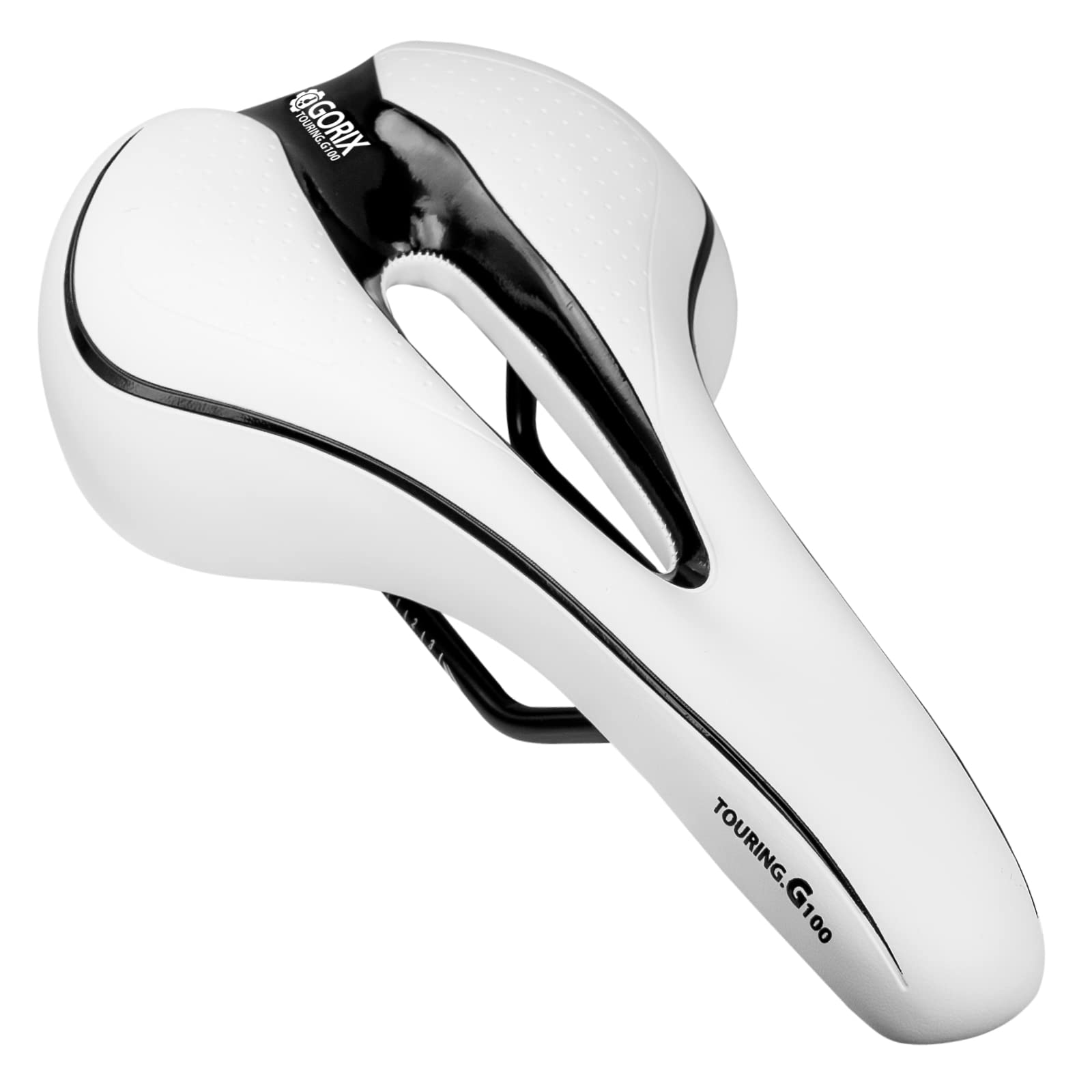
GORIX GX-C19

GORIX GX-C19

Budget trail

Our Score 9.0/10
Check Price

Worth Noting

  • Soft platform feels vague on rough descents
  • White and light colorways arrive off-shade or fade
Size
10.8 x 5.9 in
Weight
0.7 lb
Padding
Gel
Pressure Relief
Center hole
Read the full review

If you haven't measured your sit bones and you don't want to spend much finding out, the GORIX is a sensible place to start. It's one of the cheapest cutout saddles here, it comes in twenty-four colorways, and it's the kind of seat that turns up on a lot of first mountain bikes.

The shape is a classic all-rounder: 10.8 inches long, 5.9 inches wide, 0.7 lb, with a gel pad over foam, steel rails and a hole through the middle. That hole is the part that matters on a longer ride, and at this width the saddle suits riders who sit fairly upright rather than stretched out.

What we found is a saddle that's softer than the trail-focused picks here without turning into a couch. The padding is moderate rather than deep, so you don't wallow in it, and the cover has enough grip to stop you sliding forward on a climb. The colorways are the other draw, since it's one of the few saddles here you can match to a frame, though the white option arrives closer to off-white and the lighter shades fade after a season in the sun.

For commuting, green trails and a first season of mountain biking, it's hard to argue with. It's a saddle to learn what you like on, not the one you'll keep forever, and the cutout means the lesson doesn't cost you any comfort along the way.

Bottom line: The budget starting point: a cutout, moderate gel padding and two dozen colorways for riders who want comfort without measuring sit bones first.

7

ROCKBROS Memory Foam Saddle

ROCKBROS Memory Foam Saddle

Beginners

Our Score 9.0/10
Check Price

Worth Noting

  • Heaviest saddle here at 0.78 kg
Size
10 x 7.5 in
Weight
1.72 lb
Padding
Memory foam
Max Load
220.5 lb
Read the full review

Two mounting options, a 6 mm Allen key and an open-end wrench in the box: the ROCKBROS is aimed at someone who wants to swap a saddle in the driveway and get riding. Between the rail mount and the clamp-tube mount it fits more posts than a rail-only saddle does, which is why we've seen it on some odd older bikes.

What sits on top is a 10 by 7.5 inch platform of thick memory foam under a waterproof PU cover, rated to 100 kg, over a shock-absorbing base. The foam is genuinely plush, softer than anything else here, and it does what foam is supposed to do on a bike that spends its life on flat ground.

As a first upgrade it works. If you've just bought a hardtail and the stock perch is ruining your weekends, this fixes the immediate problem for very little money. The platform is wide and the foam is soft, and both of those are the boundary of what it's for: fit it to a bike that does fire roads, school runs and the occasional green loop, and it does everything you ask.

Bottom line: A cheap, plush first upgrade for a hardtail that never sees technical ground — the mounting hardware and soft foam do the work, and the weight is the trade.

How We Tested 12 Mountain Bike Saddles

We started with spec sheets, not saddles. I pulled the measurements for more than 60 mountain bike saddles, compared available widths, rail material, cover construction, and overall shape, and crossed off anything that hid its dimensions, came in only one size, or looked overpriced for how it was built. Twelve made the cut, and each spent at least three weeks bolted to the same trail bike over five months of riding.

Testing happened where saddles actually live: rocky, rooty singletrack where you're in and out of the seat constantly; long fire-road grinds where you don't stand for 20 minutes; a dusty late-summer stretch that had every cover crunching; and rainy-week trainer sessions in the garage when the trails were closed. I rode each one in the same pair of shorts, on the same bike, at the same tire pressure, and logged every ride so the comparison stayed fair.

Comfort was judged by behavior, not by how a saddle felt in the driveway — how often I slid forward or back, whether I stood on climbs I'd normally sit through, and whether anything went numb past the two-hour mark. I pressed a thumb into each saddle to gauge foam depth, then squeezed the shell to see how much it flexed; soft foam over a stiff base is usually what leaves you bruised. Width and shape got matched against sit-bone measurements, with notes on where pressure landed during long seated climbs. After every ride I checked covers for scuffs and pulled stitching, listened for creaking rails, and by month five could see which ones were starting to sag. Appearance counted too — dust and sun dull a cheap cover quickly.

Value came down to what the money actually buys: rail material, cover quality, and whether the shape comes in the width you need. None have been retired yet; the survivors are still on bikes.

How to Choose Mountain Bike Saddles

Width comes before padding

Your weight should land on the two bony points you can feel when you sit on a hard chair, and the saddle's job is to put a platform under them. Too narrow and the soft tissue in between carries the load; too wide and the wings rub the inside of your thighs with every stroke. Measure by sitting on corrugated cardboard with your knees up and reading the two dents, then add about 20 mm for a trail position. A model sold in several widths, like the WTB Volt, lets you correct a bad guess without changing saddles.

The trap is the wide comfort seat. It feels wonderful in the parking lot and wears a groove in your inner thigh by mile ten, because a saddle that broad holds your legs apart while you pedal.

Look for a channel that reaches the nose

A cutout isn't a hole for its own sake; it takes pressure off the soft tissue and the nerves running through it. Where it runs matters as much as whether it exists. A relief channel should continue forward toward the nose, because that's where you sit when you're climbing with your hips rotated forward, and a hole that stops halfway does nothing in that position. WTB takes the Volt's channel to within about 50 mm of the nose tip, while the budget options here put a hole through the middle instead. If your problem is numbness rather than surface soreness, prioritise this over padding.

Foam or gel, and how much is enough

Foam supports and gel cushions, and they aren't interchangeable. A thick gel layer feels superb for the first ten minutes and then compresses, leaving you on the shell with a wider, vaguer platform underneath. For rides that run past an hour, medium-density foam over a shaped shell holds you up better than a soft saddle, which is why the trail-focused picks here carry less padding than the inexpensive ones. Buy gel for short, upright riding and support for everything else; if you only own one saddle, buy support.

Rails, weight and the dropper-post question

Steel and CrMo rails are the durable, inexpensive choice; TiNox and alloy rails save grams on saddles like the Ergon SM Pro. Weight matters but rarely decides anything — a 0.78 kg saddle is fine on a bike that never leaves the path and irritating on one you pedal uphill, though a badly shaped saddle costs you more speed than 400 g ever will. If you run a dropper post, check how tall the saddle body is: a thick foam platform eats travel you paid for, and you notice it when the post is slammed.

Frequently Asked Questions

Final Verdict

The WTB Volt is the saddle we fit first, and the reason is unglamorous: three widths mean you buy to your sit bones instead of guessing, and the cutout, grippy cover and supportive foam handle everything from a fire-road grind to a rocky descent.

Want a slimmer, cheaper classic for a bike that does road and trail? The Charge Spoon is the one. If most of your riding is steep and seated, the Ergon SM E-MTB Sport earns its higher price.