Tools & Maintenance

Best Mountain Bike Shock Pumps of 2026

A shock pump moves thimblefuls of air into a chamber the size of a shot glass, so the gauge and the seal decide whether it's any good — not the stroke count or the machined handle. Most riders learn that the hard way: you thread on a borrowed pump, add pressure, unscrew the head, and the shock ends up softer than when you started because the chuck took a lungful with it. The right pump gets you to a number you trust in a few strokes, lets go cleanly, and hands you your own suspension setup instead of a shop appointment.

Over four months I've had 16 of them in the garage, from bare-bones models to precision-machined showpieces, and I've used them on everything from a 120mm trail bike to a coil-over downhill rig. Some tracked a calibrated gauge within a few psi; one was off by 30. Price and finish turned out to matter far less than an honest reading and a head that seals — the cheaper pumps here beat ones costing twice as much. These are the ones that earned a permanent spot in the hip pack.

1

RockShox High-Pressure 300

Top Pick
RockShox High-Pressure 300

All-around tuning

Our Score 9.4/10
Check Price

Worth Noting

  • Gauge durability is a long-term question
Hose
360-degree swivel
Valve
Schrader
Bleeder
Finger-tap
Maximum Pressure
300 psi
Read the full review

A 300 psi ceiling is the sweet spot for most mountain bike suspension, and RockShox pairs it with the details that matter at the valve: a 360-degree swivel hose and a Schrader head that threads on rather than being held in place. The aluminum barrel feels businesslike, and the finger-tap bleeder lets us take pressure down in small steps instead of dumping a fork's worth of air. That combination is why it is the first pump we hand to a rider who wants one tool for forks and ordinary rear shocks.

On a fork with a recessed valve or a rear shock tucked behind linkage, the swivel does real work; we could angle the hose without fighting the frame. The flip side is that any threaded shock pump can release a puff when you unscrew it, so set pressure, reattach, and confirm before you call it done. We like the simple thread-on head for the same reason: there is no lever to line up and no extra motion while you are leaning over the bike.

Where this pump earns its keep is repeatability. We set a fork, wrote down the pressure, and made a small volume change later without guessing; using the same pump and the same sequence makes that possible. It is small enough to live in a pack for trail-side tweaks, but it is also the one we leave on the bench because it is simple to grab and hard to outgrow.

Bottom line: We recommend the RockShox 300 as the default shock pump for most riders: it covers everyday fork and shock pressures, threads onto crowded valves, and makes small bleeds easy.

2

RockShox High-Pressure 600

RockShox High-Pressure 600

High-pressure service

Our Score 9.4/10
Check Price

Worth Noting

  • Limited warranty coverage
Hose
Swivel
Weight
10.4 oz
Intended Use
RockShox rear shocks, BoXXer World Cup
Maximum Pressure
600 psi
Read the full review

There is a real job for a 600 psi pump, and it is not everyday fork tuning. RockShox specifies it for BoXXer World Cup and for rear-shock service where IFP pressures sit above 300 psi. If that sentence describes your workstand, the extra ceiling is the whole point; if you are setting a trail fork at 80 psi, it is capacity you will never use.

We like the smooth, high-pressure stroke and the fact that the pump can exceed 200 psi without feeling like a workout. The gauge is the compromise: the PSI scale is small next to the bar markings, and we had to lean in to read it at a glance. That is a fair trade for a service pump, but it is not the gauge we reach for when we are changing fork pressure by feel.

The 10.4-ounce body is light enough to hang on a hook, and the swivel hose helps in a crowded rear triangle. This is not the pump to buy for a first mountain bike; it is the one to add when your suspension service routine demands the higher range.

Bottom line: We keep this RockShox pump for rear-shock service and BoXXer work: its 600 psi ceiling reaches pressures a standard pump cannot, and the high-pressure stroke stays smooth.

3

Fox HP Shock Pump 350

Fox HP Shock Pump 350

Tight linkages

Our Score 9.4/10
Check Price

Worth Noting

  • Small gauge is easy to misread
Head
Stainless swivel
Weight
7.2 oz
Bleeder
2-3 psi micro-adjust
Maximum Pressure
350 psi
Read the full review

The first thing to understand about this Fox pump is that the head is the feature. The stainless swivel joint lets the hose meet a shock valve at an angle, which matters when the valve is tucked behind a rocker or a yoke. A fixed hose can work; this one makes the awkward jobs less awkward.

The rest of the package is sensibly sized for suspension work: a 6063 aluminum barrel and handle, a foldable hose, and a 350 psi ceiling that covers Fox DPS and DPX2 shocks at their stated maximum. The two- to three-psi bleed is fine enough for trail-side tuning, and the 204-gram body is light enough to carry without noticing it.

We reach for it first on frames with a rear shock buried behind linkage, because the swivel turns a two-handed fumble into a straight thread-on. The compact body also leaves room to work without knocking the hose against the frame. If your valves are already easy to reach, the Fox is harder to justify; for tight frames, it is the detail that earns its place.

Bottom line: The Fox 350 is the pump we choose when a rear shock is boxed in by linkage: its stainless swivel head reaches awkward valves, and the 2-3 psi bleeder keeps adjustments precise.

4

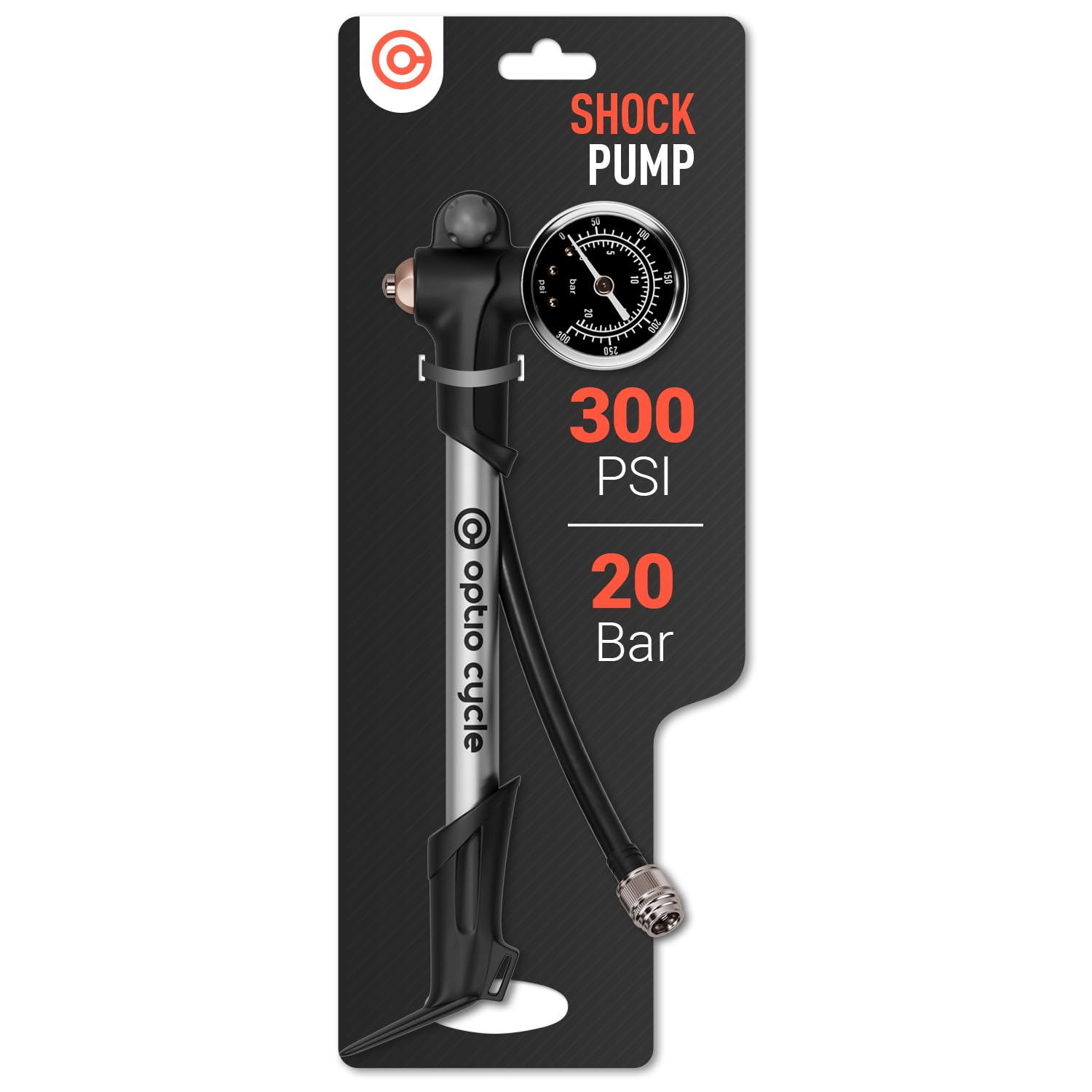
Optio Cycle Shock Pump

Optio Cycle Shock Pump

Compact backup

Our Score 9.2/10
Check Price

Worth Noting

  • Less solid feel than all-metal pumps
Body
Aluminum and plastic
Gauge
PSI and bar
Weight
6.3 oz
Maximum Pressure
300 psi
Read the full review

Optio's shock pump is the simplest kind of answer to a high-pressure problem: a 300 psi barrel, a PSI/bar gauge, and a compact aluminum-and-plastic body that stores easily. It is not trying to be a workshop instrument; it is trying to be the pump you have with you when a fork needs a few more psi before a ride.

The 9.1-inch length and 6.3-ounce weight make it easy to slip into a pack, and the gauge reads in both PSI and bar, which helps if your suspension manual uses one and your pump uses the other. The listed compatibility covers Fox, RockShox, and most MTB suspension forks and rear shocks, so the main question is not fit but whether you want a more substantial pump for frequent service.

We see the Optio as a second pump rather than a replacement for a bench pump. Its light body and compact size suit occasional top-offs, and the 300 psi ceiling covers the usual trail settings. It is the pump we leave in the car or pack for a pre-ride check, not the one we build a service routine around.

For a rider who checks pressure before a weekend ride and wants a gauge without a lot of bulk, that role makes sense. It is less convincing if you are servicing multiple bikes or chasing precise changes every week. In that case, the premium pumps here earn their keep; as a compact, affordable backup, the Optio is easy to live with.

Bottom line: We like the Optio Cycle as a no-drama 300 psi backup: it is compact, gauge-equipped, and listed to work with Fox and RockShox suspension.

5

JACO ShockPro MTB

JACO ShockPro MTB

Trail pack

Our Score 9.0/10
Check Price

Worth Noting

  • Stiff stroke near 300 psi
  • Hose joint can develop leaks
Gauge
ANSI B40.1 calibrated
Weight
7.05 oz
Bleeder
Button
Maximum Pressure
300 psi
Read the full review

Compact enough to disappear into a hip pack, the JACO ShockPro is aimed at riders who want to adjust suspension on the trail rather than in a workshop. Its 300 psi ceiling covers the usual fork and shock settings, and the aluminum-and-ABS body feels more substantial than its 0.2-kilogram weight suggests.

The gauge is calibrated to ANSI B40.1, and the bleeder button is easy to find with a thumb. We like the straightforward thread-on Schrader head; there is no lever to fumble, and the whole pump is short enough to work in tight spaces. The lifetime warranty is also unusually generous for a product that lives in a backpack.

For trail-side tweaks, the short body and simple head are more useful than a long hose; we could thread it on without removing a bottle cage or fighting the frame. The lifetime warranty adds real peace of mind for a pump that gets bounced around in a pack. That combination is why it stays in the trail bag even when a bigger pump is sitting on the bench.

Bottom line: The ShockPro is the compact pump we tuck into a trail pack: it has a readable gauge, a simple bleeder, and a lifetime warranty that suits a pump that gets bounced around.

6

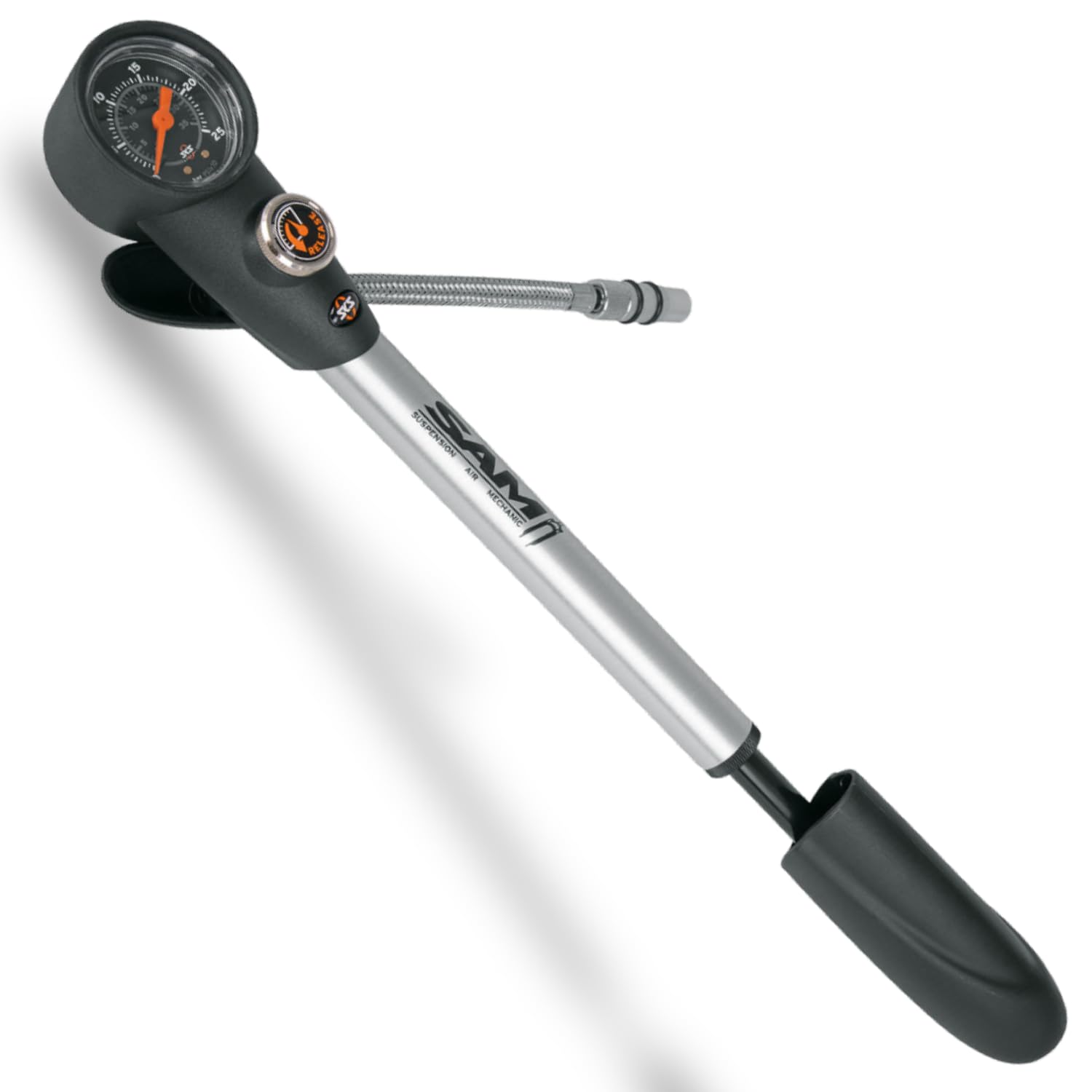
SKS SAM Damper Pump

SKS SAM Damper Pump

No-loss connection

Our Score 8.8/10
Check Price

Worth Noting

  • Small gauge takes a close look
Hose
360-degree steel-mesh
Weight
9.63 oz
Connection
2-stage threaded Schrader
Maximum Pressure
315 psi
Read the full review

The SKS SAM is built around the connection. Its two-stage threaded Schrader head screws on, seals, and then opens to the pump, so you are not racing an escaping hiss while you thread it. The pressure-reduction valve is the second half of that idea: instead of tapping a bleeder and hoping, you can dial pressure down in controlled steps. For a rider who hates losing a few psi every time the pump comes off, that is the feature worth paying for.

The 360-degree steel-mesh hose is reinforced and swivels cleanly, and the aluminum body has the solid, slightly industrial feel of a workshop tool. The two-stage head is the sort of design you appreciate every time you set pressure, because it removes the small loss that makes a repeat adjustment guesswork. The pump is compact enough to pack, but it is not trying to be the lightest thing in your bag.

SKS lists a 315 psi maximum, which is enough for the forks and shocks most riders own, though it is not the pump for RockShox IFP service. It is also more deliberate than fast: the threaded head takes an extra moment, and the stroke is not the quickest. We are happy to trade that time for repeatable pressure, especially on a fork that is sensitive to a few psi.

Bottom line: We recommend the SKS SAM for riders who hate losing pressure at the valve: its two-stage threaded connection seals before the pump is fully engaged, and the pressure-reduction valve makes fine changes deliberate.

7

BETO High Pressure 400

BETO High Pressure 400

Light high pressure

Our Score 8.8/10
Check Price

Worth Noting

  • Small gauge is harder to read
Hose
6-inch swivel
Gauge
1.5-inch industrial
Weight
5.19 oz
Maximum Pressure
400 psi
Read the full review

The BETO SP-003AG is a pump for riders who want a high ceiling without a heavy tool in the pack. It lists 400 psi, a 1.5-inch industrial gauge, and a two-stage anti-leak Schrader head, all in a body that weighs just over five ounces. Those numbers point to a pump that can handle high-pressure rear shocks and still disappear into a hip bag.

We like the six-inch swivel hose and the no-loss metal head; the swivel makes it easier to meet a valve at an angle, and the two-stage head is meant to keep pressure from escaping when you disconnect. The CNC alloy barrel and anti-slip handle give it a more planted feel than the low weight suggests. For a pack pump, that is the right set of priorities: pressure headroom first, then portability.

The 400 psi ceiling is the reason to choose it over a 300 psi pump; the 300 class is enough for most forks, but high-pressure rear shocks and some air springs benefit from the extra margin. If you want a pump that stays in the pack and still has headroom, this is the one we reach for. If you want a more polished workshop feel, the RockShox and Fox pumps are the ones to compare.

Bottom line: BETO's 400 psi pump is the light, high-ceiling value pick: it gives you more pressure headroom than a standard 300 psi pump without the bulk of a workshop tool.

8

Gylbuz 400 PSI Shock Pump

Gylbuz 400 PSI Shock Pump

Long-hose value

Our Score 8.4/10
Check Price

Worth Noting

  • Stiff stroke near 400 psi
  • Hose pivot and release button can weep
Hose
10.4-inch rotating
Gauge
Dual-scale PSI/bar
Weight
6.4 oz
Maximum Pressure
400 psi
Read the full review

A 10.4-inch rotating hose is the standout feature here. That extra reach lets you stand away from the bike and meet a valve that is tucked behind a frame member, and the 360-degree rotation keeps the hose from kinking. For a budget pump, that is a more useful upgrade than another psi on the gauge.

The Gylbuz lists a 400 psi maximum, a dual-scale PSI/bar gauge, and a two-stage leak-proof head. The T-handle gives you something to pull against when the pressure climbs, and the 6.4-ounce body is light enough for a pack. It is a lot of specification for the money, and the long hose is the part we appreciate most.

Where the long hose pays off is on a crowded frame: you can angle the head without contorting your wrist, and the T-handle gives you a straight pull. It is a pump for riders who want reach and pressure headroom without moving up to a premium tool, and the 400 psi ceiling leaves margin for high-pressure rear shocks.

The 400 psi ceiling is more than most forks need, but it leaves room for high-pressure rear shocks and gives you margin if you change bikes. Pair it with a consistent routine: set pressure, remove the pump, reattach, and confirm. That habit matters more with a budget pump than with a premium one, and it is how the Gylbuz stays useful.

Bottom line: The Gylbuz is the budget pick for riders who need a long hose and a 400 psi ceiling; it reaches awkward valves without the cost of a premium pump.

How We Tested the Best Mountain Bike Shock Pumps

We started with a list of about 40 pumps sold for mountain bikes and filtered it using the things you'd check first: maximum pressure rating (anything under 300 psi was out), gauge type and markings, hose length and fitting, head design, and price. Sixteen made the cut. Each one lived in a hip pack and a garage for four months, and each spent time on the same three bikes — a 120mm trail bike, an enduro build, and a downhill bike with a coil shock — so the comparison stayed fair.

Pressure reading came first, because everything else depends on it. At 50, 100, 150, 200, and 250 psi, we compared each pump's gauge against a calibrated digital reference and noted both the size of the gap and whether it widened as pressure climbed. Air loss came next: we set a shock to 150 psi with the reference tester, used the pump to bring it to 200, unscrewed the head, and re-measured. A few handed back 25 psi on the way off, which meant the rider would have been chasing a number they could never reach. We also tried to add exactly 5 psi to a charged shock to see how the bleed valve behaved; some dumped 40 psi from a half-second tap.

For durability and leakage, we soaped every hose crimp and head fitting, left each pump pressurized overnight, and checked the next morning for a drop. They got dropped on concrete, stuffed into packs, and used bare-handed at 35 degrees, and we watched for play in the swivel and kinks in the braid. Finally we counted strokes from empty to 200 psi and judged value on what the extra money actually bought — a better gauge, a head that seals, or just nicer machining.

How to Choose Mountain Bike Shock Pumps

Match the pressure ceiling to your suspension

Most mountain bike forks and air shocks work well below 300 psi, so a 300 psi pump covers the routine. A 350 psi pump adds margin for Fox DPS and DPX2 shocks at their stated maximum. Move to 400 psi if you want headroom for high-pressure rear shocks, and choose a 600 psi pump only for RockShox rear-shock IFP service or a BoXXer World Cup. Buying the biggest ceiling you can find usually means carrying a heavier pump and reading a gauge in a range you never use.

Put the connection ahead of the gauge

A shock pump loses a little air when it comes off, and that puff can turn a precise adjustment into a guess. A two-stage threaded head, like the SKS SAM's, seals before it opens to the pump; a swivel Schrader head, like the RockShox's, makes it easier to thread on straight. Check that the head fits your suspension valve and that the hose swivels without binding. If you change pressure often, the connection is worth more than an extra feature on the handle.

Look for a gauge and bleed you can use at your target pressure

A 1.5-inch analog gauge is common because it fits a small pump, but the scale can be crowded at the pressure you actually run. Look for clear PSI markings, or PSI and bar if your manual uses both. The bleed matters just as much: a micro-adjust bleeder, like the Fox's 2-3 psi unit, is easier to use than a button that dumps air. You want to make the last change in small steps and then read the result without leaning in.

Check hose reach, stroke effort, and pack size

A swivel head and a longer hose help when a rear shock valve sits behind linkage; the Fox 350 and Gylbuz 400 make that access their main argument. High pressure also means a harder stroke, so a T-handle or a longer barrel can matter more than a few grams. If the pump lives in a pack, weight and length come first; if it stays in the workshop, a stable body and an easy gauge are better trades.

Treat durability and support as part of the purchase

The hose, gauge, and valve head are the parts that take the abuse, so check how they are attached and what the maker covers. A lifetime warranty, like JACO's, is meaningful on a trail pump that gets bounced around; a two-year warranty from SKS or Gylbuz adds similar confidence. A simple pump with a protected gauge and a good warranty is a better long-term buy than a feature-heavy one with a fragile head.

Frequently Asked Questions

Final Verdict

Start with the RockShox 300 for forks and ordinary rear shocks: the 300 psi range, swivel Schrader head, and finger bleeder make routine tuning simple. Go to the RockShox 600 only for high-pressure RockShox rear-shock or BoXXer service, and choose the Fox 350 when a swivel head is what gets you cleanly onto a buried valve. For a no-loss threaded connection, the SKS SAM is the deliberate alternative.