Cycling Shoes

Best Road Bike Shoes of 2026

Road shoes are a study in tradeoffs: the stiffer the sole, the more of your pedal stroke reaches the rear wheel — and the more likely your toes go numb somewhere around mile 40. A pair that feels plush in the shop can turn into a hot spot on the third climb, and one that sprints beautifully can be misery to walk the ten feet into a coffee stop. The right pair holds your foot steady through the stroke, closes evenly across the top of the foot, and lets you off the bike without wincing.

I've ridden enough miles in the wrong shoes to be picky about this. Over the past eight months, my team and I have logged rides in 10 pairs — weekend group rides, trainer intervals, one long wet day none of us want to repeat — and the differences come down to things a product photo can't show: how the upper wraps, whether the closure still holds tension after an hour, whether your cleats bolt on without a stack of shims. Nobody warns first-time buyers that sizing swings wildly between brands. The picks below are the ones that earned a second ride.

1

Shimano SH-RC302

Top Pick
Shimano SH-RC302

Wide feet

Our Score 9.2/10
Check Price

Worth Noting

  • Cleat plate can loosen and need re-tightening
Model
SH-RC302
Wearer
Men's
Closure
Dial
Read the full review

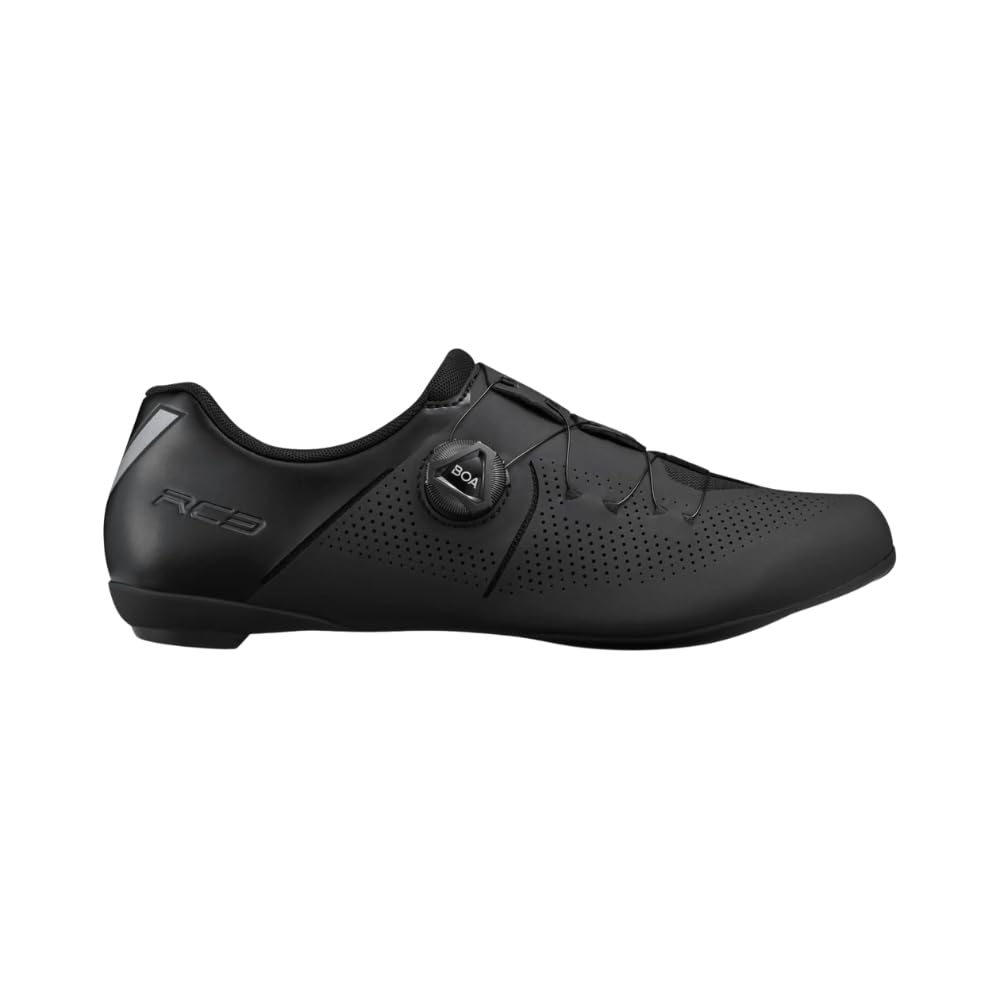
Most road shoe disappointments come back to the same place: a toe box built for a narrow last. Of everything in this guide, the RC302 is the pair we hand to riders with wide feet or a high instep, because the front of the shoe is genuinely roomy and the upper does not press down across the top of the foot.

It is firm where it counts, too. The sole is stiff enough for hard efforts without the dead, wooden feel of a race-only shoe, and the tighten-and-release dial takes up slack in seconds at the start of a ride. Sizing runs true, which is not something we can say for every shoe here.

The one thing to stay on top of is the cleat plate, which can work loose over a season and wants re-tightening before it shifts under you. Beyond that there is very little to argue with — this is the shoe that changed how much we think a roomy toe box matters.

Bottom line: If your feet are wide, this is the road shoe we point you to: a roomy toe box, a firm sole and no pressure across the top of the foot.
2

Fizik Tempo Overcurve R5

Fizik Tempo Overcurve R5

Long road rides

Our Score 9.2/10
Check Price

Worth Noting

  • Runs large, sometimes a full size
Sole
Carbon-reinforced nylon (R5)
Upper
Microtex, asymmetric wrap
Closure
Boa dial
Water Resistance
Water resistant
Read the full review

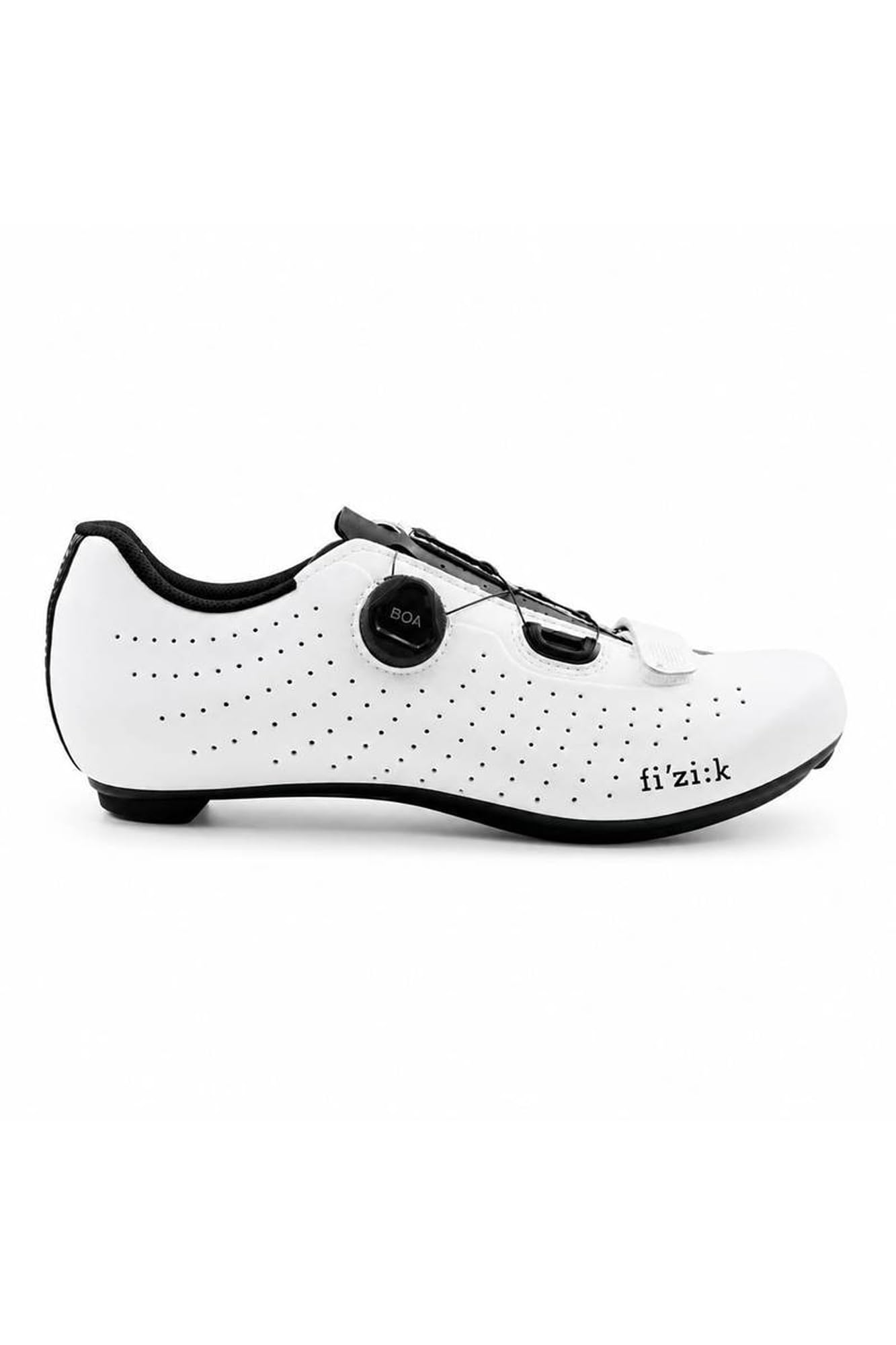
Overcurve is Fizik's name for an upper that wraps the foot asymmetrically, and you feel the idea as soon as you cinch the Boa: the material hugs the midfoot rather than pressing a seam into the top of your arch. The Microtex upper is supple, wipes clean, and has handled the scuffs of regular riding better than we expected.

Underneath, the R5 sole is carbon-reinforced nylon rather than a full carbon plate, which is the right balance for riders who are not racing. It is stiff enough that a sprint feels direct, with just enough give that a long day does not leave your arches aching.

This is the pair we reach for when the route is long and the pace is steady. The Boa holds its tension, the upper shrugs off damp mornings, and it takes a proper road cleat. Sizing is the wrinkle: it runs large, sometimes by a full size, so go down if you are between.

Bottom line: Our favorite step-up: a Boa dial and a carbon-reinforced sole that stay comfortable deep into long rides, with sizing that runs large.

3

Giro Regime

Giro Regime

Long, fast rides

Our Score 9.2/10
Check Price

Worth Noting

  • No replaceable heel pad
  • Narrow last
Model
7123147
Wearer
Men's
Closure
Dual Boa dials
Read the full review

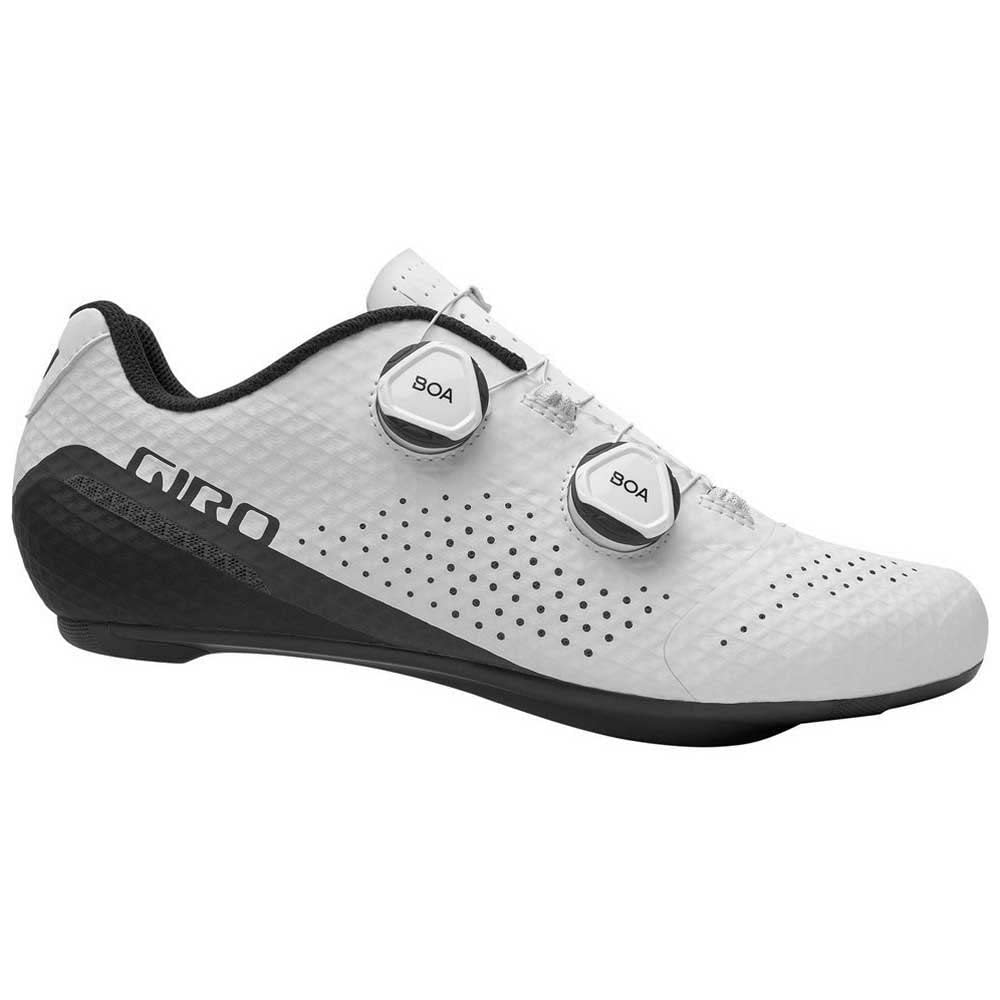
Two dials instead of one is the first thing you notice about the Regime. The upper dial sits over the instep and the lower one over the forefoot, so you can run the front of the shoe snug and leave the top of your foot looser — which is exactly what we ended up doing on longer rides.

That adjustability is why it is our premium pick, and why the shoe disappears after an hour. The sole is stiff, the upper is soft, and the combination feels closer to a slipper than anything else here until you stand on the pedals and put power through it.

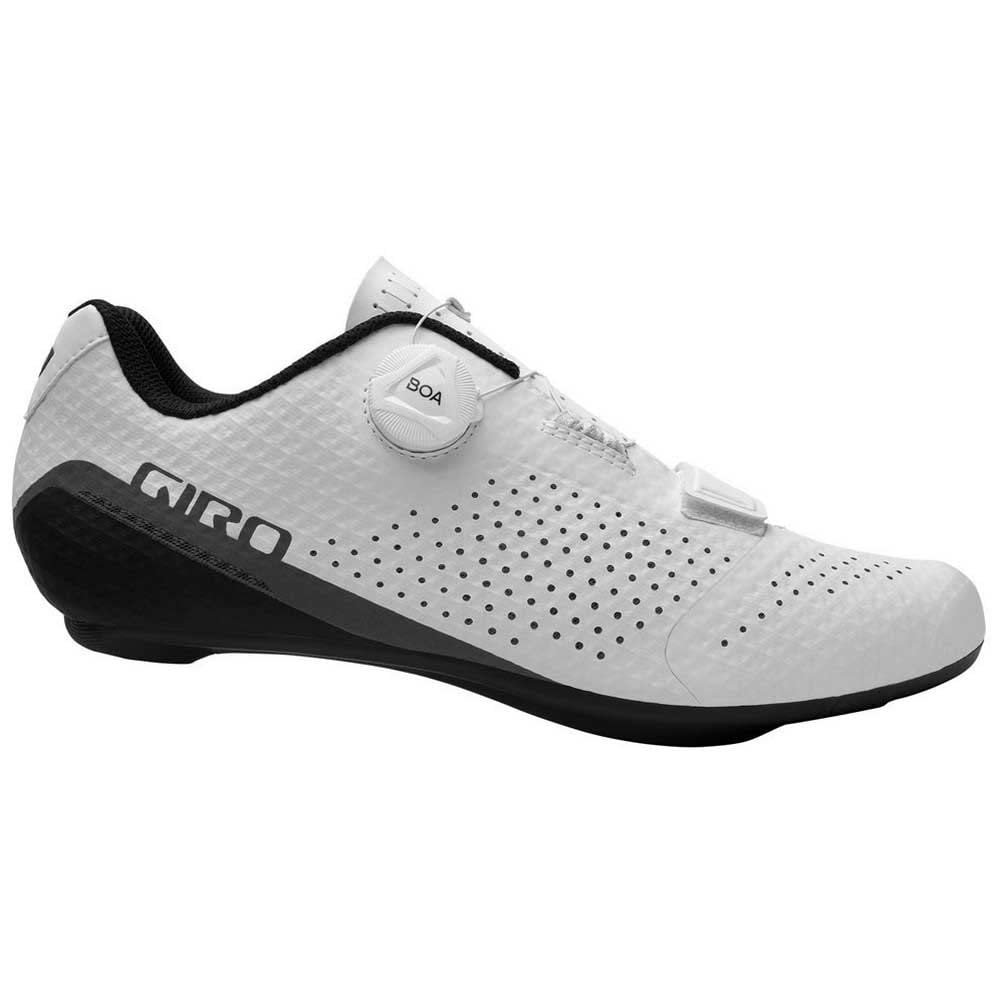
It is light, it vents well enough for summer, and the white finish is the one to pick if looks matter to you. The heel pad is not replaceable, though, which is an odd omission at this level — heel pads are the first thing to wear through when you walk into a café.

The last is narrow, as Giro road shoes tend to be, so wide-footed riders should start with the Shimano RC302 instead. Everyone else gets the pair we spend the extra on when comfort matters more than saving.

Bottom line: Our premium pick: the most comfortable shoe here over long days, with two Boa dials you can fine-tune without stopping.

4

Fizik Tempo Powerstrap R5

Fizik Tempo Powerstrap R5

First road shoes

Our Score 9.2/10
Check Price

Worth Noting

  • Strap closure is coarse next to a dial
  • Sizing runs big
Model
Tempo Powerstrap R5
Wearer
Unisex
Closure
Twin hook-and-loop straps
Read the full review

The Powerstrap is the cheapest way into a proper road shoe here, and it is the one we hand a new rider without hesitation. Fizik skips the dial and uses two hook-and-loop straps instead, which is where a good chunk of the saving comes from.

What that costs you is fine-tuning. A dial lets you take up a millimeter at a time mid-ride; a strap gives you a pull and a press, and that is it. In practice we did not miss the dial on anything short of a hard interval session, and the straps held tension well enough that we never stopped to re-fasten them.

Two things to know before you order. Sizing runs big, so go down if you are between sizes, and the upper is the part we watch over several seasons rather than the sole. For a first road shoe, or a second pair to keep on the winter bike, neither is much of a compromise.

Bottom line: The budget pick we actually ride: twin straps, a comfortable upper and enough support for real road miles at a seriously low price.

5

Giro Cadet

Giro Cadet

Everyday road riding

Our Score 9.0/10
Check Price

Worth Noting

  • Narrow last; size up if between sizes
Upper
Synchwire
Closure
BOA L6 dial
Outsole
Carbon composite plate
Cleat Adjustment
5 mm fore/aft
Read the full review

Two things decide most road shoe purchases: how stiff the sole feels under power, and how quickly you can get the closure right. The Cadet answers both with a Boa L6 dial and a carbon composite outsole plate, and it does it below the other dial shoes in this guide.

That combination is why it earned the top spot. The plate is stiff enough that we stopped noticing the pedal and started noticing the ride, and the Synchwire upper vents well enough that a hot afternoon does not turn into a footbath. The dial takes up tension in small increments, which matters when one foot swells a little over a long day.

The detail we appreciate most is the five millimeters of fore and aft cleat travel. That is enough to move a cleat from a toe-down position toward neutral, and it is the difference between a shoe that works with your pedal stroke and one you fight. The reflective details on the heel and straps are a small bonus that shows up on evening rides.

One housekeeping note: check the cleat bolts at the start of each season and put a dab of grease on the threads. It costs nothing and keeps a good pair of shoes in service.

Bottom line: Our default road shoe: a dial closure, a stiff carbon composite plate and 5 mm of cleat travel for less than the other dial shoes here.

6

Tommaso Veloce II

Tommaso Veloce II

Triathlon

Our Score 8.8/10
Check Price

Worth Noting

  • Narrow toe box
  • Straps sit far apart for wide feet
Model
Veloce II
Wearer
Men's and women's
Cleat Compatibility
Look Delta, SPD, SPD-SL
Read the full review

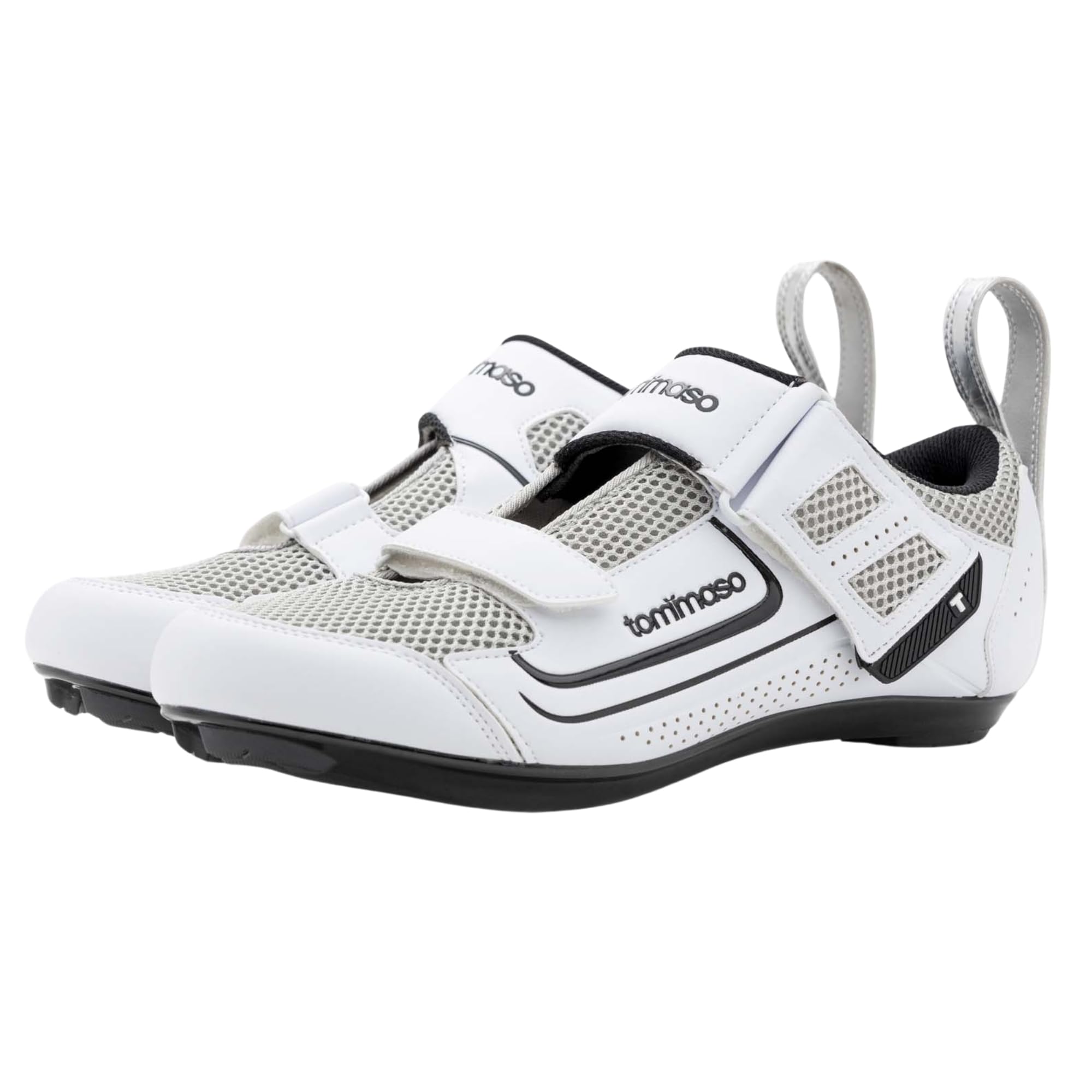
The Veloce II is the most ventilated shoe in this guide. The upper is essentially mesh with straps over it, which is wonderful in July and less wonderful in a cold spring rain — you feel the airflow, for better and worse.

What makes it genuinely useful is the drilling. Tommaso builds it to take Look Delta, SPD and SPD-SL cleats, so one pair can follow you between a road bike, a trainer and a spin bike without a second purchase. Almost nothing else here is that flexible.

Fit is the part to think about. The toe box is narrow, the shoe runs about a half size short for some feet, and the two straps sit far apart — wide-footed riders will struggle to close the gap. If that is you, start with the Shimano RC302 instead.

For triathlon, or for anyone who wants a shoe they can step into wet and pull off in a hurry, it is a smart buy: the interior is soft, the straps are quick, and there is nothing to break in. Swap the cleats between bikes and it keeps up.

Bottom line: Built for quick transitions: heavy venting, an easy on-and-off upper and drilling that takes Look Delta, SPD or SPD-SL cleats.

7

Kyedoo Cycling Shoes

Kyedoo Cycling Shoes

Indoor and outdoor

Our Score 8.8/10
Check Price

Worth Noting

  • Stiff, thin tongue
  • Durability is uneven; straps and cleats have failed
Model
QX2088
Wearer
Men's
Compatibility
Peloton and road
Read the full review

Kyedoo sells this as a Peloton shoe and a road shoe at once, and that tells you most of what to expect. It is built to work with both, goes on and off quickly, and costs less than anything else in this guide.

Quality is not the problem. The upper is sturdy, the straps hold, and the sizing lands close to your normal shoe size — with the caveat that it runs big for some feet and the toe box is snug.

Comfort is where it comes apart for road use. The tongue is stiff and thin, which we felt across the top of the foot on longer rides, and the whole shoe is shaped around a more upright, indoor position. An hour of spinning is fine; three hours on the road is not what it was built for.

Buy it as a budget shoe that covers a spin bike and a first road bike, and it does the job. Buy it as your only road shoe for long weekend rides and you will feel where the money went. For a rider testing clipless pedals without committing to a brand or a fit, that is a fair trade.

Bottom line: A cheap crossover shoe for riders splitting time between a Peloton and a road bike; it does both jobs, though neither brilliantly.

8

Shimano SH-RP101

Shimano SH-RP101

Budget daily miles

Our Score 8.6/10
Check Price

Worth Noting

  • Runs narrow
  • Straps cannot always be cinched tight enough
Model
RP101
Wearer
Unisex
Closure
Hook-and-loop straps
Read the full review

Three hook-and-loop straps is the oldest closure in road cycling, and the RP101 follows the recipe closely. There is no dial to service and nothing much to break, and you can get the shoe on and off in seconds — which is why so many of these end up on trainers and commuter bikes as well as road bikes.

Comfort is where it earns its keep. The upper does not dig into the sides of the foot or the top of the arch, cleat installation is straightforward, and riders are putting whole seasons on them without trouble. It is also one of the least expensive shoes here, and it does not feel like a compromise once you are clipped in.

Where it gives ground to our budget pick is the closure and the last. The straps cannot always be pulled tight enough for a firm hold, and the front of the shoe runs narrow, so wide-footed riders will feel the sides. As a high-volume, low-cost road shoe, though, it has a lot going for it.

Bottom line: A dependable, easy-on budget shoe that has carried a lot of riders a long way — as long as your feet are not wide.

How We Tested These Road Bike Shoes

We started by pulling every road shoe we could find with a three-bolt drilling, then cut the list by closure system, last width, and whether the brand actually stocks half sizes. Anything that only came in whole sizes, or that nobody could keep in stock long enough to buy, got dropped early. That left 10 pairs, which we rode for eight months.

Those eight months looked like real riding, not a lab bench. Each pair went through garage trainer intervals, a weekly group ride, rainy commutes, and at least one long day where we deliberately stayed in the saddle past the point of comfort. We clipped in and out at every stoplight, walked into a coffee shop in each pair, and adjusted straps mid-effort with gloves on — which is where a lot of closures reveal themselves.

Fit and sizing got measured rather than eyeballed: we compared each shoe's internal length against our regular size, wore the same sock on every first ride, and noted where pressure landed after 90 minutes. For durability, we scuffed heels on pavement on purpose, opened and closed the hook-and-loop straps 40 or 50 times to see if the edges frayed, and checked uppers for stretch after wet rides. Every pair was weighed dry and again after a soaking. Value and appearance came last — we noted which shoes still looked presentable after a muddy spring and which felt like more money than they cost. We're still riding most of these and will update as the soles wear.

How to Choose Road Bike Shoes

Start With the Last

Road shoes are built on narrow lasts, and that is the single biggest source of unhappy feet. Length is the easy part — most brands run close to your running shoe size — but width and toe-box volume vary wildly from one maker to the next. Giro's road range runs narrow, the Fizik Overcurve runs large, and the Shimano RC302 is the roomiest thing in this guide.

Buy for the foot you have. If you are between sizes, go up rather than hoping a tight shoe breaks in: an upper softens a little over a season, but a last does not change.

How Much Stiffness You Actually Need

A stiffer sole spreads load across the whole foot and stops the pedal from digging into your arch over a long ride. That is the real benefit. The power-transfer gain is smaller than the marketing suggests unless you are sprinting.

Nylon composite soles are comfortable and cheap; carbon-reinforced and full-carbon plates are stiffer and lighter, and can be unforgiving on rough tarmac. Pay for stiffness if you race or ride hard in groups, and take the composite plate otherwise. The Giro Cadet's carbon composite outsole is the middle ground most riders want.

Dials, Straps and Getting Tension Right

A dial lets you micro-adjust with one hand, keeps even tension across the top of the foot, and can be backed off mid-climb when your feet swell. Straps are cheaper and nearly indestructible, but they are coarse: you get a pull and a press, not a millimeter at a time.

Two dials beat one if the top of your foot is sensitive, because you can set the forefoot and the instep separately — that is the main thing the Giro Regime buys you. If you ride hard or your feet swell, a dial is worth paying for.

Match the Drilling to Your Pedals

Before anything else, check what your pedals take. Three-bolt drilling fits Look Delta and SPD-SL road cleats; two-bolt drilling fits SPD and most mountain-style pedals. A few shoes, like the Tommaso Veloce II, are drilled for several patterns, which is handy if you swap between bikes.

The trap is buying on looks before checking the drilling. A three-bolt-only road shoe will not take a two-bolt SPD pedal, so confirm the pattern before you order rather than after.

Frequently Asked Questions

Final Verdict

The Giro Cadet is the pair we point most road riders to. It gets the two things that matter right: a dial you can fine-tune with one hand, and a sole stiff enough that the pedal disappears under your foot. Everything else at this price asks you to give one of those up.

Wide feet change the answer — the Shimano RC302's toe box is the roomiest here, and it does not press across the top of the foot. On a tight budget, the Fizik Powerstrap R5 gives up the dial and keeps the comfort.