Cycling Shoes

Best Triathlon Cycling Shoes of 2026

The first time you try to get into a cycling shoe with wet feet and a race clock running, you learn what triathlon shoes are actually for. It isn't the bike leg — it's the ten seconds on either side of it. A shoe that swallows your foot in one push, closes with a single strap you can grab with one hand, and doesn't chew your heel when you run out of T2 in it is worth more on race day than any stiffness number printed on a box. Over the past eight months my team and I rode, raced, and drilled transitions in 12 pairs of triathlon cycling shoes, and what separated them turned out to be far less glamorous than the marketing suggests.

Two things surprise most first-time buyers. Tri shoes are built to be worn without socks, so the size that fits your running shoes often feels roomy here — and a strap that seems perfectly snug on dry land rarely stays that way once it's wet and stretched, which is why fit and true sizing matter more than almost anything else in this category. Velcro loses its bite over a season, dials and ratchets adjust quickly but can be fiddly with cold, numb fingers, and an upper that scuffs through in three months makes an inexpensive shoe expensive. We judged every pair on comfort over long rides and on the run out of T2, how fast the closure opens and shuts one-handed, how the uppers and straps held up, and whether the price matched the build. The picks below are the ones I'd rack without a second thought.

1

Fizik Tempo Overcurve R5

Top Pick
Fizik Tempo Overcurve R5

Stiff road rides

Our Score 9.2/10
Check Price

Worth Noting

  • Runs large by about a full size
Sole
R5 - carbon reinforced nylon
Upper
Microtex
Closure
Boa dial
Read the full review

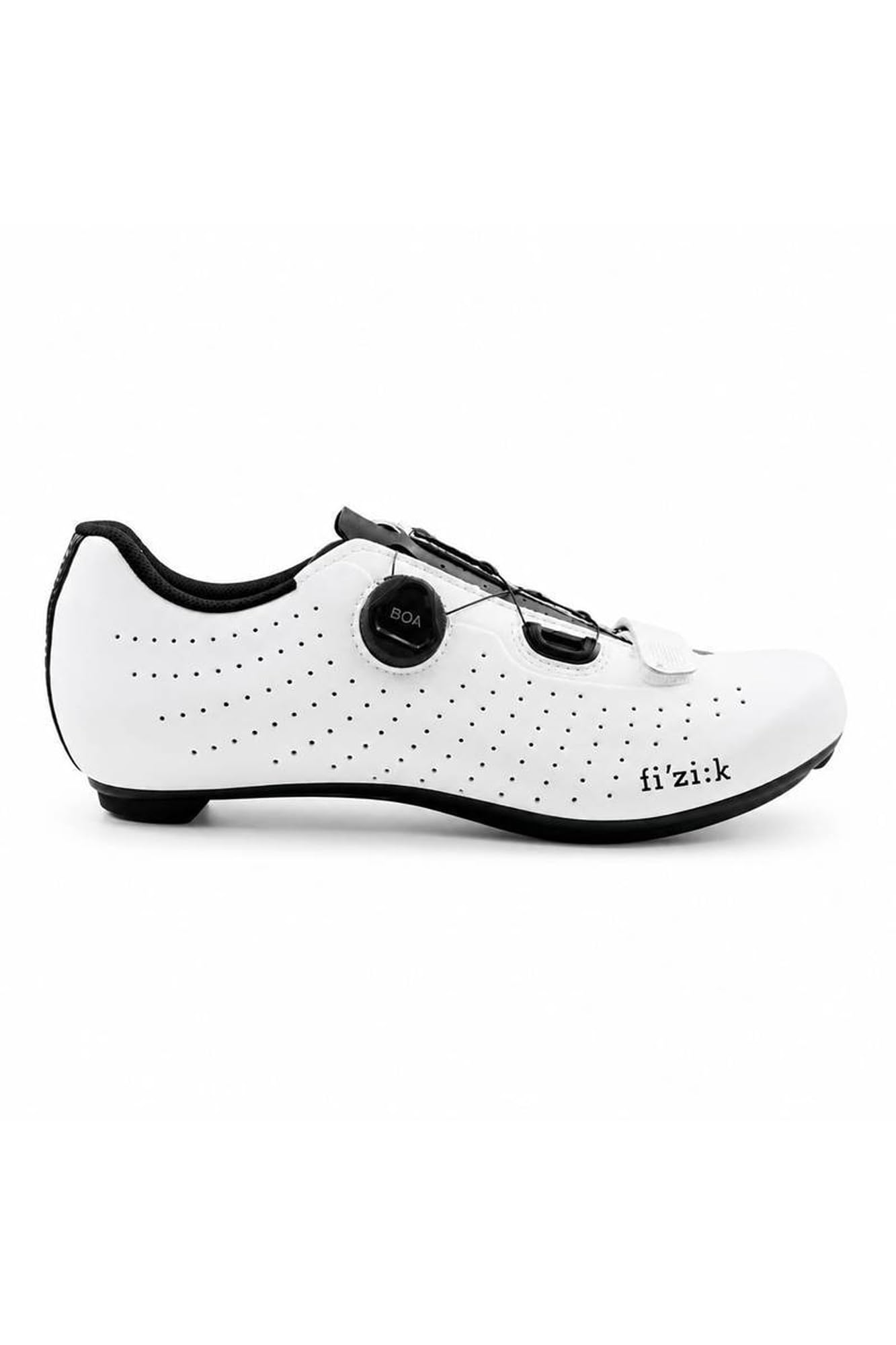
The Boa dial and carbon-reinforced nylon sole are what make the Tempo Overcurve R5 feel like a race-day upgrade over the budget shoes here. The dial takes up tension evenly across the instep, and the asymmetric upper wraps the foot without a hard pressure point. We noticed the difference most when we were pushing a bigger gear: the sole feels firm and planted rather than flexy.

The Microtex upper is durable and easy to wipe clean, and the shoe is comfortable enough for long road rides. It is not as airy as the Tommaso, but it feels more precise. The R5 sole is among the stiffest in this group, which suits triathletes who want efficient power transfer on smooth roads.

The Boa dial is secure enough for hard efforts, and the upper has a smooth, comfortable feel against the foot. We did not find any pressure points across the top of the foot, which is where cheaper shoes often bite. The shoe also looks like a proper race shoe, with a clean profile that works with most kit.

For a hilly Olympic-distance bike leg, the stiff sole and dial are worth the upgrade. The asymmetric upper is the detail we keep noticing: it wraps the instep without a pressure point, which is rare in a shoe at this level.

Bottom line: The Tempo Overcurve R5 earns its place with a stiff carbon-reinforced sole and a Boa dial that feels race-ready; just plan to size down.
2

Giro Regime

Giro Regime

Long-course racing

Our Score 9.2/10
Check Price

Worth Noting

  • Narrow fit
  • No replaceable heel pad
Closure
Dual Boa dials
Intended Use
Road cycling
Cleat Adjustment
Fore and aft
Read the full review

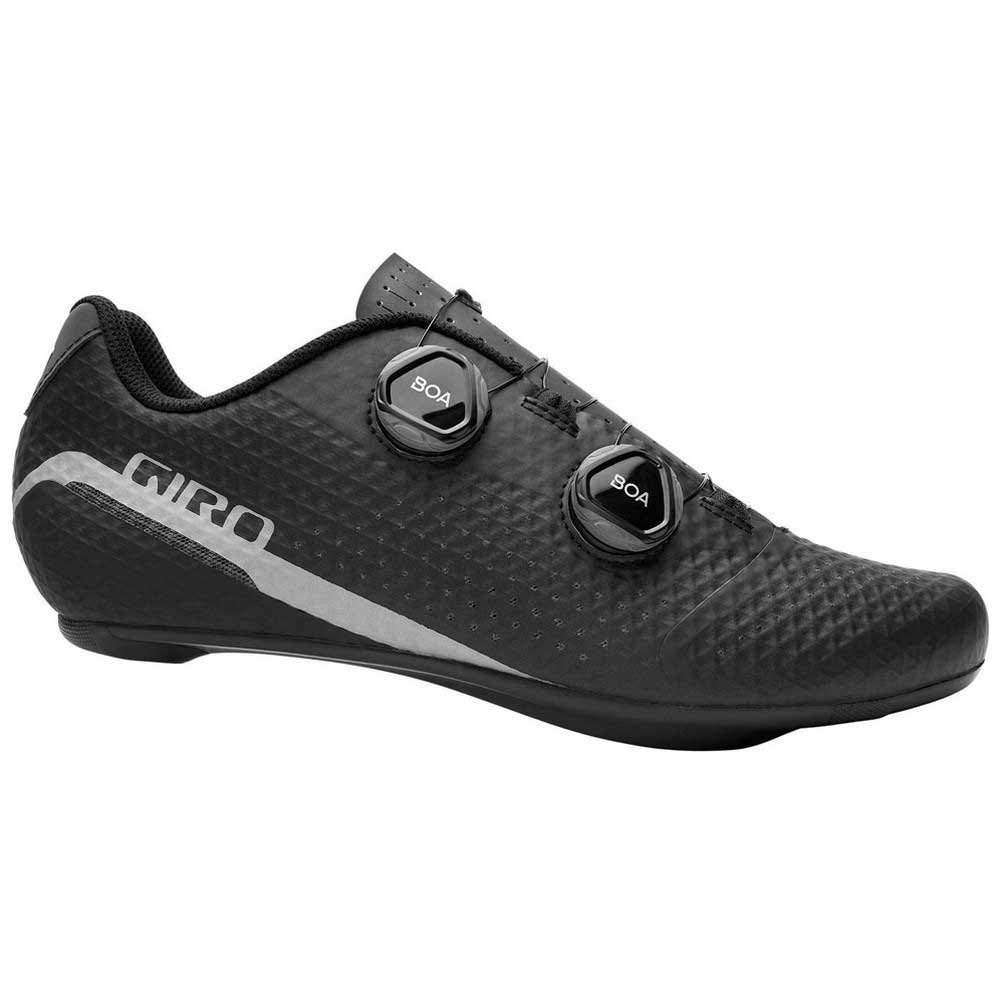
The Regime's dual Boa dials are the reason to step up from the Cadet. You can tighten the upper and lower zones separately, which makes it easy to loosen the front of the shoe on a climb and lock it down again for the descent. That kind of on-the-fly adjustment is exactly what long-course triathletes need.

The shoe is light and stiff, with a firm sole that feels efficient without being harsh. The upper is comfortable and supportive, and the white colorway looks sharp with race kit. We also like the fore-and-aft cleat adjustment, which gives you room to dial in pedal position.

The Regime is not the cheapest shoe here, but it earns its place with the dual dials and a lighter, more refined feel than the Cadet. The upper has a smooth, comfortable finish that works well with thin race socks, and the heel hold is secure without pinching.

For a 70.3 or full-distance bike leg, the ability to fine-tune tension on the move is the feature we value most. The dual Boa system is not just a premium badge; it is a practical advantage when your feet swell over a long ride.

Bottom line: Long-course triathletes who want dual Boa adjustability and a light, stiff shoe should put the Regime at the top of their list.

3

Fizik Tempo Powerstrap R5

Fizik Tempo Powerstrap R5

Simple strap fit

Our Score 9.2/10
Check Price

Worth Noting

  • Runs large by about a full size
Fit
Wider-foot friendly
Sizing
Runs large
Closure
Two Powerstrap straps
Read the full review

The Tempo Powerstrap R5 is the simple alternative: two broad straps instead of a dial, a comfortable upper, and a fit that is friendlier to wider feet than most of the race-oriented shoes here. We like it for triathletes who want to set tension once and not think about a Boa system during the bike leg.

The straps pull evenly across the instep and are easy to adjust, and the shoe feels comfortable from the first ride. It is not as stiff as the Overcurve R5 or the Giro Cadet, but it is stiff enough for training and short-course racing. The simple design also makes it easy to clean and live with.

The two-strap closure is the main compromise: it cannot match a dial for micro-adjustment, and riders who like to fine-tune tension on the move may miss that. If you want a dial, the Overcurve R5 is the natural upgrade.

For a rider with wide feet who wants a simple, good-looking road shoe, the Powerstrap is the low-risk choice. The two straps are plenty for most triathlon bike legs, and the comfortable upper makes it easy to forget you're wearing a cycling shoe.

Bottom line: The Powerstrap is the simple, roomier alternative for triathletes who do not need a Boa dial.

4

Venzo Road Cycling Shoe

Venzo Road Cycling Shoe

Wide budget fit

Our Score 9.2/10
Check Price

Worth Noting

  • Three straps take longer to fine-tune than a dial
Closure
Three straps
Intended Use
Road cycling
Cleat Compatibility
Look Delta, SPD-SL
Read the full review

The Venzo is the low-cost, wide-fit option in this group. It uses three straps instead of a dial, accepts Look Delta and SPD-SL cleats, and has enough room in the toe box to wiggle your toes or wear socks. That makes it a useful starting point for triathletes who have struggled with narrow European lasts.

The three straps are simple and secure, and the shoe feels comfortable during the ride. It is not as refined as the Giro or Fizik picks, but the build feels solid for the price. The roomy fit is the standout feature; it is the pair we point to when someone wants to try road cleats without a big commitment.

The Venzo is less refined than the Giro and Fizik picks, and the toe box is roomy rather than race-snug. That is the trade-off for the low price and wide fit. If you are racing for a podium, you will feel the difference; if you are finishing your first triathlon, you probably will not.

For a rider with wide feet who wants to try road cleats without committing to a dial system, the Venzo is the low-risk experiment. The three straps are easy to understand, and the toe box gives you room to settle in.

Bottom line: The Venzo is the low-cost, wide-fit choice for road triathletes who want three straps and common road-cleat compatibility.

5

Giro Cadet

Giro Cadet

Boa road value

Our Score 9.0/10
Check Price

Worth Noting

  • Runs small and narrow
  • Cleat screw holes can strip
Sole
Carbon composite
Upper
Synchwire
Closure
BOA L6 dial
Cleat Adjustment
5mm
Read the full review

The Cadet is the shoe we point to when a triathlete wants a stiffer pedal feel without jumping to the premium category. Its carbon composite outsole plate gives it a firm, efficient ride, and the BOA L6 dial plus one Velcro strap make the fit easy to tune before the start. We also noticed the 5mm of fore-aft cleat adjustment, which is more than some shoes here offer.

The Synchwire upper is vented and light, and the reflective details are a genuine bonus for early-morning races or evening training. The shoe feels fast without being uncomfortable, and the Boa dial holds tension well during hard efforts. It is one of the more efficient shoes in this group.

The heel counter is supportive, and the shoe feels secure when you're pulling up through the pedal stroke. The heel area can rub on longer sockless rides, so build up time in them before race day. The Boa and strap combination is also easy to adjust on the move.

For road triathletes who want a Boa-secured shoe with a stiff sole and don't need the premium dials of the Regime, the Cadet is the sweet spot. The five millimeters of cleat adjustment is the unsung detail here; it lets you dial in the pedal position that feels strongest after the run.

Bottom line: The Cadet gives road triathletes a stiff, Boa-secured ride without the premium price of the Regime.

6

Tommaso Veloce II

Tommaso Veloce II

Triathlon racing

Our Score 8.8/10
Check Price

Worth Noting

  • Narrow toe box limits wide feet
Closure
Velcro straps
Intended Use
Triathlon, road, indoor cycling
Cleat Compatibility
Look Delta, SPD, SPD-SL
Read the full review

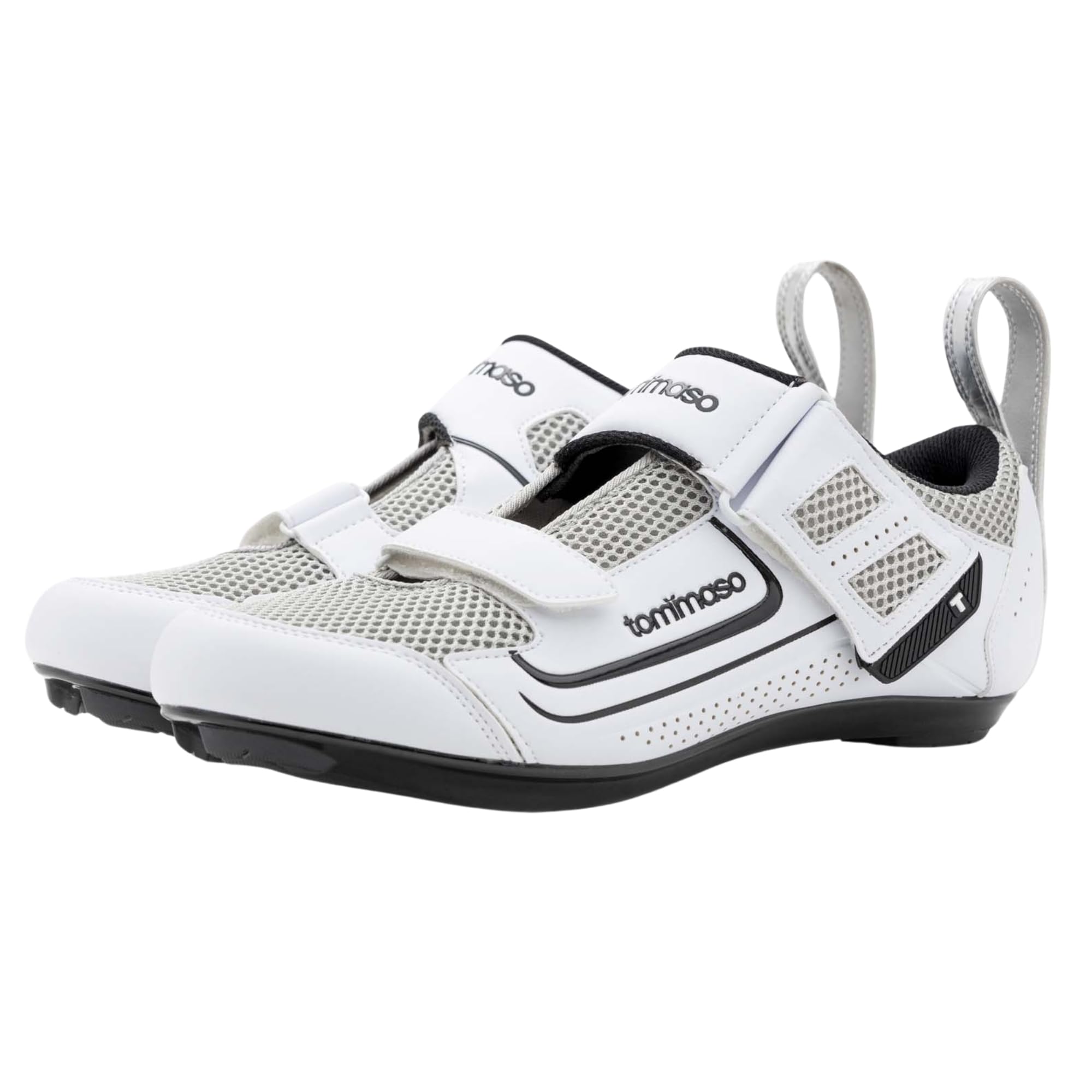
A triathlon shoe has to do two jobs at once: go on quickly in T1 and stay secure enough for an all-out bike leg. The Veloce II handles the first job better than most of this group, and its internal rubber strap gives the heel a useful extra hold when you're pedaling hard. The upper is airy and quick to dry, which matters if you race sockless or come out of the water in wet conditions.

The Velcro straps are simple to set and easy to release, and the shoe accepts Look Delta, SPD, and SPD-SL cleats, so it covers the common road and tri pedal systems. We also appreciate that the interior is soft and smooth against bare skin. The fit is secure and race-oriented, with a snug heel and no slop.

On the bike, the sole is stiff enough to feel efficient without turning every chip-seal patch into a jolt. It is not the stiffest shoe here—the Fizik Overcurve R5 and Giro Cadet feel more locked-in under hard efforts—but for sprint and Olympic racing, the easier entry and airier upper matter more to us than the last bit of sole stiffness.

The Veloce II is the pair we reach for when the race is short, the budget is real, and the priority is getting out of T1 without a struggle. The internal strap and breathable upper are the two details that make it feel purpose-built rather than a road shoe with a triathlon label.

Bottom line: For most triathletes, the Veloce II is the shoe we point to first: it goes on quickly, breathes well, and accepts the common road cleat systems without a premium price.

7

Santic Roadway

Santic Roadway

Budget road rides

Our Score 8.8/10
Check Price

Worth Noting

  • Sizing can run small
Sole
Very stiff
Closure
Buckle strap
Intended Use
Road and indoor cycling
Read the full review

The Santic Roadway is the budget shoe for triathletes who care most about a stiff sole. The sole is very stiff for the money, and the buckle strap across the front is easy to operate. It is a little heavy compared with the Giro and Fizik shoes here, but the extra material makes it feel planted rather than flexy.

The upper is comfortable and well made, and the shoe looks sharper than its price suggests. It fits true to size for many riders, and the interior is smooth enough to wear with thin socks. We like it for training rides and shorter races where a little weight is not a dealbreaker.

The weight is the trade-off: it is not the shoe we reach for on a hilly course or a long, fast bike leg. The buckle also takes a little more attention to set than a Boa dial, though it holds securely once you have it dialed. For flat, training-heavy triathlon schedules, that is a fair exchange.

The extra sole underfoot makes walking through transition a little less precarious, which is a small but real advantage on race day. If you want a stiff, low-cost shoe and don't mind a bit of heft, the Roadway earns its place.

Bottom line: The Santic Roadway is a budget standout for triathletes who want a very stiff sole and can accept a little extra weight.

8

Shimano SH-RP101

Shimano SH-RP101

First triathlon

Our Score 8.6/10
Check Price

Worth Noting

  • Single Velcro strap can loosen
  • Runs narrow for wide feet
Closure
Velcro strap
Intended Use
Road and indoor cycling
Cleat Compatibility
SPD
Read the full review

The RP101 is the shoe we hand to someone doing their first sprint triathlon. It is easy to get on and off, the single Velcro strap is quick to set, and the shoe accepts SPD cleats without a fuss. That straightforward formula is why it has become our benchmark for a low-cost transition shoe.

Comfort is the bigger surprise. The upper is supportive without cutting into the sides of the foot, and the shoe feels broken-in from the first ride. We also like that the sole is stiff enough for training without being punishing on longer spins. It is not a featherweight, but it disappears on the bike.

The RP101 is not the stiffest shoe here, so riders chasing pure power transfer should look at the Fizik Overcurve R5 or Giro Cadet. But the softer ride is part of why it is so comfortable, and for training and first races that balance makes sense.

What keeps the RP101 in our rotation is the value: it leaves room in the budget for a race entry, a cleat upgrade, or a professional bike fit. Its real trick is that it feels broken-in from the first ride, which matters when you're fitting training around a race calendar.

Bottom line: New triathletes should start with the RP101: it is comfortable, easy to get on and off, and simple to set up with SPD cleats.

How We Tested the Best Triathlon Cycling Shoes

I started with the shoes I kept noticing on feet racked near mine at races, then filtered by the specs that actually change the experience — closure type, heel loop size, drainage ports, weight, and sole stack — and read through owner reviews specifically for complaints about sizing, straps loosening, and uppers splitting. That narrowed roughly 30 models down to 12 pairs we bought ourselves and put on our feet.

Testing ran for eight months and lived where these shoes actually live. Saturday brick workouts became the main proving ground: ride, rack, run, repeat. Before every simulated T1, we stood barefoot in a shallow kiddie pool and tried to step into each shoe with wet feet, timing how long the closed entry took and whether the heel loop fit one finger or two. We practiced flying mounts and got in and out of each closure one-handed, with cycling gloves on, to see how the strap and dial shapes worked when our hands were cold and clumsy. Sockless long rides told us where seams and heel cups rubbed. Everything got worn through a rainy week and several hundred miles of clipping in and out.

Along the way we noted what we saw rather than what the spec sheet promised: heel cups that held or collapsed, uppers that stained and scuffed at the toe, Velcro that curled and caught fuzz after twenty rides, straps that felt snug in month one and sloppy by month four. We weighed each shoe on a kitchen scale, compared it against its listed size, and logged whether the fit matched our running shoe size. Value and looks got weighed too — a few pairs lost points for feeling cheap long before they wore out, and one pair we loved on the bike simply cost more than its build justified. We're still riding in several of these and will update as the miles add up.

How to Choose Triathlon Cycling Shoes

Start With Your Pedals, Not the Shoe

A triathlon shoe has to match the cleat system on your bike. Three-bolt road cleats, Look Delta and SPD-SL, are the common race setup, while two-bolt SPD is easier to walk in and popular for training. Some shoes, like the Tommaso Veloce II, list compatibility with multiple systems; others, like the Shimano RP101, are built around SPD. Check your pedal model before ordering, and use an adapter only when the shoe and cleat are designed for it.

Choose a Closure That Matches Your Transition

Velcro straps are fast to open and close, which is why they show up on budget triathlon shoes; a Boa dial gives finer tension but takes a little longer to release. For sprint and Olympic races, we prioritize quick entry and a secure heel hold over micro-adjustment. For long-course racing, dual dials like the Giro Regime's let you loosen the lower zone on a climb and tighten it again without stopping. If you have wide feet, a two-strap design such as the Fizik Powerstrap can be more forgiving than a narrow dial shoe.

Fit and Sole Stiffness Matter More Than Weight

A stiff sole transfers power, but a shoe that pinches the forefoot will cost you more than a little flex. Look for a snug heel, room to wiggle the toes, and no pressure across the instep. The Fizik Overcurve R5 and Giro Cadet are among the stiffest shoes here, while the Santic Roadway offers a stiff sole at a budget price. If you have wide feet, start with the Venzo or Powerstrap and size carefully; a close-fitting race shoe is not the place to force a fit.

Prepare for Sockless Racing and Transition Walking

Triathletes often race without socks, so seams, heel rub, and breathability matter. Build up long rides in the exact sockless setup you plan to race, and use body glide or thin socks if a shoe rubs. Road cleats are not made for running; walk carefully in transition or use cleat covers. Check cleat bolts before race day, especially on shoes with composite soles, and replace worn heel pads before they wear through.

Frequently Asked Questions

Final Verdict

For most triathletes, the Tommaso Veloce II is the shoe we recommend first. It is not the stiffest or most refined shoe here, but it gets the triathlon basics right: quick entry, a breathable upper, a secure heel hold, and compatibility with the common road cleat systems. That makes it a smart choice for sprint and Olympic racing without overspending.

If you want a stiffer race-day feel, the Fizik Tempo Overcurve R5 is the upgrade we point to; its Boa dial and carbon-reinforced sole feel more locked-in, though the fit runs large. For long-course riders who adjust on the move, the dual-Boa Giro Regime is the premium alternative.